
NoRule Book Banner

How to Start a Side Hustle Without Quitting Your Job

by Robbie Dellow
side hustle image

Starting a side hustle doesn’t require quitting your job, investing thousands of dollars, or even having a revolutionary business idea. In fact, one of the safest ways to start is to keep your existing income while testing something small on the side.

The objective at the beginning isn’t to build a large business. It’s to find something you can realistically offer, establish whether people will pay for it, and improve it using real customer feedback, rather than spending months planning something that may never work.

Your first target might be an extra $500 a month. If you reach that consistently, you can decide whether you want to grow it further. Some side hustles eventually become full-time businesses; others remain useful additional income streams. Either can be successful.

The important thing is to start small enough that you can afford to experiment, but seriously enough to find out whether the idea actually works.

START WITH WHAT YOU ALREADY HAVE

Before searching online for lists of side-hustle ideas, look at the skills, knowledge, experience and resources you already have. Starting with something familiar can dramatically shorten the time between having an idea and finding your first customer.

Ask yourself what you can already do reasonably well. Perhaps you understand bookkeeping, gardening, photography, social media, writing, fitness, computers or repairing things. You might have specialist knowledge from your existing job, a hobby you’ve developed over years, access to equipment other people don’t own, or simply experience solving a problem that other people regularly encounter.

Don’t dismiss ordinary skills because they don’t sound exciting. A successful side hustle doesn’t need to be innovative; it needs to provide something somebody is willing to pay for.

The better question is therefore not:

“What’s a great side hustle?”

It is:

“What can I already do that solves a problem for somebody else?”

That keeps you away from chasing whatever happens to be fashionable, and it also starts the process with an advantage you already possess.

FIND A PROBLEM PEOPLE WILL PAY YOU TO SOLVE

Having a skill isn’t enough. There also needs to be demand for what you intend to offer.

This is where many side hustles go wrong. Someone starts with a product they want to make or a business they think would be interesting, spends money developing it, and then tries to find people who want it.

Reverse that process. Look for an identifiable customer with an identifiable problem. A busy homeowner doesn’t necessarily want ‘garden maintenance’; they want their weekends back. A small business owner doesn’t necessarily want ‘social media management’; they want more customers without spending hours creating content. Someone buying a handmade product isn’t simply buying the object; there is a reason they prefer it to the alternatives already available.

The clearer you can become about who the customer is, what they need and why they would pay you, the easier every later decision becomes. You don’t need a detailed business plan at this stage. You need evidence that a real problem exists and that somebody is prepared to spend money solving it.

CHOOSE THE RIGHT TYPE OF SIDE HUSTLE

Most side hustles fall broadly into three models, and understanding the difference matters because each creates a different relationship between your time and your income.

Services are usually the easiest and cheapest place to start. You sell a skill or your time directly—tutoring, bookkeeping, gardening, photography, consulting, writing, design, repairs or dozens of other services. They can generate income quickly, although earning more often requires working more hours.

Products require you to create, source or buy something and sell it at a margin. They can require more money upfront, but a successful product business has greater potential to grow without your income being directly tied to every hour you work.

Digital or scalable products and services include courses, eBooks, software, subscriptions, templates and other products that can potentially be sold repeatedly after the initial work has been done. These can be attractive because of their scalability, but they are not automatically easier. You still need something people actually want and a reliable way of reaching them.

There is no ‘universally best’ side hustle. The right one is the one that fits your existing skills, available time, financial resources and the demand you can realistically reach.

THE NORULEBOOK 'SIDE HUSTLE' TEST

Before investing serious time or money, put the idea through five questions:

THE PROBLEM

What specific problem am I solving?

THE CUSTOMER

Who will actually pay me to solve it?

THE ADVANTAGE

Why am I reasonably well placed to provide the solution?

THE TEST

What is the cheapest and fastest way to find out whether someone will pay?

THE POTENTIAL

If it works, can I grow it, or will every extra dollar always require more of my time?

If you can’t answer the first four questions clearly, don’t spend more money developing the idea yet. Go back and refine it.

START SMALL ENOUGH TO BE WRONG

Once an idea passes the Side Hustle Test, the temptation is to start building the finished business. You design the perfect website, order stock, create a logo, register social media accounts and spend weeks getting everything ready before a customer has paid you a dollar.

Resist that temptation.

At this stage, your job isn’t to prove that your idea is brilliant. It is to discover, as cheaply and quickly as possible, whether your assumptions are correct. The safest way to do that is to start with the smallest workable version of what you eventually hope to build.

If you’re considering a gardening service, you don’t need a van full of new equipment before finding your first customer. If you want to sell a physical product, don’t order hundreds of units before testing whether people actually want it. If you’re thinking about an online course, you don’t necessarily need to record twenty polished modules before discovering whether anyone will pay to learn what you intend to teach.

Create enough to make the offer real, then put it in front of potential customers.

This is also why feedback from friends and family has limited value. They can help you improve an idea, but encouragement isn’t the same as demand. Someone telling you “I’d definitely buy that” costs them nothing. A stranger actually handing over money tells you considerably more.

Your first version may be basic. Your pricing may be wrong. Customers may want something slightly different from what you expected, or you may discover that the original idea simply isn’t commercially viable. None of those outcomes means the experiment failed. Finding out early, before committing substantial money and months of work, is exactly what a small test is supposed to achieve.

Don't spend thousands of dollars proving an idea nobody has paid you to prove.

The objective is not to avoid mistakes. It is to make your early mistakes small, cheap and useful, then use what you learn to decide whether to improve the idea, change direction or walk away.

GET YOUR FIRST PAYING CUSTOMER

packing and shipping orders The first meaningful milestone for a side hustle isn’t launching a website, gaining followers or printing business cards. It is getting someone to pay for what you offer.

That first transaction changes the nature of the idea because you now have evidence that at least one real customer sees enough value in your product or service to exchange money for it. Your next task is to understand why.

Talk to that customer. Find out what problem they were trying to solve, why they chose you, what almost stopped them buying and what could have made the experience better. Those conversations can reveal things that months of planning will never tell you.

Then try to do it again.

One sale might be luck. Several sales to unrelated customers begin to suggest genuine demand. If those customers return, recommend you to others or buy additional products or services, the evidence becomes stronger still.

This is where you should begin refining the side hustle rather than constantly adding new ideas. Improve what customers already value, remove things they don’t care about, adjust your pricing when necessary and pay attention to which customers are easiest to attract and most satisfied with what you provide.

Don’t become obsessed with revenue alone, either. If you sell $1,000 worth of products but spend $900 acquiring, producing and delivering them, you haven’t created a $1,000-a-month side hustle. Keep track of the actual costs involved and, importantly, how much of your time the business consumes.

The early objective is simple: Prove that strangers will pay you, understand why they did, and determine whether you can repeat it profitably.

FIND THE TIME WITHOUT BURNING YOURSELF OUT

A side hustle has to fit around the life you already have. If it requires twenty hours a week when you can realistically spare five, the problem isn’t a lack of commitment; you’ve chosen a business model that doesn’t fit your circumstances.

Before starting, decide how much time you can consistently commit each week without compromising your job, family responsibilities, health or sleep. Five reliable hours every week are more useful than an ambitious twenty-hour schedule you abandon after a month.

Then protect that time and use it for activities that move the business forward. In the early stages, that usually means developing the offer, finding potential customers, making sales and delivering what you’ve sold. Tasks such as endlessly adjusting a logo, researching competitors or perfecting a website can feel productive while allowing you to avoid the harder work of finding out whether anyone will actually buy.

If you genuinely don’t have enough time for the side hustle you’re considering, change the idea or postpone it. The objective isn’t to squeeze more work into every available hour. It is to build something sustainable enough that you can keep testing it long enough to discover whether it has potential.

USE AI AND TECHNOLOGY TO DO MORE WITH LESS

Starting a side hustle has become considerably easier because many tasks that once required specialist skills, outside contractors or substantial amounts of time can now be handled with inexpensive digital tools.

AI can help research a market, compare competitors, brainstorm offers, draft marketing material, analyze customer feedback, create first versions of website copy and automate repetitive administrative work. Website platforms can get a simple business online quickly, while accounting, payment, scheduling and email tools can handle processes that once consumed hours of a small operator’s week. Use these tools to remove friction rather than create more of it.

You don’t need fifteen subscriptions and a complicated technology stack before you’ve made your first sale. Start with the tools required to operate the business, then add automation when a repetitive task is taking enough time to justify it.

AI also doesn’t remove the need to understand your customer. It can help you create an advertisement in seconds, but it cannot make an unwanted product desirable. It can build a polished website, but a polished website doesn’t prove demand. Technology makes it easier to execute an idea; It doesn’t validate the idea for you.

The best use of technology in a side hustle is therefore straightforward: Let it handle more of the low-value repetitive work so that your limited time can be spent on the things that matter most — customers, sales and improving what you offer.

MARKET WHERE YOUR CUSTOMERS ACTUALLY ARE

You don’t need to be on every social platform. You need to be where the people most likely to buy from you can be reached.

For a local service business, that might mean Google Business Profile, local Facebook groups, community pages and referrals. A visually appealing consumer product may be better suited to Instagram, TikTok or short-form video. A specialist business-to-business service might find potential customers through LinkedIn, direct outreach or industry groups.

Choose your marketing channels based on the customer rather than whichever platform is currently fashionable. At the beginning, keep the process simple. Test a small number of channels, track where enquiries and sales actually come from, and concentrate your effort on those producing results. Ten thousand views that generate no customers are less valuable than fifty highly relevant people seeing your offer and three of them buying.

Paid advertising can accelerate something that already works, but be careful about using it to compensate for an offer that hasn’t yet demonstrated demand. Before spending heavily on advertising, you should have some evidence that customers want what you’re selling and that the economics of acquiring them make sense.

The objective isn’t maximum exposure. It is getting the right offer in front of the right people and learning which methods reliably turn their attention into customers.

DON'T BUILD YOUR BUSINESS ENTIRELY ON SOMEBODY ELSE'S PLATFORM

Social media, marketplaces and other online platforms can be excellent ways to find customers, particularly when you’re starting with a limited marketing budget. But there is a difference between Using a platform to build your business and Allowing the platform to become your business.

Algorithms change. Advertising costs change. Accounts can be restricted. Platforms can lose popularity or alter the rules governing what businesses can do. If your entire customer relationship exists inside one of them, a decision outside your control can immediately affect your income.

Where practical, give customers a way to connect with you directly. That might mean your own simple website, an email list, a customer database or a direct booking and payment system. You don’t need all of these from day one, but as the side hustle grows, gradually build assets and customer relationships that you control.

Use platforms to reach customers. Don’t unnecessarily give them ownership of your relationship with those customers.

TURN CUSTOMERS INTO YOUR MARKETING

One of the cheapest ways to grow a side hustle is to make your existing customers part of the reason new customers find you.

A recommendation from someone who has actually bought your product or used your service carries a credibility that advertising has to work much harder to create. This is particularly valuable when you’re starting out and don’t have a large marketing budget or an established reputation.

Make it easy for satisfied customers to recommend you. Ask for a review after a successful transaction, encourage referrals and, where appropriate, give customers a simple reason to return. A local service business might ask customers to leave a Google review, while an online business can collect product reviews, testimonials or customer photographs that help future buyers feel more confident.

But don’t manufacture enthusiasm. Giving away large quantities of free products in return for praise may produce plenty of positive comments without telling you whether people genuinely value what you’re selling. A paying customer who returns or recommends you without being pushed is much stronger evidence.

Word-of-mouth also tells you something useful about the business itself. If customers regularly tell other people about what you offer, you’ve probably created something they consider worth talking about. If almost nobody returns, reviews or recommends you, investigate why before spending more money trying to attract larger numbers of new customers.

Growth becomes much easier when each new customer isn’t starting from zero.

KNOW WHEN YOUR SIDE HUSTLE IS ACTUALLY WORKING

Revenue can make a side hustle look more successful than it actually is. What matters is what remains after the costs, time and effort required to generate that revenue are taken into account. You don’t need complicated financial reporting when you’re starting, but you should know a few basic numbers:
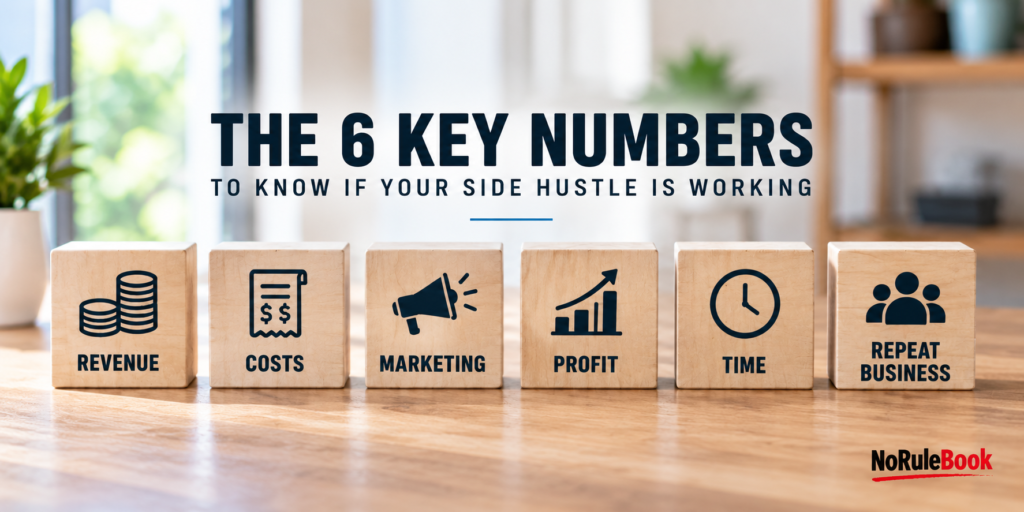
The 6 key numbers

  • Revenue: How much money is actually coming in?
  • Direct costs: What does it cost to provide the product or service?
  • Marketing costs: How much are you spending to acquire customers?
  • Profit: What is genuinely left after your business expenses?
  • Time: How many hours are you working to produce that profit?
  • Repeat business: Are customers returning or recommending others?

These numbers help distinguish a genuine side hustle from an activity that merely keeps you busy. For example, earning an additional $1,000 a month sounds attractive, but not if generating it requires $700 of expenses and eighty hours of your time. Conversely, a side hustle producing only $500 a month may be very worthwhile if it requires little ongoing work and has room to grow.

Success also depends on what you wanted the side hustle to achieve in the first place. You may simply want an extra income stream to improve your financial position. You may want to develop a skill, test a business idea or eventually create enough income to reduce your working hours elsewhere.

Don’t assume every successful side hustle has to become a full-time company. Build it toward the outcome you actually want.

WHEN SHOULD YOU CONSIDER LEAVING YOUR JOB?

If the side hustle grows strongly enough, there may eventually come a point where your job is limiting how much further the business can develop. That is when leaving employment becomes a question worth considering — not when you’ve made your first few sales.

Don’t base that decision on enthusiasm or revenue alone. You need evidence that demand is reasonably consistent, the business is profitable, customers continue to arrive and you understand how those customers are being acquired. You should also know whether the additional time created by leaving your job is likely to produce enough additional income to justify losing your salary.

Your personal finances matter just as much. A side hustle that looks promising becomes much more stressful when it suddenly has to pay your mortgage, food and household bills from the first month. Having cash reserves gives the business time to develop without every decision being driven by an immediate need for income.

Before making the move, understand the tax, insurance, licensing and other regulatory requirements that apply to operating a business in your country. What began as a small source of extra income may carry additional obligations as it grows.

There is no rule saying a side hustle eventually has to replace your job. If keeping both gives you the income, flexibility and security you want, there may be no reason to change anything.

But if the business has demonstrated sustainable demand and your job has genuinely become the main constraint on its growth, you can make the decision using evidence rather than hope.

Take The Next Step

By this point, you should have a much clearer idea of how to approach a side hustle: Start with something you can realistically offer, identify a problem people will pay you to solve, test the idea without risking large amounts of money, find your first customers and use what you learn to decide whether the opportunity is worth building.

But once you’ve found an idea with potential, another challenge begins: Turning that idea into an actual business.
NoRulesStart-Up bk no bkgrndIf your side hustle will involve selling products or services online, No Rules Start-Up was created to help you through that next stage. This 137-page eBook takes you through the practical process of starting an online business without burying you in technical jargon, helping you understand the pieces you need to put in place to move from an idea to something customers can actually find, trust and buy from. It covers the practical areas that can otherwise make getting started feel unnecessarily complicated, including establishing your online presence, creating a website, selling online, accepting payments and marketing what you offer.

You don’t need to know everything before you begin, and you certainly don’t need to build everything at once. You need to understand what matters, what comes next and what you can safely ignore until the business actually needs it.

If you’re ready to turn your side hustle idea into something real, grab your copy of No Rules Start-Up below and use it as your practical guide to getting started.

The NoRuleBook Collection

Facebook

Related Articles

Leave a Comment