

Some quotes make you feel good for a few minutes. Others stay with you because they make something you have accepted for years suddenly look different. Those are the quotes that belong here.
This isn’t a collection of motivational sayings about working harder, staying positive, or believing that anything is possible. The quotes that matter to NoRuleBook do something more useful: They challenge an assumption. They make you question where an idea came from, whether it still makes sense, and sometimes whether the life you are building is actually the one you would have chosen for yourself.
A good quote can compress an idea that might take pages to explain into a sentence you remember for years. But the words themselves are only the beginning. What matters is the question they leave behind.
These are quotes worth thinking about rather than simply agreeing with.
THE MOST POWERFUL RULES AREN'T ALWAYS THE ONES SOMEBODY FORCES YOU TO FOLLOW. THEY'RE THE ONES YOU'VE FOLLOWED FOR SO LONG THAT YOU STOPPED NOTICING THEY WERE RULES.
The easiest rules to recognise are the ones that are written down. We know when a law, employer or organization is telling us what we can and cannot do because the restriction is visible.
The more influential rules can be much harder to see :
- Get a respectable job.
- Buy a house.
- Keep climbing the career ladder.
- Work hard now so you can enjoy yourself later.
- Success means earning more, owning more and moving upwards.
- Certain things should have happened by a certain age.
There is nothing inherently wrong with any of these choices, but when enough people follow them for long enough, they can stop looking like choices at all. They become ‘just what people do.’
That is when an unwritten rule becomes particularly powerful, because nobody has to enforce it anymore. We begin enforcing it ourselves, often without remembering when or why we accepted it.
Questioning those rules doesn’t mean automatically rejecting them. Some will still make perfect sense. The important distinction is whether you are following something because, after thinking about it, it remains right for you – or simply because it has become so familiar that you no longer recognize there was ever another option.
What have you stopped questioning simply because you’ve become used to it?
THERE IS A PROFOUND DIFFERENCE BETWEEN WANTING SOMETHING AND FEELING OBLIGATED TO WANT IT.
One of the strangest things about social expectations is that they can influence not only what we do, but what we believe we want.
We grow up surrounded by signals about what a successful life is supposed to contain. A particular kind of career. Financial progress. A better house. Recognition. Marriage. Children. Travel. Retirement. Different cultures and families may change the details, but almost everyone inherits some version of the list. Many of those things can bring enormous happiness and meaning. The problem begins when we stop distinguishing between something we genuinely value and something we have learned to regard as evidence that our life is progressing correctly.
That distinction can be surprisingly difficult to make because external approval feels good. Achieving something other people admire can easily be mistaken for wanting the thing itself.
There is no NoRuleBook version of the correct life waiting to replace the conventional one. Choosing marriage because it matters to you is no less independent than choosing to remain single. Building a large company isn’t less authentic than keeping one deliberately small. Owning a beautiful home isn’t evidence of conformity if it genuinely contributes to the life you want.
The question is not whether your choices look conventional. It is whether they are yours.
If nobody else could see your life, would you still want the same things?
WE'VE BECOME SO GOOD AT PREPARING FOR LIFE THAT WE'VE FORGOTTEN TO LIVE IT.
There is always a convincing reason to postpone something :
- Finish your education first.
- Establish your career.
- Get the mortgage under control.
- Build the business.
- Save more money.
- Wait until the children are older.
- Wait until work becomes quieter.
- Wait until retirement.
Each decision can make perfect sense on its own. The danger appears when temporary postponement quietly becomes the structure of an entire life.
Preparing for the future is sensible. Financial security matters. Responsibilities are real, and telling people to abandon them in pursuit of every passing desire would be ridiculous. But preparation is supposed to support living, not permanently replace it.
The problem with continually moving life into the future is that the future has an inconvenient habit of becoming the present and arriving with another reason to wait.
You don’t need to abandon long-term plans to question this pattern. Sometimes the more useful question is simply whether some part of the life you keep promising yourself later could begin, in some form, now.
How much of your life are you currently living – and how much are you still preparing to live?
ONE OF THE GREATEST RISKS IN LIFE IS NOT FAILURE. IT IS UNCONSCIOUS SUCCESS.
Failure is easy to recognize. You wanted something and didn’t get it.
Success can be more complicated. Imagine doing everything you were supposed to do and succeeding at it. You earned the qualifications, built the career, increased your salary, bought the things that demonstrated progress and gradually became very good at meeting the expectations placed in front of you. Then one day you realize that you never actually decided whether you wanted the destination.
That is unconscious success: Becoming increasingly successful according to a definition you inherited without ever examining whether it matched what mattered to you.
The answer isn’t to reject ambition, money, achievement or status. All of them can be worthwhile. It is to define what they are for. Money might create freedom. A career might provide purpose. A business might allow you to build something you care about. Achievement might matter deeply because of the challenge involved. But if the measurement itself becomes the objective, it is possible to keep winning while gradually moving further away from the life you would have consciously chosen.
Failure can force you to reconsider your direction. Success sometimes gives you no reason to.
If everything you are currently working towards succeeds, will it create a life you actually want?
THE MEASURE OF FAILURE IS TO BE THE RICHEST PERSON IN THE GRAVEYARD.
Money matters. It provides security, choices and opportunities, and having too little of it can severely restrict the life you are able to live. The problem begins when accumulating money stops being a means of supporting your life and quietly becomes the measure of whether that life has been successful.
It is remarkably easy for this to happen because money provides a convenient scoreboard. More is measurable. A larger salary, growing investments, a more valuable business or a bigger bank balance all provide visible evidence of progress, even when we haven’t stopped to ask what that progress is ultimately supposed to achieve. There is nothing wrong with building wealth. The more important question is what the wealth is for.
Perhaps it allows you to travel, spend more time with people you care about, support your family, pursue something meaningful, work less, help others or simply live without constantly worrying about money. In all of those cases, wealth is doing something useful: it is helping create the life you want.
But there is an important difference between having enough money to live well and spending your life accumulating more simply because more has become the objective.
Nobody reaches the end wishing the final number in their bank account had been slightly higher simply for the sake of the number itself.
Are you building wealth to support your life – or building your life around accumulating wealth?
HOW DID FREEDOM END UP AT THE END OF LIFE?
For generations, we have largely accepted a remarkably strange structure for adult life: Spend your healthiest decades working, save what you can, meet your responsibilities and eventually reach the point where you have accumulated enough money to regain control over your time. We call that final stage RETIREMENT.
There is nothing wrong with retirement, or with preparing financially for later life. The assumption worth questioning is why so much of the freedom we associate with living – travelling, exploring interests, controlling our days and spending more time with people we care about – became concentrated at the far end of the journey.
Most people cannot simply stop working, nor would everyone want to. Bills still need paying and responsibilities don’t disappear because we decide we would like more freedom. But freedom doesn’t have to mean never working again. It can also mean having greater control over where you work, how much you work, what you work on and how much of your life remains available for everything else that matters.
Perhaps the goal shouldn’t only be to accumulate enough money to become free someday. It can also be to deliberately create more freedom along the way.
Retirement can remain part of the plan. It just doesn’t have to be the first time freedom appears in it.
What would change if you stopped treating freedom as something you have to wait for?
BE BRAVE ENOUGH TO SUCK AT SOMETHING NEW.
Children are expected to be beginners. They fall off bicycles, hit terrible notes on musical instruments, lose sporting matches and make mistakes while learning because nobody expects competence to arrive before practice.
Adults often become considerably less comfortable with the same process.
As we get older, we build identities around the things we already know how to do. We become experienced in our careers, competent at familiar tasks and accustomed to knowing what is expected of us. Starting something completely new can suddenly mean becoming the least capable person in the room again, and that can be surprisingly uncomfortable. So we avoid it.
 We say we’re too old to learn the instrument, change careers, start the business, learn another language, take up the sport or understand the new technology. Sometimes there are genuine limitations, but often the real obstacle is much simpler: We don’t want to be bad at something long enough to become good at it.
Being a beginner is not evidence that you lack ability. It is the unavoidable first stage of acquiring it. If you only do things you already know how to do, you can protect yourself from looking incompetent. You also guarantee that your existing abilities become the boundaries of your life.
What would you try if you were willing to be terrible at it for a while?
THE BIGGEST RISK MAY BE SPENDING YOUR ENTIRE LIFE TRYING TO AVOID RISK.
We are taught to think of risk as something created by action.
Leave the secure job and you might regret it. Start a business and you might lose money. Move somewhere new and it might not work out. Pursue an unconventional idea and you might fail publicly.
Those risks are easy to see because they involve changing something. What is much harder to see is the risk attached to not changing anything.
Staying in a job you dislike carries a risk. Never testing the business idea carries a risk. Continually postponing something you want to experience carries a risk. Always choosing the safest available option carries the possibility that you eventually build an extremely secure life that you never found particularly interesting.
That doesn’t mean taking every risk is courageous or sensible. Some risks are foolish, and there are times when protecting what you already have is absolutely the right decision.
The mistake is assuming that avoiding a visible risk leaves you with no risk at all.
Every important decision has more than one possible cost. There is the cost of acting and getting it wrong, but there can also be a cost to doing nothing and never discovering what might have happened.
A well-designed life isn’t one in which every risk has been eliminated. It is one in which you have consciously decided which risks are worth taking and which are not.
When you think about what could go wrong if you take a chance, do you also ask what could go wrong if you never do?
SINCE WHEN SHOULD YOUR WORK DEFINE WHO YOU ARE?
Ask someone what they do and there is a very good chance they will answer with their occupation.
I’m an accountant. I’m a teacher. I’m a builder. I’m a business owner.
It is such a normal exchange that we rarely notice what has happened. We asked someone what they do, and they told us what they do for money.
Work naturally becomes part of identity because it occupies so much of adult life. It provides structure, status, social connections and, for some people, a genuine sense of purpose. There is nothing wrong with being proud of your profession or building part of your identity around something you have spent years becoming good at.
The problem appears when the job becomes the entire answer to the question of who you are.
You can also be a parent, traveler, friend, musician, volunteer, gardener, adventurer, reader, creator, learner or dozens of other things that never appear on a business card. Some of those roles may matter considerably more to you than the one that pays your salary.
This becomes particularly obvious when work disappears. Retirement, redundancy, illness or a career change can leave people struggling with identity precisely because so much of it had been attached to an occupation.
Perhaps work deserves to be an important part of a life without being allowed to define the person living it.
If you couldn’t mention your occupation, how would you describe who you are?
A GOOD SALARY CAN MAKE IT VERY EASY TO STAY IN A LIFE YOU DON'T WANT.
We normally think of a good salary as something that increases freedom – and it can. Money creates choices, security and opportunities that become considerably harder when finances are tight. But money can also make leaving something increasingly expensive.
As income rises, lifestyles often rise with it. The mortgage gets larger, spending increases, expectations change and financial commitments accumulate. Eventually, walking away from a career you no longer want can mean giving up not only a salary but an entire lifestyle built around it.
This creates a peculiar kind of trap because, from the outside, everything can look like success. You have progressed professionally, earn good money and possess many of the things you were told achievement should provide. Questioning that life can therefore feel irrational or even ungrateful.
The answer isn’t to abandon a well-paid career simply because it pays well. If you enjoy the work and it supports the life you want, there may be nothing to question. The danger is allowing the salary to become the reason you stop asking whether you still want the life attached to it.
Financial success should ideally increase your options. It shouldn’t quietly remove them.
If your current job paid considerably less, would you still want to be doing it?
TRAVEL MAKES YOU REALISE THAT NO MATTER HOW MUCH YOU KNOW, THERE'S ALWAYS MORE TO LEARN.
Travel has an unusual ability to expose how many things we mistake for universal truths simply because they are normal where we come from.
Ideas about work, family, success, food, relationships, punctuality, money, ageing, personal space and what constitutes a good life can feel completely obvious until you arrive somewhere where millions of perfectly functioning people organise those things differently.
That doesn’t mean another culture has discovered the correct answer and yours has got it wrong. The value lies in discovering that there can be more than one answer.
Travel therefore does something more useful than adding places to a list. At its best, it introduces doubt into assumptions you didn’t realize you had. You return with more knowledge, but sometimes the greater lesson is an awareness of how much you still don’t know.
That intellectual humility matters far beyond travel. The moment we become completely certain that our way of seeing something is the only sensible way is often the moment we stop looking closely enough to discover alternatives.
Which of your beliefs feel obvious mainly because you’ve never lived somewhere they weren’t?
The quote is only the beginning
The best quotes don’t give you instructions for living. They interrupt the way you have been thinking long enough for you to examine it.
That is why the quotes in this article matter. None of them tells you to quit your job, reject money, avoid retirement, take reckless risks or deliberately choose an unconventional life. They simply ask whether the assumptions behind your choices have ever been examined.
A quote cannot tell you what the right life looks like because there isn’t one version that works for everybody. What it can do is make you stop long enough to ask a better question. And sometimes one good question is enough to change the direction of a life.
Take The Next Step
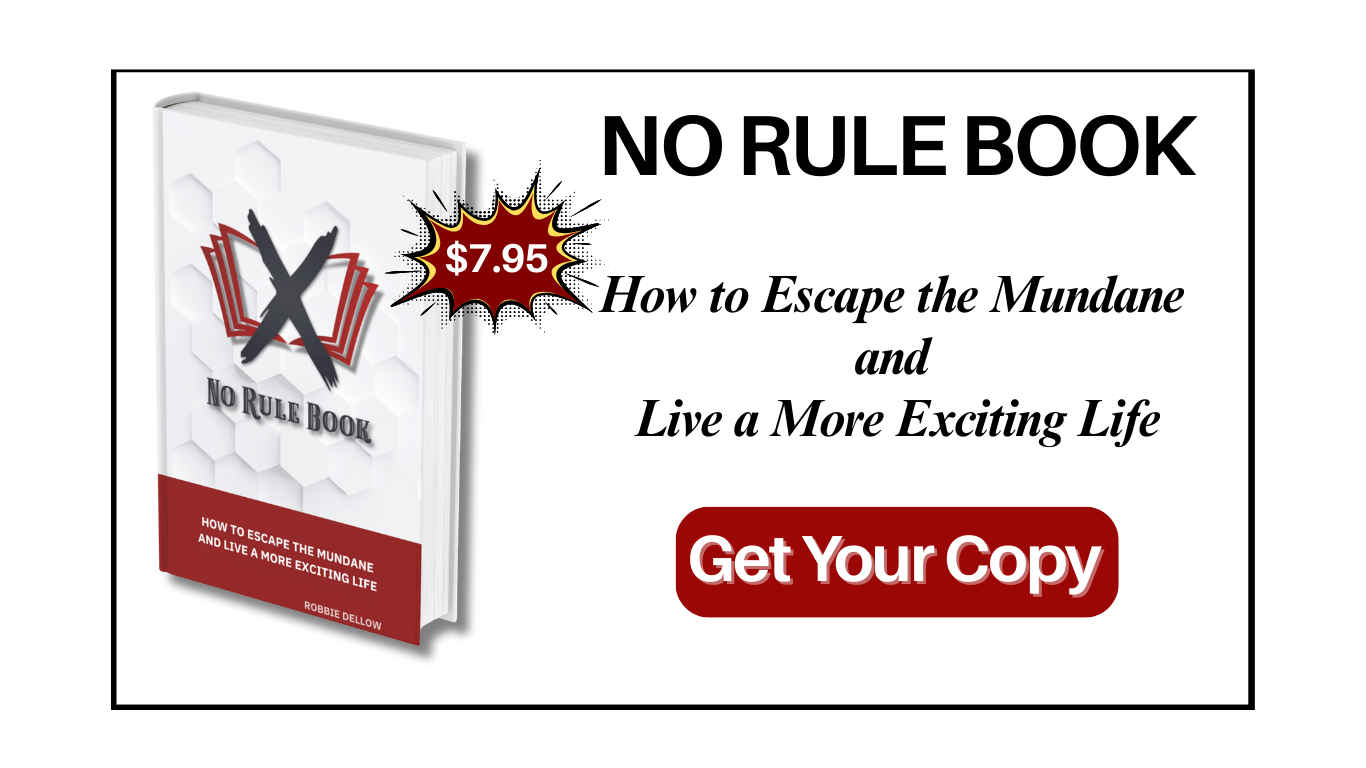
If some of these quotes made you question assumptions you’ve been carrying around without noticing, that is exactly what NoRuleBook was created to explore.
The NoRuleBook eBook goes beyond individual quotes and examines the unwritten rules that influence how we think about success, work, money, relationships, age and the way a life is supposed to unfold. More importantly, it helps you identify which of those rules still make sense for you—and which deserve to be questioned.
If you want to go deeper, click the NoRuleBook image below to get your copy.
The NoRuleBook Collection
-
-20%
NoRuleBook
$9.95Original price was: $9.95.$7.95Current price is: $7.95. -
-50%
No Rules Start-Up
$19.95Original price was: $19.95.$9.95Current price is: $9.95. -
-35%
NoRuleBook Bundle
$22.90Original price was: $22.90.$14.95Current price is: $14.95.

 Submitted 1.0
 Manual 5.0