

NoRule Book Banner

Life Is a Ponzi Scheme — Are the Old Rules Still Worth Following?

by Robbie Dellow
life is a Ponzi scheme image

The Unwritten Rules We're Told To Follow

Most of us inherit a rough outline of how life is supposed to work long before we are old enough to question who wrote it.

Get educated, find a secure job, work hard, buy a house, pay down the mortgage, save for retirement and, somewhere toward the end of that long sequence, arrive at the stage when you finally have enough money and enough control over your time to enjoy the freedom you spent decades preparing for.

There is nothing inherently wrong with that plan. In fact, for millions of people it has worked remarkably well, providing stability, financial security and a structure around which they could build their lives.

But there is a question we don’t ask nearly often enough :

“What happens when the conditions that made the plan work begin to change, but the rules remain the same?"

That is where the uncomfortable comparison with a Ponzi scheme begins. Not because modern society is literally a Ponzi scheme. It isn’t. A real Ponzi scheme is a fraud in which money from new investors is used to provide apparent returns to earlier investors, and eventually collapses when there are no longer enough new participants to keep the arrangement going.

Society is obviously far more complex than that, and its systems create real value rather than simply redistributing money between participants. Yet some parts of the traditional life bargain do share one characteristic worth examining: They work more easily when each new generation is sufficiently large and economically productive to support commitments made to the generations before it.

For decades, that assumption sat quietly underneath many of the rules we came to regard as normal.

Now some of the numbers are changing.

The problem isn't that the old rules were necessarily wrong. It's that we keep assuming they must still be right.

THE LIFE PLAN WE INHERITED

The traditional life plan did not appear from nowhere. Many of its rules became conventional precisely because, under the conditions of the time, they made sense.

A stable career provided predictable income, which made a long-term mortgage manageable. Paying that mortgage gradually converted income into ownership of an asset that could provide security later in life, whilst decades spent in the workforce allowed people to accumulate savings and contribute taxes toward public services and retirement systems. Eventually, after the children had grown and the mortgage had been paid down, retirement offered the freedom that working life had largely postponed.

From students days to golden years imageThe individual pieces reinforced one another, which is one reason the sequence became so powerful. Education led to work, work led to property, property contributed to wealth, and decades of contribution were followed by a period in which people could draw more heavily upon their accumulated assets, savings and public support.

Over time, however, a life plan that had developed under particular economic and demographic conditions began to acquire the status of something much more permanent. Buying a house wasn’t simply one possible financial decision; It became what responsible adults were expected to do. A secure career wasn’t merely one way of earning a living; it became evidence that you were progressing. Retirement wasn’t simply a financial arrangement for later life; It became the promised reward for decades spent working.

None of those ideas suddenly became foolish. But somewhere along the way, we stopped asking often enough whether the conditions supporting them had changed.

WHERE THE PONZI COMPARISON BECOMES UNCOMFORTABLE

Consider retirement, because this is where the dependency built into the traditional life plan becomes particularly visible.

Across much of the developed world, retirement systems were created when populations looked very different from the populations expected in the decades ahead. There were proportionally more working-age people contributing taxes and pension payments, fewer retirees drawing upon those systems, and people generally spent fewer years in retirement than many do today. As life expectancy increased and birth rates declined, that balance gradually began to shift.

The change is now substantial. Across OECD countries, there were around 22 people aged 65 or over for every 100 people of working age in 2000. By 2025 there were 33, and the OECD projects that figure will reach 52 by 2050. Over roughly the next four decades, the working-age population itself is projected to decline by around 13 percent across the OECD, although the scale of that change varies considerably between countries.
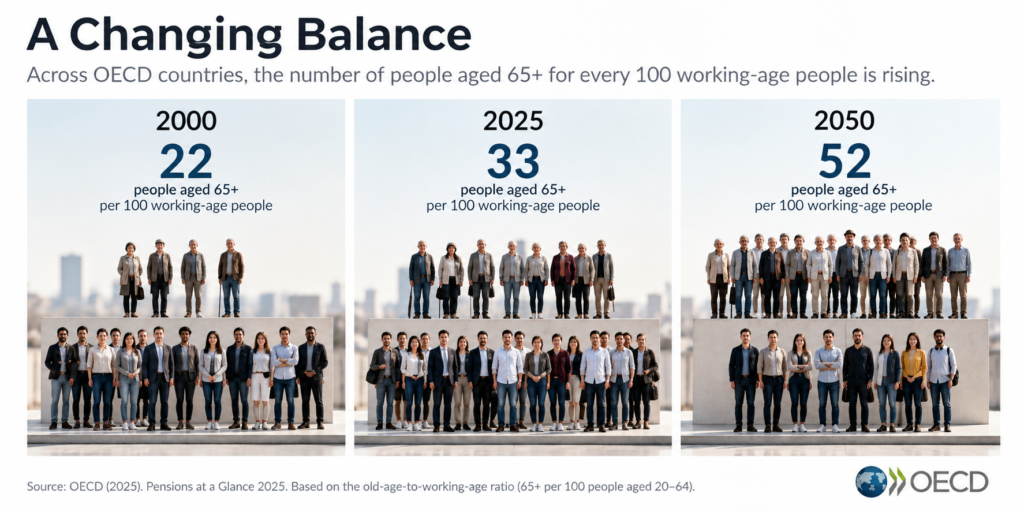
Ageing across the demographic imageThat matters because many retirement systems depend, at least partly, on people working today to finance benefits being paid today. The OECD specifically warns that shrinking working-age populations will place increasing pressure on pay-as-you-go pension systems, while ageing populations will also increase demand for healthcare and other age-related public spending.

None of this means those systems are Ponzi schemes, nor does it mean they are destined to collapse. Governments can respond in many ways, including changing retirement ages, contribution rates, pension entitlements, taxation, migration settings and incentives for people to remain in employment longer. Different countries also fund retirement in very different ways, which means the pressures will not be identical everywhere.

But this is precisely where the Ponzi metaphor becomes useful, because it draws attention to dependency rather than fraud. Some of the promises made to one generation become easier to honor when there is a sufficiently large and productive generation behind it helping to finance them. When that demographic relationship changes significantly, something else eventually has to adjust.

For somebody organizing their life around a retirement that may still be thirty or forty years away, the important lesson is therefore not that the system cannot be trusted. It is that today’s rules should not automatically be treated as guarantees about tomorrow.

A promise can survive for generations and still need to change when the assumptions underneath it no longer do.

THE HOUSE WAS PART OF THE DEAL TOO

Home ownership became another pillar of the traditional life plan because a house could perform several jobs at once. It provided somewhere to live, encouraged long-term saving through mortgage repayments and, if its value increased over time, became a substantial store of wealth that could contribute to financial security later in life.

For somebody who bought a home decades ago and watched both their mortgage shrink and the value of their property rise, the advice to ‘get on the property ladder’ could therefore be entirely rational. (even though sometimes you use ladders to climb down).

The problem comes when we assume that because the rule worked for one generation, repeating the rule under different conditions must produce the same outcome.

Across many developed economies, younger generations are finding it harder to achieve the same levels of home ownership as earlier generations did at comparable ages. OECD research published in 2025 found declining home ownership across successive generations and increasing difficulty for younger households trying to acquire housing.

That does not make buying a house a bad idea. It means the decision needs to be made using today’s price, today’s income, today’s borrowing costs and today’s alternatives, rather than the experience of somebody who entered the same market under very different conditions.

The distinction sounds obvious when written down, yet much of the advice we give about life still ignores it.

We tell people what worked. We don’t always ask why it worked.

And without understanding why a rule produced a good outcome, we have no reliable way of knowing whether the same rule will produce that outcome again.

THE BIGGER PROBLEM WITH INHERITED RULES

Housing and retirement make the problem particularly easy to see because the changing conditions can be measured, but the same principle applies to many of the other rules around which we build our lives. University may be an excellent investment when a qualification provides access to a career that justifies the time and money involved, just as a conventional career can provide income, purpose and security for someone who genuinely wants the life that comes with it. The problem begins when decisions like these stop being treated as choices that need to be evaluated and instead become automatic stages of a life we are expected to follow.

Part of the difficulty is that the world can change much faster than the expectations we inherit from it. Technology can transform an industry within a few years, the economics of education or housing can shift within a generation, and entirely new ways of working and earning can emerge while the advice passed between generations remains largely unchanged. A rule that developed because it once represented the safest or most sensible option can therefore continue circulating long after some of the conditions that originally made it sensible have changed.

This does not mean inherited wisdom should be discarded simply because it comes from an earlier generation. Much of it exists precisely because people before us learned valuable lessons about risk, security and the consequences of poor decisions, and ignoring that experience merely for the sake of doing something different would be no more independent than following it blindly. Inherited wisdom should be a starting point for judgment, not a substitute for it.

Even the familiar idea that we should sacrifice freedom now so that we can enjoy it later deserves to be examined in this way. For generations, postponement was built deeply into the structure of adulthood: people worked through their healthiest and often most active decades, accumulated enough financial security and eventually reached retirement, when greater control over their time became the reward for everything that came before. Yet if technology, remote work, entrepreneurship and more flexible ways of earning allow some people to distribute that freedom differently across their lives, it becomes reasonable to ask whether postponing so much of it until the final decades should still be treated as the only responsible approach.

That does not mean the answer is automatically to reject university, abandon conventional careers, avoid buying property or spend today without preparing for tomorrow. For many people, those traditional choices will remain excellent ones because the reasons behind them still make sense for the lives they want to build. What matters is understanding why a rule worked before assuming that following it today will produce the same result.

The more consequential the decision, the more important that distinction becomes, because these are not rules we can test without cost. A degree can consume years of time and substantial amounts of money, a mortgage can shape decades of financial decisions, and a career can gradually become the organizing structure of a person’s life. When the commitment is that large, “this is what sensible people do” is not enough reason to make it.

The better question is whether the assumptions underneath that advice still hold under the conditions you face today.

A rule can contain generations of wisdom and still deserve to be questioned when the world around it changes.

FOLLOWING THE SAME RULES DOESN'T GUARANTEE THE SAME RESULT

This is where conversations between generations can become unnecessarily hostile.

same rules different conditionsSomeone who worked for decades, bought a house, raised a family, saved carefully and eventually retired comfortably may quite reasonably believe that the formula worked because they were disciplined enough to follow it. Somebody entering adulthood under different housing costs, employment conditions and demographic pressures may look at exactly the same formula and conclude that the sacrifices being demanded no longer offer the same probability of reward.

Both can be describing their own reality accurately.

The mistake comes when either assumes that their experience proves what everybody else should do.

Older generations do not need to apologize for succeeding under the conditions they encountered, while younger generations do not need to reject everything that came before them simply to demonstrate independence. The useful question is not which generation had life harder, because that argument can continue forever without helping anybody make a better decision.

The useful question is:

Which conditions changed, and what should that change about the decisions we make now?

Following the same rules does not guarantee the same outcome when the conditions that made those rules work have changed.

THIS ISN'T REALLY ABOUT THE YOUNG

Younger generations naturally appear at the centre of this discussion because they have the longest period ahead of them in which today’s assumptions may change. Someone beginning a career now could spend forty years working under tax, housing, employment and retirement settings that evolve considerably before they reach the age at which they expected to benefit from them.

But the question is much bigger than youth.

A forty-five-year-old who has spent twenty years climbing a career ladder can still ask whether reaching the next rung is worth another twenty. A fifty-five-year-old can question whether freedom really needs to wait until a prescribed retirement age. Someone who owns a house can reconsider whether continuing to pour money into property is necessarily their best use of capital, just as someone who rents can examine whether buying is genuinely right for them rather than treating ownership as proof of adulthood.

The moment at which you discover that a rule no longer serves you does not have an age limit.

That is why this article is not really an argument for young people refusing to play the old game. It is an argument for everyone understanding the game before deciding how much of their life to commit to it.

SO, IS LIFE REALLY A PONZI SCHEME?

No – not literally.

Life is not a fraudulent investment operation, society does not exist simply to enrich earlier participants, and the traditional rules around careers, housing, saving and retirement have produced genuine benefits for millions of people.

But the metaphor forces us to confront something that is easy to ignore.

Some of the systems supporting the life plan we inherited rely upon future generations continuing to work, pay taxes, create economic value and participate in arrangements established long before they arrived. At the same time, individuals are encouraged to organize decades of their own lives around expectations about housing, careers and retirement that were shaped under conditions that may no longer be identical.

That doesn’t mean the old system has failed. It means “this is how it has always been done” is no longer enough information on which to build a life.

The question isn’t whether an old rule is old. It is whether the reason that made it sensible still exists.

If it does, follow it.

If it doesn’t, examine the alternatives.

And if you cannot explain why you are following it at all, perhaps that is the rule most worth questioning.

Don't inherit somebody else's life plan without checking whether the assumptions underneath it still hold.

The ponzi scheme of life image

Take The Next Step

Choose one of the major rules around which you are currently organising your future, whether that involves buying a house, building a career, earning a degree, saving for retirement or postponing greater control over your time until some distant point when you finally consider yourself financially secure.

Instead of asking whether that rule is conventional or unconventional, ask why it became conventional in the first place. What conditions made it sensible? Do those conditions still exist? What has changed? What would following the rule cost you today, what would rejecting it cost you, and which choice best supports the life you actually want?

You may discover that the traditional answer remains the right one, and if you do, you should follow it with greater confidence because you now understand why.

You may also discover that you have been organising years of your future around an assumption that nobody ever asked you to examine.

That is the difference between living by default and living by design.

It is also the thinking at the heart of the NoRuleBook eBook, which explores the unwritten rules shaping how we work, spend, succeed and live, and provides practical ways to decide which ones still deserve a place in your life.

Click the NoRuleBook image below to get your copy and start examining the rules behind the life you’ve been told to build.

The NoRuleBook Collection

Facebook

Related Articles

Leave a Comment