

For decades, Wall Street had an information hierarchy that seemed almost impossible to disrupt. Professional investors had expensive research terminals, teams of analysts, relationships across the financial industry and enormous pools of capital, while ordinary investors generally operated much further down the information chain, reading financial news, listening to analysts and choosing from opportunities that had already been examined by people with considerably greater resources.
Then, in January 2021, a struggling American video-game retailer exposed just how much that hierarchy had begun to change.
GameStop seemed an unlikely company to become the centre of a financial rebellion. Its business had been built around physical video-game stores at precisely the time customers were increasingly buying games digitally, and many professional investors believed the company’s prospects were poor enough to justify betting heavily against its shares.
That conclusion wasn’t irrational. GameStop genuinely faced serious business problems. But something unusual had developed around the stock. Short sellers had accumulated enormous positions against GameStop, while a growing community of individual investors online had begun questioning whether Wall Street had become too confident in the company’s demise. Among the most prominent was Keith Gill, better known online as Roaring Kitty and DeepFuckingValue, who had spent months publicly arguing that GameStop was being undervalued.
What followed became one of the strangest episodes in modern financial history, but its significance went well beyond one stock price.
For perhaps the first time on this scale, millions of people could see what happened when ordinary investors gained some of the tools that institutions had always possessed: Information, Communication and the Ability to Coordinate almost Instantly.
GameStop didn't prove that the crowd was smarter than Wall Street. It proved that Wall Street no longer had a monopoly on influencing the market.
WALL STREET THOUGHT IT UNDERSTOOD THE STORY
By 2020, the case against GameStop appeared straightforward. The company operated thousands of physical stores in an industry moving rapidly toward digital distribution, and short sellers increasingly positioned themselves to profit if its share price continued falling.
Short selling itself wasn’t unusual or inherently sinister. An investor who believes a company is overvalued can borrow shares, sell them and attempt to buy them back later at a lower price, profiting from the difference if the prediction proves correct.
What was unusual was the scale. According to the SEC’s subsequent examination of the episode, GameStop’s short interest reached 122.97% of its public float in January 2021, an extraordinarily high figure that was possible because shares could effectively be lent and shorted more than once as they passed between market participants.
That created vulnerability. If GameStop’s price began rising rather than falling, some short sellers could eventually be forced to repurchase shares to limit their losses, adding still more buying pressure.
But first somebody had to challenge the assumption that GameStop was destined to keep falling.
ONE INVESTOR SAW SOMETHING DIFFERENT

Keith Gill had been publicly discussing GameStop long before the story became global news. Posting videos as Roaring Kitty and sharing his investment position on Reddit under the name DeepFuckingValue, Gill argued that the market had become excessively pessimistic about the company.
This distinction matters.
Gill wasn’t initially buying GameStop simply because he wanted to attack hedge funds. He had developed an investment thesis and concluded that the market might be wrong.
That is a much more useful NoRuleBook lesson than simply celebrating contrarianism, because independent thinking does not mean automatically taking the opposite side of conventional wisdom. Sometimes conventional wisdom is correct. The value lies in being willing to examine the evidence yourself rather than treating consensus as proof.
Gill’s argument began attracting attention on Reddit’s WallStreetBets community, where thousands of investors could examine it, challenge it, ridicule it, improve upon it or decide to put their own money behind it. And this was where something genuinely new began happening.
The internet hadn’t merely given ordinary investors access to information. It had given them distribution.
An investment idea that once might have remained inside a conversation between a handful of friends could now spread to thousands and eventually millions of people, each capable of acting on it immediately from a smartphone.
The informational hierarchy surrounding investing was beginning to flatten.
THEN THE CROWD ARRIVED
As interest in GameStop accelerated in January 2021, its share price began climbing at extraordinary speed. The rising price put pressure on investors who had bet against the company, and some short sellers bought shares to close their positions, contributing additional demand.
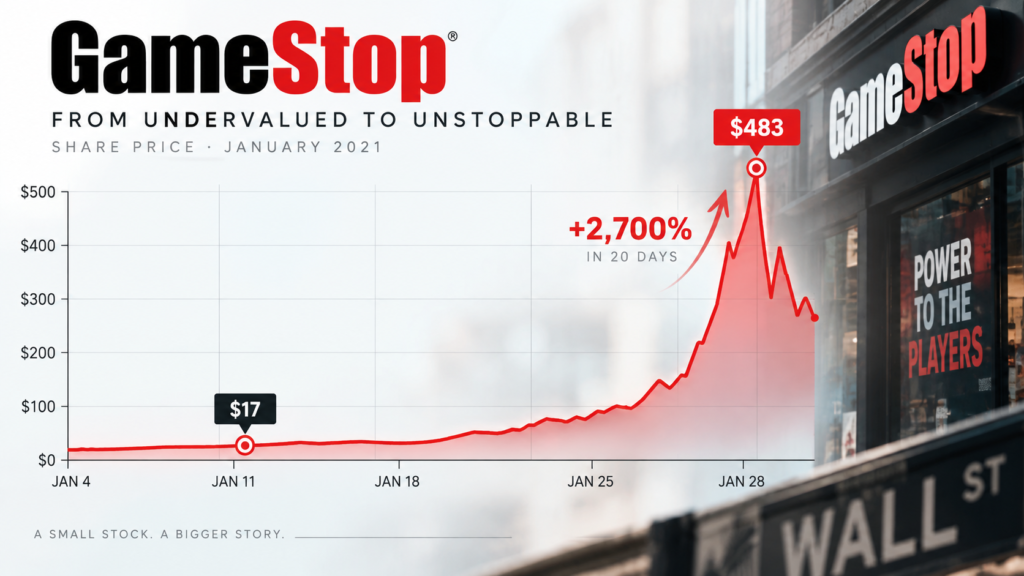
The situation became widely described as a short squeeze. But the reality was more complicated than the popular story that retail investors simply forced hedge funds to buy GameStop until the price exploded.
The SEC later found evidence that short sellers buying shares to cover their positions contributed to periods of price increases, but concluded that this activity represented only a fraction of overall buying volume. The continued rise reflected broader positive sentiment and enormous demand from investors who simply wanted to own the stock. That distinction makes the GameStop story more significant rather than less. The crowd wasn’t merely exploiting a mechanical weakness created by short sellers. It had become a market force in its own right.
Reddit posts, YouTube videos, screenshots of trading positions, memes and online discussion were influencing investment behaviour on a scale that traditional financial institutions could no longer dismiss as background noise. GameStop itself later warned investors that comments appearing on blogs, message boards and social media could materially influence its share price.
The old assumption that meaningful market narratives primarily flowed from analysts, financial media and institutional investors had been broken.
THEN ROBINHOOD STOPPED THE BUYING
On January 28, the story took another dramatic turn.
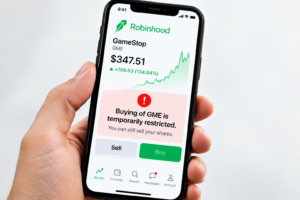
Robinhood and several other brokerages restricted purchases of GameStop and certain other highly volatile stocks while customers who already owned shares were generally still able to sell them. To many retail investors, the decision appeared to confirm everything they already suspected: ordinary people had finally begun winning against powerful financial institutions, and suddenly the rules had changed. That interpretation spread rapidly.
But the documented explanation was more complicated.
Extreme volatility had caused clearinghouse collateral requirements to surge. Robinhood was notified of a deposit deficit of roughly $3 billion on the morning of January 28, creating an immediate liquidity problem for the brokerage. Trading restrictions helped reduce those requirements, while Robinhood subsequently raised additional capital.
Robinhood later disclosed that the restrictions were imposed because of increased deposit requirements generated by the unprecedented volatility.
That doesn’t mean customers were wrong to be angry. A platform built around making markets accessible had suddenly prevented some of its users from buying precisely when they most wanted access, and the episode exposed financial-market plumbing that many ordinary investors had never previously needed to understand.
But it also illustrates another important NoRuleBook principle :
Questioning the official explanation is healthy. Automatically assuming the opposite explanation is true is not independent thinking.
The restrictions deserved scrutiny, and they received it through congressional hearings, regulatory investigation and lawsuits. Yet challenging institutions is most useful when skepticism remains attached to evidence rather than becoming another form of unquestioned belief.
GAMESTOP CHANGED WHO COULD MOVE A MARKET
The most important consequence of GameStop was not that ordinary investors defeated Wall Street, because reality was never that simple. Some hedge funds lost enormous amounts of money. Other institutional investors profited. Some retail investors bought early and made extraordinary gains, while others arrived much later and suffered substantial losses as the price moved violently in both directions.
What changed was something deeper.
The barriers separating professional and individual investors had already been weakening for years. Commission-free trading had reduced transaction costs, smartphones had put brokerage accounts in people’s pockets, financial information had become widely available online and communities such as Reddit allowed investment ideas to spread without passing through traditional financial gatekeepers.
GameStop showed what could happen when all of those changes converged around a single stock.
Ordinary investors could now research together, communicate together and, intentionally or otherwise, create enough collective demand to influence markets in ways institutions had to take seriously. The SEC’s review subsequently identified issues ranging from brokerage trading restrictions and digital engagement practices to payment for order flow and short-selling dynamics as areas deserving further consideration.
The crowd had acquired power.
But acquiring power and knowing how to use it are different things.
THE RULE GAMESTOP REALLY BROKE
The unwritten rule GameStop challenged wasn’t that professional investors always know best. It was the assumption that professional institutions were the only participants capable of creating enough information, conviction and coordinated capital to materially influence a market.
Technology changed that.
But GameStop also demonstrated why replacing one source of unquestioned authority with another doesn’t solve the underlying problem. Following a Wall Street analyst simply because they work for a prestigious institution isn’t independent thinking, but neither is buying a stock simply because thousands of people on Reddit believe it is going ‘to the moon.’
A crowd can identify something professionals missed. A crowd can also become euphoric, tribal and spectacularly wrong.
The lesson isn’t to trust Wall Street or distrust Wall Street, just as it isn’t to trust Reddit or distrust Reddit. It is to recognise that access to information has become far more democratic while responsibility for judging that information has increasingly shifted toward the individual.
That makes independent thinking more valuable, not less.
When everyone can get access to a microphone, the challenge is no longer finding someone willing to tell you what to think. It's deciding who deserves to be believed.
Take The Next Step
The GameStop story shows what can happen when people stop assuming that established institutions must have the best information simply because they have traditionally held the authority. But it also shows the danger of replacing one form of unquestioned thinking with another, because following thousands of strangers online is no more independent than automatically following a Wall Street analyst.
The next step is not to become more contrarian. It is to become more deliberate about how you decide what deserves your belief. The next time you find yourself accepting an expert opinion, popular assumption or strongly held view, ask yourself a simple question:
That distinction sits at the heart of NoRuleBook. The goal isn’t to reject conventional wisdom simply because it is conventional, but to recognise the assumptions shaping your decisions, question the ones that deserve questioning, and then make a conscious choice about what you believe and how you act.
If you want to take that thinking further, the NoRuleBook eBook explores the unwritten rules that influence how we work, spend, succeed and live, and provides practical ways to decide which rules still make sense and which ones may be holding you back.
Click the NoRuleBook image below to get your copy and start questioning the rules you’ve been following without ever deciding whether they belong in your life.
The NoRuleBook Collection
-
NoRuleBook
$9.95Original price was: $9.95.$7.95Current price is: $7.95. -
No Rules Start-Up
$19.95Original price was: $19.95.$9.95Current price is: $9.95. -
NoRuleBook Bundle
$22.90Original price was: $22.90.$14.95Current price is: $14.95.