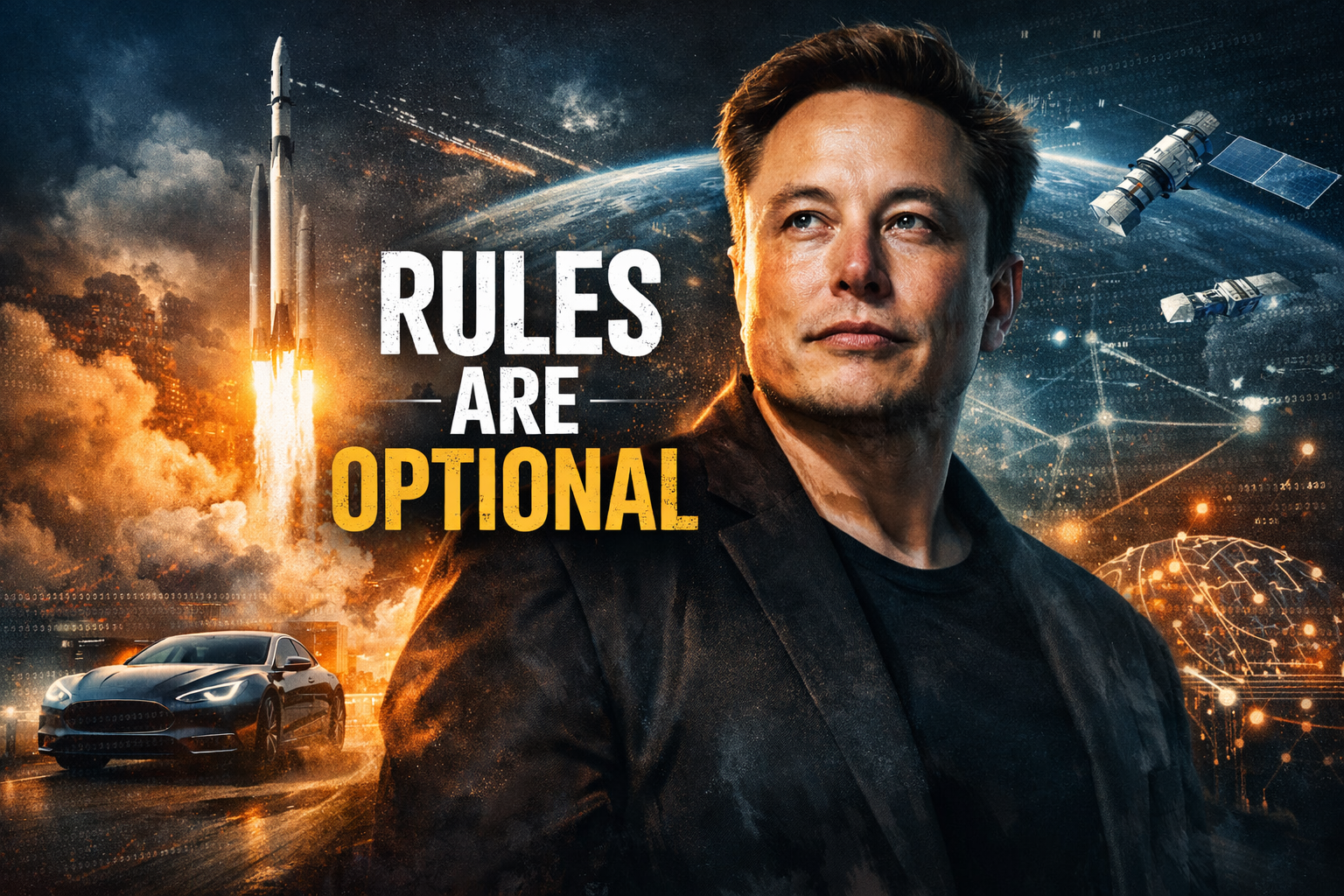
Few modern figures divide opinion quite like Elon Musk. Admired by some, criticized by others, and constantly scrutinized by all, Musk has become one of the most visible examples of what happens when someone refuses to follow the traditional rules of business, leadership, and innovation.
What makes Elon Musk particularly fascinating through a NoRuleBook lens is not just what he has built, but how he has chosen to build it. His career is a sustained experiment in ignoring convention, questioning authority, and backing a long-term vision even when the odds — and public opinion — are stacked against him.
Having disrupted multiple industries that were considered untouchable, Musk stands as one of the clearest modern examples of rule-breaking in action.
A Very Public Rule Breaker
Love him or loathe him, Elon Musk does not operate quietly. The South African-born entrepreneur has built a portfolio of companies that reads less like a business plan and more like speculative science fiction — except most of it now exists.
At the center of Musk’s worldview is a belief that progress does not come from optimization of the status quo, but from radical rethinking. He has repeatedly entered industries dominated by entrenched incumbents and exposed how fragile their “unbreakable” rules really were.
That approach has not made him universally popular. But it has made him impossible to ignore.
Challenging Entire Industries, Not Just Companies
SpaceX and the Cost of Space
When Musk founded SpaceX, the aerospace industry was dominated by government contractors and cost-plus inefficiency. Rockets were expendable, launches were rare, and failure was politically unacceptable.
Musk challenged all of that. SpaceX’s ambition to make humanity a multiplanetary species was dismissed as fantasy, yet its real breakthrough came from something more practical: dramatically reducing the cost of spaceflight through reusable rockets. After three failed launches that nearly ended the company, the fourth succeeded — and changed the economics of space forever.
Tesla and the Automotive Status Quo
Tesla did not just introduce electric vehicles. It attacked the internal combustion engine’s assumed permanence. More controversially, Tesla rejected the dealership model entirely, selling cars directly to consumers and bypassing a system that had existed for over half a century.
This decision triggered legal battles in several U.S. states, but it also exposed how much of the automotive industry’s structure existed for tradition’s sake rather than customer benefit.
Starlink, Neuralink, Solar, and Boring Tunnels
Through Starlink, Musk is reshaping global connectivity by deploying thousands of satellites. Through Neuralink, he is pushing uncomfortable conversations about the future relationship between humans and machines. Through solar energy and tunnelling, he has targeted industries notorious for stagnation and cost overruns.
Each venture follows the same pattern: find an industry protected by inertia, question its assumptions, and absorb short-term pain in pursuit of long-term leverage.
Refusing to Play the Business Game as Taught
One of the most revealing aspects of Elon Musk’s approach is his rejection of orthodox startup doctrine. Musk has openly dismissed the value of detailed business plans, arguing that in high-uncertainty environments, rigid planning often creates false confidence rather than real adaptability.
This mindset was tested brutally when Tesla sat one month away from bankruptcy. Facing hesitant investors, Musk bluffed that he would fund the company himself if needed. The gamble worked, the investment closed, and Tesla survived.
These moments reveal something deeper than bravado. They show a willingness to accept reputational and financial risk in service of a larger vision — Something that corporate cultures often suppress rather than reward.
Elon Musk the Provocateur
Musk’s public behavior has earned him as many critics as supporters. He openly mocks rivals, antagonizes politicians, and uses humor in ways that often feel juvenile or reckless. From trolling billionaires to challenging world leaders and tech CEOs alike, Musk’s refusal to perform “respectability” is part of his rebellion against elite norms.
While this approach has obvious downsides, it also reinforces a central NoRuleBook truth : Conformity is often mistaken for competence.
Why Elon Musk Matters Beyond the Headlines
Elon Musk is not important because he is wealthy. He is important because he demonstrates what happens when someone is willing to question rules that others treat as fixed laws of nature.
He backs visions that take decades, accepts failure publicly, and absorbs criticism at a scale few could tolerate. The risks he has taken — financial, reputational, and personal — are often underplayed by critics who focus solely on outcomes.
For balanced context on Musk’s impact across industries, Britannica provides a grounded overview of his career and ventures here : Britannica Elon Musk biography.
Lessons and Key Takeaways from Elon Musk
Elon Musk’s career offers practical lessons that extend beyond entrepreneurship. The first is that rules are rarely as rigid as they appear. Many exist because no one has challenged them recently, not because they are optimal.
Another lesson is that long-term vision creates short-term discomfort. Musk repeatedly endures periods where progress looks like failure, and where public opinion turns sharply against him. He accepts this as the cost of attempting something meaningful.
Perhaps most importantly, Musk demonstrates that intelligence alone is not the deciding factor. What matters is conviction, persistence, and the willingness to shoulder responsibility when outcomes are uncertain.
These are not traits reserved for billionaires. They are habits of thinking that can be applied at any scale.
The NoRuleBook Perspective
Elon Musk is not a blueprint to be copied. He is an example of what becomes possible when someone refuses to outsource their thinking.
This philosophy sits at the heart of NoRuleBook — Questioning inherited assumptions, challenging authority when necessary, and designing a path that aligns with your own values rather than societal expectations.
If you are interested in applying this mindset to your own work or ventures, these ideas are explored further in both the NoRuleBook and the NoRules Start-Up eBooks. Both can be bought at a discounted price by clicking here.
Elon Musk’s story is not about genius. It is about audacity. And audacity, when paired with persistence, has a way of rewriting the rules.


 Submitted 1.0
 Manual 5.0