

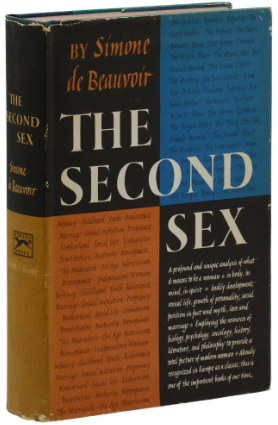
In 1949, Simone de Beauvoir bravely did something the world wasn’t ready for (and sadly, in many countries, still isn’t ready to hear). She told women an uncomfortable truth : That they were not born inferior — That they had been trained to be inferior.
Not by biology.
Not by fate.
Not by God.
But by a system designed for the benefit of men.
She wrote a book, titled ‘The Second Sex’ which The Vatican promptly banned. Critics shredded her name. Professors dismissed her. Men raged. Women whispered about her in secret.
But Simone de Beauvoir kept writing anyway.
This NoRuleBook article isn’t just about the story of her book.
It’s the story of a courageous woman who refused to accept the life that was expected of her, and in doing so, changed the meaning of being a woman forever.
A childhood built to create obedience
Simone Lucie Ernestine Marie de Beauvoir was born in Paris on January 9, 1908, to a family desperately clinging to the illusion of status. They had money once. Titles, too — or so they liked to pretend. But the emergence of World War I soon wiped it all away.
With their wealth gone, one thing remained : Control.
Her mother, deeply Catholic and rigidly traditional, sent Simone and her sister to a strict convent school. The lessons the girls learned there was simple : Your highest purpose is to marry well, obey quietly, and disappear into domestic life.
Simone studied her mother.
A smart woman. A capable woman. Reduced to silence under the title of “wife.”
Simone watched that slow erasure and thought : NO.
By the age of fourteen, she abandoned religion altogether. She didn’t replace it with another belief system. She replaced it with questions. With philosophy. With a hunger to understand the world instead of simply inheriting one.
In that decision alone, she broke her first rule.
The dowry that never came became her freedom
Simone’s father encouraged her intelligence. He even bragged that she “thought like a man.” In that time, that was supposed to be flattering. It was also unconsciously revealing : Brilliance was assumed to be a male trait.
But when the family money disappeared, so did Simone’s “value” on the marriage market. With no dowry, she was considered unmarriageable.
For most women in early 20th century France, this would have been a crisis. For Simone, it was an opening.
No husband meant no master.
No domestic prison.
No social script.
She leaned fully into her studies. At just 21 years old, she became the youngest person in France to pass the agrégation — the brutal, elite national philosophy exam that qualified teachers. She placed second in the entire country.
First place went to a man named Jean-Paul Sartre.
The love story she refused to label
Sartre asked her to marry him. She said no. Not because she didn’t love him, but because she refused to sign a contract that turned women into dependents. Instead, they created their own rules. They would be lifelong partners. Intellectual equals. Complete freedom. Radical honesty. No marriage. No shared home. No ownership. An open relationship built on choice, not obligation.
For over fifty years, they met in cafés, wrote beside each other, edited each other’s work, shared their lives — without ever becoming husband and wife.
The world called it immoral.
Simone called it honest.
In refusing marriage, she wasn’t rejecting love. She was rejecting a system where love required female submission.
And that was just the beginning.
“One is not born, but rather becomes, a woman”
After World War II, women were pushed back into the kitchens, the nurseries – The very silence they had temporarily escaped. During the war they had worked, run factories, supported nations. After the war, they were told to forget all of that and smile. Be an obedient housewife supporting their husband with question.
Simone refused to forget.
From 1946 to 1949, she worked obsessively on a book that would expose how women had been shaped, restricted, shamed, and controlled for centuries.
She didn’t write an emotional rant. She built an intellectual case.
She analyzed :
History
Biology
Psychology
Economics
Religion
Literature
Philosophy
She studied how laws, institutions, marriage, motherhood, and language had worked together to turn women into “the second sex” — the Other, not the default Human.
And she boiled it down to one devastating sentence that would echo through generations:
“One is not born, but rather becomes, a woman.”
In May 1949, The Second Sex was published.
The world exploded.
Banned by the Vatican. Passed in secret by women.
The backlash was fast. Ugly. Even personal.
Catholic leaders called her evil.
Professors threw the book across classrooms. Critics called her vulgar, obscene, dangerous.
Albert Camus accused her of humiliating the French male.
People confronted her in restaurants just to insult her.
The Vatican banned The Second Sex and placed it on the Index of Prohibited Books.
Spain banned it under Franco’s dictatorship. Women smuggled copies across borders and passed them quietly from hand to hand, as if they were forbidden weapons.
Men feared it because it stripped away their inherited authority.
Women clung to it because it explained the cage they had been living in without even knowing it.
Despite the outrage, the book sold over 22,000 copies in its first week. Eventually, more than a million copies worldwide, and translated into forty languages. A foundational text of second-wave feminism.
Betty Friedan read it and went on to write The Feminine Mystique.
Simone had ignited a global awakening.
She didn’t ask to be called a feminist. She acted like one.
For decades, Simone avoided labels. She didn’t want to be boxed in again — even by a movement.
But in the 1970s, she stepped fully into activism.
She signed the Manifesto of the 343, publicly declaring she had had an illegal abortion to challenge French law. She marched. She spoke. She helped found feminist journals. She demanded reproductive rights, intellectual recognition, bodily autonomy.
Even in her sixties, she was more radical than most people in their twenties.
She used her influence not to become palatable, but to become louder.
When Sartre died in 1980, she was devastated. Six years later, in 1986, Simone de Beauvoir died at the age of 78. They are buried side by side in Paris.
Together, but separate. And most importantly, by choice.
Simone de Beauvoir and the NoRuleBook philosophy
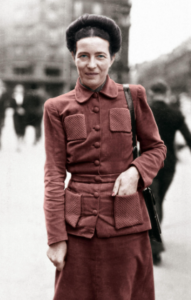 Simone didn’t just live outside the rules. She exposed who wrote them.
Who benefitted from them.
And who was crushed by the rules.
She refused marriage when marriage meant surrender.
She refused silence when silence meant complicity.
She refused gratitude for rights that should never have been withheld.
That refusal is her real legacy.
Not the fame.
Not the controversies.
Not even the book.
Her power came from this : She understood that freedom does not come from permission. It comes from refusal.
That is pure NoRuleBook.
She proved that the life you are handed is just a draft. A suggestion for how to live. A socially accepted myth. Life does not come with a Rule Book. There is No Rule Book.
Simone de Beauvoir was born into a world that demanded obedience from women. She rejected it at fourteen and spent the rest of her life proving that gender was not destiny — it was design. And designs can be redesigned. Or even destroyed.
The world banned her truth.
She kept writing anyway.
And millions finally understood : The cage had no lock after all – It only contained a story that needed breaking out into the world and be heard.
-
-20%

No Rule Book
Original price was: $9.95.$7.95Current price is: $7.95. -
-35%
No Rule Book + No Rules Start-Up
Original price was: $22.90.$14.95Current price is: $14.95. -
-50%
No Rules Start-Up
Original price was: $19.95.$9.95Current price is: $9.95.


 Submitted 1.0
 Manual 5.0