

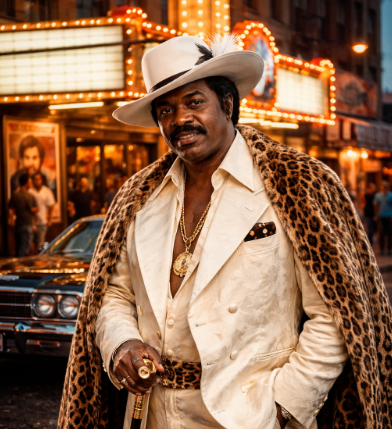
By the time Rudy Ray Moore found the character that would eventually make him a cult legend, he was already in his forties and had spent years trying to make something happen in entertainment.
He had sung, danced, recorded music, performed comedy and reinvented himself more than once, yet none of it had delivered the kind of breakthrough that would suggest a major career was waiting around the corner. By the conventional timetable of show business, where youth is prized and aspiring performers are expected either to be discovered or eventually accept that they probably never will be, Moore had every reason to conclude that his opportunity had passed.
Instead, while working around a Los Angeles record store in 1970, he encountered something that almost everyone else in the entertainment industry had overlooked.
It wasn’t a polished script, a brilliant new business plan or an introduction to somebody powerful in Hollywood. It was a collection of outrageous street stories about a larger-than-life character called Dolemite, told in rhythmic, rhyming language by a local man named Rico.
Moore listened carefully.
And where other people might simply have heard crude entertainment, he heard the beginnings of something much bigger.
Years OF Trying Without Breaking Through
Long before Dolemite existed, Moore had been trying to find his place in entertainment.
Born in Arkansas in 1927, he performed as a singer and dancer while young, served in the U.S. Army and entertained troops in Germany, then continued pursuing music and comedy after returning home. He tried different personas, different styles and different ways of attracting an audience, but the career he imagined never quite arrived.
There is a tendency for successful people to tell their stories retrospectively, thus making everything that happened before the breakthrough sound like preparation. Usually it doesn’t feel like preparation at the time. It normally feels more like failure.
This distinction matters, because Moore’s story becomes far less interesting if we imagine him as somebody confidently following a predetermined path toward eventual success. He wasn’t. He was an ageing entertainer still searching for something that worked while the conventional entertainment industry offered little evidence that it was particularly interested in him.
By 1970, he was working at Dolphin’s of Hollywood, a Los Angeles record store, when he began hearing stories about Dolemite.
The character belonged to a long African-American oral tradition of rhyming street stories and boasts, and Moore recognised something in the language, humour and rhythm that he believed could connect with an audience.
Rather than dismissing the material because it didn’t resemble mainstream entertainment, he began studying it. That decision changed his life.
Finding Dolemite

Moore invited Rico to tell him more of the stories, recorded material and began developing his own version of Dolemite: an outrageously confident, profane, sharply dressed hustler whose exaggerated stories and rhyming boasts were unlike almost anything mainstream audiences were accustomed to hearing.
It was not respectable entertainment.
That was part of the point.
Moore combined the Dolemite character with music, comedy and the rhythmic spoken-word traditions he had absorbed, eventually recording Eat Out More Often, an album whose explicit language and provocative presentation made it difficult to promote through conventional channels.
The normal industry response might have ended the experiment.
Moore’s response was different.
If mainstream radio wasn’t going to play the material, he didn’t need mainstream radio. If conventional retailers were uncomfortable displaying it, he could find other ways of getting it into people’s hands. His records circulated through Black communities and independent outlets, sometimes sold from behind counters in plain wrappers because their covers and contents were considered too explicit for ordinary display.
Word spread.
The important thing was that Moore had discovered something the gatekeepers had failed to understand: there was an audience for what he was making even if the established industry didn’t know what to do with it.
That difference would define almost everything that followed.
The Gatekeepers Weren't The Audience
This is one of the easiest mistakes for creators and entrepreneurs to make.
Someone rejects an idea and we naturally assume they have rejected it because the idea isn’t good enough.
A publisher rejects a manuscript, so perhaps the book isn’t worth reading. A record company passes on an artist, so perhaps the music isn’t commercially viable. An investor declines a business idea, so perhaps customers won’t want it either.
Sometimes those conclusions are correct.
But sometimes we confuse the opinion of a gatekeeper with the opinion of the market.
Rudy Ray Moore discovered that the two could be very different.
His material was crude, confrontational and far outside what mainstream entertainment companies considered safe, but the people buying his records weren’t asking whether a major label approved of them. They were buying something that spoke in a language and style they recognised, delivered by a performer who wasn’t trying to make himself acceptable to an audience somewhere else.
Moore hadn’t persuaded the gatekeepers to change their minds.
He had discovered that he could reach his audience without their permission.
The breakthrough wasn't getting accepted by the system. It was realising that the system wasn't the only route to the audience.
Then He Decided To Make A Movie
Success with the records gave Moore an even more ambitious idea.
Dolemite shouldn’t exist only on an album or nightclub stage. He should be in a movie.
There was, however, an obvious problem. Moore wasn’t a Hollywood star, didn’t have a major studio behind him and didn’t possess anything resembling the resources normally required to produce a feature film.
Once again, the conventional route appeared closed. So he started building his own.
Using money earned from his records, Moore financed much of Dolemite himself. The production reportedly cost around $100,000, an extraordinarily modest amount even in the mid-1970s, and filming proceeded under conditions far removed from the controlled machinery of a major Hollywood production.
The movie starred Moore as Dolemite, a nightclub owner and larger-than-life hero who emerges from prison, takes on corrupt enemies and fights his way through a story overflowing with kung fu, comedy, sex, swagger and the exaggerated mythology Moore had already created around the character.
It was released in 1975. And nobody watching it could reasonably mistake it for a polished Hollywood production.
Dolemite Wasn't Perfect - And That's What Makes The Story Interesting
There are moments in Dolemite where the filmmaking limitations are impossible to hide.
The production is rough. Performances vary wildly. The action can look amateurish, continuity isn’t always elegant and the entire film possesses the energy of people trying to make something happen with whatever resources happen to be available.
If Moore had waited until he possessed the money, expertise, connections and technical resources required to make the film the “proper” way, there is a good chance Dolemite would never have existed. Instead, he made the version he could make.
That distinction is important because there is an increasingly popular piece of motivational advice that tells people simply to “start before you’re ready.”
Moore’s story is more useful than that cliché. He didn’t succeed merely because he was willing to produce imperfect work. Plenty of imperfect work disappears without anybody noticing.
What mattered was that he understood his audience well enough to know which imperfections they would forgive because he was giving them something they weren’t getting elsewhere.
The film had energy, attitude, humour and a central character audiences already knew from Moore’s records. It represented people and entertainment sensibilities that mainstream Hollywood frequently ignored, and its roughness became part of the experience rather than an automatic reason to reject it.
The market gave Moore an answer very different from the one the traditional gatekeepers might have predicted.
Contemporary reports recorded strong openings in several American cities, and by October 1975 the film had reportedly taken more than $3 million at the box office against its roughly $100,000 production cost.
The Difference Between Quality And Permission
There is an important warning hidden inside Moore’s success.
His story does not prove that quality doesn’t matter.
Nor does it mean every rejected idea is secretly brilliant, every amateur production deserves an audience or every expert who says something needs improvement should be ignored.
That would simply replace one bad rulebook with another.
The more useful lesson is that we often treat professional standards as though they are laws of nature, when in reality some of them are simply the expectations of a particular industry at a particular moment.
Sometimes those standards exist for very good reasons. Sometimes they protect quality. But sometimes they also create barriers that prevent unusual ideas, unconventional people and underserved audiences from finding one another.
Moore wasn’t trying to make the film Hollywood would have made. He was making the film Hollywood wasn’t making.
That gave him room to succeed on completely different terms.
He Didn't Wait To Be Discovered
The mythology of creative success often revolves around discovery.
The unknown singer is spotted in a club. The manuscript reaches the right publisher. The actor gets the audition that changes everything. The entrepreneur meets the investor who finally understands the vision.
Those stories happen, but they create a dangerous assumption: somewhere out there is a person with the authority to decide when your real career begins.
Moore’s career eventually took the opposite route.
When the conventional music industry offered limited opportunity, he produced and distributed his own records. When Hollywood wasn’t offering him starring roles, he helped finance his own movie and made himself the star. When his material was too explicit for mainstream distribution channels, he found audiences through the channels available to him.
He didn’t completely escape the entertainment system—Dolemite ultimately secured theatrical distribution through Dimension Pictures—but he entered that relationship from a very different position because he had already created the product and demonstrated that an audience existed. AFI records Moore as the film’s producer and notes that he invested his own money in its production.
That is very different from standing outside the gate asking someone to let you in.
Moore had begun building his own gate.
Success Arrived After The Age When It Was Supposed To
There is another part of Rudy Ray Moore’s story that deserves more attention.
He wasn’t 19 when Dolemite changed his career.
He wasn’t 25.
He was in his forties when the character began taking shape and approaching 50 when Dolemite reached cinemas.
That matters because society quietly attaches timetables to ambition.
By a certain age, you’re supposed to know what you’re doing. By another, you should be established. Eventually, trying something completely new begins to look less like ambition and more like irresponsibility.
Moore’s life makes a mess of that timetable.
The years before Dolemite weren’t erased when he became successful, nor did they suddenly become evidence that everything happens for a reason. They were years in which he tried things, learned how audiences responded, absorbed styles and traditions, discovered what didn’t work and kept looking for an opening.
Then an opening appeared in a record store when he was already old enough to have been told that his chance had probably gone.
He noticed it because he was still looking.
Sometimes being 'too late' simply means you're measuring your life against somebody else.
The Culture Eventually Caught Up With Him
Perhaps the most remarkable part of Moore’s story came later.
The rhyming boasts, rhythmic storytelling, exaggerated persona and street language that had once seemed too crude and marginal for mainstream entertainment began to look increasingly familiar as hip-hop emerged and transformed popular culture.
Moore eventually became known as the Godfather of Rap, not because he invented hip-hop by himself—he didn’t—but because later artists recognised elements in his work that anticipated and influenced the performance styles that followed.
Snoop Dogg put it particularly clearly when paying tribute to him:
“Without Rudy Ray Moore, there would be no Snoop Dogg.”
Moore’s influence has also been acknowledged across generations of hip-hop performers, while the Dolemite films developed a cult following far beyond the audiences that originally discovered them.
There is something wonderfully NoRuleBook about that trajectory.
The performer whose material was once too explicit, too rough and too far outside the mainstream eventually became recognised as an influence on a form of culture that moved directly into the mainstream.
He hadn’t necessarily been wrong.
In some respects, the culture simply hadn’t caught up with him yet.
What Rudy Ray Moore Actually Teaches Us
It would be easy to turn this into another story about perseverance.
Keep going and believe in yourself. Never give up.
There is some truth in all of that, but it reduces Moore’s story to advice that could be printed on almost any motivational poster. What he did was much more interesting.
He paid attention when the established industry didn’t. He noticed an audience that wasn’t being adequately served, recognized material that other people might have dismissed, adapted it into something distinctly his own and then found ways of reaching customers even when conventional distribution channels were uncomfortable with what he was selling.
When he wanted to move into film, he didn’t wait indefinitely for somebody else to decide he was ready. He used what he had already built to finance the next step.
And most importantly, Moore understood something creators can easily forget :
Sometimes they are excellent judges. Sometimes they’re right to say no. But occasionally the most important question after rejection isn’t:
“How do I convince them?”
It is:
“Do I actually need them?”
The NoRuleBook Lesson
Every industry develops a rulebook.
There is a proper way to get published, a proper way to finance a company, a proper way to make a film, a proper age to become successful and a proper sequence of people whose approval you’re expected to obtain along the way.
Those systems can be useful because expertise matters, standards matter and experienced people often know things outsiders don’t. But the danger begins when we mistake the usual route for the only route.
Rudy Ray Moore didn’t prove that gatekeepers are unnecessary or that rejection should always be ignored. What he demonstrated was something subtler and far more useful: when the established route doesn’t recognize what you’re creating, it may be worth asking whether the problem is your idea—or whether you’re simply presenting it to people who were never going to understand its audience.
Sometimes the answer is to improve the work. Sometimes the answer is to keep trying. And occasionally, the answer is to build a different route entirely.
Moore spent years trying to fit himself into an entertainment industry that had little idea what to do with him. His career changed when he stopped depending entirely on that industry’s permission and began building directly for people who understood what he was creating.
He didn’t wait for the rulebook to include him. He found another way to play.
Take The Next Step
Rudy Ray Moore’s story isn’t an invitation to ignore every critic, reject professional standards or assume that an idea must be brilliant simply because somebody else doesn’t understand it. Sometimes criticism is exactly what we need, and sometimes rejection is useful information telling us that the work isn’t ready.
The challenge is learning to recognise the difference between valuable criticism and unnecessary permission.
There may be something in your own life that you’ve quietly placed in somebody else’s hands because you’ve assumed they need to approve it first: a business that needs an investor, a creative project that needs a publisher, a career change that needs other people to understand it, or an idea you’ve postponed because you’re waiting until you have the credentials, resources or confidence to do it properly.
Perhaps those things really do require more preparation. But perhaps they don’t require as much permission as you’ve been taught to believe.
That is the question NoRuleBook keeps returning to—not whether every rule should be broken, but whether the rule you’re following is actually necessary in the first place.
Click the NoRuleBook image below to explore the collection.
The NoRuleBook Collection
-
-20%
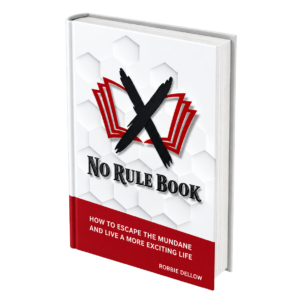
NoRuleBook
$9.95Original price was: $9.95.$7.95Current price is: $7.95. -
-50%

No Rules Start-Up
$19.95Original price was: $19.95.$9.95Current price is: $9.95. -
-35%
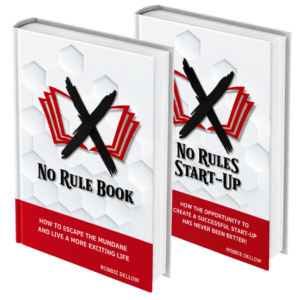
NoRuleBook Bundle
$22.90Original price was: $22.90.$14.95Current price is: $14.95.

 Submitted 1.0
 Manual 5.0