
NoRule Book Banner

The Billionaire Playbook Is Broken : Why Dying Rich Is a Failure

by Robbie Dellow
The billionaire playbook image

There is a strange way in which we measure financial success.

If someone builds a company worth millions, we admire them. If they turn those millions into billions, we admire them even more. Each new zero becomes another point on an invisible scoreboard, and somewhere along the way the money itself stops being primarily about what it can buy and starts becoming evidence of how well somebody has played the game.

Then, when that person eventually dies with an enormous fortune still attached to their name, we often describe the size of the estate as though it were the final confirmation of a life successfully lived.

But there is an obvious question hiding inside that definition of success : 


“If you reach the end of your life still holding vastly more wealth than you could ever have used, was accumulating it really the achievement - or did you simply run out of time before deciding what it was for?"

A small number of extraordinarily wealthy people have asked versions of that question themselves, and some reached conclusions that ran directly against the conventional billionaire playbook.

They didn’t decide that creating wealth was wrong.

They questioned the assumption that keeping it was the ultimate objective.

The Comforting Idea Of Legacy Wealth

The traditional path makes intuitive sense.

Build wealth during your lifetime. Protect it. Invest it. Allow it to compound. Provide for your family and, if the fortune becomes large enough, create a foundation or charitable structure that can continue distributing some of it long after you are gone.

There is nothing inherently wrong with that model. Permanent foundations have financed extraordinary work in medicine, education, science, culture and poverty reduction, while inherited wealth can provide security and opportunity for future generations.

But there is another question that receives considerably less attention.

Why does the giving have to wait?

Why should a fortune continue accumulating simply because accumulation is what successful people are expected to do?

Why should preserving capital indefinitely automatically be considered more responsible than deliberately putting that capital to work against problems that exist today?

More than a century ago, one of America’s wealthiest businessmen began asking exactly those questions.

Julius Rosenwald Saw A Different Purpose For Wealth

Julius Rosenwald image

Julius Rosenwald was not born into the kind of fortune that would later carry his name.

The son of German-Jewish immigrants, he eventually became one of the driving forces behind Sears, Roebuck and Company, helping transform it into one of the great American retail businesses of the early twentieth century.

Success made Rosenwald extraordinarily wealthy.

What makes his story interesting, however, is not simply how much money he accumulated, but what he decided wealth was supposed to do once he had it.

Rosenwald became deeply involved in philanthropy, particularly education for Black Americans living under segregation in the South. Working with Booker T. Washington and local communities, he helped establish a program that ultimately contributed to the construction of thousands of schools.

But Rosenwald didn’t simply arrive with a cheque and build whatever he wanted.

The model frequently required communities themselves to participate through money, land, labour or other contributions, alongside support from public authorities and Rosenwald’s fund. That meant the schools weren’t simply gifts dropped into communities from a distant millionaire; local people had invested in making them happen too.

By the time the program ended, more than 5,000 schools and related educational buildings had been created across the American South.

Yet perhaps the most unconventional part of Rosenwald’s philanthropy concerned what was supposed to happen after he was gone.

He did not want his foundation to exist forever. He believed philanthropic institutions could become more interested in preserving themselves than solving the problems they had been created to address, so the Rosenwald Fund was instructed to spend down its assets rather than becoming a permanent monument to its founder.

Within years of his death, it had done exactly that. The money had finished its job.

What IF Completion Is Better Than Permanence?

This challenges one of the strangest assumptions surrounding success: That things become more meaningful when they continue carrying our names after we disappear.

We name buildings after donors. Foundations carry family names across generations. Universities, hospitals, galleries and institutions become monuments not only to what money accomplished but to the people who supplied it.

Again, there is nothing automatically wrong with that. Recognition can encourage others to give, and permanent institutions can accomplish work over generations that no individual could complete within a lifetime.

But Rosenwald’s approach introduces another possibility :

"What if success sometimes means finishing?"

What if a foundation solves the problem it was created to address, spends its money and then closes?

What if wealth doesn’t need to become an institution simply because its owner became successful enough to create one?

What if the greatest evidence that money achieved something meaningful is not that the fortune survived, but that it didn’t?

Those questions would reappear decades later among some of the richest people in modern history.

When Billionaires Started Questioning The Scoreboard

Warren Buffett image

Warren Buffett spent most of his life doing something he is extraordinarily good at: allocating capital.

He bought businesses, invested in companies and allowed wealth to compound over decades until he became one of the richest people in history.

Yet Buffett has also argued against the idea that enormous fortunes should simply pass untouched from one generation to another. He has committed the overwhelming majority of his wealth to philanthropy and has said that using a tiny portion of his fortune for himself provides everything he needs, while the remainder can have vastly greater effects on other people’s lives.

In 2010, Buffett joined Bill Gates and Melinda French Gates in establishing The Giving Pledge, encouraging extremely wealthy people to commit the majority of their fortunes to charitable causes either during their lifetimes or through their wills.

The Giving Pledge doesn’t require every billionaire to follow the same philanthropic model, and its members have very different ideas about how and when wealth should be distributed.

But the existence of the pledge itself represents an interesting shift in the conversation.

Instead of asking:

How much wealth can one person accumulate?

it introduces another question:

How much of it do they actually need to keep?

That is a very different scoreboard.

Then Someone took The Idea MUCH Further

Chuck Feeney James Bond image

One businessman pushed this philosophy further than almost anyone.

Chuck Feeney made billions through Duty Free Shoppers and then quietly set about giving virtually all of it away during his own lifetime.

His Atlantic Philanthropies ultimately invested more than $8 billion around the world before deliberately closing in 2020. Feeney championed an idea he called Giving While Living: Rather than waiting until death to distribute a fortune, use it while you’re alive. When you can see what works, learn from what doesn’t, and redirect resources accordingly.

Read the full Chuck Feeney story →

Rosenwald had questioned permanent philanthropy generations earlier. Buffett and Gates helped move large-scale giving into the modern billionaire conversation. Feeney demonstrated what could happen when somebody took the idea of giving during their lifetime almost to its logical extreme.

Different people.

Different eras.

Different approaches.

But all of them force us to reconsider the same assumption :
"Why do we automatically treat accumulation as success, and distribution as something that comes afterwards?"

Money Is a Tool, Not A Scoreboard

There is an important distinction here.

The argument isn’t that wealth is bad.

Without people building profitable businesses, investing capital, taking risks and creating economic value, much of the wealth available for philanthropy wouldn’t exist in the first place.

Nor is there anything inherently noble about simply getting rid of money. Giving badly can waste enormous resources. Poorly designed philanthropy can create dependency, distort priorities or fund projects that sound impressive but accomplish very little.

The interesting question is what happens after money has fulfilled its purpose for the person who owns it.

There is a point at which another million dollars can transform someone’s life.

There is another point at which another million dollars may barely alter it.

The precise point is different for everyone, but for someone who already owns several homes, has financial security extending beyond anything they could realistically consume and possesses enough wealth to provide comfortably for generations, the meaning of the next dollar begins to change.

It becomes less about security. Less about freedom. Less about comfort. Increasingly, it becomes a number. And numbers are remarkably good at turning themselves into scoreboards.

The danger isn’t becoming wealthy. It’s forgetting what the wealth was supposed to be for.

The Problem With 'Someday'

There is another reason this matters, as the traditional wealth rulebook is built around delay.

First build the fortune. Then make sure it is secure. Then accumulate enough that you will never have to worry. Then provide for the family. Finally you may, perhaps, start thinking seriously about what the excess could accomplish.

The difficulty is that “enough” has a habit of moving.

The person who once imagined financial freedom at $1 million discovers that $5 million feels safer. At $5 million, $10 million becomes the next milestone. The billionaire sees another billionaire with ten times as much.

There is always another level. Always another reason to wait. Always another number capable of turning abundance back into insufficiency.

This is not exclusively a billionaire problem. Most of us do something remarkably similar with resources that have nothing to do with enormous fortunes.

The Story Isn't Really About Billionaires

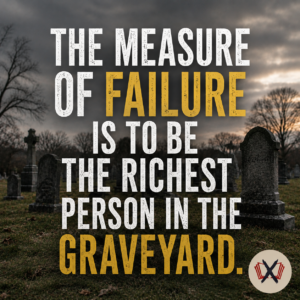
The measure of failure

Few people reading this will ever have to decide what to do with $10 billion. But almost everyone has something they are accumulating for later :

  • Money
  • Time
  • Experience
  • Knowledge
  • Freedom
  • Plans

We tell ourselves we will travel when work becomes less demanding. Spend more time with people we love once things settle down. Start the project when we have more security. Give more when we earn more. Enjoy what we’ve built when retirement finally arrives.

There is always a perfectly sensible reason to postpone using what we have.

And sometimes postponement genuinely is sensible. Saving money matters. Planning for retirement matters. Providing for children matters. Building security matters.

NoRuleBook isn’t an argument against any of those things.

It is an argument against doing them without ever questioning when preparation has become postponement.

Because the billionaire who dies holding a fortune he intended to use ‘someday’  and the ordinary person who reaches retirement having postponed the life they wanted for forty years, may be following different financial trajectories, but they can be trapped by the same assumption : Later is where life gets used.

The Last Shirt Has No Pockets

This old saying, basically means that ‘whatever we accumulate during our lives eventually stays behind. So there is no point in having pockets in the afterlife.’

That doesn’t make accumulation meaningless. Money can create security, freedom, opportunity and choices. It can protect the people we love and allow us to build things that would otherwise never exist.

But perhaps that is precisely the point.

Money has value because of what it allows us to do.

Once accumulation becomes the objective itself, the tool has quietly become the trophy.

Rosenwald understood that. Buffett has questioned it. Feeney built an entire philosophy around refusing it.

And their examples invite the rest of us to ask a question that has very little to do with becoming billionaires:

What are you accumulating that might become more valuable if you actually started using it?

The NoRuleBook Lesson

The conventional rulebook gives us an easy way to measure success.

MORE :  More money. More assets. More security. More status. More left behind.

It is measurable, comparable and conveniently visible.

But a meaningful life has never fitted particularly well onto a scoreboard.

Perhaps the better question isn’t how much we manage to accumulate before time runs out, but whether the resources that passed through our hands—whatever their size—were actually used for something we believed mattered.

For one person, that may mean giving away billions. For another, helping their children buy their first home. For someone else, taking a year away from work, starting a business, supporting a cause, travelling while they’re healthy enough to enjoy it or simply deciding that they already have enough and would rather reclaim some of their time.

There is no single correct answer, and that’s the point.

NoRuleBook isn't telling you what to do with your money. It is simply asking if you've ever consciously decided what your money is for.

Because dying rich isn’t necessarily failure.

But reaching the end with enormous resources you always intended to use differently—and discovering that you spent your entire life waiting for the right time to use them – might be.

Take The Next Step

The stories of Julius Rosenwald, Warren Buffett and Chuck Feeney are unusual because the numbers involved are enormous, but the question underneath them is surprisingly ordinary :

“What are you saving for later that could make your life - or someone else's life - better now?"

The answer doesn’t have to involve giving away your savings or abandoning sensible financial planning. It might simply mean noticing where preparation has quietly turned into postponement, and deciding whether the future really needs everything you’re currently withholding from the present.

That question sits at the heart of NoRuleBook: Not rejecting conventional choices simply because they’re conventional, but examining them closely enough to know whether they still make sense for the life you actually want :

  • Build security
  • Plan for tomorrow
  • Look after the people who depend on you

But don’t become so good at preparing for life that you forget your resources have a purpose while you’re still here to use them.

Click the NoRuleBook image below to explore the collection.

The NoRuleBook Collection

Facebook

Related Articles

Leave a Comment