

There is a strange moment that happens in workplaces, families, institutions and societies everywhere. Someone points to a rule, procedure or expectation that clearly isn’t producing the result it was supposed to produce, and almost everyone in the room quietly agrees.
They know the process wastes time. They know the policy creates unnecessary work. They know the tradition no longer makes much sense. They may even have complained about it privately for years.
Then someone asks the obvious question.
“So why are we still doing it?”
And suddenly the room changes.
People who were perfectly comfortable criticising the rule become surprisingly uncomfortable with the idea of abandoning it. Reasons begin appearing. That’s how we’ve always done it. There must have been a reason for it originally. Changing it could create other problems. Somebody higher up probably wouldn’t approve. Perhaps we should just leave it alone.
Nothing about the rule has suddenly become more effective. What has changed is that complaining about an ineffective rule carries very little risk, while questioning whether the rule should continue can carry considerably more.
That distinction helps explain something deeply human: Recognizing that a rule doesn’t work, and being willing to stop following it, are two very different things.
When A Rule Outlives The Problem It Was Created To Solve
Most rules don’t begin as stupid ideas.
They usually emerge because somebody is trying to solve a genuine problem. A workplace introduces a procedure after something goes wrong. A family develops a tradition because it once made life easier. An industry creates a standard because consistency is useful. A government introduces a regulation in response to circumstances that existed at the time.
The problem is that circumstances change much faster than rules do.
Technology improves. Risks disappear or change. Workplaces evolve. Information becomes easier to access. Cultural expectations shift. The original problem may become smaller, disappear completely or be replaced by an entirely different problem, yet the rule designed around it can remain remarkably resilient.
Eventually, people stop remembering why the rule exists at all.
They simply know that this is how it’s done.
At that point something important has happened. The rule has stopped being a solution that must justify itself and become a default that must be justified before anyone is allowed to change it.
The burden of proof has quietly reversed.
Instead of asking, “Why should we continue doing this?” we begin asking, “Can you prove that changing it will work?”
And because the future can never be proven with complete certainty, the old rule gains an enormous advantage simply by already existing.
Familiarity Can Feel Safer Than Evidence
Human beings don’t make every decision by calmly comparing evidence and selecting the most rational option. If we did, everyday life would become exhausting.
We rely on habits, conventions, routines and assumptions because they allow us to move through the world without reconsidering every decision from scratch. Most of the time, that is extraordinarily useful.
The difficulty begins when familiarity itself becomes evidence.
A rule that has existed for twenty years can feel safer than an alternative that has been tested for two, even when the alternative appears to work better. The old system’s weaknesses are familiar and therefore manageable, while the new system’s weaknesses remain unknown.
This creates an odd asymmetry.
When the established rule produces a bad result, people often blame the circumstances.
When somebody breaks the rule and produces a bad result, people blame the decision to break the rule.
That difference matters because following the existing system provides something beyond predictability. It provides cover.
If you followed the approved procedure and things went badly, you can usually point to the procedure. If you ignored it and tried something different, the result belongs much more directly to you.
Sometimes the safest decision for the individual therefore isn’t the decision most likely to produce the best outcome.
It is the decision least likely to leave them personally responsible if the outcome is bad.
The Safety Of Saying "I Followed The Rules"
Imagine two employees faced with the same problem.
The first follows company procedure exactly, even though they suspect it won’t work. The problem gets worse.
The second ignores part of the procedure and tries something different. The problem gets worse.
Both produced the same outcome, but they may not face the same consequences.
The first person can say:
“I followed the procedure.”
The second has to say:
“I made the decision.”
That difference helps explain why ineffective systems can survive even when many of the people inside them recognise their weaknesses. Institutions don’t merely teach people what to do; they also create structures around responsibility, permission and risk.
Following a rule can protect you from having to defend your judgement.
Breaking one means you may have to explain why you thought you knew better.
This doesn’t mean procedures are bad. In hospitals, aviation, engineering and countless other environments, well-designed procedures can prevent catastrophic mistakes. The lesson isn’t that independent thinkers should ignore expertise and improvise whenever they feel like it.
It is that the existence of a procedure is not, by itself, evidence that the procedure remains the best response to the problem.
Rules deserve respect when they work.
They shouldn’t receive immortality simply because they once did.
When Rules Become Part Of Who We Are
Some rules survive for another reason entirely: After following them for long enough, we stop experiencing them as rules. They become part of our identity.
Work hard. Get qualifications. Build a career. Buy a home. Be sensible with money. Stay secure. Don’t take unnecessary risks. Act your age. Be realistic.
None of these ideas is inherently wrong. For many people, some or all of them will lead to exactly the life they genuinely want.
The NoRuleBook question is different:
Did you choose them, or did you inherit them?
That can be surprisingly difficult to answer because the longer we live according to an expectation, the more psychologically expensive it can become to question it.
Someone who has spent twenty years building a prestigious career isn’t merely reconsidering a job if they begin wondering whether they want something different. They may be questioning two decades of decisions, sacrifices, status and identity.
A person who has always been known as sensible may find an unconventional choice uncomfortable not because the choice is necessarily foolish, but because it conflicts with the person they have learned to be.
The rule and the identity have become tangled together. Changing one can feel like threatening the other.
When Everyone Is Waiting For Someone Else To Question It
There is an even stranger reason ineffective rules survive.
When almost nobody believes in them.
Imagine a workplace where twelve people privately think a weekly meeting is a complete waste of time. Each person looks around the table and sees eleven other people continuing to attend without objection.
What conclusion do they draw?
Perhaps everyone else thinks the meeting is useful. So nobody says anything.
The next week, twelve people who privately think the meeting is pointless turn up again, providing twelve pieces of apparent evidence that everybody believes the meeting should continue.
The rule sustains itself.
This phenomenon can occur far beyond workplaces. Groups can maintain traditions, expectations and behaviours partly because individuals misread everyone else’s compliance as genuine support.
Sometimes the crowd isn’t following the rule because everybody believes in it.
Everybody is following because everybody thinks everybody else believes in it.
That is one of the great paradoxes of conformity: A rule can appear socially powerful even when much of its support exists only in private assumptions about other people’s beliefs.
All it may take to disturb the illusion is one person asking :
“Does anyone actually think this still makes sense?”
The Social Cost Of Being The First Person To Ask
Of course, asking that question isn’t always rewarded.
Groups depend upon a certain amount of predictability. Workplaces need coordination. Families need compromise. Communities need shared expectations. Constantly challenging everything would make cooperation almost impossible. This is why people who question established practices can easily be interpreted as difficult rather than thoughtful.
The person asking why a process exists may be accused of wasting time.
The employee proposing a different approach may be told they don’t understand how things work.
The person choosing an unconventional life may discover that concern from friends and family grows in direct proportion to how far their choices depart from the familiar script.
Sometimes those reactions are justified. The challenger may be wrong.
But sometimes the discomfort comes before anyone has seriously considered the idea at all.
The rule-breaker has disturbed something more fundamental than the rule. They have disturbed certainty.
Once one person demonstrates that an accepted way of doing something is actually a choice, everyone else is forced to see it as a choice too. And choices require thinking.
Why Systems Struggle To Abandon Old Rules
Large systems have an additional problem: changing a rule rarely means changing only a rule.
Processes grow around it. Jobs are created to administer it. Software is designed around it. Budgets accommodate it. Performance measures assume it exists. Other procedures begin depending upon it. Eventually an ineffective rule can become one thread in a much larger fabric. Pulling it out may make perfect sense in isolation, but create consequences elsewhere.
This is why institutional inertia shouldn’t always be mistaken for stupidity or conspiracy. Sometimes systems continue doing something ineffective because changing it is genuinely complicated.
But complexity can also become an excuse.
The longer an organization operates around a rule, the more expensive questioning that rule can become, which means longevity itself starts protecting it.
“We’ve been doing this for thirty years” somehow becomes an argument for continuing… Such a statement should sometimes be an argument for reviewing.
A Rule Should Have To Earn Its Place
NoRuleBook isn’t an argument for living without rules. That would be ridiculous.
Rules allow strangers to cooperate, businesses to function, roads to remain reasonably safe and societies to operate without renegotiating everything every morning.
The problem begins when obedience replaces judgement.
A useful rule should be connected to a purpose. If circumstances change, we should be willing to ask whether the rule still serves that purpose. If it does, keep it. If it needs modification, improve it. If it no longer solves the problem it was designed to solve, its age should not protect it from examination.
This applies just as much to the invisible rules in our own lives.
Perhaps you should work until 65.
Perhaps buying a house is the right financial decision.
Perhaps university is the best route into the career you want.
Perhaps staying in the secure job is wiser than starting the business.
Perhaps the traditional choice really is the best choice.
It requires you to have examined the question."
Independent thinking isn’t automatically choosing the opposite of what everybody else chooses. If everyone turns left and you automatically turn right simply because they’re turning left, the crowd is still determining your direction.
The objective is not rebellion. It is conscious choice.
The NoRuleBook Test
Think of one rule in your life that you follow largely because it feels like the normal thing to do. (It could involve work, money, relationships, retirement, education, success, age, family, lifestyle or something much smaller).
Then ask yourself three questions:
1. What problem is this rule supposed to solve?
Try to identify its original purpose rather than merely explaining the rule itself.
2. Does it still solve that problem for me?
Not whether it works for your parents, colleagues, neighbors or society generally. Does it produce the outcome you believe it is supposed to produce in your circumstances today?
3. If this rule didn’t already exist, would I choose to create it?
This may be the most revealing question of all. Because sometimes the strongest argument supporting a rule isn’t that it works. It’s simply that it is already there.
The NoRuleBook Truth
Rules are one of civilization’s greatest inventions. They allow us to benefit from lessons learned before we arrived and prevent every generation from having to rediscover everything through trial and error.
But that strength contains a weakness. Once a rule becomes familiar enough, we can forget that somebody once invented it.
It wasn’t handed down by the universe. It was created by people responding to particular circumstances with the knowledge, technology, pressures and assumptions available to them at the time.
Some of those rules remain extraordinarily useful. Others have outlived the world that created them. The challenge is knowing the difference.
And perhaps one of the most valuable habits of independent thinking is learning to ask a question that sounds almost embarrassingly simple:
“What is this rule actually for?”
If there is a good answer, you may have discovered why the rule deserves to stay.
If nobody can remember the answer, you may have discovered something even more interesting.
Take The Next Step
You don’t need to start breaking rules after reading this article. Start by noticing them.
Choose one assumption in your life that has become so normal you rarely think about it anymore, and trace it backwards. Where did it come from? What was it supposed to achieve? Who benefits from it? What would genuinely happen if you did something differently?
You may examine it carefully and decide that the conventional rule makes perfect sense.
That’s still independent thinking.
But if the only explanation you can find is “that’s just how it’s done,” don’t confuse familiarity with necessity.
A rule should earn its place in your life.
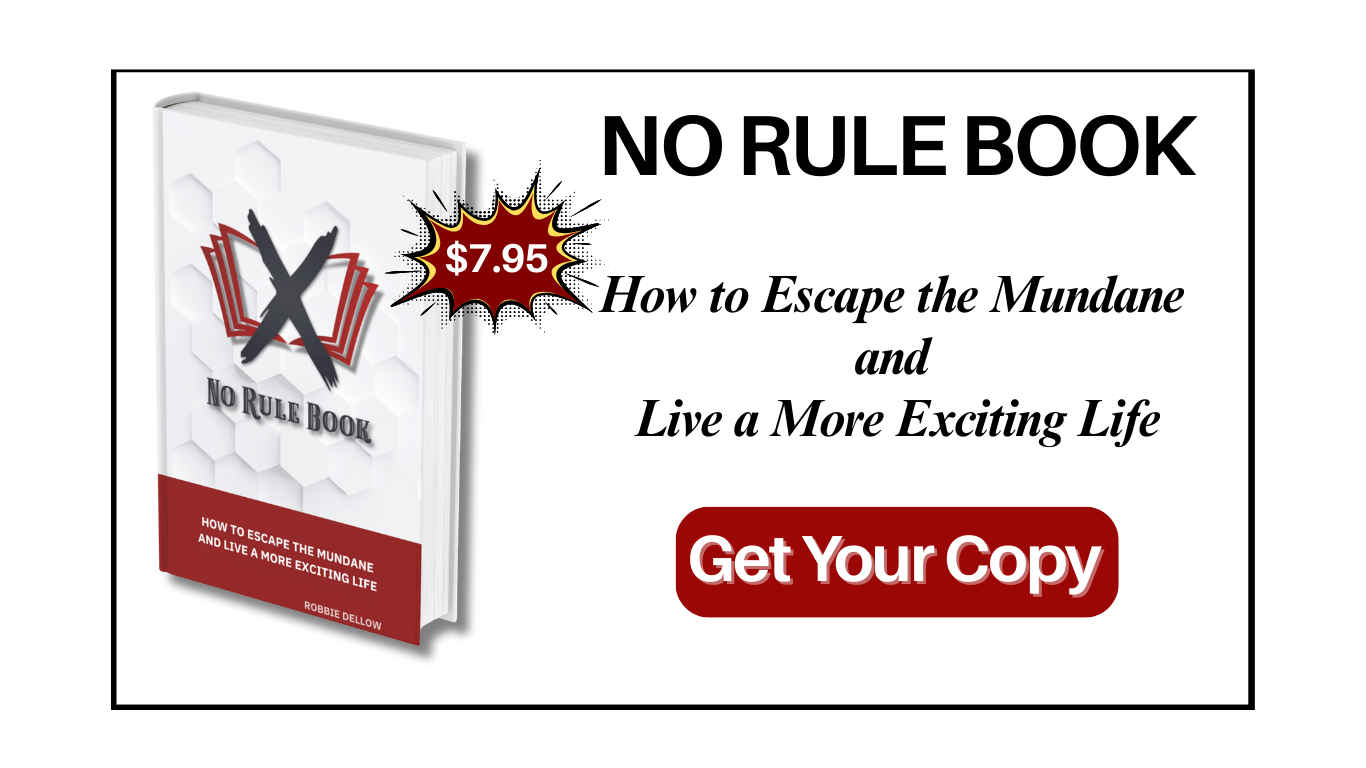
Click the NoRuleBook image below to explore the collection.
The NoRuleBook Collection
-
-20%
NoRuleBook
$9.95Original price was: $9.95.$7.95Current price is: $7.95. -
-50%

No Rules Start-Up
$19.95Original price was: $19.95.$9.95Current price is: $9.95. -
-35%
NoRuleBook Bundle
$22.90Original price was: $22.90.$14.95Current price is: $14.95.

 Submitted 1.0
 Manual 5.0