

NoRule Book Banner

Trudy Ederle: The Woman Who Shattered the ‘Weaker Sex’ Myth

by Robbie Dellow
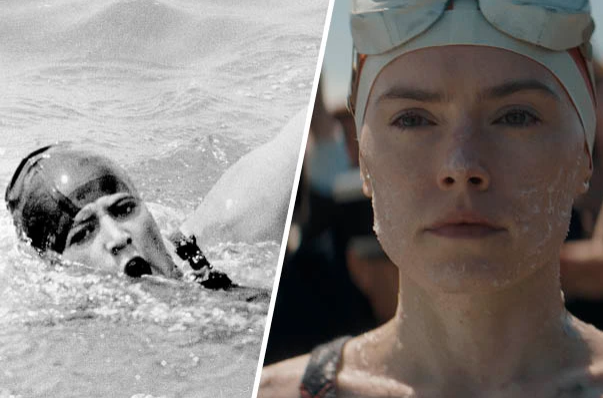
trudy ederle image

In the summer of 1926, much of society still had very definite ideas about what women were physically capable of doing. Women’s participation in competitive sport had increased during the early decades of the twentieth century, but the belief that women were inherently too fragile for extreme physical endurance remained deeply embedded in popular thinking. Like many long-standing assumptions, it had been repeated so often that it was easily mistaken for an established fact rather than a belief that still needed to be tested.

Gertrude “Trudy” Ederle was about to provide one of the most spectacular tests imaginable.

On August 6, 1926, the 20-year-old American entered the English Channel from the French coast and began swimming toward England, attempting something no woman had ever successfully done. Simply reaching the other side would have made history, yet what happened over the following fourteen and a half hours turned Ederle’s achievement into something far more significant.

When she eventually reached the English coast, she had not merely become the first woman to swim the Channel. She had completed the crossing faster than any man had ever done it before.

At a time when women were routinely described as the ‘weaker sex,’ Ederle had confronted one of the assumptions contained within that label and exposed how unreliable it could be. She didn’t need to debate what women might theoretically be capable of doing, because she had produced something considerably harder to dismiss: Evidence.

Some unwritten rules survive because nobody has properly tested whether they are actually true.

A WORLD THAT HAD ALREADY DECIDED WHAT WOMEN COULD DO

Ederle grew up in New York at a time when women’s competitive sport was still establishing its legitimacy. Women had been excluded entirely from the first modern Olympic Games in 1896, and although opportunities expanded during the decades that followed, female athletes continued to compete against social expectations as well as against each other. Ideas about femininity and physical fragility influenced which sports women were encouraged to pursue and how far they were expected to push themselves.

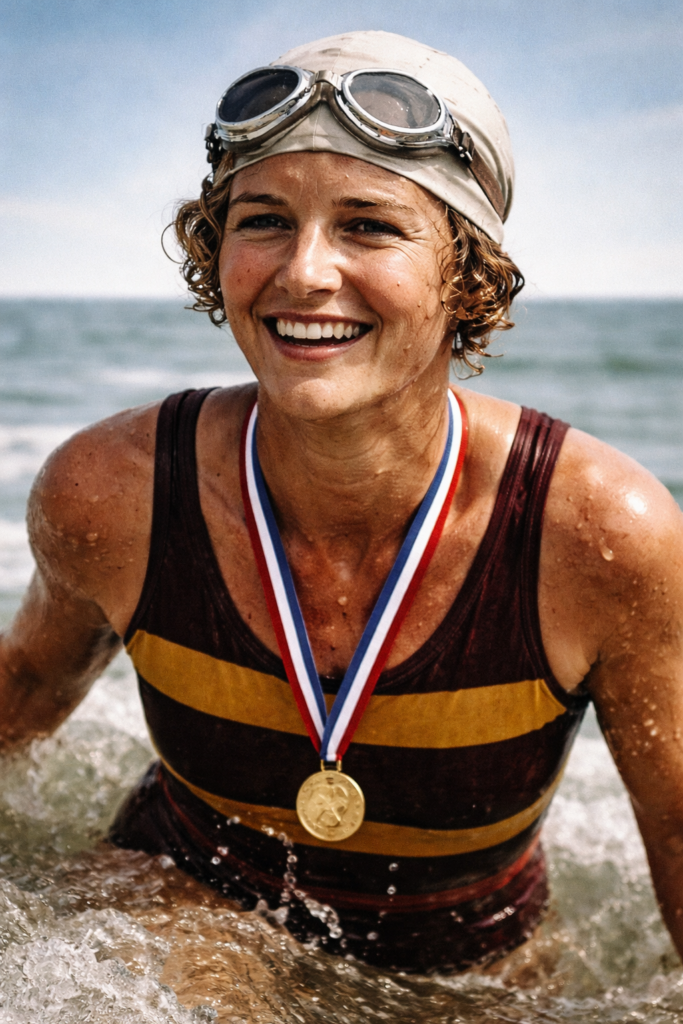
Ederle’s ability in the water soon became difficult to reconcile with those assumptions. After learning to swim as a child, she joined the New York’s Women’s Swimming Association, developing into an exceptional freestyle swimmer, setting records while still in her teens. At the 1924 Paris Olympics, she won gold as part of the United States 4×100-metre freestyle relay team and bronze medals in both the 100-metre and 400-metre freestyle events.

By then, Ederle was already one of the world’s leading female swimmers, but the challenge that would define her life existed far beyond the controlled environment of an Olympic swimming pool.

The English Channel had become one of endurance swimming’s great tests. Although the shortest distance between England and France is roughly 21 miles, tides and powerful currents can force swimmers to cover considerably farther, while cold water, unpredictable weather and many hours of continuous exertion make the crossing exceptionally difficult. By the time Ederle turned her attention to it, only a handful of men had successfully completed the journey, whilst no woman had ever reached the other side.

In a culture already inclined to believe that women lacked the physical endurance of men, that absence could easily be treated as evidence of a natural limit. Yet there was an important question hidden inside the assumption: Did the fact that no woman had crossed the Channel mean that women couldn’t do it, or simply that no woman had done it yet?

WHEN FAILURE SEEMED TO PROVE THE RULE

Trudy Ederle and medal

Ederle first attempted the Channel in August 1925, but after approximately nine hours in the water, her trainer, Jabez Wolffe, instructed another swimmer accompanying her to pull her from the sea because he believed she was in difficulty. Ederle strongly disagreed with the decision and maintained that she could have continued, but whatever the circumstances surrounding the intervention, the result remained the same: She had attempted to become the first woman to swim the English Channel and had failed.
For anyone who already believed that women lacked the endurance required for such a crossing, the outcome could easily have been interpreted as confirmation. This is one of the ways established assumptions protect themselves, because when somebody challenges a supposed limit and fails, the failure can become evidence for the rule rather than evidence about one particular attempt.

Ederle refused to draw that conclusion. She understood that failing to cross the Channel once did not establish that she, or any other woman, was incapable of crossing it. Instead of allowing the unsuccessful attempt to define the boundary of what was possible, she returned the following year, changed trainers and prepared again. This time working with English swimmer Bill Burgess, who had successfully crossed the Channel himself.

That response reveals something more interesting than simple persistence. Ederle was effectively separating the failure of an attempt from the impossibility of the goal. A distinction that becomes particularly important whenever failure appears to support something everybody already believes.

Failure can tell you that something didn't work. It cannot, by itself, tell you that something cannot work.

THE CHANNEL PUT THE ASSUMPTION TO THE TEST

On the morning of August 6, 1926, Ederle entered the water at Cap Gris-Nez on the French coast and began swimming toward England, accompanied by a support boat carrying her trainer, family and crew.

Once she was in the water, the assumptions that existed on land became irrelevant. The Channel offered her no advantage because she was a woman, but neither did it become more difficult simply because society believed women were incapable of conquering it. The cold, tides, currents and distance presented the challenge as it actually existed rather than as generations of convention had described it.
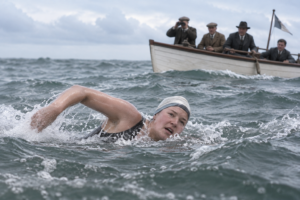
Trudy Ederle Swimming ChannelFor hour after hour, Ederle continued swimming as the currents pushed her away from a direct route and difficult conditions extended the challenge. During the crossing, those aboard the support boat reportedly became concerned enough to suggest that she abandon the attempt, prompting a response from Ederle that captured just how differently she viewed the situation from those watching her:  “What For?”

She kept going, and fourteen hours and 31 minutes after leaving France, Ederle reached the English coast at Kingsdown, Kent.

The woman who had been pulled from the Channel the previous year had returned and become the first woman in history to successfully swim it. From that moment onward, nobody could credibly argue that completing the crossing was simply beyond the physical capabilities of women.

Yet the time on the clock made the achievement considerably more powerful.

SHE DIDN'T JUST CROSS THE CHANNEL — SHE CHANGED THE STANDARD

Before Ederle’s crossing, the fastest recorded Channel swim had been completed by Argentine swimmer Enrique Tirabocchi in 16 hours and 33 minutes. Ederle completed the journey in 14 hours and 31 minutes, almost two hours faster than the existing record.

The Channel swimming record That transformed the meaning of what she had accomplished. Had Ederle simply reached England, she would still have made history by demonstrating that a woman could withstand one of endurance swimming’s toughest challenges, but by completing the crossing faster than every man who had preceded her, she confronted the ‘weaker sex’ assumption in a way that was much harder to explain away.

Her achievement did not prove that men and women were physically identical, nor should one exceptional athlete be used to make sweeping claims about biological differences between the sexes. What Ederle demonstrated was more specific and far more relevant to her story: A widely accepted belief about the limits of women’s endurance had been treated with greater certainty than the evidence justified.
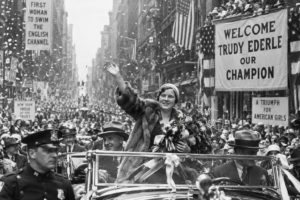
Trudy Ederle ticker tape parade imageHer achievement became international news, and when she returned to New York, enormous crowds gathered for a ticker-tape parade through Manhattan. Yet beneath the celebration was something more consequential than another sporting record. Before August 6, 1926, people who believed women could not swim the English Channel could point to the simple fact that no woman ever had; afterward, that argument had disappeared forever.

The Channel hadn’t changed. The evidence had.

WHEN AN ASSUMPTION STARTS SOUNDING LIKE A FACT

This is what makes Ederle’s story particularly relevant to NoRuleBook, because some of the most powerful unwritten rules don’t sound like rules at all. Instead, they present themselves as statements about reality, telling people that they are too old to change direction, that somebody from their background doesn’t succeed in a particular field, or that a certain ambition simply isn’t realistic for someone like them.

When assumptions like these are repeated for long enough, the distinction between an observed constraint and an inherited belief can gradually disappear. The fact that something has rarely, or perhaps never, been done becomes evidence that it cannot be done, even when there may be other explanations for the absence of precedent.

That was precisely the problem surrounding Ederle’s challenge. No woman had successfully crossed the Channel, but that fact alone could not establish why no woman had succeeded. It certainly couldn’t prove that no woman ever could.

Ederle changed the evidence by becoming the counterexample.

This does not mean that every limitation we encounter is imaginary, because real constraints exist and intelligent rule questioning requires us to recognise them. Determination cannot eliminate biology, economics, physical danger or countless other realities simply because we would prefer them not to exist. The lesson from Ederle’s story is therefore not that we should ignore every limit placed in front of us, but that we should understand what evidence supports the limit before allowing it to determine what we believe is possible.

Before accepting a limit, ask whether it has actually been demonstrated — or simply repeated.

QUESTION THE RULE — DON'T JUST REBEL AGAINST IT

There is an important distinction between questioning a rule and automatically rejecting it. If we decide that conventional wisdom must always be wrong simply because it is conventional, we are not really thinking independently; we are still allowing the rule to determine our behaviour, only this time by deliberately doing the opposite.

Ederle’s story illustrates a much more useful approach. After her unsuccessful Channel attempt in 1925, she had evidence that the challenge was extraordinarily difficult, but she did not pretend that difficulty didn’t exist. Instead, she reconsidered the circumstances of the failure, changed her preparation and returned to test the supposed boundary again. What she refused to accept was the leap from ‘This attempt failed’ to ‘Therefore a woman cannot do this.’

That distinction reaches well beyond sport. Whenever we encounter a rule about what someone of our age, background, education, gender or circumstances is supposedly capable of doing, the useful response is neither blind obedience nor automatic rebellion. It is to ask where the boundary came from, what evidence supports it and whether the circumstances that created it actually apply to us.

Sometimes that examination will confirm that the conventional advice is sensible. At other times, it may reveal that an assumption has survived largely because nobody had sufficient reason, opportunity or determination to properly test it.

Ederle discovered which kind she was facing by putting the rule against reality.

WHY TRUDY EDERLE STILL MATTERS

Nearly a century after Ederle crossed the Channel, women compete at the highest levels of endurance sport no longer carries the shock that surrounded her achievement in 1926. In many ways, that normality is one measure of how thoroughly expectations can change. Because a boundary that one generation treats as natural can eventually become so outdated that later generations struggle to understand why anybody believed in it so strongly.

Ederle was not solely responsible for changing attitudes toward women in sport, and her achievement was part of a much broader transformation driven by many female athletes. What makes her story exceptional is the clarity of the challenge she presented to one particular assumption. Society had drawn a line around what women were supposedly capable of enduring, and she crossed that line in a way that could be measured against the very men whose performances had previously defined the standard.

That is why her story remains useful even for people who have no interest in swimming the English Channel. All of us encounter boundaries whose origins we rarely investigate, and some of those boundaries will be genuine while others may survive primarily because people before us accepted them and passed them on. The challenge is learning to tell the difference.

On August 6, 1926, the Channel was no shorter than it had been the day before. The water was no warmer and the currents had not become more forgiving. What changed was the evidence about who could cross it, because Trudy Ederle had forced an inherited assumption to confront reality.

Sometimes the most powerful way to expose an imaginary limit is to cross it.

Take The Next Step

Think about an important limit you have accepted in your own life. Particularly one connected to your age, career, education, background, abilities or what somebody in your circumstances is supposedly expected to do. Next, consider where your certainty about that limit actually came from. Rather than immediately rejecting it, examine the evidence behind it and ask whether the boundary has genuinely been demonstrated, whether circumstances have changed since the assumption developed and whether there are already people whose experiences contradict it.

You may discover that the constraint is real, in which case understanding it allows you to make a better decision rather than wasting time fighting reality. But if the supposed limit rests mainly on convention, repetition or an assumption that has never been properly tested, Ederle’s story leaves you with a very different question:

"What would happen if you tested it?”

That process of separating genuine constraints from inherited rules is central to the NoRuleBook eBook, which provides practical ways to identify the assumptions influencing your choices, understand why they exist and consciously decide whether they deserve to determine what you believe is possible.

Click the NoRuleBook image below to get your copy and start questioning the limits you’ve been told are reality.

The NoRuleBook Collection

Facebook

Related Articles

Leave a Comment