
NoRule Book Banner

Two Rulebooks in Society? Why Power Changes the Rules

by Robbie Dellow
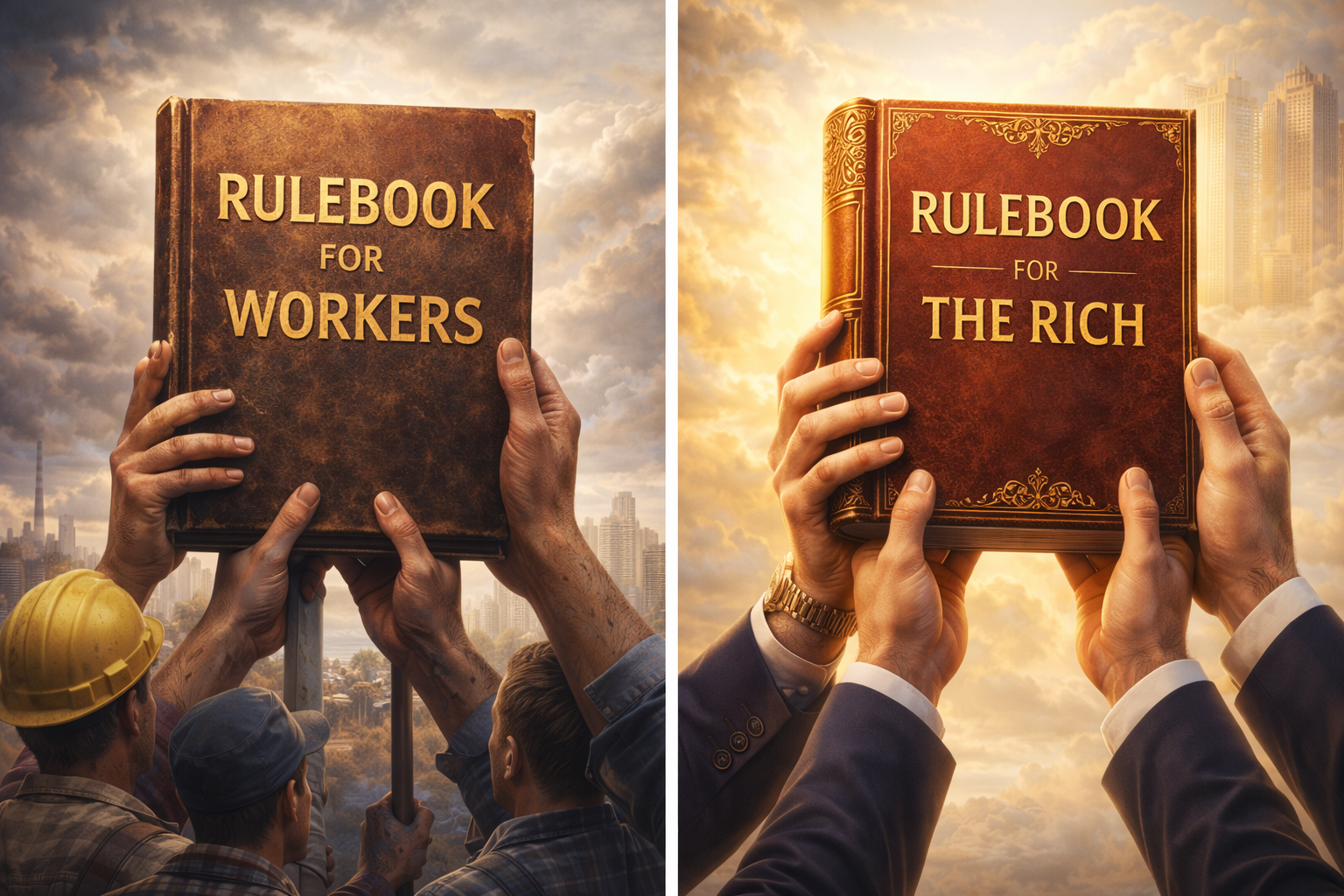
Two rulebooks in society image

You don’t notice it at first.

You grow up believing the world operates according to a fairly straightforward bargain: work hard, tell the truth, follow the rules, take responsibility for your mistakes and, broadly speaking, the system will treat you the same way it treats everyone else.

It is a reassuring idea, and for the most part it is probably necessary. Societies cannot function if people assume that every contract is optional, every law negotiable and every obligation something that applies only when convenient.

But eventually you begin noticing moments when the bargain doesn’t seem quite as simple as you were taught.

An ordinary person misses enough mortgage payments and may lose their home. A small business makes the wrong financial decisions and can disappear. Someone without money or connections enters the legal system and quickly discovers how expensive it can be simply to defend themselves.

Then you look further up the hierarchy and see something different.

Corporations negotiate settlements. Governments rescue institutions considered too important to fail. Wealthy defendants assemble teams of specialists that most people could never afford. Powerful organisations can spend years negotiating consequences that would arrive far more quickly for someone with fewer resources.

The rules have not necessarily disappeared.

But the experience of those rules has changed.

And that raises an uncomfortable question:

Are there really two rulebooks in society — one for people with power, and another for everyone else?

The Rulebook You Were Given

The first rulebook is familiar because most of us have been learning it since childhood.

Play fair. Pay what you owe. Obey the law. Honour your commitments. Respect authority. Accept the consequences when you get something wrong.

There is nothing inherently sinister about those ideas. In fact, much of civilisation depends upon them. Rules create predictability between strangers, allow contracts to mean something, and give people at least some confidence that tomorrow will operate according to roughly the same expectations as today.

For most people, however, that public rulebook can also feel relatively rigid. A speeding fine is not normally the beginning of a sophisticated negotiation. A bank does not restructure your mortgage simply because you know the right person. And few ordinary people facing a serious legal problem can surround themselves with an army of lawyers, advisers and public-relations specialists.

The rule may technically be the same for everyone. The ability to respond to it is not.

That distinction matters, because perhaps the real divide isn’t between people who have rules and people who don’t. Perhaps it is between those who must largely accept the consequences presented to them and those with enough money, influence, institutional importance or negotiating power to shape what those consequences eventually become.

When The Banks Fell - And Didn't

Lehman Brothers Bank image

The Global Financial Crisis (GFC) provided one of the clearest modern demonstrations of this tension.

In 2008, financial institutions that had appeared almost untouchable suddenly began collapsing. Lehman Brothers filed for bankruptcy, credit markets seized up and governments confronted the possibility that failures at the top of the financial system could cascade through the entire global economy.

The consequences did not remain on Wall Street.

People lost jobs and homes. Retirement savings were devastated. Businesses failed. Governments faced the terrifying possibility that allowing major institutions to collapse might produce an economic catastrophe considerably worse than the one already unfolding.

So they intervened.

In the United States, Congress authorised the Troubled Asset Relief Program as part of a broader effort to stabilise a financial system in which major institutions were failing or approaching collapse. The reasoning was not irrational: governments feared that allowing the financial system itself to disintegrate would inflict even greater damage on ordinary people.

Yet the episode exposed an uncomfortable asymmetry.

When an individual becomes financially unsustainable, the system can allow that individual to fail.

When an institution becomes important enough to the system itself, its failure can become everybody else’s problem.

The larger you become inside a system, the more your consequences can become the system’s consequences too.

That doesn’t prove the bailouts were wrong. Allowing everything to collapse simply to demonstrate equal treatment would hardly have helped the millions of people whose livelihoods depended upon the financial system continuing to function. But it does reveal something important about power.

Rules exist alongside incentives, dependencies and consequences. Once an organisation becomes sufficiently important, decisions about how its failures are handled are no longer based solely on what feels fair.

They are also based on what happens to everyone else if it falls.

The Epstein Moment

The Epstein Files image

Few cases have damaged public confidence in equal treatment quite like Jeffrey Epstein.

The important point here is not the endless speculation surrounding every famous person who ever crossed his path, nor is association evidence of criminal wrongdoing.

The documented facts are disturbing enough.

During the federal investigation of Epstein in 2006–2008, prosecutors entered into a non-prosecution agreement that resolved the federal investigation. Years later, the U.S. Department of Justice’s own Office of Professional Responsibility concluded that then-U.S. Attorney Alexander Acosta had exercised poor judgment in resolving the investigation through that agreement, although it did not find professional misconduct by Department attorneys. The review also concluded that Epstein’s victims had not been treated with the forthrightness and sensitivity expected by the Department.

That matters because the deeper issue is not whether every conspiracy subsequently attached to the Epstein story is true.

It is what cases like this do to public trust.

When people see someone with extraordinary wealth and access receiving an outcome they struggle to imagine being available to an ordinary defendant, they begin wondering whether justice is determined only by the written law—or also by the resources available to negotiate within it.

Once that suspicion takes hold, the damage extends beyond one defendant or one prosecution.

People begin questioning the rulebook itself.

The Hierarchy Of Consequences

Money does not make someone immune from the law. Powerful people go to prison. Corporations collapse. Politicians lose office. Billionaires lose fortunes.

So it would be simplistic to claim that the powerful simply live above the rules. But resources can profoundly change someone’s ability to respond when those rules arrive.

Money can buy better legal representation. Status can provide access most people never receive. Networks can open doors, create negotiating leverage and influence how a dispute is understood publicly. Large organisations can absorb fines that would destroy a smaller competitor, while wealthy individuals can survive legal battles whose cost alone would force an ordinary person to surrender.

None of those advantages guarantees victory. But neither are they irrelevant.

And perhaps this is where the metaphor of Two Rulebooks becomes useful.

The first is the written rulebook: laws, regulations, contracts and formal procedures.

The second isn’t really a rulebook at all.

It is an understanding of how the system surrounding those rules actually works.

Who can negotiate? Who has leverage? Who can afford to wait? Who understands the process? Who has access to expertise? Who becomes important enough that other people have something to lose if they fail?

The written rules may be identical.

The negotiating position rarely is.

The System Isn't Broken

It is tempting to look at these inequalities and conclude that the system is simply broken.

Sometimes it may be.

But there is another possibility worth considering: Some of the outcomes that appear unfair are produced not because a system has stopped functioning, but because it is balancing objectives other than fairness.

Governments rescued banks because they feared economic collapse. Prosecutors negotiate because trials involve uncertainty, expense and limited resources. Regulators settle because years of litigation may produce worse outcomes than an imperfect agreement today.

Institutions constantly make trade-offs.

That doesn’t automatically make those trade-offs just, and it certainly doesn’t mean they shouldn’t be questioned.

But understanding why a system produces an outcome is more useful than simply being outraged that it produced one.

A system can be functioning exactly as designed and still produce outcomes worth questioning.

That distinction is important.

If we assume every unequal outcome is evidence of corruption, we stop thinking.

But if we assume every outcome produced by an established institution must therefore be fair, we stop thinking too.

NoRuleBook should live in the uncomfortable space between those two assumptions.

The Illusion Of Equal Rules

We often talk about equality before the law as though equal written rules automatically create equal experiences.

They don’t.

Imagine two people receiving exactly the same legal problem. One has savings, specialist advice, professional contacts and enough financial security to spend two years fighting. The other has rent due next week and cannot afford to miss work.

The rule may be identical.

The choices available under that rule are completely different.

The same principle extends beyond law.

An employee with six months of savings can challenge an unreasonable employer more easily than someone living from payday to payday. An entrepreneur with wealthy connections can survive failures that would end somebody else’s business. A person with professional networks can reach decision-makers another person may never know exist.

That isn’t necessarily evidence of some secret conspiracy.

It is leverage.

And leverage is one of the least discussed forms of freedom.

Why This Matters For You

This is where the idea becomes more useful than simply complaining that rich and powerful people sometimes receive advantages.

Most of us cannot rewrite global power structures tomorrow. We cannot make every institution perfectly fair, eliminate every advantage created by wealth or ensure that every person enters every negotiation with identical resources.

But we can stop confusing the formal rules with the complete reality of how systems work.

We can start asking better questions :

  • Who benefits from this arrangement?
  • What is actually negotiable?
  • Who makes the decision?
  • What incentives are influencing them?
  • What would increase my options?

And perhaps most importantly:

  • What could I build today that gives me more freedom tomorrow?

That might mean savings that allow you to walk away from a bad job. Skills that make you less dependent on one employer. Relationships that expose you to opportunities you would otherwise never encounter. Knowledge that allows you to negotiate rather than simply accept. A reputation that makes other people willing to take your call.

None of that requires abandoning ethics or becoming cynical.

It means understanding that independence often comes from options, and options rarely appear by accident.

The Risk Of Obedience

There is another danger hidden inside the public rulebook.

If you spend your life becoming exceptionally good at following instructions, you may eventually discover that nobody ever promised those instructions would lead somewhere you actually wanted to go.

You can study hard, build the respectable career, buy the right house, accumulate the right possessions, wait patiently for retirement and fulfil every expectation placed in front of you—and still arrive at a life that feels strangely unfamiliar.

Not because somebody deliberately deceived you.

But because you became so focused on following the route that you never stopped to ask who chose the destination.

This is where the idea of two rulebooks reaches beyond banks, courtrooms and powerful institutions.

The people with the greatest freedom are often not those who have learned how to break every rule.

They are those who understand which rules are fixed, which are negotiable, which are merely expectations—and which were never rules in the first place.

The NoRuleBook Lesson

Perhaps there aren’t really two rulebooks.

Perhaps there is one visible rulebook containing the laws, procedures and expectations everyone is taught—and another layer of reality that becomes visible only when you begin paying attention to incentives, leverage, negotiation and power.

Recognising that second layer doesn’t require you to abandon morality.

It doesn’t require you to distrust every institution, assume every wealthy person is corrupt or treat every rule as something to be defeated.

It simply requires you to stop confusing fairness as an ideal with perfect symmetry as a description of how the world actually works.

The goal isn’t cynicism.

It is awareness.

Because once you understand how a system actually operates, you can make better decisions inside it. You can build more options, negotiate when negotiation is possible, recognise when someone else’s interests are shaping the rules presented to you and, perhaps most importantly, notice when an unwritten rule has been masquerading as something you had no choice but to obey.

You don’t have to smash the system to stop being naïve about it. You just have to learn to see it clearly.

And once you can see the rulebook, you are finally in a position to decide which parts of it deserve to govern your life.

take The Next Step

The idea of two rulebooks isn’t an invitation to become suspicious of everything around you. It is an invitation to become more curious about the systems you participate in and the assumptions you have inherited from them.

Some rules are necessary. Some protect us. Some make cooperation possible. Others are simply conventions that have survived long enough to acquire the appearance of inevitability.

The challenge is learning to tell the difference.

NoRuleBook explores that same question in everyday life—how expectations surrounding work, money, success, age and security quietly shape the choices available to us, and what can happen when we begin understanding those rules rather than merely following them.

The aim isn’t to live without rules.

It is to live with your eyes open.

Click the NoRuleBook image below to explore the collection.

The NoRuleBook Collection

Facebook

Related Articles

Leave a Comment