
Rubik’s Cube And How It Became
Ernő Rubik never set out to become famous. He wasn’t trying to invent a global phenomenon, build a brand, or impress anyone outside his classroom. He was trying to solve a small, personal problem : How to help his students understand movement in three dimensions.
That alone already breaks one of society’s loudest rules — That anything worth doing must start with ambition, scale, or a commercial goal. Rubik’s work began with curiosity, and that choice shaped everything that followed.
Born in Hungary in 1944, Rubik grew up surrounded by two opposing forces. His father was an aircraft engineer, precise and structured. His mother was a poet, fluid and imaginative. Where many people are pulled in one direction, Rubik learned to sit comfortably between logic and creativity. That balance would become his quiet advantage.
As an architect and later a design professor, Rubik noticed something most people ignore. Students could memorize formulas and diagrams, yet still fail to understand how objects move in space. Instead of repeating the same teaching methods of his peers, he decided to build something physical. Something that forced the brain to work differently.
 He created a cube.
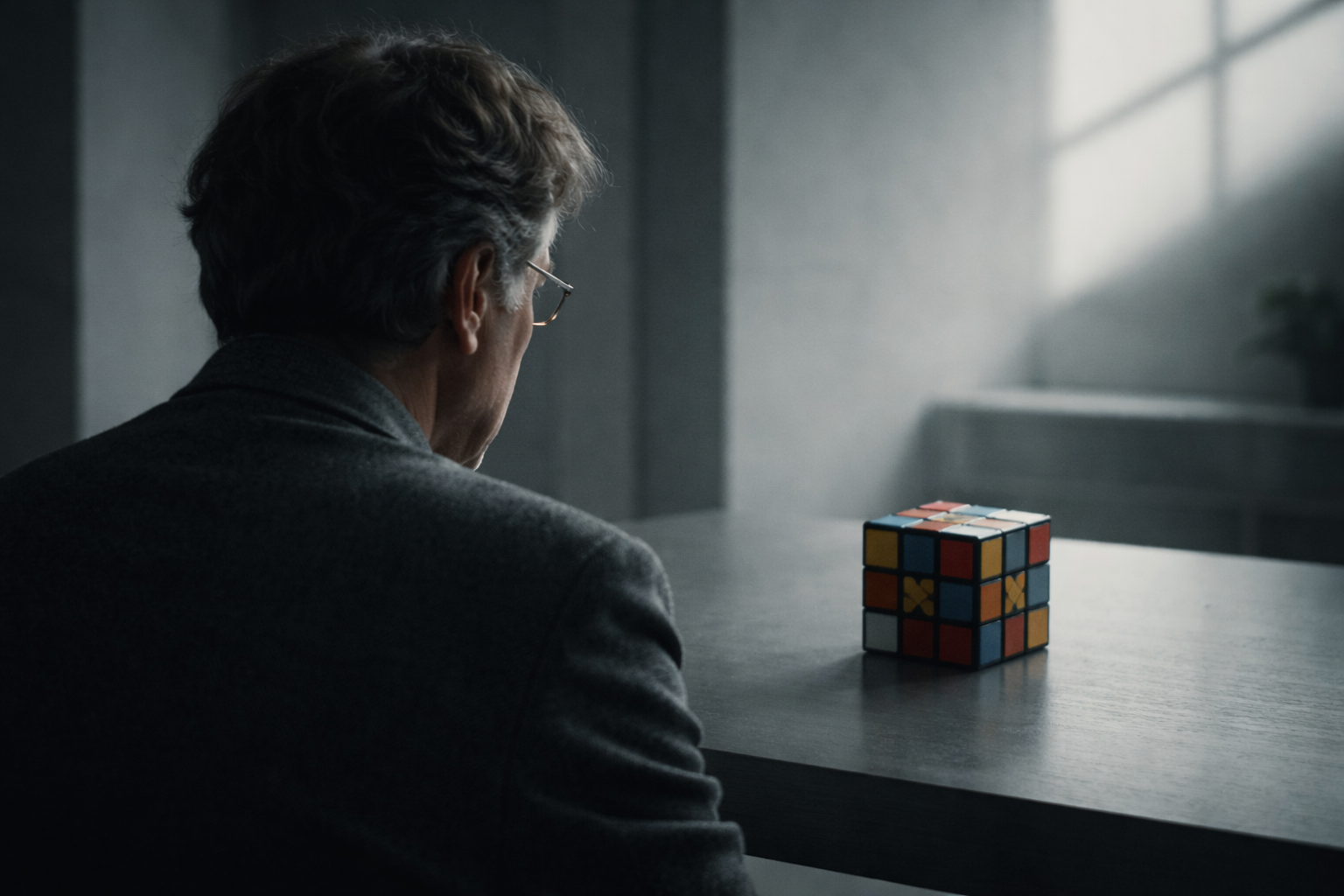
At first, it was nothing remarkable. A rough wooden object designed for learning, not for perfection. But when Rubik scrambled the cube, he discovered something unsettling. He couldn’t solve it. The object he built to explain movement had become a problem he couldn’t escape.
That moment matters. Most people abandon ideas the moment they become uncomfortable. Rubik persisted. He struggled with the cube for weeks, not because he was stubborn, but because the difficulty revealed depth. Being stuck wasn’t a failure. It was evidence that the idea had more potential than he originally imagined.
There’s a lesson there most people miss. If your own creation confuses you, challenges you, or exposes gaps in your thinking, that’s not a sign to quit. It’s a sign you’ve gone beyond imitation and into discovery.
However, when Rubik eventually showed the cube to manufacturers, the response was predictable. It was too complex. Too intellectual. Too difficult for the average person. The market didn’t want to think, they said. It wanted entertainment.
Rubik didn’t argue with them. He didn’t pivot. He didn’t dilute the idea to make it easier to sell. He simply refused to let go of something he believed in, even without validation. That quiet persistence is another lesson hiding in plain sight. You don’t need universal agreement to continue. You need internal alignment. Just as the Rubik’s Cube shifted thinking, learning how to identify the unwritten rules in your industry helps you see hidden constraints you never noticed before.
Eventually, Rubik’s cube found its way beyond Hungary. And when it did, something remarkable happened. People didn’t reject the difficulty. They were drawn to it. The Rubik’s Cube became a global obsession not because it was easy, but because it demanded patience. Every move affected the whole. Every shortcut created new problems. Progress required restraint, not force.
That’s why Rubik’s cube still matters decades later. It mirrors life more accurately than most advice ever could. You can’t rush complex systems. You can’t fix everything at once. And the desire to “just make one more move” often creates the very mess you’re trying to escape.
Rubik’s response to success is perhaps the most NoRuleBook part of his story. He didn’t chase celebrity. He didn’t turn himself into a motivational figure. He didn’t flood the world with opinions. Instead, he stayed close to the work. He kept teaching. He focused on creativity, learning, and curiosity.
In a culture obsessed with visibility, Rubik chose depth. That decision carries a quiet but powerful message: influence doesn’t require noise. Some of the most important ideas in the world come from people who never try to dominate the room.
Rubik’s life also challenges the belief that success requires speed. Rubik’s Cube wasn’t rushed. Its impact wasn’t planned. Its adoption wasn’t engineered. It unfolded slowly, organically, because it was built on something solid. In a world addicted to shortcuts, Rubik’s patience is a reminder that durability comes from depth, not urgency.
The Rubik’s Cube doesn’t explain itself. It doesn’t flatter you. It doesn’t meet you halfway. It simply exists, waiting to see if you’re willing to engage with it honestly. That’s the final lesson Rubik leaves behind. Real growth doesn’t beg for attention. It waits quietly for those willing to wrestle with it.
Society tells us to optimize, to monetize, to scale quickly and loudly. Ernő Rubik ignored those rules. He built something meaningful without permission. He accepted confusion as part of the process. And he allowed his work to speak long after he stopped speaking for it.
He didn’t change how the world plays.
He changed how the world thinks.
And he did it by never opening a rulebook.

-
-20%

No Rule Book
Original price was: $9.95.$7.95Current price is: $7.95. -
-35%
No Rule Book + No Rules Start-Up
Original price was: $22.90.$14.95Current price is: $14.95. -
-50%
No Rules Start-Up
Original price was: $19.95.$9.95Current price is: $9.95.


 Submitted 1.0
 Manual 5.0