
The Man Who decided Everest Wasn't Difficult Enough
There are easier ways to get to Mount Everest.
By the mid-1990s, the route taken by most international climbers was well established. You flew into Nepal, made your way toward Base Camp, joined an expedition and spent weeks acclimatising before attempting the highest mountain on Earth. None of this made Everest easy. At 8,849 metres above sea level, it remained one of the most hostile environments a human being could voluntarily enter.
Göran Kropp looked at that challenge and decided that simply getting to the mountain should be part of the expedition too. So in October 1995, the Swedish adventurer climbed onto a bicycle loaded with climbing equipment and began riding south and east from Sweden toward Nepal.
He wasn’t riding a lightweight touring bike with a credit card in his pocket and hotels waiting at the end of each day. Kropp was transporting much of what he intended to use on Everest. Pulling an enormous load across thousands of kilometers, as he travelled through Europe and onward toward Asia.
By the time he eventually reached Nepal, he had cycled roughly 13,000 kilometers. And only then did the climbing expedition begin.
It is easy to tell Kropp’s story as an example of extreme determination, because almost every part of it invites that interpretation. He deliberately rejected many of the conveniences available to an Everest climber, travelled to the mountain under his own power and intended to climb without supplementary oxygen or Sherpa support.
But if we reduce his story to another lesson about refusing to quit, we miss the most interesting thing he did.
Because after cycling halfway across the world and climbing almost to the top of Everest, Göran Kropp did something that motivational slogans rarely celebrate. He turned around.
When Everything You Have Invested Tells You To Keep Going
By May 3, 1996, Kropp had reached the point where determination could easily have become dangerous. He had spent months preparing for Everest, cycled roughly 13,000 kilometres from Sweden to Nepal carrying an extraordinary amount of equipment, established himself on the mountain and climbed to within striking distance of the summit without supplementary oxygen. Almost everything he had done since leaving Sweden had been directed toward reaching one particular place, and now that place was tantalisingly close.
It is difficult to imagine a situation more perfectly designed to make somebody keep going.
The closer we get to something we have sacrificed heavily to achieve, the harder it becomes to judge the next decision independently of everything that came before it. Time, money, effort and identity begin accumulating around the objective until changing direction can feel less like making a sensible decision and more like admitting that everything already invested has somehow been wasted. We tell ourselves that we have come too far to stop, spent too much to walk away or endured too much to return without the outcome that was supposed to justify it all.
On Everest, those psychological pressures become intertwined with physical danger. The summit is not the end of the climb, however much it may feel like it when it is finally within reach, because every climber who reaches the top still has to get back down through an environment in which exhaustion, deteriorating weather, darkness and altitude can rapidly turn small problems into fatal ones.
Kropp understood that distinction when it mattered.
Although he had climbed extraordinarily high and was close to completing the objective that had brought him halfway around the world, he judged that he was running too late to continue safely. Reaching the summit would mean little if doing so left him without enough time or strength to descend, and no amount of cycling, training or sacrifice could change the conditions confronting him at that moment.
So he turned around.
There is something deeply counterintuitive about that decision. Kropp’s entire expedition appeared to celebrate persistence: he had deliberately chosen an almost absurdly difficult way of reaching Everest, endured months on a bicycle and then attempted the mountain without supplementary oxygen. Yet when persistence stopped being the intelligent response, he was willing to abandon it.
That is what makes the decision more interesting than a conventional story about refusing to quit. Kropp did not lack determination; few people could reasonably accuse him of that. What he demonstrated was the ability to prevent determination from becoming an instruction that had to be obeyed regardless of changing circumstances.
The mountain did not care how far he had cycled to reach it, how much he had trained, what he had sacrificed or how badly he wanted the summit. The only question that mattered was whether continuing upward still made sense.
And Kropp was willing to answer that question based on the situation in front of him rather than the investment behind him.
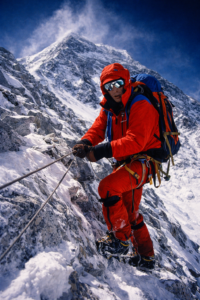
Persistence is valuable only whilst the thing you are persisting with still deserves to be pursued.
Everest Was About To Show Why That Mattered
Only a week after Kropp turned around, Everest became the setting for one of the most infamous disasters in mountaineering history.
On May 10, climbers from several expeditions moved toward the summit while a series of delays gradually compressed the amount of time available for a safe descent. Some climbers reached the summit considerably later than planned, and as the afternoon progressed, conditions on the mountain deteriorated dramatically. A violent storm eventually swept across the upper slopes, catching exhausted climbers at extreme altitude and turning the descent into a desperate struggle for survival.
Eight people died on Everest during May 10 and 11, including experienced expedition leaders Rob Hall and Scott Fischer. The disaster has since been examined through books, documentaries, interviews and competing accounts from survivors, and it would be wrong to reduce such a complicated event to one simple explanation. Weather, congestion, communication, judgement, exhaustion, commercial pressures and individual circumstances all contributed to what happened.
Yet the tragedy also became closely associated with a phenomenon mountaineers had recognized long before 1996: Summit Fever – the psychological pull that can make turning around increasingly difficult as a climber approaches an objective for which enormous sacrifices have already been made.
That pressure is understandable. Imagine spending years preparing for an Everest expedition, committing a substantial amount of money, travelling halfway around the world, enduring weeks of acclimatisation and finally climbing high enough to see that the summit is within reach. At that point, turning around does not feel like returning another day; It can feel as though every sacrifice made along the way will become meaningless unless those final meters are completed.
The danger is that none of those previous sacrifices changes the weather, increases the amount of daylight remaining or gives an exhausted climber more oxygen. They explain why reaching the summit matters so much, but they do not determine whether continuing toward it is still the right decision.
The same psychological trap appears in far less dramatic circumstances. Someone can continue pouring money into a struggling business because admitting that the original strategy has failed feels harder than investing a little more. A person can remain in a career they no longer want because twenty years spent building it seems to demand another ten. A project can continue consuming resources long after the evidence has changed because abandoning it would force everyone involved to confront how much has already been spent.
Economists describe this tendency as the sunk-cost effect: Allowing resources that cannot be recovered to influence a decision about what should happen next.
Kropp’s first 1996 Everest attempt offers an unusually vivid illustration of the alternative. He had invested more in reaching that point than most of us will ever invest in a single objective. Yet when the conditions changed the calculation, he did not allow the size of that investment to make the decision for him.
Turning around did not erase the 13,000 kilometres he had cycled, nor did it transform the expedition into a failure. It simply meant recognising that everything he had already done belonged to the past, while the decision about whether to continue climbing belonged to the present.
That distinction would soon become even more important, because Kropp had not abandoned Everest.
He had abandoned one attempt.
Turning Around Didn't Mean Giving Up
There is an important difference between giving up on an objective and recognizing that the particular way, moment or conditions in which you are pursuing it no longer make sense. We often blur those two decisions together, which is why changing course can feel like weakness even when it is the most rational thing available to us.
Kropp remained on Everest through the terrible events of May 1996. He had already demonstrated that he was willing to turn around when the circumstances demanded it, but that decision had not changed the reason he had travelled there. The mountain remained, his objective remained, and so did the possibility that another opportunity might emerge.
On May 23, twenty days after abandoning his first summit attempt, Kropp climbed again. This time he reached the summit of Mount Everest without supplementary oxygen.
The achievement is extraordinary in isolation, but it becomes much more revealing when placed beside what happened three weeks earlier. If Kropp had continued upward on May 3 simply because he believed that determined people never turn around, his story might have ended very differently. Instead, he demonstrated two qualities that are too often presented as opposites: the determination to continue pursuing something extraordinarily difficult and the judgement to stop pursuing it when the conditions made continuing unnecessarily dangerous.
That is a far more useful understanding of persistence. Persistence does not require repeating the same decision regardless of the evidence. It does not mean becoming emotionally attached to a particular route, timetable or method simply because you have already invested heavily in it. Sometimes genuine persistence requires changing the plan precisely because you care enough about the larger objective not to destroy it through attachment to one attempt.
Kropp had not travelled thousands of kilometers merely to prove that he could refuse to turn around. He had travelled there to climb Everest. Knowing the difference helped him eventually do it.
Persistence Is Not The Same As Refusing To Change Course
We tend to admire persistence because the stories we tell about successful people are usually reconstructed after we know how it all ended. Looking backwards, the path appears clearer than it ever felt to the person actually travelling it, and every setback can be presented as another obstacle that the eventual winner heroically refused to let stand in the way.
That creates a seductive lesson: If you want something badly enough, keep going.
There is truth in that, but only up to a point. Persistence becomes dangerous when we stop distinguishing between commitment to an objective and commitment to the particular plan we originally created for reaching it. The first can give us the patience to survive setbacks and uncertainty; The second can keep us moving in the wrong direction simply because changing course feels too much like admitting defeat.
Kropp’s Everest expedition demonstrates the difference unusually well. His larger objective remained remarkably consistent, but he was willing to change his immediate decision when reality demanded it. Turning around on May 3 did not mean that Everest suddenly mattered less to him, nor did it invalidate the thousands of kilometres he had already cycled. It meant recognising that the route to the objective included the possibility of retreat, recovery and another attempt.
That distinction matters far beyond mountaineering. An entrepreneur can remain committed to building a successful business while abandoning a product customers clearly do not want. Someone can remain committed to becoming financially secure while recognising that an investment thesis has failed. A person can remain committed to meaningful work while leaving a career that no longer provides it. In each case, changing direction can look like inconsistency if we focus only on the original plan, yet it may actually represent a deeper form of consistency because the person remains committed to the purpose rather than becoming trapped by the method.
The question, therefore, is not simply whether you have enough determination to continue. It is whether continuing in the same direction still deserves that determination.
Commit to the objective strongly enough to persist, but not so blindly that you become incapable of changing the plan.
The Danger Of Turning Suffering Into A Philosophy
There is another part of Kropp’s story that deserves more careful treatment than the usual adventure narrative gives it.
He deliberately made an already difficult undertaking considerably harder. Instead of flying to Nepal, he cycled there. Instead of treating the journey to Everest as transportation before the adventure began, he made the transportation part of the adventure itself. He climbed without supplementary oxygen and placed enormous emphasis on self-reliance, choosing an approach that stripped away many of the conveniences associated with a conventional expedition.
It would be easy to turn those choices into a universal lesson that harder is somehow more authentic, that safety nets weaken us or that the purest achievements are those involving the greatest amount of suffering. Kropp’s life can certainly be used to support that interpretation if we select the right details, but it would also be a poor lesson to take from him.
Difficulty does not automatically create value, just as convenience does not automatically destroy it. Flying to Nepal would not have made another climber’s Everest ascent meaningless, and using supplementary oxygen does not somehow invalidate the courage or effort required to operate at extreme altitude. Different people can pursue the same mountain for different reasons and legitimately choose different ways of doing it.
What Kropp appears to have understood was something more personal. He wanted the journey itself to reflect the experience he was seeking, and therefore designed an expedition around his own ideas of self-reliance rather than automatically accepting the established template for how an Everest expedition was supposed to work. That is a much more useful NoRuleBook lesson than simply telling people to choose the hardest possible route.
Living by your own rulebook does not mean automatically rejecting the easier option, because that would merely replace one rigid rule with another. It means understanding why you are making the choice in the first place and deciding whether the conventional route serves that purpose.
Kropp’s bicycle made perfect sense for HIS expedition because the journey to the mountain was part of what he wanted the expedition to mean. Somebody else could make an equally conscious decision to board an aircraft.
The independence lies in making the choice deliberately.
Self Reliance Doesn't Mean You Pretending You Control Everything
Kropp’s approach to adventure was strongly associated with self-reliance, and there is something compelling about a person who tries to reduce the distance between what they want to accomplish and their own ability to accomplish it. Carrying your own equipment, developing your own skills and accepting responsibility for your decisions can produce a kind of confidence that is very different from simply believing that everything will work out.
Yet self-reliance can become another misleading slogan – if it is taken to mean that capable people should never depend on anyone or anything else.
Nobody climbs Everest independently of reality. Weather still matters, altitude still matters, equipment still matters, knowledge accumulated by previous climbers still matters, and decisions made by other people on a crowded mountain can affect your own safety regardless of how self-sufficient you intended to be. The stronger form of self-reliance is therefore not the belief that you need nothing from the world around you, but the willingness to take responsibility for understanding what you can control, what you cannot control and how your decisions should change when the difference becomes important.
Kropp’s May 3 turnaround illustrates that better than any slogan about toughness could. He had prepared himself to endure extraordinary discomfort, but endurance did not give him authority over the mountain. When the conditions and timing told him that continuing was becoming too dangerous, he accepted information he did not want to receive. That requires a different kind of strength.
It is relatively easy to call yourself independent when independence means doing what you already wanted to do. The harder test arrives when the evidence contradicts the decision you desperately want to make.
Thinking for yourself includes being willing to tell yourself that you're wrong.
WHAT GÖRAN KROPP ACTUALLY DEFIED
It is tempting to describe Kropp as a man who ‘defied human limits,’ because almost everything about his expedition seems designed to do just that. Cycling from Sweden to Nepal, before attempting Everest without supplementary oxygen, was so far outside ordinary experience that it naturally becomes a story about refusing to accept limitations.
But Kropp did not actually prove that human limits were imaginary. His story demonstrates almost the opposite.
He trained because physical limits were real. He prepared because the mountain was dangerous. He turned around because time, altitude and exhaustion imposed consequences that determination could not negotiate away. He eventually succeeded not because he convinced himself that limits did not exist, but because he learned which limits could be expanded through preparation and which ones needed to be respected when they appeared. That is a much more useful distinction.
Some of the limits in our lives are inherited assumptions. We are told that people like us don’t do certain things, that a career must follow a particular sequence, that we are too old to begin again or that an unconventional idea cannot work because nobody has done it that way before. Those limits deserve examination because they may exist primarily in expectation rather than reality.
Other limits are evidence.
A business running out of cash cannot solve the problem by believing more strongly. A body that is injured needs recovery regardless of how motivated its owner feels. An Everest climber running dangerously late cannot create additional daylight through determination.
The NoRuleBook approach should never be to assume that every limit is there to be broken. It should be to find out what kind of limit you are dealing with.
Kropp challenged convention relentlessly, but when reality gave him an answer he didn’t like, he was capable of listening.
That may have been one of the reasons he survived long enough to return twenty days later and stand on top of the world.
THE END OF AN EXTRAORDINARY LIFE

Göran Kropp continued climbing and exploring after Everest, building a life around adventure rather than treating his 1996 expedition as the achievement after which everything else became an epilogue. His life, however, ended far earlier than anyone would have expected.
In September 2002, at the age of 35, Kropp was climbing at Frenchman Coulee in Washington State when he fell during a rock climb. Protection intended to arrest the fall failed, and he suffered fatal injuries. The American Alpine Club’s subsequent accident report examined a combination of factors surrounding the fall rather than reducing what happened to a romantic story about an adventurer dying while doing what he loved.
We should resist doing that too.
There is nothing about Kropp’s philosophy that requires us to pretend his death was somehow not tragic. A remarkable life does not become more authentic because it ends while pursuing an adventure, and celebrating somebody’s willingness to accept risk should not require us to romanticize the consequences when that risk becomes real.
What makes Kropp worth remembering is what he did while he was alive.
He conceived an adventure that almost nobody else would have imagined in quite the same way, accepted an enormous amount of difficulty because that difficulty was part of the experience he wanted, and travelled thousands of kilometers under his own power toward the highest mountain on Earth.
But perhaps the most useful moment in the entire story occurred when he was almost there.
He stopped.
He looked at the conditions rather than the distance already travelled, accepted that this attempt had reached its limit and turned around. Then, when circumstances allowed, he tried again.
The NoRuleBook Truth
Göran Kropp’s story does not need to become another motivational tale about never giving up, because the reality is considerably more interesting.
He showed that persistence and flexibility can coexist. You can be extraordinarily committed to an objective without becoming imprisoned by the first plan you made for reaching it, just as you can question conventional ways of doing something without assuming that every convention must therefore be wrong.
Sometimes the rule that deserves challenging is the one telling you that something cannot be done.
At other times, it is the one telling you that because you have already come this far, you have to keep going.
The skill is learning to recognise the difference.
Kropp cycled roughly 13,000 kilometres toward Everest, climbed almost to its summit and still found the judgement to turn around when continuing no longer made sense. Twenty days later, he returned and reached the top.
His achievement was not simply that he knew how to persist.
He knew what he was persisting for.
The strongest commitment isn't refusing to turn back. It's refusing to let pride, sunk costs or somebody else's idea of quitting make the decision for you.
Take The Next Step
Kropp’s story leaves us with a more useful question than simply asking whether we are persistent enough. Most of us already know that worthwhile things can require perseverance, and we have heard countless versions of the advice to keep going when circumstances become difficult. What we hear far less often is how to recognise the moment when persistence has stopped serving the objective and started serving our pride, our fear of admitting a mistake or our reluctance to accept that what we have already invested cannot be recovered.
Think about something in your own life to which you have already committed substantial time, money, effort or identity. It could be a business, career, investment, project, relationship with an idea, or a plan you have been pursuing for so long that abandoning or changing it would now feel uncomfortable. Then try to separate everything you have already invested from the decision you would make if you were encountering the situation for the first time today.
Ask yourself whether the evidence still supports continuing in the same direction, or whether your strongest argument for continuing has quietly become some variation of I’ve already come this far. If circumstances have changed, consider whether the objective itself is still wrong or whether, like Kropp on Everest, it may simply be the present route, timing or method that needs to change.
This distinction is important because turning around does not necessarily mean surrendering the destination. Sometimes the smartest way to remain committed to something is to stop pursuing it in a way that no longer works, preserve what you can, learn what the failed attempt has taught you and decide whether there is a better opportunity to try again.
Kropp’s May 3 decision did not erase the thousands of kilometres he had cycled or make his expedition meaningless. Nor did reaching the summit twenty days later prove that he should have continued the first time. If anything, the successful second attempt reinforces why the earlier decision mattered: he was able to return because he had not allowed everything already invested in the first attempt to dictate what happened next.
The next time you find yourself saying that you have come too far to turn back, therefore, try replacing that statement with a better question:
If I hadn't already invested so much in this, knowing what I know today, would I still choose to continue?
Your answer may be yes. If the evidence still supports the direction, then everything Kropp’s story tells us about commitment and persistence still applies.
But if the answer is no, continuing simply because you have already travelled a long way may not be determination at all. It may be allowing the past to make a decision that belongs to the present.
If stories like Göran Kropp’s make you question some of the assumptions that quietly influence your decisions, that is exactly what NoRuleBook is designed to explore.
Click the NoRuleBook image below to explore the collection.
The NoRuleBook Collection
-
NoRuleBook
$9.95Original price was: $9.95.$7.95Current price is: $7.95. -
No Rules Start-Up
$19.95Original price was: $19.95.$9.95Current price is: $9.95. -
NoRuleBook Bundle
$22.90Original price was: $22.90.$14.95Current price is: $14.95.