Rubik Wasn't trying To Invent A Toy
In Budapest in 1974, Ernő Rubik was wrestling with a problem that had nothing to do with creating the next global toy craze. He was an architect and teacher interested in geometry, structure and the way objects moved through three-dimensional space, and he wanted to create something his students could actually hold in their hands rather than merely imagine from drawings on a page.
The problem was deceptively difficult. Rubik wanted to build a cube made from smaller cubes whose individual sections could move independently, while the larger object somehow remained intact. Today, after decades of seeing Rubik’s Cubes twisted effortlessly in people’s hands, the mechanism seems almost obvious. In 1974, however, Rubik had to work out how such an object could exist at all.
He experimented with wooden blocks and improvised materials, trying different ways of connecting the pieces while allowing them enough freedom to rotate. Eventually he produced a working prototype, and when he added different colours to its faces, he could finally see what happened when the sections moved.
Then something unexpected happened.
Rubik twisted his creation.
The neat blocks of colour broke apart and scattered across the cube, producing combinations he had never anticipated. What had begun as an exploration of movement suddenly revealed another possibility entirely. Rubik had not simply built an object that moved. He had created a problem.
And there was one rather awkward detail.
He didn’t know how to solve it.
Rubik later recalled that once the colours had become thoroughly scrambled, he wasn’t even certain that he would be able to restore the cube to its original state. The inventor had effectively become the first person trapped by his own invention.
That is where the story of the Rubik’s Cube really begins.
Then His Own Invention Defeated Him
Imagine creating something and then discovering that you cannot work out how it works.
Rubik could have dismantled the cube, reconstructed it and declared the experiment finished, but the object had presented him with a much more interesting question: if the cube could be scrambled through a sequence of perfectly logical movements, surely there had to be a sequence of movements capable of taking it home again. Finding that sequence was another matter.
There are 43,252,003,274,489,856,000 possible configurations of a standard Rubik’s Cube. More than 43 quintillion ways of arranging it, yet only one condition in which every face returns to a single color.
Rubik had no instruction manual because nobody had written one. There was no YouTube tutorial waiting to show him an algorithm, no online community sharing techniques and no previous solver whose method he could copy. He had created the problem, which meant he also had to discover the rules for solving it.
It took him about a month.
What makes that month interesting isn’t simply that Rubik persisted until he succeeded. Plenty of stories can be turned into familiar lessons about perseverance if we try hard enough. What happened during that month points toward something more interesting.
Rubik had created an object whose difficulty was not a defect in the design. The difficulty was what transformed the design into an experience.
Without the problem, it was an ingenious mechanical object. With the problem, it became a puzzle. And that distinction would eventually matter far more than Rubik could have imagined.
The problem Was The Product
Most businesses are trained to remove friction.
If customers find something confusing, simplify it. If something takes too long, make it faster. If people struggle to understand how a product works, redesign it until they don’t have to think so hard.
Much of the time, that is excellent advice. Nobody wants an unnecessarily complicated checkout process, an instruction manual that requires an engineering degree or a door handle that makes you wonder whether you should push, pull or apologise to it.
But there is an assumption hidden inside the idea that difficulty should always be removed:
Difficulty and value are opposites.
The Rubik’s Cube challenged that assumption almost accidentally.
If Rubik had somehow redesigned the cube so that everybody could solve it immediately, he might have made it easier to use, whilst simultaneously destroying much of the reason to use it.
The frustration was part of the attraction. Each unsuccessful attempt revealed something about the puzzle. A completed face created the satisfaction of progress, only for the next movement to destroy part of what had just been achieved. Patterns slowly emerged from what initially looked like chaos, and eventually the person holding the cube began to realise that the problem wasn’t random at all.
There were rules hiding inside it. The challenge was discovering them. This made solving the cube fundamentally different from simply possessing one. The value wasn’t sitting inside the plastic object waiting to be consumed. Much of the value had to be earned by interacting with it.
And when the Cube eventually began looking for a much larger audience, that same difficulty that made it fascinating also gave the toy industry a reason to doubt whether anybody would want it.
Too Difficult To Sell
The Magic Cube, as it was originally known, reached Hungarian shops in 1977. But taking it beyond Hungary was complicated. Rubik was working behind the Iron Curtain in a communist country whose tightly controlled export system was hardly designed to turn an unusual Hungarian puzzle into an international consumer phenomenon.
There was also another problem.
Toy companies weren’t necessarily convinced that ordinary people wanted a puzzle this difficult. American toy manufacturers initially balked at the idea, regarding it as too cerebral for a mass-market toy. That judgement made perfect commercial sense if you began with the conventional assumption that successful toys should be immediately understandable, accessible and rewarding. The Cube was almost the complete opposite. You could understand the objective in seconds and then spend days, weeks or months failing to achieve it.
Yet the story did not end with Rubik stubbornly ignoring everybody and somehow being proved right. The international breakthrough was much more interesting than that. The Magic Cube began appearing at international toy fairs, where it caught the attention of businessman and toy marketer Tom Kremer. Kremer recognized that the very object others regarded as commercially awkward might have enormous potential, and he helped bring it to the attention of Ideal Toy Company. Ideal eventually took the gamble.
The Magic Cube was renamed to Rubik’s Cube, and in 1980 it entered the international market.
The supposedly difficult product was about to discover whether millions of people really wanted something that refused to give them an easy answer.
They did.
The World Didn't Want An Easier Puzzle
When the Rubik’s Cube reached the international market in 1980, it arrived with almost none of the qualities you might expect from a product about to become a global phenomenon. It did not light up, make a sound or reward the player after a few minutes. There was no story to follow, no character to identify with and no obvious progression from beginner to winner. It was simply a small plastic cube with six colored faces, and a challenge that could be explained in a simple sentence :
Mix it up, then put it back.
The simplicity of that objective disguised the extraordinary difficulty of achieving it, and that was precisely what made the Cube so hard to put down. You could hand it to somebody who had never seen one before and they would understand almost immediately what they were supposed to do. Within minutes, however, they would usually discover that understanding the objective and understanding how to reach it were entirely different things.
The Cube spread with remarkable speed. By 1982, around 100 million had been sold worldwide, turning an obscure Hungarian teaching object into one of the defining cultural objects of the early 1980s. Books explaining how to solve it became bestsellers, competitions appeared, people compared solving methods and the Cube began appearing everywhere from classrooms and offices to television programs and family living rooms.
Yet something about that success deserves more attention than the sales figures.
People were not buying the Cube despite the fact that it was difficult. They were buying it, at least partly, because it was difficult.
That distinction matters, because it challenges one of the assumptions that increasingly shapes the way products, technology and even our everyday lives are designed : That a better experience is necessarily an easier experience.
why Do We Enjoy Something That Frustrates Us?
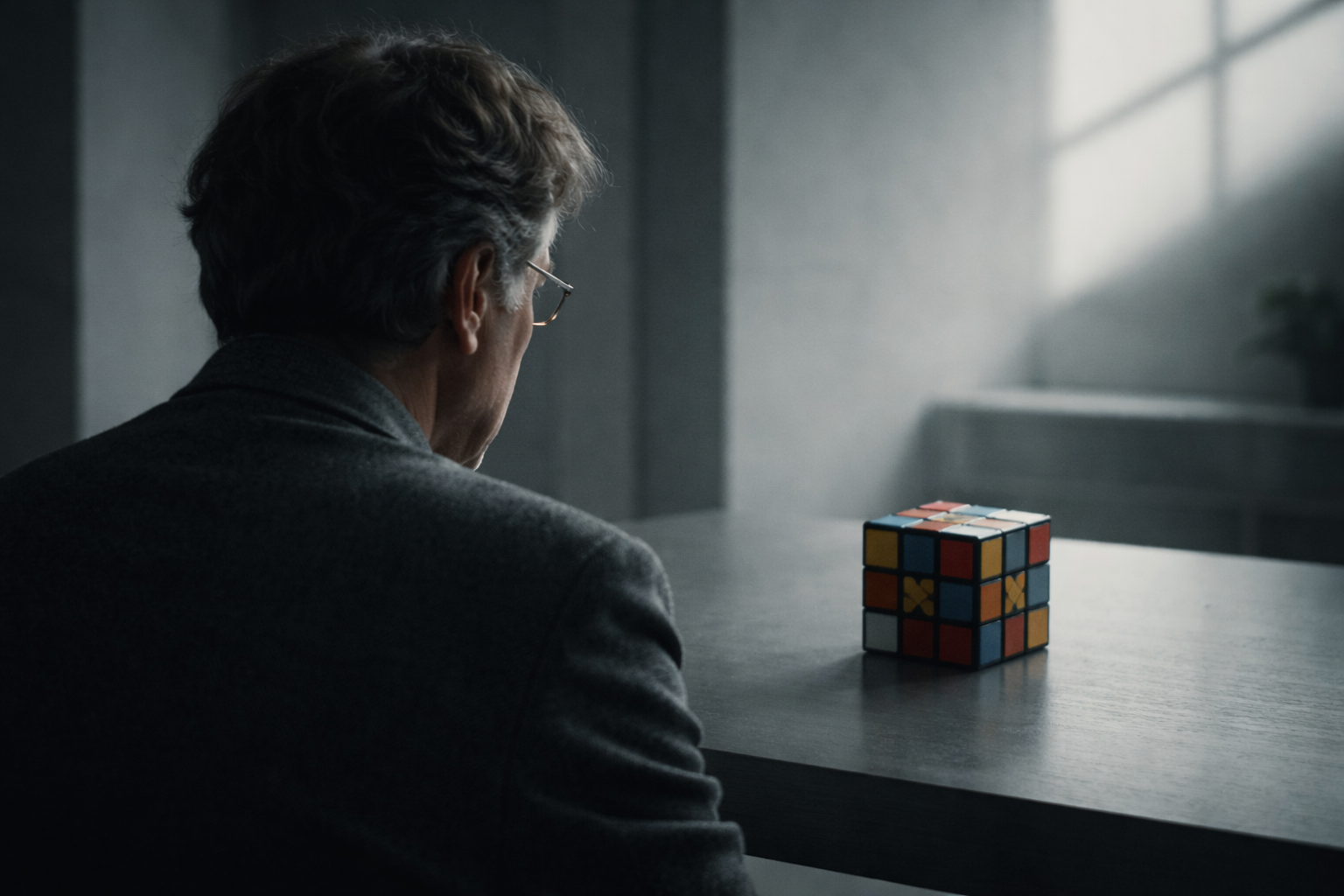
There is a peculiar moment familiar to almost anyone who has spent time with a Rubik’s Cube. You manage to complete one face and experience the brief satisfaction of believing you are finally making progress, only to discover that solving another part seems to require destroying the part you have just completed. So you try something else.
Perhaps you notice that certain pieces behave differently from others, or that repeating a particular sequence produces a pattern. What initially seemed like random movement slowly begins to reveal an underlying structure, and the Cube starts teaching you something simply by refusing to cooperate.
That is a very different kind of satisfaction from pressing a button and receiving an immediate reward.
The pleasure comes from the distance between not knowing and eventually knowing. It comes from noticing something you had previously missed, understanding a pattern that once looked chaotic and gradually becoming capable of doing something that once seemed impossible. Remove that distance and you remove much of the experience.
Imagine a crossword puzzle that automatically filled in every answer the moment you hesitated. It would certainly be easier, but few people would describe it as a better crossword. Imagine climbing a mountain only to discover an elevator beside the trail that could take you directly to the summit. If your only objective were to stand at the top, the elevator would be wonderfully efficient, but if the reason you came was to climb the mountain, removing the difficulty would also remove much of what made reaching the summit meaningful.
The same distinction appears throughout ordinary life. Learning an instrument would be easier if you never had to practice scales or struggle with awkward chords, but becoming capable of playing something you once couldn’t play is part of what makes learning rewarding. A sport without the possibility of losing would spare us disappointment, whilst also destroying much of the reason winning matters.
This does not mean difficulty is automatically valuable. There is nothing noble about a badly designed website that makes it difficult to buy something, a bureaucracy that wastes three hours of your day, or a piece of software that requires twenty clicks to perform a task that should require two.
The more useful distinction is between pointless friction and productive friction.
Pointless friction stands between you and the value. Productive friction helps create the value.
The Rubik’s Cube is an unusually pure example of the second kind. The difficulty isn’t an obstacle preventing you from reaching the product. The difficulty is part of the product.
Not every obstacle is standing between you and the value. Sometimes overcoming the obstacle is where the value comes from.
When removing Friction Removes The Value
Modern technology has become extraordinarily good at removing friction from our lives, and in many respects that is a genuine achievement. We can send money without visiting a bank, navigate unfamiliar cities without unfolding a map, translate languages instantly and access information that once required hours in a library.
But once removing friction becomes an unquestioned principle, it is easy to stop asking whether every form of friction actually deserves to disappear.
Streaming services removed the need to wait for a television program to begin. Smartphones removed much of the need to remember telephone numbers, directions and appointments. Search engines removed much of the effort involved in finding information, and generative AI can now remove a substantial portion of the effort involved in producing an answer, writing a document, summarizing an argument or solving a problem.
Again, much of this is enormously useful. The NoRuleBook argument is not that difficulty is virtuous and convenience is somehow corrupt. The more interesting question is what happens when the effort we remove was doing something valuable for us.
If AI gives you an answer in ten seconds to a problem that might previously have required an hour of thought, it has unquestionably saved you time. But if the hour of thought would have forced you to question assumptions, discover connections, make mistakes and develop a deeper understanding of the problem, then the calculation becomes more complicated. You have removed the effort, but you may also have removed some of the learning that occurred because of the effort.
The same applies well beyond technology. Parents naturally want to remove unnecessary difficulties from their children’s lives, managers want to make work easier for employees, businesses want to make things effortless for customers and individuals understandably look for ways to make their own lives more convenient.
Sometimes that is exactly what should happen. Sometimes, however, we need to ask a different question:
Is this difficulty preventing the value—or producing it?
That question changes the objective. Instead of automatically trying to make everything easier, we begin distinguishing between friction that wastes human effort and friction that develops human capability.
Ernő Rubik could hardly have known in 1974 that the strange object in his hands would eventually become such a useful illustration of that distinction. He had simply created a mechanism, scrambled its colors and discovered that returning them to order was much harder than expected.
Half a century later, that difficulty is still there. And remarkably, people are still choosing it.
The Cube That refused To Become Obsolete
The frenzy surrounding the Rubik’s Cube eventually cooled. Like almost every cultural phenomenon that explodes into public consciousness, the Cube passed through the familiar cycle of fascination, saturation and apparent decline. By the mid-1980s, it would have been easy to file it alongside countless other crazes that had briefly captured the world’s attention before disappearing … except the Cube never really disappeared.
New generations kept discovering it, and eventually the internet gave enthusiasts something the first generation of solvers had never possessed: the ability to find one another instantly, exchange algorithms, watch solving techniques and compete across borders. What had begun as a solitary puzzle gradually developed an international competitive culture around speedcubing.
The objective remained exactly the same, but the standard of what humans could do with it changed dramatically.
The first time somebody handles a scrambled Cube, solving it at all can seem extraordinary. Experienced speedcubers now solve it in seconds, not because the Cube became easier, but because generations of people kept studying the problem, sharing knowledge and refining techniques. That may be one of the most interesting parts of the Cube’s longevity.
Technology usually survives by becoming easier, faster or more capable. The Rubik’s Cube has survived whilst stubbornly remaining, in its essential form, the same problem.
It did not need to eliminate its difficulty to remain relevant. People became better at meeting it.
The NoRuleBook Truth
We spend a great deal of our lives trying to remove obstacles, and often we should. An outdated process, an unnecessary restriction, a pointless convention or an inefficient system deserves to be questioned precisely because it makes something harder without creating corresponding value.
But that does not mean every obstacle deserves the same treatment.
Some difficulties force us to pay attention. Some make us develop skills we would otherwise never acquire. Some create the satisfaction that comes from mastery, and some transform an experience from something we merely consume into something we actively participate in.
The challenge is learning to tell the difference.
The lesson of the Rubik’s Cube is therefore not that we should make life unnecessarily difficult, nor that struggle is automatically good for us. It is that ease should not become an unquestioned objective any more than difficulty should become an unquestioned virtue.
When we encounter friction, the useful question is not simply, “How can I remove this?”
It is :
“What is this difficulty doing?”
If it is wasting time, blocking access or preserving an outdated way of doing things, remove it if you can. But if the difficulty is developing capability, creating satisfaction, encouraging discovery or making the achievement meaningful, eliminating it may solve the wrong problem.
Rubik created a puzzle that millions of people wanted to solve precisely because it refused to solve itself for them.
And more than fifty years after he first twisted those coloured blocks out of order, that may be the Cube’s most enduring lesson.
Sometimes making something easier makes it better. Sometimes making it easier removes the very thing that made it worth doing.
Take The Next Step
The Rubik’s Cube offers a useful way to think about difficulty because it forces us to make a distinction we often overlook. When something in our lives feels frustrating, inefficient or unnecessarily hard, the natural response is to ask how we can make it easier. Sometimes that is exactly the right question, but before removing the obstacle it is worth understanding what role the obstacle is actually playing.
Choose one area of your life where you are currently experiencing friction. It might be learning a new skill, building a business, exercising, creating something, developing a relationship, studying, or simply trying to become better at something that refuses to come easily.
Instead of immediately asking how you can make it easier, ask yourself what the difficulty is actually doing. Is it wasting your time without producing anything useful, or is the struggle forcing you to learn, practise, adapt, concentrate or develop a capability you would not acquire if somebody simply handed you the answer?
The distinction matters because the correct response is completely different. Pointless friction deserves to be removed wherever possible, while productive friction may deserve to be protected. The objective is not to make life harder for the sake of it, but neither should we become so committed to convenience that we accidentally remove the experiences through which mastery, confidence and satisfaction are created.
This becomes particularly important as AI and other technologies make it possible to bypass more and more of the difficult parts of thinking, learning and creating. The question will increasingly be not simply whether technology can do something for us, but whether allowing it to do so removes an inconvenience or removes an experience we actually needed.
The next time you find yourself wishing something were easier, therefore, don’t automatically assume that the difficulty is the problem. Look at it more carefully and decide whether it is standing in your way or quietly helping you become capable of getting somewhere worth reaching.
Before you remove the friction, ask whether the friction is preventing the value - or creating it.
If ideas like this make you question some of the assumptions you’ve been living by, that is exactly what NoRuleBook is designed to explore.
Click the NoRuleBook image below to explore the collection.
The NoRuleBook Collection
-
NoRuleBook
$9.95Original price was: $9.95.$7.95Current price is: $7.95. -
No Rules Start-Up
$19.95Original price was: $19.95.$9.95Current price is: $9.95. -
NoRuleBook Bundle
$22.90Original price was: $22.90.$14.95Current price is: $14.95.