
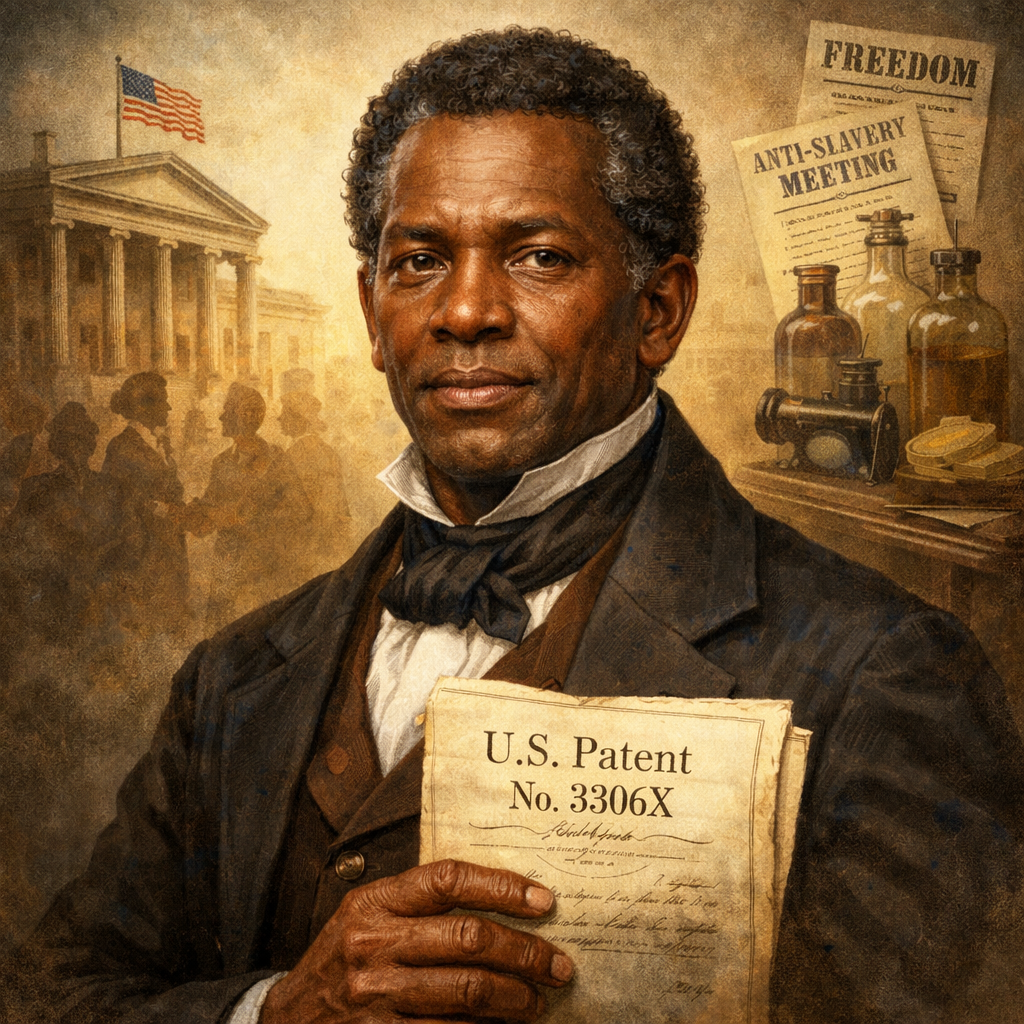
On March 3, 1821, the United States government granted a patent to a tailor in New York City named Thomas Jennings.
The invention itself was practical rather than spectacular. Jennings had developed a process he called ‘dry scouring,’ a method for removing dirt and grease from clothing without damaging the fabric in the way conventional cleaning sometimes could. It was the sort of innovation that often emerges, not from a laboratory or grand scientific ambition, but from somebody becoming frustrated with a problem encountered repeatedly in ordinary work.
Yet there was nothing ordinary about the document Jennings received. And that is because Thomas Jennings was black.
He had been born free in New York City in 1791, and because he was a free citizen, he could satisfy the citizenship requirement then associated with obtaining a United States patent. His patent for dry scouring—later catalogued as U.S. Patent No. 3306X—is recognised by the National Inventors Hall of Fame as the first U.S. patent granted to a Black American. Historians sometimes describe Jennings more cautiously as the first known black American patent holder because early patent records did not routinely identify applicants by race.
That distinction might sound like a small piece of legal history until we consider what a patent actually represents.
A patent says that an idea belongs to you. It recognizes that you created something. It gives you rights over that creation for a period of time, and allows you to benefit economically from what your mind produced.
In 1821, the United States government was prepared to recognise Thomas Jennings’ ownership of an idea.
At the same time, millions of Black Americans were living within a system in which their ownership of themselves was denied.
That contradiction makes Jennings’ story much more than an interesting footnote in the history of dry cleaning. It places him at the intersection of invention, citizenship, property, race and freedom, and it raises a question that reaches far beyond the particular process he patented:
What does it mean for a society to recognize someone’s right to own an idea while still debating whether people like him are entitled to fully own their own lives?
The Tailor Who Noticed A Problem
Long before Jennings became part of patent history, he was solving a much more immediate problem.
He had trained as a tailor and developed a successful clothing business in New York, working with garments at a time when clothing represented a considerably larger investment for many people than the disposable fashion of the modern world might lead us to imagine. Good clothing needed to last, which meant that cleaning a garment without ruining its shape, appearance or fabric mattered.
Jennings became dissatisfied with the cleaning methods available to him.
Such dissatisfaction is where many inventions begin. Not with somebody declaring that they are going to become an inventor, but with somebody working closely enough with a problem to become irritated by the accepted solution.
Jennings experimented with different approaches until he developed what he called dry scouring – a method intended to remove dirt and grease while avoiding the damage that could result from conventional washing. In 1820, he applied for a patent, and the following year the government granted it. The National Inventors Hall of Fame describes his process as a predecessor of today’s dry-cleaning methods, while Smithsonian similarly characterizes it as a forerunner, rather than claiming that Jennings invented modern dry cleaning as we know it today.
There is a familiar pattern here that has appeared repeatedly in the stories we’ve explored throughout NoRuleBook. The opportunity was hidden inside something people had learned to accept.
Clothes became dirty. Existing cleaning methods could damage them. That was simply part of dealing with clothing. Until somebody asked whether it had to be.
This is why innovation so often begins with expertise rather than inspiration. Jennings understood clothing because he worked with it. He saw how fabrics behaved, what customers needed, and where existing methods failed. His advantage wasn’t that he stood outside the industry and suddenly produced a brilliant idea from nowhere; It was that he had spent enough time inside the problem to recognize something that deserved a better solution.
The question wasn’t :
“What can I invent?”
It was closer to :
“Why are we still doing it this way when it isn’t working particularly well?”
That is a much more useful place to begin.
There is something strangely appropriate about what happened to Jennings’ invention after he received his patent.
We know the patent existed. We know when it was issued. We know what the process was called. But we no longer know precisely how it worked.
Early American patents were not originally numbered in the system familiar today, and thousands of the documents were being stored temporarily at Blodget’s Hotel in Washington when fire swept through the Patent Office’s collection in December 1836. Roughly 10,000 early patent records were lost. When surviving and reconstructed records were later catalogued, they became known as the X-patents.
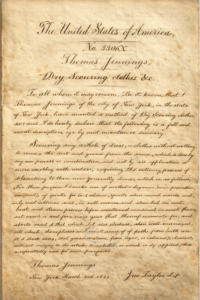 Jennings’ patent became No. 3306X.
Some of those lost patents were eventually reconstructed from copies held elsewhere, but Jennings’ complete specification has never been recovered. The exact formula and process behind his dry-scouring method therefore disappeared with the fire. This creates a peculiar historical situation.
We remember the achievement, but we have lost the invention.
That uncertainty is another reason we should resist the temptation to inflate Jennings’ story by claiming that he single-handedly invented modern dry cleaning. We cannot inspect his original specification closely enough to make that claim, and modern dry cleaning would continue developing through later chemical and technological innovations.
Jennings doesn’t need the exaggeration. What we can say is already remarkable enough: A black tailor, working in New York, recognized a practical problem, developed a new cleaning process, secured legal ownership of that process in 1821, and became the earliest known black American to do so.
And the patent mattered for reasons that went far beyond clothing.
Who Was Allowed To Own An Idea?
It is tempting to describe Jennings as a man who simply broke through a law prohibiting black Americans from holding patents. The historical reality is more revealing.
Early federal patent legislation did not explicitly exclude applicants according to race. The Smithsonian’s Lemelson Center notes that the Patent Act of 1790 was ostensibly color-blind, while the later 1793 framework required an applicant to swear that he was a citizen. Free Black Americans such as Jennings could therefore obtain patents, although racial discrimination and unequal access to money and legal enforcement created very real practical barriers.
For enslaved inventors, the situation was fundamentally different.
An enslaved person had no equivalent legal standing to claim an invention as property. This was not merely theoretical. Decades after Jennings received his patent, the question reached the U.S. Attorney General when a Mississippi slaveholder attempted to patent an agricultural device invented by an enslaved Black craftsman named Ned. The legal problem exposed the grotesque logic of slavery: the enslaved inventor could not obtain the patent, while the slaveholder could not legitimately claim to be the inventor.
Jennings occupied the other side of that legal divide because he had been born free.
His citizenship meant that the patent system could recognize something extraordinarily important: His intellectual labor belonged to him.
The government wasn’t giving Jennings permission to have an idea. People create ideas regardless of whether institutions recognize them. What the patent provided was something much more consequential—the legal ability to claim ownership, benefit financially from the invention and prevent others from simply taking the protected process as their own.
That distinction helps explain why access to systems matters :
- Talent can exist without recognition.
- An invention can exist without a patent.
- A business idea can exist without capital.
- A voice can exist without a platform.
But the ability to convert any of those things into economic or social power often depends upon access to institutions that recognize, protect and distribute them.
Jennings had access to one such institution. And what he did with the leverage it helped create is where his story becomes considerably more interesting.
When An Invention Becomes Leverage
The conventional version of an inventor’s story usually ends around here.
A problem appears. The inventor solves it. A patent is awarded. The invention becomes commercially successful, and the inventor receives a place in history.
Jennings’ life refuses to end so conveniently.
His tailoring business and dry-scouring process contributed to his prosperity, but he did not treat economic success as an endpoint detached from the society around him. As his standing and resources grew, Jennings became increasingly involved in the abolitionist and civil-rights movements of nineteenth-century New York.
He helped establish and support Black institutions, was associated with the Abyssinian Baptist Church, participated in the growing convention movement through which free Black Americans organised politically, and later helped establish the Legal Rights Association to challenge racial discrimination through the courts. The National Inventors Hall of Fame records him as assistant secretary at the First Annual Convention of the People of Color in Philadelphia in 1831 and as an organiser of the Legal Rights Association in 1855.
Smithsonian also reports that substantial earnings from Jennings’ invention were directed toward abolitionist causes, legal aid and institutions serving New York’s Black community.
This changes the meaning of the patent. It wasn’t simply recognition. It became leverage.
Jennings had learned how to operate successfully within parts of the economic and legal system available to him, and rather than concluding that his own success proved the wider system was fair, he used some of the resources created by that success to challenge injustices that remained.
That is an important distinction because individual success can sometimes conceal structural failure.
If one person manages to overcome a barrier, we can tell the story as evidence that the barrier doesn’t really exist. Look at what he achieved. Anyone could have done it.
Jennings’ response appears to have been almost the opposite.
His ability to succeed did not make him less interested in the people who were denied the opportunities available to him. It gave him more ability to do something about it. And eventually that struggle would arrive remarkably close to home.
More than three decades after Thomas Jennings received his patent, his daughter Elizabeth was travelling to church in New York City when she attempted to board a streetcar. It was July 1854.
Elizabeth Jennings was a teacher and church organist, and like her father she was free. None of that protected her when the conductor objected to her presence because she was black. After initially being told she could remain if other passengers did not object, she was eventually forcibly removed from the streetcar with the assistance of a police officer.
She did not quietly accept what had happened. Neither did her father.
Thomas Jennings helped pursue legal action against the streetcar company and hired a young lawyer named Chester A. Arthur, who decades later would become the 21st president of the United States. Elizabeth won her case and was awarded damages. The decision did not instantly desegregate every form of public transportation in New York, but it became an important legal victory in the continuing campaign against segregated streetcars.
There is an extraordinary continuity between father and daughter.
In 1821, Thomas Jennings had used a legal system to establish that his creation belonged to him. In the 1850s, that same family was using another part of the legal system to argue that his daughter could not simply be denied access to public transportation because somebody had decided that the color of her skin placed her outside the people entitled to use it.
Neither story is about standing outside the system and shouting at it.
Both involve understanding that systems contain mechanisms—patents, contracts, courts, legal rights—that can sometimes be used to challenge other rules embedded within the same society.
That does not make the system fair. It makes understanding the system powerful.
The Difference Between Entering A System And Accepting It
There is a version of the Thomas Jennings story that would fit neatly into the conventional rule-breaker narrative.
The system was discriminatory. Jennings refused to accept its limitations. He broke through the barriers, became successful, and proved the system wrong.
It sounds inspiring, but it also misses something much more interesting about what he actually did.
Jennings did not reject the patent system. He used it.
He learned a trade, built a business, developed an invention, applied through the legal process available to him, and secured the protection that process could provide. Later, when his daughter was forcibly removed from a streetcar, the Jennings family did not conclude that the courts were part of an unjust society and therefore useless to them. They went to court and demanded that the rights available within that legal system be applied to Elizabeth as well.
At the same time, Thomas Jennings clearly did not mistake his own ability to operate within some American institutions for evidence that American society was fair. His abolitionist work, his involvement in black civic organizations, and his role in the Legal Rights Association demonstrate precisely the opposite. He could recognize the value of a system in one context while challenging its injustice in another. That is a much more sophisticated form of rule-breaking than simply standing outside a system and refusing to participate.
We often talk about systems as though we have only two choices: Accept them or reject them. If an industry works in a particular way, we either play by its rules or become the disruptive outsider. If an institution is flawed, we either cooperate with it and become part of the problem or refuse to participate and preserve our independence. Real change is rarely that clean.
A system can contain useful mechanisms alongside harmful assumptions. A law can provide one right while withholding another. An organization can create genuine opportunities while maintaining practices that deserve to be challenged. Even an industry filled with outdated conventions may contain infrastructure, knowledge, networks and protections that are extremely valuable.
The independent thinker therefore has another option : Learn the system well enough to distinguish between the parts worth using and the parts worth challenging.
Jennings understood the value of legal ownership. He did not reject patents because the society administering them was deeply unequal. He claimed the protection available to him and converted an idea into economic value. When that economic success gave him greater resources and influence, he directed some of them toward changing conditions that remained profoundly unjust. The National Inventors Hall of Fame records that he became a significant abolitionist and civil-rights organizer, participating in the Convention of the People of Color and helping organize the Legal Rights Association.
His story therefore offers something more useful than the familiar instruction to “break the rules.”
Sometimes the smartest challenge begins by asking :
Which rules can give me leverage over the rules I want to change?
That question applies far beyond nineteenth-century America.
An entrepreneur may use the infrastructure of an established industry while challenging its pricing model. An employee may work within an organization while questioning one of its assumptions. A creator may use a platform’s distribution system without allowing its algorithm to determine everything they create. New technologies such as AI can be used to challenge established ways of working without requiring us to accept every assumption built into those technologies.
Using a system does not automatically mean agreeing with everything about it. Sometimes it means understanding where the leverage is.
When Success Becomes Evidence
There is another trap hidden inside stories such as Jennings’.
When somebody succeeds despite enormous barriers, their achievement can be used to tell two completely different stories.
The first says : Look how extraordinary this person was.
The second quietly becomes: Therefore the barriers couldn’t have been that significant.
That second conclusion is dangerous.
Jennings’ patent demonstrates that a free black American could obtain a patent in 1821. It does not demonstrate that race had ceased to matter, that black inventors enjoyed equal access to capital and institutions, or that the wider legal system treated black Americans equally. Indeed, the significance of Jennings’ citizenship becomes clearer precisely because enslaved people occupied a fundamentally different legal position. His individual success was real. So were the inequalities surrounding it.
We encounter this reasoning constantly because exceptional people make convenient evidence. Somebody becomes wealthy after leaving school, so education must not matter. An immigrant builds an enormous company from nothing, so structural barriers must be irrelevant. Somebody reaches the top of an organisation despite discrimination, so discrimination must have disappeared. One entrepreneur succeeds without outside investment, so anyone whose company fails must simply not have worked hard enough.
The problem is that an exception can demonstrate what is possible without telling us what is probable.
Jennings’ achievement showed what a talented, skilled and commercially successful free black citizen could accomplish within the patent system available to him. It did not prove that everybody stood at the same starting line.
Jennings himself appears to have understood that distinction remarkably well. Rather than allowing personal prosperity to separate him from the struggles of other black Americans, he became more deeply involved in them. His business success gave him resources, social standing and connections that could be turned toward abolitionism, community institutions and legal challenges.
That changes how we might think about success itself.
Success is often presented as escape. You overcome the obstacle, leave the difficult circumstances behind and earn the freedom to concentrate on your own life. Jennings shows another possibility :
- Success can create leverage that did not exist before.
- Money can finance a challenge.
- Expertise can expose a bad assumption.
- Reputation can attract attention to something previously ignored.
- Connections can open doors for other people.
- Knowledge of an institution can reveal where its own rules can be used to challenge its practices.
The interesting question therefore isn’t simply “How do I succeed within this system?”
It is also:
“If I do succeed, what does that success allow me to change?”
The Patent Was Never The Whole Story
Thomas Jennings died in 1859, nearly four decades after receiving his patent and only a few years after helping organize the legal campaign that followed his daughter’s removal from a New York streetcar. The United States he left behind was still profoundly divided over slavery, and the Civil War was less than two years away.
If we remember Jennings only as ‘the first black American to receive a patent,’ we give him an important place in history, but we also reduce an unusually rich life to a historical first.
The patent matters because of what it represented. That of a man who spent his working life understanding fabric noticed that the accepted way of cleaning it wasn’t good enough. Rather than accepting the problem as part of the trade, he experimented until he found another way. He then used an existing legal mechanism to establish ownership of what he had created, turned his skill and invention into economic leverage, and used some of that leverage in struggles that extended far beyond his own business.
Years later, when his daughter encountered another rule that society expected her to accept, the family again looked closely at the system rather than simply accepting the behavior of the people enforcing it. They found a mechanism through which the rule could be challenged and used it.
There is a pattern running through those events. Jennings did not appear to ask whether the system as a whole was good or bad before deciding whether to engage with it. He asked, in effect, what could be done with the tools available inside it.
That is a far more useful question.
The NoRuleBook Truth
NoRuleBook is built around questioning rules, but questioning a rule does not automatically require rejecting the entire structure surrounding it. Sometimes the existing system contains exactly the tool you need.
Thomas Jennings’ patent protected an invention within a society whose conception of rights and citizenship remained deeply unequal. His business operated within the economy of that society. The courts, his family later turned to, existed within the same broader legal order that tolerated profound racial discrimination. Yet Jennings repeatedly found ways to turn existing mechanisms into leverage.
That doesn’t mean the system deserves credit for every change made against its injustices, nor does it mean working within institutions is always the best route to reform. There are moments when structures are so restrictive that meaningful alternatives have to be built outside them, just as there are moments when direct opposition becomes unavoidable.
The point is that “inside or outside” is itself sometimes a false choice.
You can participate without surrendering your judgement. You can use a rule without believing every rule around it is legitimate. You can learn how an institution works precisely because understanding its machinery makes you better equipped to challenge what it gets wrong.
Sometimes challenging a system doesn't mean standing outside it. It means understanding it well enough to discover where the leverage already exists.
That may be the most useful way to remember Thomas Jennings.
Not simply as the first black American known to have received a U.S. patent, although that achievement alone deserves recognition.
Remember him as the tailor who noticed that an accepted method wasn’t good enough, found another way, secured ownership of his solution and then discovered that the value created by an idea could become something larger than personal success.
The invention cleaned clothes.
The leverage it created would then be used for something much bigger.
Take The Next Step
Thomas Jennings’ story leaves us with a more useful challenge than simply asking which rules in our lives we should break.
Think instead about one system you currently feel constrained by.
It might be the industry you work in, the company you work for, the way your profession operates, a government process, the financial system, an online platform, the education system, or even a technology you increasingly depend upon. There may be parts of that system you dislike, rules you believe are outdated, or barriers that make something you want to achieve considerably harder than it needs to be.
Our natural reaction is often to concentrate on the restriction. We become very good at explaining what the system prevents us from doing, who controls it and why the rules are frustrating, yet that focus can prevent us from asking a different question :
What does this same system already allow me to do?
Look more closely at the mechanisms available inside it. There may be rights you have never exercised, rules you have assumed rather than actually checked, exceptions nobody mentions, technology that has changed what is possible, people who can open doors, information that is publicly available, appeals processes that are rarely used, or resources that exist precisely because somebody before you challenged the system successfully.
Then separate the parts of the system you genuinely need from the assumptions you have simply inherited about how you are supposed to operate within it.
Jennings did not need to dismantle the American patent system before he could benefit from it. He needed to understand what it allowed him to claim. His invention gave him commercial value, that value contributed to greater economic independence, and the resources and standing he developed could then be directed toward struggles much larger than the original problem of cleaning clothes.
So rather than beginning with:
“How do I get around this system?”
try asking :
“Where is the leverage inside it?”
That change in perspective does not guarantee that the system will suddenly become fair or that every barrier can be overcome from within. Sometimes the available leverage will be insufficient, and the better answer really will be to challenge the structure directly, create an alternative or walk away from it altogether.
But you should discover that after examining the system, rather than assuming it beforehand.
There is also a second question worth carrying away from Jennings’ story. If you eventually gain more money, knowledge, influence, technology, credibility or access than you have today, what could that new leverage allow you to change that you cannot change now?
Success does not have to mean escaping the problem. Sometimes it can mean becoming better equipped to do something about it.
Thomas Jennings began with an everyday frustration in a tailor’s shop and developed a better way of cleaning clothes. What makes his story enduring, however, is that the value he created did not remain confined to the invention itself. The patent became part of a much larger life in which economic independence, civic involvement and legal action became connected.
Perhaps that is the more interesting definition of leverage.
Not simply gaining enough power to change your own circumstances, but gaining enough to help change circumstances that should never have been accepted in the first place.
Click the NoRuleBook image below to explore the collection.
The NoRuleBook Collection
-
-20%
NoRuleBook
$9.95Original price was: $9.95.$7.95Current price is: $7.95. -
-50%
No Rules Start-Up
$19.95Original price was: $19.95.$9.95Current price is: $9.95. -
-35%
NoRuleBook Bundle
$22.90Original price was: $22.90.$14.95Current price is: $14.95.

 Submitted 1.0
 Manual 5.0