Nobody Knows Her Name — Yet Apple and Tesla Depend On Her
Touch your phone screen right now and feel how smooth it is beneath your fingertips. It feels ordinary because we experience it every day. We pull our phones from our pockets without thinking about them, scroll through social media, answer messages, watch videos, and check the news, rarely stopping to wonder who actually built the invisible pieces that make these devices possible.
There’s a decent chance that the glass beneath your fingers was made by a woman who once raised pigs and ducks in a small Chinese village, left school at sixteen because her family could not afford to keep her there, and spent her teenage years working sixteen-hour shifts for less than a dollar a day polishing watch lenses.
Her name is Zhou Qunfei.
Most people have never heard of her. Yet some of the largest technology companies on Earth depend on her factories.
Her story is fascinating not because it is another tale about someone becoming rich. Stories like that are everywhere. Her story matters because it quietly tears apart several rules that society often teaches people to accept without question.
The Rules She Was Supposed To Follow
A Childhood That Offered Few Promises
Zhou was born in 1970 in Xiangxiang in China’s Hunan province, the youngest of three children in a family that had already experienced more hardship than most people see in a lifetime.
Before she was born, her father, a former soldier, suffered a devastating industrial accident that left him with severe injuries, losing a finger and much of his eyesight. Her mother died when Zhou was just five years old, leaving the family to survive through determination rather than opportunity.
Life was practical and difficult. Her father repaired bicycles, made bamboo baskets and built chairs to earn whatever income he could, while Zhou helped raise pigs and ducks around the family home.
There were no signs that this village girl would someday sit beside the world’s most powerful technology leaders. There were certainly no signs that she would become one of the richest self-made women on Earth.
But life rarely announces itself before it changes.
Leaving School Did Not Mean Education Ended
When Zhou turned sixteen, reality arrived in a way many young people understand today – She needed to find her way in the world.
She had shown promise in school and was reportedly the only sibling to attend secondary school, but ability and opportunity do not always arrive together. She left school and moved to Shenzhen to live with relatives and search for work.
Many people would view this as the point where a dream ended, but Zhou treated it as the point where a different type of education would begin.
There is a quiet detail in her story that reveals far more about her character than any billionaire headline ever could : When she searched for factory jobs, she deliberately chose factories near Shenzhen University so she could attend evening courses after work.
After spending entire days working on factory floors, she studied accounting, computer operations, customs processing and commercial vehicle driving. She collected skills one by one, not because anyone forced her to, and not because there was an immediate reward waiting at the end. She simply kept adding bricks.
Most people think education is something that ends with a graduation ceremony. Zhou appeared to understand that learning only becomes powerful when nobody is making you do it.
The Letter That Changed Everything
Zhou’s first factory job involved polishing watch lenses, work that demanded long hours and endless repetition, where day after day she stood doing the same movements until time itself probably felt mechanical. The shifts could stretch to sixteen hours, and for all of that effort she earned less than a dollar a day. At sixteen years old, it would have been easy to believe that this was simply what life looked like now.
But after three months, she decided she could not continue.
What happened next says more about who Zhou was than anything that happened after the billions, the factories, or the headlines.
She sat down and wrote a resignation letter. It would have been understandable if the letter had been filled with frustration. After all, the hours were brutal and the work was exhausting. Many people in that situation would have written on angry letter, or simply walked away without an explanation.
Instead, Zhou wrote something unusual. She explained honestly why she was unhappy with the conditions and the work itself, but she also thanked the company for the opportunity it had given her. She wrote about wanting to continue learning and growing rather than simply escaping a difficult job.
The factory manager read the letter and reacted in a way Zhou could never have expected. Instead of accepting her resignation, he promoted her.
Years later, it would become easy to look back and treat that moment as some dramatic turning point, as though a single letter changed her entire future. But perhaps that misses the real lesson. The letter itself was not important. What mattered was what the letter revealed.
Even as a teenager working at the bottom of a factory floor, Zhou was already doing something that many people never learn to do at all. She was paying attention, speaking honestly, looking beyond her immediate situation, and thinking about where she wanted to go rather than simply where she wanted to escape from.
Long before she built factories, she had already started building herself.
Building an Empire From Almost Nothing
Years passed, and Zhou continued climbing within the factory world, learning far more than the specific jobs she had been hired to perform. She paid attention to how machines worked, how production lines moved, how products were made, and how small changes in process could create better results. While others finished their shifts and went home, Zhou collected knowledge wherever she could find it, storing away skills that at the time probably seemed unrelated and ordinary.
But ten the factory she worked for closed.
For many people, that would have felt like the ground disappearing beneath their feet. Jobs provided certainty, even if they provided little else, and certainty is difficult to walk away from when you have grown up with very little. Yet uncertainty also has a strange habit of creating moments where people either retreat or step forward.
Zhou stepped forward.
In 1993, at only twenty-two years old, she used around US$3,000 in savings to start a watch lens business of her own. Calling it a business at that early stage almost sounds too generous. There was no impressive office overlooking a city skyline and no team of executives sitting around polished boardroom tables. The company existed inside a cramped three-bedroom apartment.
Her brother and sister lived and worked there. Their spouses, and two cousins, joined the business too.
The apartment became a workshop, complete with an office and factory. It was crowded with people trying to build something larger than the walls surrounding them. During the day there was production work to complete. Machines needed around-the-clock attention. Processes had to be improved. Problems constantly appeared.
Zhou did not stand at a distance and tell the others what to do. She stepped up and repaired the machinery herself when it broke. She redesigned production systems. She taught herself more advanced screen-printing techniques and was always looking for better ways to manufacture and refine the products.
From the outside it probably looked small. But from the inside, Zhou was building strong foundations. Because the thing about empires is that they rarely look like empires at the beginning. They usually look like ordinary people doing ordinary work in ordinary places long before anybody notices.
Becoming Invisible and Essential, at the Same Time
Slowly and steadily, the small apartment operation began growing into something much larger. Opportunities that once seemed unreachable started appearing one after another. The company secured contracts with mobile phone manufacturers and gradually moved into larger and more advanced work.
Then came a challenge from Motorola.
The company wanted stronger glass that would survive drops and impacts in ways existing products could not. It was a difficult problem and one many others had failed to create a suitable solution for. Zhou and her team solved it.
Then, in 2007, another opportunity presented itself. One that at the time probably looked like just another contract. Apple had just released the first iPhone. At the time, nobody knew that the device would reshape industries, alter culture and eventually become one of the most influential products ever created. Yet sitting on the front of that device was something most people would never think about.
Glass.
Glass made by Zhou’s company.
Suddenly, her work was being held in millions of hands around the world, and eventually billions. People stared at screens every day without ever knowing the name of the woman whose factories had helped create them.
Perhaps that reveals something strange about how we view success.
We tend to notice the visible people. We know the names of CEOs, celebrities and public figures, because they stand under bright lights where everyone can see them.
But many of the people shaping the world operate quietly in the background :
- They build systems nobody notices.
- They solve problems nobody thinks about.
And sometimes they become essential long before they become famous.
Thirty Years Later She Was Sitting at the World's Table
If somebody had walked into Zhou’s village when she was sixteen and told her what her future looked like, they probably would have sounded completely disconnected from reality.
Imagine finding the teenage girl helping raise pigs and ducks in rural Hunan and saying that one day she would sit at a formal state banquet attended by presidents, billionaires and some of the most powerful people on Earth.
Imagine trying to explain that one day she would travel through the gates of Beijing’s Great Hall of the People, not as a factory worker searching for a job, but as one of the invited business leaders seated among global executives and political figures.
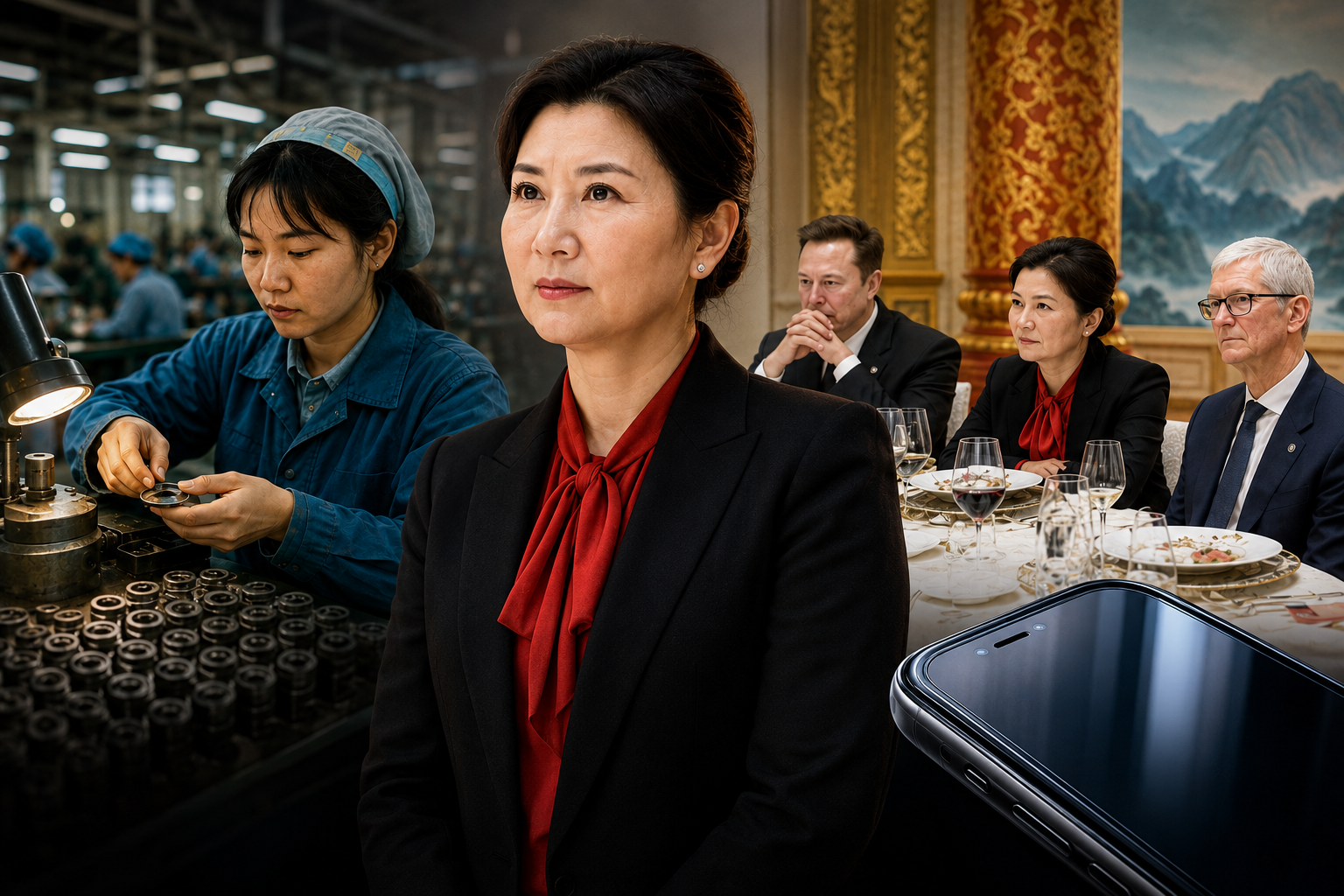
On the evening of May 14, 2026, Chinese President Xi Jinping hosted a state banquet in Beijing for U.S. President Donald Trump during his official visit to China. Business leaders from both countries attended alongside political figures and senior executives.
Then something happened that caused people around the world to start sharing a photograph.
Zhou Qunfei had been seated between two men whose names are recognised almost everywhere.
On one side sat Elon Musk. On the other sat Tim Cook.
The image looked almost symbolic.
To most people, Elon Musk and Tim Cook are the visible faces of giant technology empires. They stand on stages, appear in interviews, dominate headlines and move financial markets with a few words.
Sitting quietly between them was a woman many people had never heard of. Yet there was something almost poetic about the seating arrangement.
Both of those men depended, in different ways, on products coming from Zhou’s company.
The girl who once polished watch lenses for less than a dollar a day had become the woman sitting between two of the most influential technology executives in the world.
If you had shown that photograph to the sixteen-year-old Zhou, she almost certainly would not have believed it.
But perhaps the most interesting thing about that image is that it was not created by one lucky break, one perfect decision, or even one dramatic overnight success story. That photograph was built slowly.
It was built in evening classes after work. It was built in factories. It was built in small apartments crowded with relatives. It was built through thousands of small improvements and lessons repeated over decades.
People often overestimate what can happen in a year and underestimate what can happen in thirty.
Sometimes a photograph captures far more than a moment. Sometimes it captures thirty years.
What Readers Can Take Away From Zhou's Story
If someone had met Zhou Qunfei at sixteen, standing on a factory floor after leaving school because her family could not afford for her to continue her education, there would have been nothing particularly extraordinary to see.
They would not have seen a future billionaire.
They would not have seen the founder of a global company supplying some of the largest technology businesses on Earth.
They would not have seen a woman who would eventually sit between Elon Musk and Tim Cook at a state banquet attended by many of the most powerful world leaders.
They would have seen a tired teenage factory worker trying to earn a living.
That is perhaps what makes stories like hers so interesting.
We tend to imagine successful people looking different from everyone else at the beginning. We tell ourselves they must have possessed something obvious from the start – An extraordinary talent, powerful connections, unusual luck, or some hidden quality separating them from everybody around them.
But Zhou’s story does not really feel like that.
Instead, it feels like watching somebody repeatedly make small decisions that most people would barely notice at the time :
- She left school, but continued educating herself.
- She worked exhausting factory shifts, but attended evening classes afterward.
- She became unhappy in her job, but chose to leave with honesty rather than anger.
- She started with a small apartment, but treated it as though it were just the beginning of something larger.
- She kept learning.
- She kept improving.
- She kept moving.
None of those moments looked life-changing on their own. Yet decades later, when viewed together, they formed something much larger.
Perhaps that is because compounding exists in places beyond money.
- Skills compound.
- Knowledge compounds.
- Relationships compound.
- Reputation compounds.
- Character compounds.
- Small decisions compound.
Most people understand this idea when discussing investments. Put a small amount of money away and over many years the growth slowly begins accelerating.
Life often works in exactly the same way.
The difficulty is that the early stages rarely look impressive. The first few years can feel invisible. There are no headlines. There are no cameras. There are no dramatic moments announcing that something important is happening.
There is only repetition.
Lessons.
Improvements.
Conversations.
Risks.
Development of necessary skills.
Repeated again and again, until one day people look at the result and call it an overnight success. And perhaps that is the biggest unwritten rule Zhou Qunfei quietly challenged.
People often believe extraordinary lives are built through enormous leaps.
Her story suggests they may actually be built through thousands of small steps that nobody notices until the journey is already over.
Next Step
If this story inspired you to question the rules that hold you back, you’ll find more rule‑breaking stories and practical tools in our NoRuleBook eBook. Learn how thinkers, creators and activists across history have challenged conventions, and discover how you can apply these lessons to your own life. Click the NoRuleBook image below to grab your copy and join a community of fearless rule breakers.
The NoRuleBook Masterclass Collection
-
No Rule Book
$9.95Original price was: $9.95.$7.95Current price is: $7.95. -
No Rule Book + No Rules Start-Up
$22.90Original price was: $22.90.$14.95Current price is: $14.95. -
No Rules Start-Up
$19.95Original price was: $19.95.$9.95Current price is: $9.95.