

NoRule Book Banner

Has the Australian Dream Changed?

by Robbie Dellow
The Australian Dream

For generations, Australians were raised with a simple promise :

  • Work hard
  • Get a stable job.
  • Save your money.
  • Buy a house.
  • Build a life.

It was never officially written down anywhere, yet it became one of the most powerful unwritten rules in Australian society. The family home was more than shelter. It became proof that you had ‘made it.’ A reward for your discipline and a symbol that the system worked.

Parents passed this belief on to their children. Schools reinforced it. Politicians built campaigns around it. Banks profited from it. Entire suburbs were designed around it.

And for a long time, the promise mostly held true.

“The Australian Dream wasn't just about owning a home. It was the belief that if you played by the rules, the rules would reward you.”

Then something changed. Quietly at first. Almost invisibly.

House prices began rising faster than wages. Investors started treating homes less like places to live and more like financial assets. Tax rules rewarded people for owning multiple properties, while younger generations struggled to buy even one.

For years younger Australians complained that the game no longer made sense. The older generations  often dismissed their concerns as lazy, entitled, impatient, or unwilling to sacrifice.

But now something significant has happened. The Australian government itself has effectively admitted there is a serious problem.

Not activists.
Not angry renters on social media.
Not frustrated twenty-somethings.

THE AUSTRALIAN  GOVERNMENT

And this changes everything!

Watch the NoRuleBook Documentary

Prefer to watch? See the short NoRuleBook documentary below, then continue reading for the deeper story.

The Australian Dream
Begins To Crack

The recent budget announcement by Prime Minister Anthony Albanese and Treasurer Jim Chalmers was not just another housing policy update. It was something much bigger.

For decades the Australian government largely protected the housing market status quo. Policies like negative gearing and capital gains tax concessions became deeply embedded in the economy, helping fuel property investment and creating enormous wealth for existing homeowners and investors.

But the latest budget broke political tradition.

The government announced major changes to negative gearing rules for future investors and changes to capital gains tax arrangements, arguing that younger Australians are being locked out of home ownership.

That wording matters.

Because governments are usually extremely careful about admitting when foundational systems stop functioning fairly.

Yet here they were openly acknowledging :

  • house prices have exploded
  • younger people are struggling to buy homes
  • the current system favours existing wealth
  • the status quo is becoming politically dangerous

That is not a small shift. It is an acknowledgement that some of the assumptions underpinning the old Australian Dream no longer match reality.

And perhaps the most powerful part of all was the data itself.
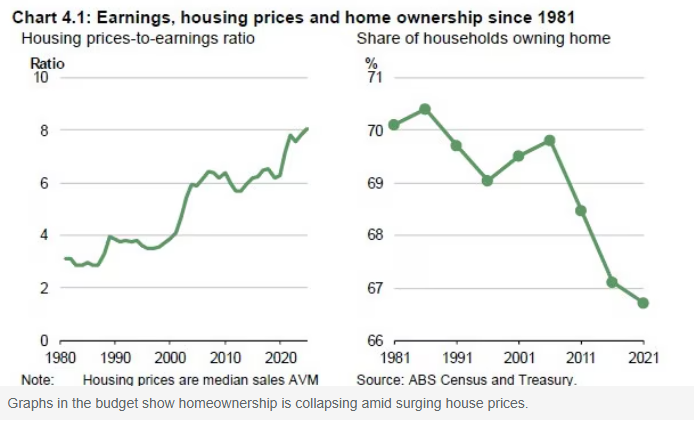
Australian House prices and home ownership

The graph tells a brutal story in seconds : 

  • On the left side it shows house prices compared to incomes climbing relentlessly higher.
  • On the right side it clearly shows home ownership rates falling.

Put the two graphs together and the change becomes difficult to ignore: homes have become dramatically more expensive relative to earnings while home ownership has fallen.

Australians are working within a system where the traditional path to home ownership has become dramatically harder, especially for younger generations trying to enter the market without existing wealth behind them.

Suddenly years of frustration are starting to make sense.

When The Rules Stopped Matching Reality

One of the most dangerous things any society can do is continue teaching old rules after reality has fundamentally changed.

This is where much of the anger is now coming from.

Many younger Australians did what they were told to do. They studied hard. Went to university. Built careers. Delayed gratification. Tried to save. Yet despite following the ‘correct’ path, many still found themselves permanently behind.

Meanwhile, older generations often experienced a completely different economic landscape.

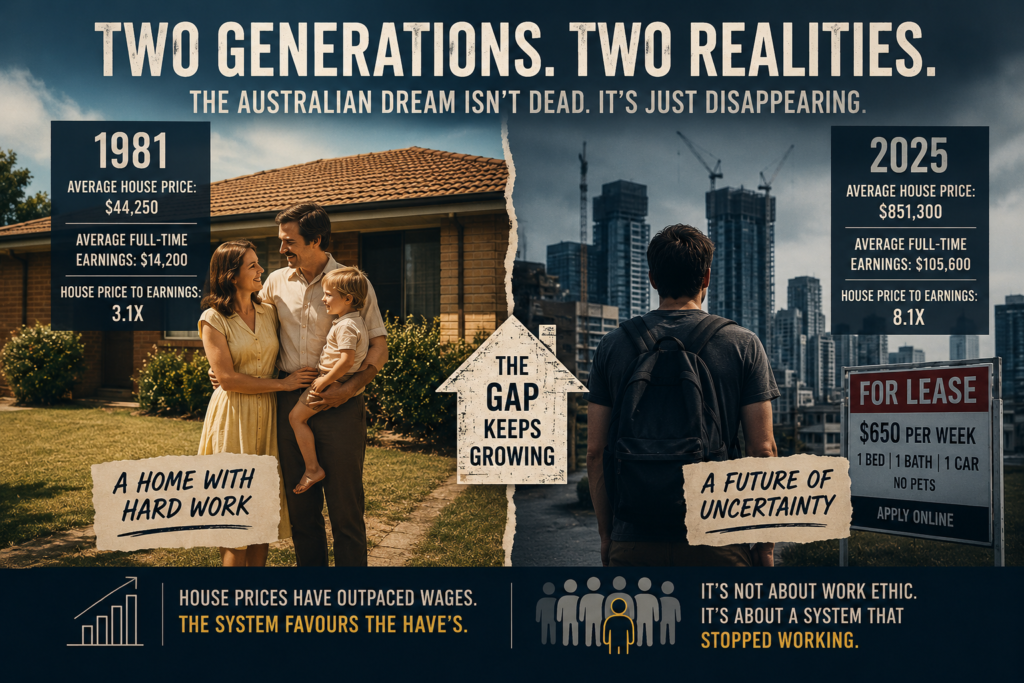
In 1981, the average Australian house price was reportedly around $44,250 while average earnings were roughly $14,200. Houses were expensive, but still relatively connected to incomes. Today, the average house price sits above $850,000.

The ratio between wages and property has stretched to levels previous generations never faced at the same age. And this changes psychology. Because eventually people stop believing effort leads to reward, and this is also when their trust in institutions begins eroding. Not because people suddenly become lazy or irresponsible, but because they start questioning whether the social contract itself still exists.
The Australian Dream Is Broken

“The problem isn't that a generation stopped following the rules. It's that the rules stopped producing the same results.”

The Housing Market Became A Wealth Machine

Somewhere along the way, housing stopped being viewed mainly as shelter. It became an investment engine.

Politicians encouraged it. Banks encouraged it. Television glorified it. Dinner conversations revolved around it. Property became almost a national obsession.

Those already inside the market often benefited enormously. Those outside it watched prices run away faster than they could save. The government’s own budget papers effectively acknowledged this distortion, arguing that ‘tax settings incentivised investors to purchase existing homes rather than increase housing supply.’

This is a remarkable statement.

Because for years, critics argued the system rewarded speculation more than accessibility. Now the government itself is acknowledging that some of those incentives helped distort the market.

Of course, many Australians who own investment properties are not villains. Many simply played by the rules available to them.

That is important to understand, as this is not really about blaming individuals. It is about recognising that systems create incentives, and over time those incentives can produce outcomes nobody originally intended.

The problem is that once a housing market becomes heavily tied to wealth creation, any attempt to reform it becomes politically explosive.

Because every policy creates winners and losers.

Younger Generations Are Not Imagining It

Perhaps the biggest psychological shift now happening is that younger Australians are starting to realise that falling behind in the housing market cannot always be explained by personal choices alone.

This matters because many people internalise the idea that if they can’t  buy a home then they simply weren’t trying hard enough.

But when house-price-to-income ratios explode, whilts home ownership rates decline, the conversation changes from individual responsibility to that of systemic reality.

This does not mean effort no longer matters. Effort does matter. But it also means the playing field has changed dramatically, and once people realise that, they begin questioning other assumptions too.

If the housing system changed … What else has changed?

These questions are exactly why this issue resonates so deeply online.

Because housing is not just about housing. It represents stability, adulthood, freedom, identity, and hope for the future.

Why This Story Has Become Emotionally Explosive

The reason discussions about housing become so heated — particularly on social media — is that almost everyone has something at stake :

  • Older Australians fear losing wealth.
  • Younger Australians fear never building any.
  • Renters feel trapped.
  • Homeowners feel defensive.
  • Investors feel targeted.
  • And Governments fear political backlash.

And beneath all of it sits an uncomfortable question :

“What happens when a society built around home ownership slowly becomes a society where fewer people can realistically achieve it?”

This question strikes directly at the heart of the Australian identity.

For decades, owning a modest suburban home was viewed as normal. Achievable. Expected even. Now it increasingly feels like a privilege tied to timing, inheritance, dual incomes, family support, or existing assets. This changes the national psyche.

Because when people begin to doubt that their future will be better than the one their parents experienced, frustration grows quickly.

The Bigger Lesson Nobody Wants To Admit

The most confronting part of this entire debate is not the policy itself. Policies will change repeatedly over time. They always do. The deeper issue is what this moment reveals about modern society. It reveals that systems evolve faster than the stories societies tell about them.

For years, younger Australians were still being handed a map designed for a completely different economic world.

A world where :

  • Housing cost far less relative to income.
  • Home ownership was more attainable for younger adults.
  • Asset prices had not raced so far ahead of wages.
  • The path from work → saving → home ownership was considerably shorter.

Yet the old advice kept being repeated as though nothing had changed :

  • Work harder.
  • Save more.
  • And stop complaining.

But eventually reality becomes too obvious to ignore. And when even governments begin publicly acknowledging the problem, it signals something profound :

  • The old Australian social contract is starting to fracture.

That does not mean home ownership is impossible. Many young Australians will still buy homes. But it does mean the traditional Australian Dream no longer functions the way previous generations were taught it would.

And perhaps that is the real reason this issue hits such a nerve.

Because deep down, many people can feel it already.

“When the world changes, yesterday's map doesn't guarantee yesterday's destination.”

The rules changed years ago.

What changed in 2026 was that the old rulebook became much harder to defend.

For generations, Australians were taught a familiar formula: work hard, save carefully, buy a home and build a better life.

There was nothing foolish about following that advice. For millions of people, it worked. But when the world changes, continuing to follow yesterday’s map does not guarantee that you will arrive at yesterday’s destination.

Perhaps that is the real lesson of the Australian Dream.

The dream itself may not be dead. But the rulebook for reaching it has changed.

Continue 'The Dream' Series

Three countries – Three versions of the same promise

For generations, each promised some version of the same idea: work hard and you could build a better life. But do those promises still work the way they once did?

Explore how the dream has changed across three countries :

🇦🇺   Has the Australian Dream Changed?

🇺🇸   Is the American Dream Still Alive?

🇳🇿   Is the New Zealand Dream Over?

The NoRuleBook Collection

Facebook

Related Articles

Leave a Comment