


It allows us to postpone difficult decisions without feeling as though we are giving anything up. After all, we tell ourselves we are not abandoning the dream of travelling through Europe, writing a novel, learning the guitar or starting a business. We are simply delaying it until life becomes a little less complicated. It feels responsible. Even sensible.
The difficulty is that life rarely becomes less complicated. It simply changes in the ‘complications.’
The exams give way to university. University becomes the search for a career. Careers bring mortgages, relationships, children and responsibilities that would have been unimaginable twenty years earlier. Just as one obstacle disappears, another quietly takes its place, each one convincing us that the life we really want is still waiting patiently on the other side.
What makes this pattern so deceptive is that none of these decisions are necessarily wrong. Building a career, raising a family, paying off a home and looking after the people we love are all worthwhile pursuits. The problem arises when preparation quietly replaces participation, and we become so focused on creating a better future that we forget we are living in the present.
Somewhere along the way “later” stops being a temporary delay and becomes a permanent habit.
It is one of those ideas that hides in plain sight. We rarely notice it because it sounds so reasonable. There will be more money next year. Work should calm down after this project. The children will be older soon. Once the mortgage is smaller, life will feel less stressful. Retirement is only another decade away.
Each explanation makes perfect sense on its own. Collectively, however, they can stretch across an entire lifetime.
Looking back, very few people regret working hard or taking their responsibilities seriously. What they often regret are the experiences they assumed would always be waiting for them: the friendship that slowly drifted away because there was never time for lunch, the trip that remained permanently bookmarked in a travel magazine, the creative project that never moved beyond an idea scribbled in the corner of a notebook, or the simple afternoons with children who somehow became adults while everyone was busy planning for tomorrow.
That is what I mean by The Later Trap. It is not a lack of ambition, courage or discipline. In many ways, it is the opposite. It is the quiet belief that life can safely be postponed until all the important work has been completed, without ever noticing that life itself was always part of that work.
If you stop and think about it, very few of us ever consciously chose the timeline we have been following.
We inherit it.

The problem is not the milestones themselves. It is the quiet assumption that fulfilment always lies just beyond the next one.
Few people ever stop to ask whether the path they are following still reflects the life they actually want. We simply keep moving because everyone around us seems to be moving in the same direction. Friends celebrate promotions. Families congratulate home ownership. Social media fills our screens with carefully curated versions of success that reinforce the idea that there is a correct sequence to life, and that falling behind somehow means falling short.
It is hardly surprising that so many people begin measuring their lives against an invisible timetable they never consciously agreed to.
Psychologists sometimes refer to this as the social clock—the unspoken expectation that certain achievements should happen at certain ages. We may never have heard the term before, but most of us have felt its influence. By thirty, you should be established. By forty, successful. By sixty-five, ready to retire. These deadlines are rarely written down anywhere, yet they can feel remarkably real.
The irony is that life has never been so predictable. People change careers in their fifties, discover unexpected passions in their sixties and fall in love in their seventies. Some build businesses after retirement. Others finally travel the world after decades of believing the opportunity had passed them by. Real life stubbornly refuses to follow the neat timetable we imagine it should.
Perhaps that is because life was never designed to unfold according to a universal schedule. It unfolds according to circumstances, opportunities, setbacks, chance encounters and choices that no planner could ever fully anticipate.
The mistake is not having goals or ambitions. The mistake is believing there is only one acceptable moment to begin living them.
One of the greatest illusions about postponing life is believing that what we are saving for the future will still be there when we finally arrive.
Sometimes it is. Often it isn’t.
The dream holiday can still be taken at sixty-five, but the children who once begged to come along have long since built lives of their own. The guitar can still be learned after retirement, but the fingers may not move quite as freely as they once did. A business can certainly be started later in life—many successful ones have been—but there are opportunities, markets and moments that belong to a particular season and quietly disappear when that season passes.
This is not an argument for doing everything immediately. Life demands patience, planning and responsibility. There are seasons when paying the mortgage, raising children or caring for ageing parents quite rightly become the priority. The mistake is not recognising those responsibilities. The mistake is believing that life itself can simply be placed on hold until they have all been completed.
 The truth is that life has never worked in chapters as neatly as we imagine. It unfolds while we are making plans. Every year quietly changes us in ways that are almost impossible to notice from one day to the next. Parents grow older. Children become adults. Friendships drift apart through nothing more dramatic than the passing of time. The places we always meant to visit change. Sometimes they disappear altogether. Even we are different people at fifty than we were at twenty-five, carrying different hopes, different fears and different levels of energy.
There is a reason so many elderly people speak less about the things they did and more about the things they never quite found time to do. Regret rarely arrives as one dramatic event. More often, it is the accumulation of countless small decisions to wait just a little longer.
Perhaps that is why one of the most common reflections shared by people nearing the end of life is not that they wished they had earned more money or accumulated more possessions, but that they wished they had been more present, taken more chances, spent more time with the people they loved and worried less about what others expected of them. Those reflections appear with remarkable consistency across cultures and generations, suggesting that while our circumstances differ, our deepest regrets often look surprisingly similar.
The tragedy is that these regrets are rarely caused by one catastrophic mistake. They are usually the result of perfectly sensible decisions, repeated often enough that they slowly become a way of living. Every delay has a good reason. Every postponement seems temporary. Yet over the course of decades, temporary has an uncanny way of becoming permanent.
Perhaps that is why the old man in the hospital bed doesn’t remember the emails he answered or the meetings he attended. His mind drifts instead towards the conversations he never had, the places he always meant to see and the younger version of himself who believed there would always be another opportunity.
That is the quiet cost of waiting.
It is not only that time passes. It is that opportunities pass with it.
Perhaps the greatest irony is that almost nobody deliberately chooses to live by these invisible rules.
They inherit them.
Parents pass them on because they want their children to be secure. Teachers encourage them because they believe education creates opportunity. Employers reward commitment because businesses depend upon reliable people. Friends reinforce them because they are following much the same path themselves. Every generation quietly hands the script to the next, rarely stopping to ask where it came from in the first place.
There is nothing sinister about this. In many respects, these unwritten rules have helped build stable families, successful careers and thriving communities. They exist because they have often served a purpose.
The danger begins when we mistake a common path for the only path.
Some people will find deep fulfilment climbing the corporate ladder. Others will discover it building a business from their garage. Some will dedicate themselves to raising children. Others will spend years travelling the world. Some will change careers at fifty, write their first novel at sixty, or fall in love at seventy-five. None of these lives is inherently more successful than another.
The mistake is assuming there is a universal timetable against which every life should be measured.
Perhaps that is why the question is not whether you should reject society’s expectations altogether. Expectations can provide structure, discipline and purpose. The better question is whether the life you are building still belongs to you, or whether it has quietly become a reflection of what everyone else expected it to be.
That question has no universal answer.
Only an honest one.
If reading this article has encouraged you to pause for a moment and think differently about the assumptions guiding your own life, then it has already served its purpose. Not because it has told you what decisions to make, but because it has reminded you that they are, and always have been, yours to make.
The old man lying in the hospital bed at the beginning of this story was never really the subject of the article.
He was simply a mirror.
 A reminder that one day every one of us will look back across the landscape of our own lives. We will remember the people who mattered, the risks we took, the moments that changed us and, perhaps, the dreams we kept postponing because we believed there would always be more time.
None of us knows exactly when that moment will come.
What we do know is that it will not ask whether we followed the expected timeline. It will not care whether we achieved every milestone at precisely the right age or accumulated the possessions we thought would finally make us feel complete.
It will ask something far simpler.
Did you live a life that was truly yours?
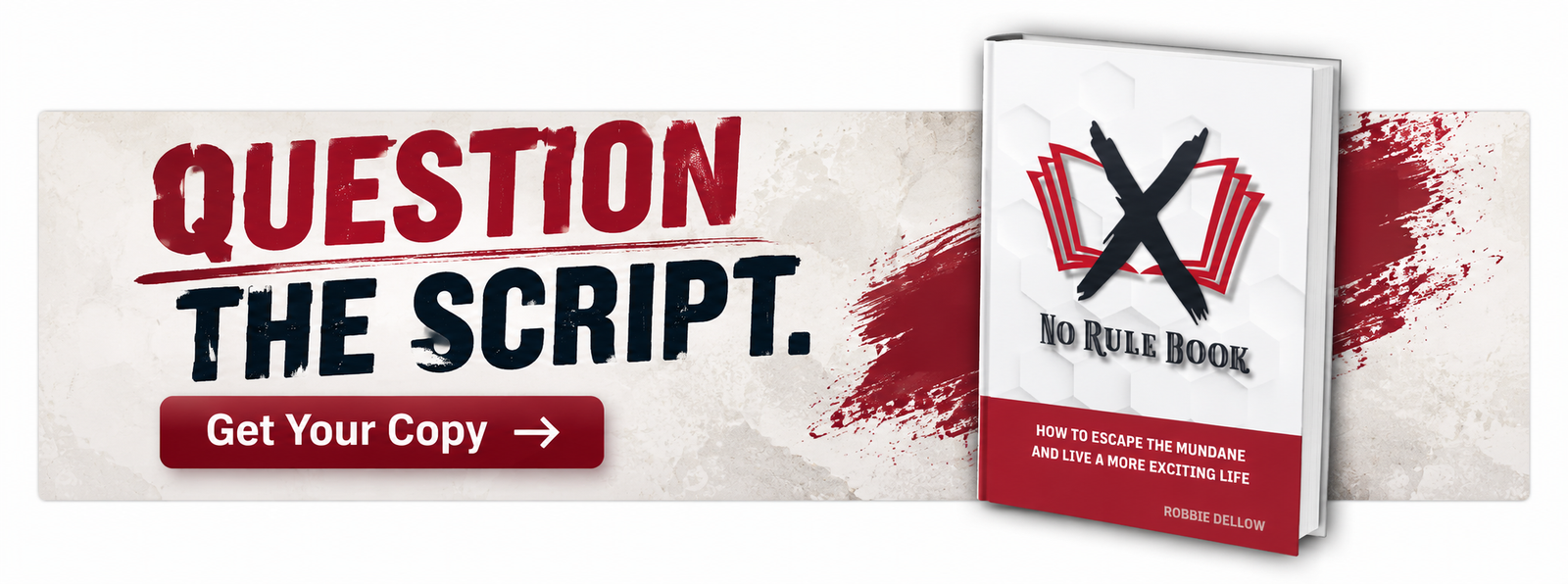
That is the question at the heart of NoRuleBook.
Not because there is a correct way to answer it, but because too many people never realize they were allowed to ask it in the first place.
-
-20%

NoRuleBook
Original price was: $9.95.$7.95Current price is: $7.95. -
-50%

No Rules Start-Up
Original price was: $19.95.$9.95Current price is: $9.95. -
-35%

NoRuleBook Bundle
Original price was: $22.90.$14.95Current price is: $14.95.

 Submitted 1.0
 Manual 5.0