
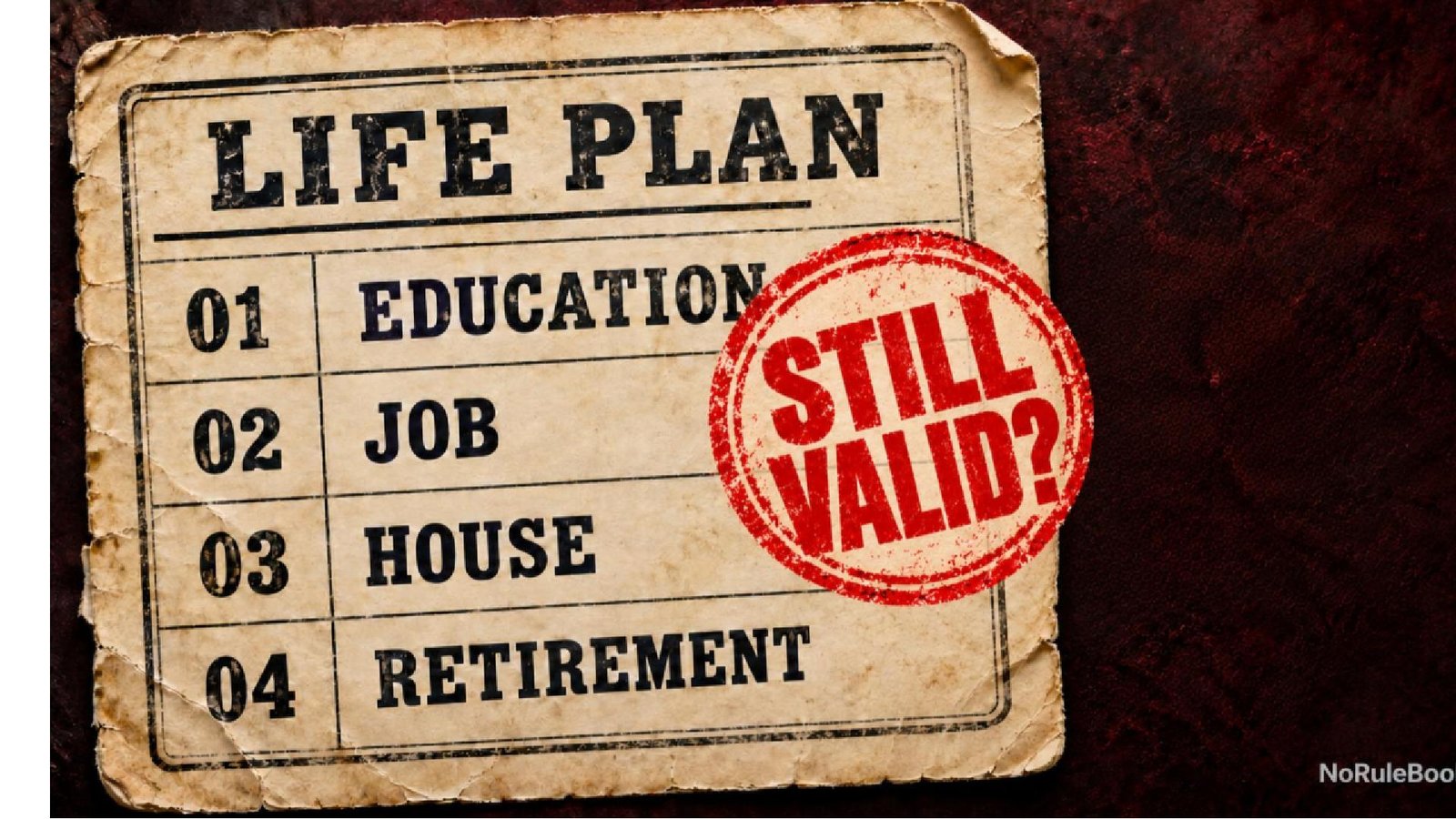
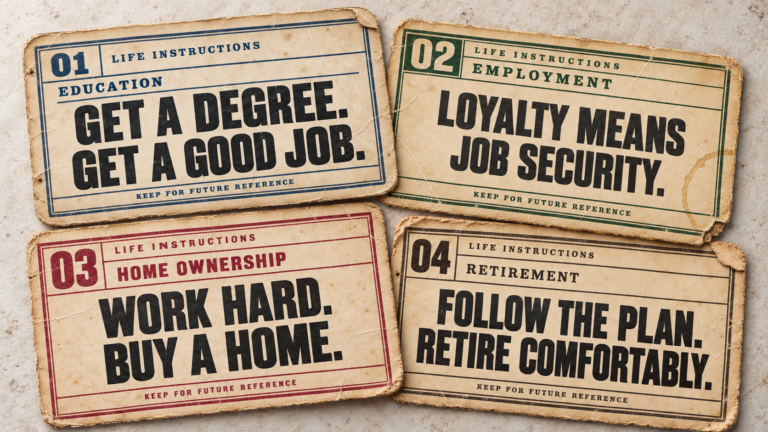
For many of us, the plan was laid out before we were old enough to question it. Get an education, find a stable job, buy a house, start a family and keep working until retirement, when there would finally be time to enjoy everything we had been working towards.
The details varied between families and countries, but the sequence was familiar enough to feel like common sense. Following it meant being responsible, making progress and giving yourself the best chance of a comfortable future. Parents recommended it because they wanted their children to be secure, and teachers encouraged it because education could open doors.
But advice carries assumptions about the world in which it will be used. A plan built around affordable housing, predictable employment and a clear retirement horizon deserves another look when those conditions change.
What if you’re following rules designed for a world that no longer exists?
Watch the NoRuleBook Documentary
Prefer to watch? See the short NoRuleBook video below, then continue reading for the deeper story.
What happens when the world changes but the rules don’t?
Why yesterday’s advice still feels like common sense
You are making decisions in the world you live in; their advice may be rooted in the world they remember.
Advice becomes convincing when someone can point to their own life as evidence. They studied, found work, bought a home and eventually retired, so recommending the same approach feels reasonable. Their experience gives them a good reason to trust what worked.
However, the difficulty comes when a personal experience becomes a universal instruction, with too little attention paid to the conditions that made it possible.
The cliche – “Work hard and you’ll get ahead” leaves several questions unanswered. Working hard at what, with which opportunities, and towards whose definition of getting ahead? “Buy a house as soon as you can” needs context too: At what price, with what income, and with how much room left for the rest of your life?
These questions don’t diminish anyone’s achievements. They help distinguish the effort someone made from the circumstances in which that effort produced a result.
You can respect the people offering advice while still examining whether it applies. You are making decisions in the world you live in; their advice may be rooted in the world they remember.
The plan stayed familiar. The conditions didn’t.
Education remains valuable, but “get a degree” is only the beginning of a decision. The subject, cost, qualification requirements and available alternatives all matter. Someone entering a profession that requires a degree faces a different choice from someone considering university mainly because they don’t know what else they are supposed to do. The useful question is what a particular education will help you do, and whether its likely value justifies the commitment involved.
Employment deserves the same scrutiny. A job can provide income, structure and satisfying work without guaranteeing that the role—or the skills it requires—will remain unchanged. Research from the International Labour Organization identifies job transformation as the most likely overall effect of generative AI, rather than assuming every exposed occupation will disappear. That makes adaptability relevant even to people who intend to stay in their chosen careers. International Labour Organization
Housing is another place where a familiar instruction can conceal a very different calculation. The OECD tracks house prices relative to incomes as a measure of affordability, because a purchase price means little without considering the income available to pay it. Comparing the age at which two generations bought their first homes tells us less than comparing what each purchase demanded of them. OECD Owning a home may provide exactly the stability you want. It may also involve commitments that restrict other choices. Either way, it deserves a decision based on your circumstances rather than a deadline inherited from someone else’s life.
Starting a family belongs to an even more personal conversation. Whether to have children, when to have them, and what family life should look like cannot sensibly be reduced to the next box on a standard checklist.
Retirement, meanwhile, involves assumptions about future income, health, work and eligibility rules. Planning for later life matters, but so does questioning how much of your present you are postponing for a future you cannot fully predict.
Working harder won’t correct outdated directions
When life fails to deliver what we expected, it is easy to assume that we haven’t worked hard enough. We look at the qualification we still need, the deposit we haven’t saved or the promotion that went to someone else, and decide that the answer must be another year of effort. There is always something more we could do, and because the plan itself feels so familiar, we rarely stop to ask whether it is still taking us somewhere we want to go.
Imagine someone who chose a career because it promised security, spent years becoming qualified and gradually built a life around the income. By the time they realise the work no longer suits them, they have responsibilities that make changing direction difficult, along with the uncomfortable feeling that leaving would mean wasting everything they have already invested. Staying seems sensible, so they work towards the next promotion, hoping that a better salary or a different title will settle a question that has very little to do with either.
The same pattern can develop around buying a home. What began as a desire for somewhere secure to live becomes a race to reach a deposit, followed by years of arranging life around repayments. For some people, that commitment brings exactly the stability they wanted. For others, it gradually consumes the freedom they thought they were working towards, although admitting this can be difficult when everyone around them regards home ownership as proof that they are doing well.
There is nothing unusual about finding yourself in either position. Decisions accumulate, circumstances change, and a choice that once made sense can become something you continue defending long after you have stopped believing in it. The important question is whether the next commitment still deserves your time, given what you now understand about your life.
Progress can be gained with hard work, but it cannot help you decide whether the destination is worthwhile. That part requires a pause, an honest look at where you are heading and a willingness to reconsider directions you may never have chosen for yourself.
A changing world creates different choices
That pause can feel unsettling, particularly when the familiar plan has given you a sense of certainty for years. Once you begin questioning it, however, you may also notice possibilities that were difficult to see while you were concentrating on keeping up.
Someone considering a change of career might begin studying online while remaining in their current job, giving themselves time to discover whether a new interest holds up beyond the appeal of escaping their existing work. Another person might test a small business idea with a handful of customers before committing their savings, while someone who once assumed they had to buy a house immediately might decide that renting for a few more years gives them room to move, retrain or understand where they actually want to settle.
These choices involve compromises, and none provides an easy route around responsibility. A business can demand more of you than a job ever did, independent learning cannot replace every professional qualification, and flexibility can become stressful when you need a dependable income. Looking beyond the traditional plan means taking those realities seriously as well as recognising the opportunities.
It also means allowing familiar choices to survive the examination. You may still want a long career in one profession, a home you own and a family life built around a particular place. There is considerable value in discovering that these are things you want, rather than things you have been pursuing because you would struggle to explain choosing anything else.
The world will continue changing after you make your decision, just as your own priorities will change with experience. A useful plan leaves room for that movement, so you can respond to what you learn without treating every adjustment as an admission that you got your life wrong.
Which rules still deserve a place in your life?
Once you recognise that the traditional life plan is something you can question, such familiar instructions begin to look different. Buying a house becomes a choice you can assess against your circumstances, changing employment becomes an option you can explore, and the experiences you want from life become things you can consider making room for along the way, rather than automatically postponing them until retirement.
That change in perspective gives you room to ask what each decision would actually bring to your life. You may want to own a home because you value having somewhere permanent, with the freedom to make it your own and put down roots. Those are reasons worth considering alongside the cost and commitment. But if the urgency comes mainly from seeing friends buy or feeling that you should have reached that milestone by now, it is worth separating their progress from your own needs.
Imagine someone who enjoys their work but has an opportunity to take a role in another city. They have also been saving for a house, partly because their family has always encouraged them to settle down and buy. Until now, they have treated those plans as a fixed sequence: buy first, then make other decisions around the mortgage. Once they allow themselves to see buying as a choice, they can compare the two opportunities more honestly, considering whether they want to stay, what the new role offers and how much they value the freedom to move.
They may still decide to buy, or they may give themselves another year before committing. Either decision can make sense when it reflects what they want and what they can reasonably manage. The useful change is that an inherited timetable no longer makes the decision for them.
The same approach applies to employment. Changing jobs can be a sensible response to new opportunities, changing interests or a workplace that no longer suits you, while staying can be equally worthwhile when the work continues to meet your needs. Considering both possibilities allows you to judge your situation without assuming that loyalty requires you to remain indefinitely or that progress always requires you to leave.
As you look at your own plans, consider which commitments you would choose again today and which you have continued mainly because they were already in place. Your finances, responsibilities and health will influence what you can do, but understanding those constraints gives you a starting point for a realistic decision. You can then work towards a life that suits your circumstances, with room to reconsider it as those circumstances change.
THE NORULEBOOK 'LIFE PLAN' AUDIT
Choose one part of your life plan. Check whether the advice behind it fits your circumstances today, then decide what you want to do.
Which part are you reviewing?
☐ Education ☐ Employment ☐ Buying a home
☐ Starting a family ☐ Retirement ☐ Other: __________
1. The Rule You Inherited
What were you taught to do?
Write the advice or expectation, including any age or deadline.
Example: “Get a degree and you’ll have a secure career.”
2. WHAT IT PROMISED YOU
What was that advice supposed to give you?
☐ Security ☐ Income ☐ Freedom ☐ Stability
☐ Belonging ☐ Approval ☐ Other: __________
What matters most to you about that outcome?
3. THE ASSUMPTIONS BEHIND IT
What needs to be true for the plan to work?
Consider costs, employment opportunities, income, location, time or health.
4. DOES IT FIT TODAY’S WORLD?
Does that match your world today?
| Check the assumptions | Your answer |
|---|---|
| What still holds true? | _________________________ |
| What has changed? | _________________________ |
| What have you assumed without checking? | _________________________ |
5. WOULD YOU CHOOSE IT YOURSELF?
If nobody expected this of you, would you still choose it?
☐ Yes ☐ Yes, with changes ☐ No ☐ I’m unsure
Why?
6. THE ALTERNATIVES AVAILABLE
What could you do differently while still pursuing what matters to you?
Consider a different route, timetable, location or level of commitment.
7. YOUR UPDATED PLAN
What is your decision for now?
☐ Keep the plan ☐ Adapt the plan
☐ Explore another route ☐ Gather more information
My updated plan is:
Before making a bigger commitment, I will:
I will do this by: _________________________
You don’t need a different life plan just because the world has changed. You need to check whether yours still fits.
A plan you can explain to yourself
After working through the audit, you may find that much of your life plan still makes sense. Perhaps you want to buy a home because you have found somewhere you intend to stay, or continue in your profession because the work remains rewarding and offers opportunities you value. Examining those choices gives you a clearer understanding of why they deserve your commitment, even if they look much the same from the outside.
You may also discover that part of your plan has been carried forward without much consideration. A deadline that once seemed important might have come from watching what your parents achieved at your age, while a career decision may still be shaped by advice you received before you understood the work involved. Recognising that influence gives you an opportunity to reconsider the decision with the knowledge you have now.
That can be uncomfortable when you have already invested years in a particular direction. There may be money involved, people depending on you and practical reasons why change will take time. Those commitments belong in your thinking, but so does the cost of continuing towards something you no longer want simply because it would be difficult to explain stopping.
A plan you can explain to yourself takes all of that into account. You understand what you hope to gain, what the commitment will require and which assumptions need to remain true for it to work. You also have a reason to return to it when your circumstances change, rather than treating a decision made years ago as an instruction you must follow indefinitely.
Take The Next Step
The next time someone offers you advice about what you should do with your life, take an interest in why they believe it. Their experience may contain something valuable, particularly when you understand the circumstances in which their choices worked. That conversation becomes more useful when there is room to consider how your opportunities, responsibilities and ambitions differ from theirs.
Give yourself that same room when thinking about your future. You can want the security of a home without accepting a deadline for buying one, value your education while taking your working life in an unexpected direction, or prepare responsibly for later life while making time for experiences that matter to you now. These choices deserve to be considered on their own merits, with an understanding of what they offer and what they ask of you.
Some people will recognise your decisions because they resemble their own. Others may struggle to understand them, especially if you depart from a path they trusted. Their concern can come from affection, but reassurance from other people will only take you so far when you are the one who has to live with the choice.
“What if you’re following rules designed for a world that no longer exists?” is a question worth carrying with you as your life develops. The answers may change as you gain experience, take on responsibilities or discover opportunities you couldn’t have anticipated. Allowing your plans to develop with that understanding is part of taking your future seriously.
You cannot know everything the coming years will bring, but you can choose a direction that makes sense in the world you live in, guided by what matters to you and a willingness to keep learning along the way.
Live by design. Not by default.
The NoRuleBook Collection
-
-20%
NoRuleBook
$9.95Original price was: $9.95.$7.95Current price is: $7.95. -
-50%
No Rules Start-Up
$19.95Original price was: $19.95.$9.95Current price is: $9.95. -
-35%
NoRuleBook Bundle
$22.90Original price was: $22.90.$14.95Current price is: $14.95.

 Submitted 1.0
 Manual 5.0