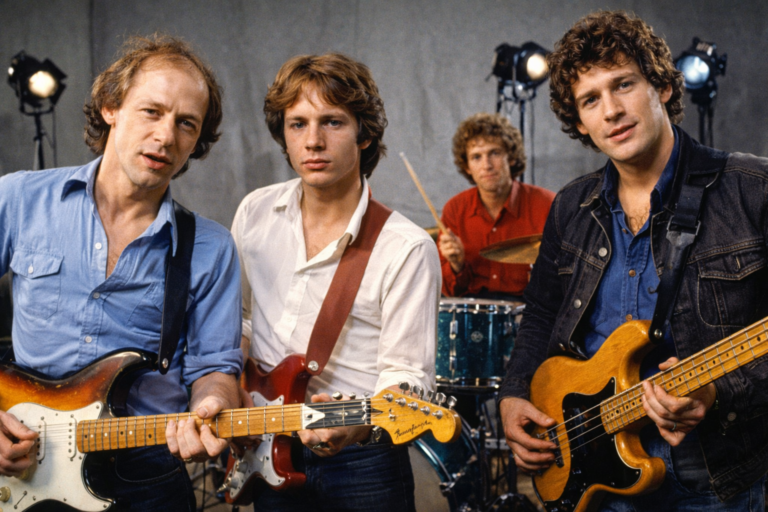

Somewhere in Deptford, South London, Mark Knopfler walked into a pub for a drink and found a scene that gave no indication it would become part of rock history.
The place was practically empty. Just a few people were there, including a couple of young men playing pool, while in one corner a small Dixieland jazz band worked its way through its set. There was no sense of occasion, no crowd gathering around the musicians, and certainly nothing resembling the glamorous mythology that would later surround rock music. Knopfler would remember the band as decidedly down-at-heel, playing to an audience so small that they seemed almost surprised anyone was listening.
Then, at the end of the night, came the detail that stayed with him. The band announced its name.
The contrast was almost absurd. Here was a modest jazz band playing in an unremarkable pub to virtually nobody, yet carrying a name that suggested grandeur, confidence and command of the room. Knopfler later recalled that they could hardly have looked less like sultans of anything.
Most people could have finished their drink, walked home and forgotten the whole thing by morning.
Knopfler noticed.
That distinction matters, because originality is often described as though it begins with somebody sitting down and deliberately trying to invent something nobody has ever imagined before. Yet some of the best ideas begin much more quietly. Somebody notices a contradiction, a conversation, an inconvenience, an unusual behavior or a detail that thousands of other people might encounter without giving it another thought.
The world provides the raw material. The difference is who is paying attention.
For Knopfler, that nearly empty pub eventually became Sultans of Swing, a song about musicians continuing to play even though the world outside seemed largely indifferent to them. There was something almost prophetic about the subject, because the band that would eventually record the song was itself about to enter a music industry in which it did not seem particularly well designed to fit.
Dire Straits were not going to sound like the cultural moment people expected them to sound. And, at first, there was no reason to believe the cultural moment would even care.
The wrong Band For The Moment
London in 1977 was not short of musical excitement.
Punk had become one of the most visible forces in British popular culture, bringing with it an aesthetic built around urgency, confrontation and deliberate rejection of much that had come before. Disco was enormous. New Wave was developing. Musical identities were changing quickly, and the industry was paying close attention to what might come next.
Into that environment came Dire Straits.
There was no grand manifesto announcing a revolution. Mark Knopfler’s singing was restrained and conversational, his songwriting observational rather than confrontational, while his fingerstyle guitar playing had a clarity and economy that sounded strikingly different from much of the music attracting attention around them. Even the band’s volume could surprise people: their future manager Ed Bicknell later remembered seeing them at Dingwalls after having toured with the Ramones and immediately noticing how unusually quiet Dire Straits were by comparison.
It would be tempting to turn this into a simple story in which punk represented conformity and Dire Straits heroically refused to follow it. But that would miss the point.
Punk itself had emerged partly by challenging conventions. The musicians creating it were hardly guilty of following some ancient musical rulebook, and Dire Straits were not the only people making music that sounded different from punk. Popular culture is almost always more varied than the simplified version we remember decades later.
The interesting question is not whether Dire Straits ignored the trend. It is what they didn’t allow the trend to tell them.
They did not conclude that because another musical style was attracting enormous attention, their own approach had therefore become invalid. Knopfler did not suddenly need to sing differently, play differently or manufacture an image designed to convince the industry that Dire Straits belonged to whichever movement happened to be receiving the most attention. That distinction extends far beyond music.
Watching what other people are doing can be useful. Trends contain information. Markets change. Audiences change. Technology changes. Customer expectations change. Ignoring all of that in the name of individuality can become every bit as mindless as following it. The problem begins when observation becomes obedience.
When we see something succeeding around us, it is remarkably easy to move from ‘This is working for them’ to ‘Therefore this is what I should become.’
Businesses imitate competitors. Creators imitate whatever is currently attracting views. Professionals reshape themselves around whatever career appears safest. Entrepreneurs chase fashionable industries. Students choose qualifications because everybody says those qualifications are where the opportunities will be.
Sometimes those decisions are perfectly sensible. But sometimes we abandon something valuable not because evidence has shown that it doesn’t work, but because something else has temporarily become more fashionable.
Dire Straits were about to discover that being out of step with the moment and being wrong were not necessarily the same thing.
A Song That Didn't Sound Right Yet
There is another part of the Sultans of Swing story that makes the usual “believe in your idea” lesson much more interesting.
Knopfler had originally written the song on a National Steel guitar in an open tuning. And he wasn’t particularly impressed by it.
He later described that early version as dull. The lyrics were already there, the strange little pub scene had already become a song, but something about the music wasn’t working. Had Knopfler treated his first reaction as a final verdict, Sultans of Swing might have remained nothing more than an interesting idea that never found its proper form.
Then he played it on a different guitar.
Knopfler had acquired a 1961 Fender Stratocaster, and when he transferred the song to it, something changed. He later recalled that the song suddenly came alive; different chord changes emerged and the pieces began falling into place. He regarded the experience as an example of how profoundly the tool on which music is created can shape the music itself.
That is a small detail in the history of a famous song, but it contains an unusually useful idea.
When something isn’t working, we often make the diagnosis too quickly.
The idea is bad.
Perhaps.
But perhaps the idea is being expressed through the wrong medium. Perhaps the business has the wrong pricing model. Perhaps the product is aimed at the wrong customer. Perhaps the writer has chosen the wrong format. Perhaps somebody who believes they are in the wrong career is actually in the wrong organisation. Perhaps a skill that appears unremarkable in one environment becomes extremely valuable when combined with another.
Changing the form is not the same as abandoning the idea.
This doesn’t mean endlessly protecting an idea from evidence by insisting that some magical version of it will eventually work. There comes a point when persistence becomes denial, and one of the hardest parts of independent thinking is recognising that point.
But there is an important question to ask before throwing an idea away :
Is the idea failing—or have I simply not found the form in which the idea works?
Knopfler changed the instrument.
The song remained.
And the version that emerged would soon be placed on a demo tape made by a band that, at the time, had very little money and almost no reason to expect what was about to happen.
The Demo That Was Supposed To Give Advice
Dire Straits had only recently formed when they went into the tiny Pathway Studios in North London during the summer of 1977 and recorded a five-song demo that included Sultans of Swing, Wild West End, Down to the Waterline and Water of Love.
This was not the polished launch of an established band backed by a major marketing campaign. Dire Straits were still living remarkably close to the circumstances suggested by their name, and the demo represented an attempt to get their music in front of people who might be able to help them move forward.
One of those people was Charlie Gillett, the respected broadcaster and music writer who presented Honky Tonk on BBC Radio London.
The band was looking for advice. Gillett heard something more.
He liked Sultans of Swing enough to play the demo on his radio programme and encouraged record-company interest in the band. The song that had begun with Knopfler noticing an almost empty pub was suddenly being heard by an audience the band could never have reached from the small rooms in which they were performing. Within months, Dire Straits had signed with Phonogram’s Vertigo label.
There is a wonderfully useful contradiction in this part of the story.
Dire Straits succeeded partly because they didn’t change themselves to resemble what was fashionable. But they also succeeded because they did listen.
They made a demo. They sought advice. They put their music in front of somebody whose judgement and connections could help them. They later rerecorded Sultans of Swing for their debut album rather than treating the first demo as untouchable.
In other words, they were neither blindly conformist nor blindly stubborn. And that distinction takes us much closer to what independent thinking actually requires.
It is easy to tell people to ignore the critics, trust themselves and refuse to compromise. It sounds inspiring, but it can also be terrible advice. Sometimes the critics are right. Sometimes the product really is bad. Sometimes the audience is telling you something important. Sometimes an idea needs to be changed substantially, and occasionally it deserves to be abandoned altogether.
The challenge is learning how to listen to information without automatically surrendering your direction to it.
Dire Straits didn’t need to become the Ramones because the Ramones represented one exciting part of the musical moment. Knopfler didn’t need to abandon Sultans of Swing because its first musical form sounded dull to him.
But neither did he insist that the first version was perfect simply because it was his.
He changed what needed changing. He kept what didn’t. And somewhere inside that distinction lies one of the most useful NoRuleBook lessons in the entire story.
When The Audience Doesn't Know It's Supposed To Say No
Signing a record contract gave Dire Straits an opportunity, but it did not suddenly prove that their instincts had been right.
The band went into Basing Street Studios in London in early 1978 with producer Muff Winwood to record its debut album, including a new version of Sultans of Swing. By then the song had travelled quite a distance from the quiet South London pub that had inspired it, yet there was still nothing inevitable about what would happen next. A record company could put the music into shops and radio stations could choose to play it, but neither could guarantee that listeners would care.
Then something interesting began happening elsewhere.
The album started finding listeners internationally, particularly in places such as the Netherlands and Australia, and the momentum surrounding the band began to build. Sultans of Swing was eventually rereleased in Britain as its reputation grew, and this time the response was very different. In 1979 it reached No. 8 on the UK singles chart and No. 4 on the Billboard Hot 100 in the United States, transforming Dire Straits from an unusual new British band into an international success. That sequence matters because it complicates one of the stories we often tell ourselves about good ideas.
We like to imagine that quality announces itself immediately. If a song is brilliant, people should recognise it the first time they hear it. If a business idea is strong, customers should appear quickly. If an article, video or piece of creative work is good, the audience should respond. If somebody has real ability, surely the market will notice.
But markets do not operate like impartial judges waiting to identify quality. Timing matters. Distribution matters. Exposure matters. Context matters. Sometimes the first audience is the wrong audience, sometimes there isn’t enough of an audience yet, and sometimes an idea needs to travel through several different environments before it reaches the people who respond to it.
This doesn’t mean that poor results should always be blamed on the audience. That is another comforting story creators and entrepreneurs can tell themselves when they don’t want to confront evidence that something isn’t working. If people repeatedly reject an idea, there may be a very good reason for it, and independent thinking should never become an excuse for refusing to learn. The more interesting question is what the evidence is actually telling you.
The initial British response to Sultans of Swing could have been interpreted as evidence that the song wasn’t good enough. The growing response elsewhere suggested something different. The music hadn’t suddenly improved between those two reactions. What had changed was its reach, its context and the number of people encountering it.
There is a useful distinction here that is easy to miss when we reduce success and failure to a single number :
- Sometimes the market is telling you no
- Sometimes it is telling you not yet
- And sometimes it simply hasn’t heard you
Knowing which of those messages you are receiving can make the difference between intelligently abandoning something that does not work and prematurely abandoning something that has never really been tested.
The Difference Between Ignoring Trends And Ignoring Information
By the time Sultans of Swing became an international hit, it would have been easy to construct the sort of heroic story we often attach to successful outsiders: Dire Straits ignored the music industry, refused to compromise, trusted themselves when nobody else did, and eventually forced the world to recognise their brilliance.
It is a satisfying story. But it isn’t a particularly useful one.
Dire Straits had certainly retained a musical identity that did not neatly follow the most visible fashions of the moment, but almost everything else about their early progress involved interaction with other people. They recorded a demo because they wanted somebody to hear it. They approached Charlie Gillett because his experience and judgement mattered. They accepted a recording contract. They worked with a producer. They rerecorded songs. They toured, promoted the album and participated in the machinery that allowed their music to reach an audience.
Their independence did not come from refusing outside influence. It came from being selective about which outside influence deserved to change them. That is a far more difficult skill than simply ignoring everyone.
If you decide in advance that other people’s opinions don’t matter, you protect yourself from bad advice, but you also protect yourself from good advice. If you automatically follow what the market appears to want, meanwhile, you may become highly responsive while gradually losing whatever made your work distinctive in the first place.
Most of us therefore operate somewhere between two bad extremes. At one end is conformity, where every trend becomes an instruction and every successful competitor becomes a model to imitate. At the other is stubbornness disguised as independence, where every criticism becomes proof that people “don’t get it” and every failure becomes evidence that the world isn’t ready.
Independent thinking lives in the uncomfortable space between them.
It asks us to remain open enough to change without becoming so easily influenced that we change direction every time somebody else succeeds.
That is especially important now because we live in an environment that makes other people’s apparent success almost impossible to ignore. Social media continuously shows us which ideas are attracting attention. Analytics tell us which posts performed best. Search data tells businesses what people are looking for. Algorithms recommend what audiences already seem to like, while artificial intelligence can analyse competitors, identify trends and generate variations of whatever is currently performing well.
All of this can be enormously useful.
It can also create a sophisticated new form of conformity.
If every creator studies the same successful content, every business analyses the same competitors and every entrepreneur asks the same AI systems what the market currently wants, the tools designed to help us make better decisions can quietly encourage everybody toward the same decisions.
The lesson from Dire Straits is not that we should ignore those signals. It is that we should understand what they are.
A trend tells you what is gaining attention now. It does not automatically tell you what you should become.
When The Right Idea Is In The Wrong Form
This brings us back to Knopfler sitting with Sultans of Swing before Dire Straits had a record deal, before Charlie Gillett played the demo, before the international charts and long before the song became so closely associated with his guitar playing.
He already had the idea. He already had the lyrics. And he thought the song was dull.
There is something wonderfully reassuring and slightly unsettling about that, because we often assume that successful creators recognise their best ideas immediately. We imagine a moment of inspiration followed by certainty, as though the person responsible for the work can somehow see its future before everybody else.
Knopfler’s experience suggests something much more ordinary. An idea can be promising while its first execution is not. The difficulty is that from inside the process those two things can feel almost identical.
Imagine launching a product that customers do not buy. The obvious conclusion is that the product is unwanted, but perhaps the problem is its price, its positioning, its packaging or the audience to whom it has been presented. Imagine creating a video that nobody watches. Perhaps the idea is weak, but perhaps the title fails to communicate it, the opening loses people before the argument begins or the platform has barely distributed it. Imagine reaching a point where your career feels wrong. Perhaps the profession itself no longer suits you, but perhaps it is the organisation, role or working environment that has become the problem.
In each case, abandoning the whole idea may eventually be the correct decision. But it should not necessarily be the first diagnosis.
Knopfler did not solve Sultans of Swing by sitting down and forcing himself to believe harder in the original version. He changed something tangible. He moved the song onto another guitar, heard different possibilities and allowed the music to develop around what he discovered.
That is experimentation rather than stubbornness. And it gives us a much better alternative to the familiar advice to “never give up.”
Before giving up, change a variable. Change the format. Change the environment. Change the audience. Change the price. Change the tool. Change the way you are presenting the idea. Then observe what happens.
If nothing improves after repeated, meaningful experiments, the evidence becomes increasingly useful. Perhaps the idea really does deserve to be abandoned. But if changing one element suddenly reveals something that was previously hidden, then the original failure has taught you something very different.
It has shown you where the idea did not work.
That is not always the same as showing you that the idea itself cannot work.
The Pub Most People Would Have Forgotten
There is still one part of the story we haven’t returned to.
Before the record deal, before the demo tape and before Knopfler discovered what happened when he moved the song onto a Stratocaster, there was simply a musician standing in an almost empty pub watching another group of musicians play.
Nothing about the evening announced itself as important.
There was no great performance that changed Knopfler’s understanding of music, no famous musician he happened to encounter before the rest of the world discovered them, and no dramatic event that would obviously demand to be turned into a song. What caught his attention was almost comically small: the contrast between an unimpressive setting and the magnificence of the band’s name.
The Sultans of Swing.
That was enough.
It is easy to underestimate this part of creativity because noticing something does not look particularly impressive. We celebrate the finished song, business, invention, book or artwork, while the tiny observation from which it grew often disappears from the story. Yet before somebody can connect ideas differently, they first have to notice what is available to be connected.
That ability may be becoming more valuable rather than less valuable.
We now have tools capable of generating ideas, summarising information, identifying patterns and producing enormous quantities of competent material almost instantly. When the cost of producing another piece of content continues to fall, simply producing more of it becomes less distinctive. The advantage can move further upstream, toward the quality of the observation, question or experience from which the work begins.
AI could generate a thousand song ideas involving musicians in pubs.
What it could not give Mark Knopfler in 1977 was his experience of walking into that particular pub, noticing that particular contradiction and finding it interesting enough to carry away with him.
The opportunity was sitting in front of everyone in the room. The observation belonged to the person who noticed it.
The NoRuleBook Truth
It would be easy to finish the story of Sultans of Swing with a familiar lesson about believing in yourself when the world wants you to conform, but the real story deserves something better than that.
Dire Straits did not succeed by refusing to change. The song itself changed. Its arrangement changed. It was rerecorded. The band sought advice, worked with other people and responded to opportunities as they appeared. Nor did they succeed simply because they ignored trends. They operated inside a music industry whose fashions, technologies, gatekeepers and audiences mattered enormously to what happened next.
What they did not do was confuse all of that information with an instruction to become somebody else.
That is a much more useful form of independence.
Independent thinking doesn't mean refusing to listen. It means learning what to change without automatically changing who you are.
Sometimes an idea really is wrong, and the intelligent decision is to let it go. Sometimes the idea is sound but the execution needs work. Sometimes the audience is wrong, the timing is wrong or the format is wrong. And occasionally the most important thing you can do is notice something everybody else has walked past because they assumed there was nothing there worth seeing. The difficulty is that nobody can give you a universal rule for distinguishing between those situations. Which is precisely why there can be no rulebook for it.
You have to observe, test, listen and decide.
A nearly empty pub in South London did not look like the beginning of an international hit, and an early version of Sultans of Swing did not even sound particularly exciting to the man who had written it. Yet Knopfler noticed what was worth keeping, changed what wasn’t working and allowed the idea to develop without forcing it to resemble whatever happened to be fashionable around him.
That may be the most useful lesson in the whole story.
Don’t confuse an idea that needs to change with an idea that needs to disappear.
Don't confuse an idea that needs to change with an idea that needs to disappear.
Take The Next Step
The story of Sultans of Swing leaves us with a more useful question than simply asking whether we should persist when something isn’t working.
Think about something in your own life that you have been tempted to abandon. It might be a business idea that hasn’t gained traction, a creative project that isn’t attracting an audience, a career direction that no longer feels right, a skill you haven’t found a use for, or even an ambition that seems to have stalled.
Before deciding that the idea itself has failed, separate the idea from the way you are currently trying to make it work.
What have you actually tested?
Could the problem be the audience rather than the idea, the format rather than the content, the environment rather than your ability, the timing rather than the opportunity, or the tool rather than what you are trying to create? Then choose one meaningful variable and change it.
Not ten things at once, because then you will learn very little from what happens next. Change one element sufficiently to give the idea a genuinely different test, observe the response, and allow the result to give you more information than you had before.
If it still doesn’t work, that matters. You may need another experiment, a larger change or eventually the willingness to walk away. NoRuleBook thinking should never become an excuse for endlessly defending an idea simply because it is ours. But neither should a disappointing first version automatically become a verdict on everything the idea might become.
Mark Knopfler thought the early version of Sultans of Swing was dull. He didn’t need a motivational speech telling him to believe in himself, and he didn’t need to throw the song away. He needed to discover what happened when he changed the instrument and listened again.
There is one other part of his story worth carrying into your own week. Pay closer attention to the things you would normally walk past: the strange contradiction in a conversation, the customer who uses something differently from the way it was intended, the awkward workaround everybody accepts, the small frustration nobody questions, or the moment that simply makes you wonder, “Why is it like that?”
You don’t need to know immediately what to do with what you notice.
Knopfler didn’t walk into that nearly empty pub knowing he had just found one of the defining songs of his career. He simply noticed something worth remembering.
Sometimes the next step isn’t coming up with a better idea. It’s looking again at an idea—or an ordinary moment—you dismissed too quickly.
That is what living by design rather than default requires: Enough independence to question the first verdict, enough curiosity to try something different, and enough honesty to listen carefully to what happens next.
Click the NoRuleBook image below to explore the collection.
The NoRuleBook Collection
-
NoRuleBook
$9.95Original price was: $9.95.$7.95Current price is: $7.95. -
No Rules Start-Up
$19.95Original price was: $19.95.$9.95Current price is: $9.95. -
NoRuleBook Bundle
$22.90Original price was: $22.90.$14.95Current price is: $14.95.