
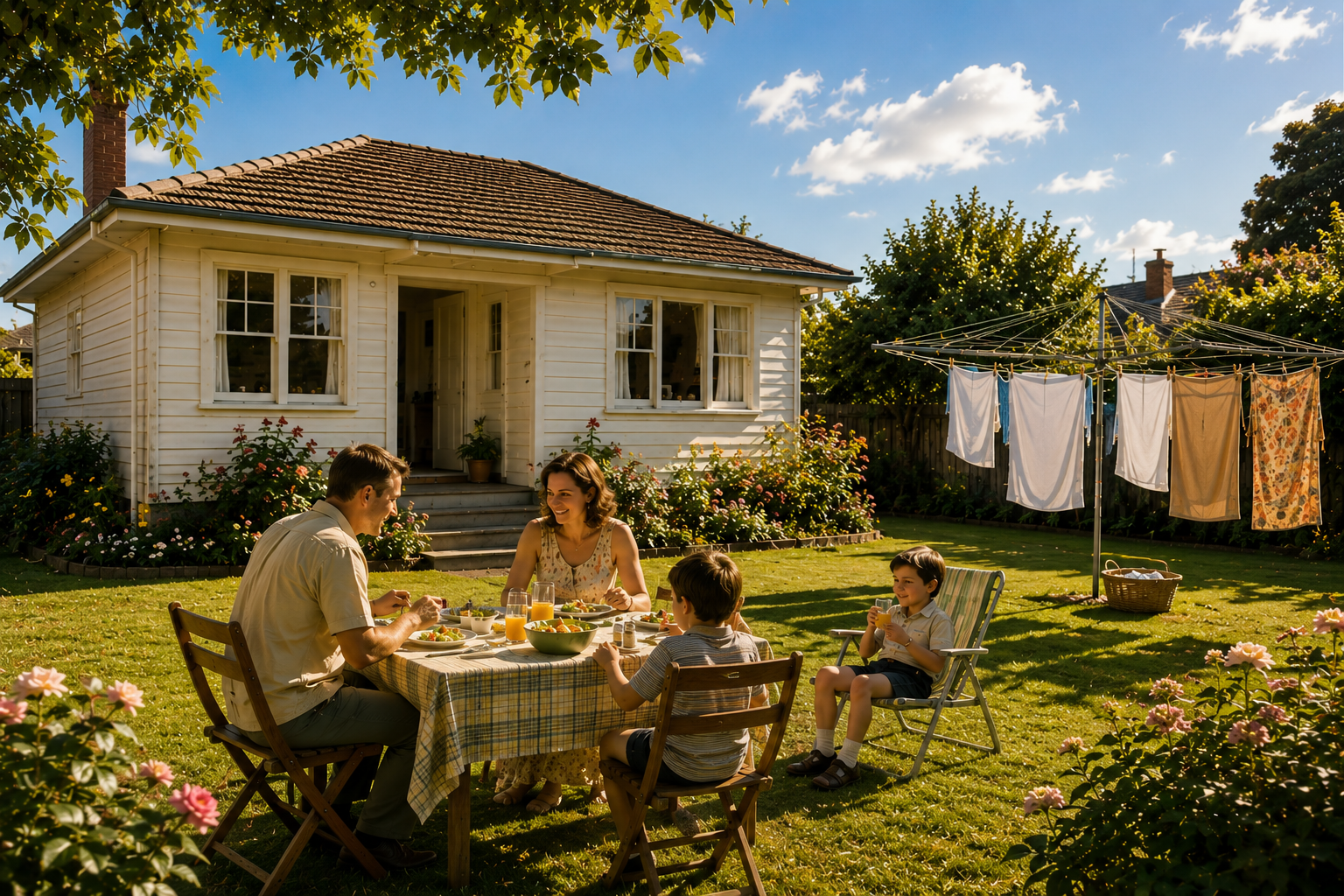
 The classic New Zealand dream has long been tied to the idea of the family home on a quarter-acre section. Te Ara describes how individual houses on their own sections became a New Zealand ideal, and how the “quarter-acre dream” became part of the country’s housing culture, even as modern sections increasingly became smaller.
To understand why that mattered, you have to understand what the quarter acre represented.
It was not just land. It represented what was possibility.
A quarter-acre section meant room to move. It meant kids could play outside without being driven somewhere. It meant a vegetable garden, a dog, a shed full of tools, a trampoline, cricket or swing-ball on the lawn, and neighbors close enough to know your name, but not so close that you could hear every conversation through the wall.
It also reflected something deeper in New Zealand culture : The idea that ordinary people should not have to be wealthy to live well.
New Zealand has often told itself a story about being more equal, more practical, and less obsessed with class than other societies. Whether that story was always fully true is debatable, but it shaped the national imagination. The quarter-acre home fitted that narrative perfectly. It was modest, useful, and grounded. It said success was not about showing off. It was about having enough space to build a life.
The old Kiwi dream is often remembered as if it was created purely by individual effort. Work hard, save hard, buy a house. Simple stuff to understand, huh.
But this is only part of the story.
For much of the twentieth century, government policy, suburban expansion, public housing, lending structures, and large-scale home building helped make home ownership more reachable for many families. Te Ara notes that in the 1950s, New Zealand’s group housing scheme encouraged builders to construct new suburban homes using state-approved plans, supporting the growth of large design-and-build companies.
That matters because it challenges one of the myths people sometimes tell younger generations today : That previous generations simply tried harder.
Many did work hard. Very hard. But they were also building their lives inside a system where the dream was more aligned with wages, land availability, house prices, and public policy. The ladder was not easy to climb, but for many people it was at least leaning against the wall.
One of the clearest signs that the Kiwi dream is under pressure is not just that people are struggling to buy homes. It is that more New Zealanders are asking whether they should build their lives somewhere else.
 Stats NZ migration data shows large numbers of New Zealanders continue to leave for Australia, with 47,700 migrant departures from New Zealand to Australia in the year to September 2025. The Guardian also reported that provisional data showed 73,900 New Zealand citizens departed in the year to August 2025, with more than half of those who left in 2024 moving to Australia.
That is not just a statistic. It is a national signal.
Leaving New Zealand is not new, of course. The Overseas Experience (OE) has always been part of Kiwi culture. Generations of New Zealanders have left for London, Sydney, Melbourne, Perth, Canada, or somewhere else, often with every intention of coming home later.
But this option is different for many people. It is not just for adventure. It is for economic reasons. It is wages. It is opportunity. It is housing. It is the feeling that the life their parents built in New Zealand might now be easier to build somewhere else.
That is a painful shift. Because for a country as small and emotionally connected as New Zealand, the decision to leave is rarely just practical. It carries grief with it. People do not usually leave because they hate New Zealand.
The danger in talking about the Kiwi Dream is that we can become too attached to the old shape of it.
The quarter-acre section / The detached home / The garage / The lawn / The bach / The boat
Those things mattered, but perhaps they were never the real dream. Perhaps they were simply the visible form the dream took at a particular moment in New Zealand history.
The deeper dream was :
- Security
- Freedom
- Time With Family.
It was the belief that ordinary people could build an extraordinary life without needing to become rich first.
That distinction matters because New Zealand may never fully return to the old quarter-acre model. The population has changed. Cities have changed. Land use has changed. Environmental expectations have changed. The way people work, live, and form families has changed.
 Trying to recreate the past may not be realistic. It may not even be desirable for everyone. Some people prefer apartments. Some want walkable neighborhoods. Some want smaller homes and more freedom. Some want to live rurally. Some want to work remotely, travel more, or build lives that do not look anything like the old suburban template.
But none of that removes the central question : Can ordinary people still build a good life here?
Not a perfect life. Not a rich life. Not an Instagram life. Just a good life.
-
-20%
NoRuleBook
Original price was: $9.95.$7.95Current price is: $7.95. -
-50%

No Rules Start-Up
Original price was: $19.95.$9.95Current price is: $9.95. -
-35%
NoRuleBook Bundle
Original price was: $22.90.$14.95Current price is: $14.95.

 Submitted 1.0
 Manual 5.0