NoRule Book Banner

The Hidden Cost of Possessions: When ‘Stuff’ Starts Owning You

by Robbie Dellow
the secret of the wealthy image

When I sold my house in Brisbane, Australia, in 2005, I got rid of most of the possessions I had accumulated. Furniture, household goods and much of the stuff that had gradually become part of everyday life disappeared, and although I expected to miss some of what I had given up, something quite different happened.

I felt lighter.

Today, almost everything I own could fit into two suitcases, and what has stayed with me from that experience isn’t the satisfaction of owning less for its own sake. I have no interest in turning minimalism into another set of rules about how many shirts someone should own, or how empty their living room should be. What surprised me was how closely possessions and obligations had become connected, and how much easier it was to make decisions once many of those obligations disappeared.

Since then, I have travelled extensively, lived in different countries, and sometimes changed plans simply because an interesting opportunity appeared. Owning less didn’t create those opportunities but it removed some of the practical reasons I might otherwise have conveniently used to say no.

That experience made me question an unwritten rule most of us encounter from an early age: As we become more successful, we are supposed to accumulate more :  A better house. A flash car. More furniture. More clothes. More possessions that demonstrate, both to ourselves and to everyone watching, that we are moving forward.

Yet there is a question hidden inside that version of success that we rarely stop to ask.

What if some of the things we acquire to improve our lives eventually make our lives less free?

Everything you own has a purchase price. Many things also have an ownership price.

THE SUCCESS RULE WE RARELY QUESTION

For much of our lives, progress is associated with accumulation. We begin with very little, start earning money and gradually acquire the things adulthood and success are supposed to include. Eventually, what we own can become one of the easiest ways of measuring how well we believe we are doing.

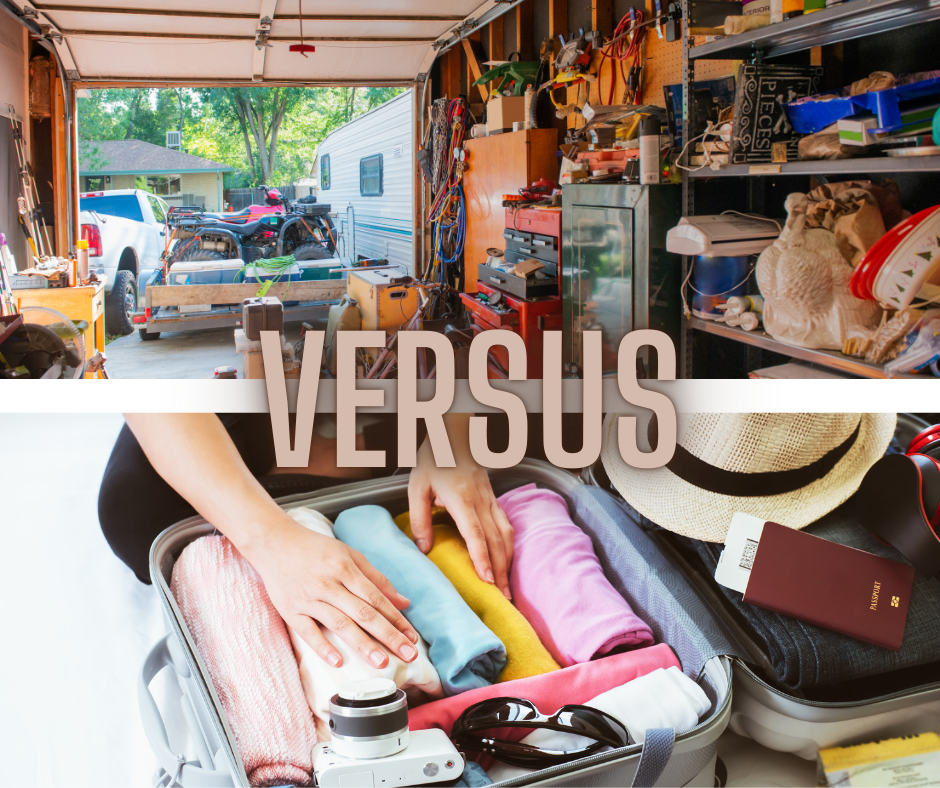
Cluttered garage imageThere is nothing inherently wrong with that. A comfortable home can make life better, a reliable car can provide enormous convenience and possessions that we genuinely use or love can easily justify the money and space they require. The problem begins when ownership stops being a conscious choice and becomes something we pursue simply because accumulation is what successful people are expected to do.

Social comparison can make that pressure even stronger. We see other people’s renovated homes, new cars, clothes, holidays and carefully selected glimpses of their lives, while rarely seeing the debt, maintenance, working hours or other obligations sitting behind them. The visible possession becomes evidence of success, while the invisible cost of maintaining that success remains conveniently out of sight.

Over time, this can create a peculiar cycle in which we work to earn money, use the money to acquire things, and then devote more money and time to maintaining, storing, insuring, protecting and eventually replacing what we have acquired.

The question isn’t whether possessions are good or bad. It is whether the value they add to our lives is greater than the freedom they take away.

EVERYTHING YOU OWN HAS TWO PRICES

The price written on an object when you buy it is rarely its complete cost.

A boat has a purchase price, but it may also have mooring fees, insurance, maintenance and repairs. A holiday property can provide wonderful experiences while simultaneously creating rates, insurance, upkeep and the responsibility of looking after a building that sits somewhere else. Even relatively inexpensive possessions accumulate costs through storage, replacement, maintenance and the physical space required to keep them.

Then there is the cost that doesn’t appear on a bank statement.

Possessions require attention.

The more complicated our ownership becomes, the more things there are to organize, repair, insure, move, clean, secure or simply think about. None of those responsibilities may be particularly burdensome on its own, but collectively they create friction, and friction matters when an opportunity appears that requires us to move quickly.

This is where the real cost of ownership can become easy to underestimate. Something can be perfectly affordable financially while still being expensive in terms of time, attention and flexibility.

A storage unit is a simple example. Someone can spend thousands of dollars over several years storing possessions they rarely use because getting rid of them feels wasteful, even when the accumulated storage fees eventually exceed the value of what is being protected. At that point, the question is no longer simply what the possessions are worth –  It is what keeping them is costing.

The real cost of something isn't always what you paid to acquire it. Sometimes it's what you continue giving up to keep it.

DO YOU WANT THE THING — OR WHAT THE THING GIVES YOU?

One of the most useful questions I have learned to ask about ownership is deceptively simple:

"Do I actually want this thing, or do I
want the experience or benefit I associate with it?"

The difference matters.

Someone dreaming of owning a beach house may really be dreaming about spending time beside the ocean. Someone wanting a boat may primarily want occasional days on the water. Someone considering an expensive car may value the driving experience, convenience or status rather than ownership itself.

Traditionally, enjoying something and owning it have been closely connected, but they don’t always need to be. Renting, borrowing, sharing and short-term access can sometimes provide most of the benefit without creating a long-term obligation.

That doesn’t automatically make renting smarter than owning, because in many circumstances ownership makes excellent financial and practical sense. The point is simply that access and ownership are different things, and we often jump directly to ownership without considering whether ownership is actually the part we value.

Once you separate the experience from the object, a different question becomes possible.

What is the least restrictive way of getting what I actually want?

rented boat ride experience imageFor someone who uses a boat every weekend, owning one may be entirely sensible. For someone who wants to go boating twice a year, hiring one may provide the experience without requiring the other 363 days of responsibility. Neither choice is inherently better; what matters is whether the ownership serves the life or the life begins serving the ownership.

WHEN OWNERSHIP MAKES PERFECT SENSE

Questioning ownership should not become another rigid rule telling us that possessing less is automatically better, because that would simply replace one unquestioned convention with another.

Some possessions provide security, convenience or pleasure far beyond the obligations they create. A home can provide stability and belonging while also becoming a valuable financial asset. Equipment can enable someone to earn an income or pursue something they love. Sentimental possessions can carry meaning that has nothing to do with their resale value, while investments and business assets can create rather than restrict future choices.

The objective, therefore, isn’t to own as little as possible. It is to own deliberately.

A possession that genuinely improves your life may easily justify everything required to maintain it. The problem is the accumulation that happens without that calculation ever taking place, particularly when we acquire something primarily because it represents the kind of life we believe successful people are supposed to have.

There is little freedom in getting rid of something valuable merely to prove that you can live without it. Equally, there is little freedom in spending years paying for and maintaining something you barely use because owning it once represented success.

The better question is not “Should I own this?” It is “Is owning this worth what ownership requires from me?”

THE FREEDOM DIVIDEND

The greatest benefit I have experienced from owning relatively little is not having less stuff around me. It is having fewer things that need to be considered when making a decision.
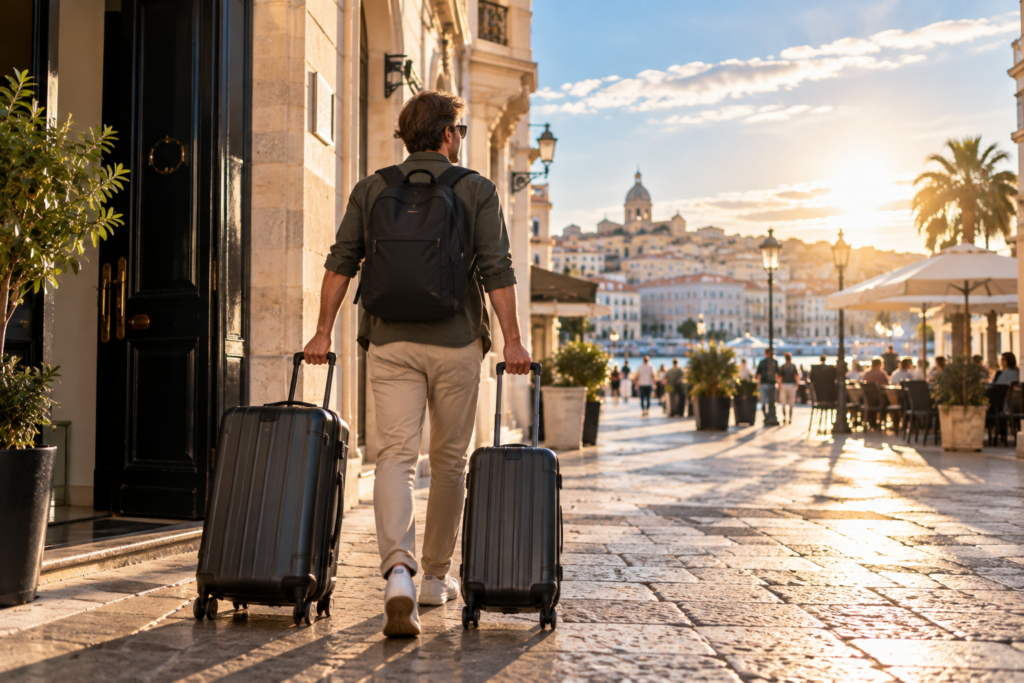
The freedom dividendIf an opportunity appears somewhere else, I don’t need to organize a house full of possessions before considering it. If I want to spend an extended period travelling, there isn’t a long list of physical belongings requiring my attention while I’m away. The practical threshold for changing direction is simply lower.

That flexibility has become increasingly valuable to me because freedom isn’t only about having enough money to make choices. It is also about having constructed a life that allows those choices to be made.

Someone can have considerable financial resources while simultaneously creating so many fixed commitments that changing direction becomes extraordinarily difficult. Conversely, a person with fewer resources may sometimes possess greater flexibility because there is simply less holding them in place.

This doesn’t make one lifestyle superior to another. Some people genuinely want deep roots, a permanent home and possessions accumulated over a lifetime, and if those things contribute to the life they consciously want, there is no reason NoRuleBook should tell them otherwise.

The important point is that every commitment represents a trade.

If what you own gives you more value than the flexibility you surrender, the trade may be worthwhile. If it doesn’t, then the possession may be costing you something considerably more valuable than money.

Freedom isn't only having the resources to say yes. It is having a life that doesn't force you to say no.

EXPERIENCES, POSSESSIONS AND WHAT WE REMEMBER

There is another reason to question the assumption that accumulating possessions automatically creates a richer life. Research into experiential and material purchases has repeatedly found that experiences can produce particularly strong benefits for happiness, connection and memory, although that does not mean experiences are always superior or that material purchases cannot contribute substantially to well-being.

What makes the distinction useful is not that we should replace every object with an airline ticket. It is that experiences and possessions often demand different things from us after the money has been spent.

An experience ends, but its value can continue through memories, relationships and stories. A possession remains, which can be valuable precisely because we continue using it, but remaining also means it can continue requiring space, money and attention.

This is why the familiar question “Can I afford it? doesn’t always go far enough. Something may fit comfortably within our budget, whilst still conflicting with the kind of life we want to build.

A better calculation includes freedom.

THE NORULEBOOK 'OWNERSHIP' TEST

Before making a significant purchase, particularly one that creates an ongoing commitment, it is worth looking beyond the price and asking what you are really signing up for.

WHY DO I WANT IT?

Separate the object from what it represents. Are you buying something because you genuinely value its function or enjoyment, or because ownership represents success, status or what someone in your position is expected to have?

WHAT WILL IT REALLY COST?

Look beyond the purchase price to maintenance, insurance, storage, repairs, financing, replacement, attention and time. The objective isn’t to make ownership appear unattractive, but to calculate the complete trade rather than only its most visible part.

COULD I ACCESS IT INSTEAD?

If what you really want is the experience or function, consider whether renting, borrowing, sharing or paying for access could provide it without creating a permanent obligation.

WHAT FREEDOM AM I TRADING?

Consider whether owning it maybe makes certain things harder. Does it reduce your ability to travel, relocate, change careers, invest elsewhere or simply spend your time differently?

IS THE TRADE WORTH IT?

If the answer is yes, then own it and enjoy it. The purpose of questioning an unwritten rule is not to produce a predetermined answer; It is to make sure the decision is actually yours.

If the answer is no, you may be about to buy an obligation disguised as success.

OWN WHAT IMPROVES YOUR LIFE — NOT WHAT PROVES YOUR SUCCESS

Getting rid of many of my accumulated possessions in 2005 taught me something I hadn’t expected. I thought I was disposing of objects, but what I noticed afterward was the disappearance of obligations that had been attached to them.

That experience doesn’t mean everyone should reduce their life to two suitcases. What works for me may be completely wrong for somebody who values permanence, a family home or the pleasure of being surrounded by things accumulated over decades. The NoRuleBook lesson isn’t minimalism. It is conscious ownership.

We spend enormous amounts of our lives acquiring things, yet relatively little time asking whether those things continue to serve the life we originally wanted them to improve. Some unquestionably do. Others remain because selling them feels difficult, because replacing them once seemed like progress, or because letting them go would force us to reconsider what success actually means.

Real wealth includes money, but money is valuable largely because of what it allows us to do with our lives. If accumulating possessions begins consuming the time, flexibility and choices that money was supposed to create, it is worth asking whether the equation has quietly reversed.

Own the things that genuinely make your life better. Enjoy them without guilt and keep them for as long as their value exceeds their cost.

But don’t accumulate things merely to demonstrate that you are succeeding.

Don't own excess stuff. Own your life.

Take The Next Step

Look around at what you own and choose one significant possession or commitment that consumes money, time, space or attention. Rather than asking whether you like it or whether you can afford it, ask a more revealing question: If you didn’t already own it, knowing everything you know about the cost and responsibility of keeping it, would you choose to acquire it today?

If the answer is yes, you have probably identified something that genuinely contributes to your life. If the answer is no, you may have discovered an obligation that survives mainly because you have become accustomed to carrying it.

That is exactly the kind of inherited assumption NoRuleBook is designed to help you examine. The eBook provides practical ways to identify the unwritten rules shaping your decisions, question why you are following them and consciously decide which ones still deserve a place in the life you want to build.

Click the NoRuleBook image below to get your copy and start deciding what deserves to stay in your life — and what doesn’t.

The NoRuleBook Collection

Facebook

Leave a Comment