

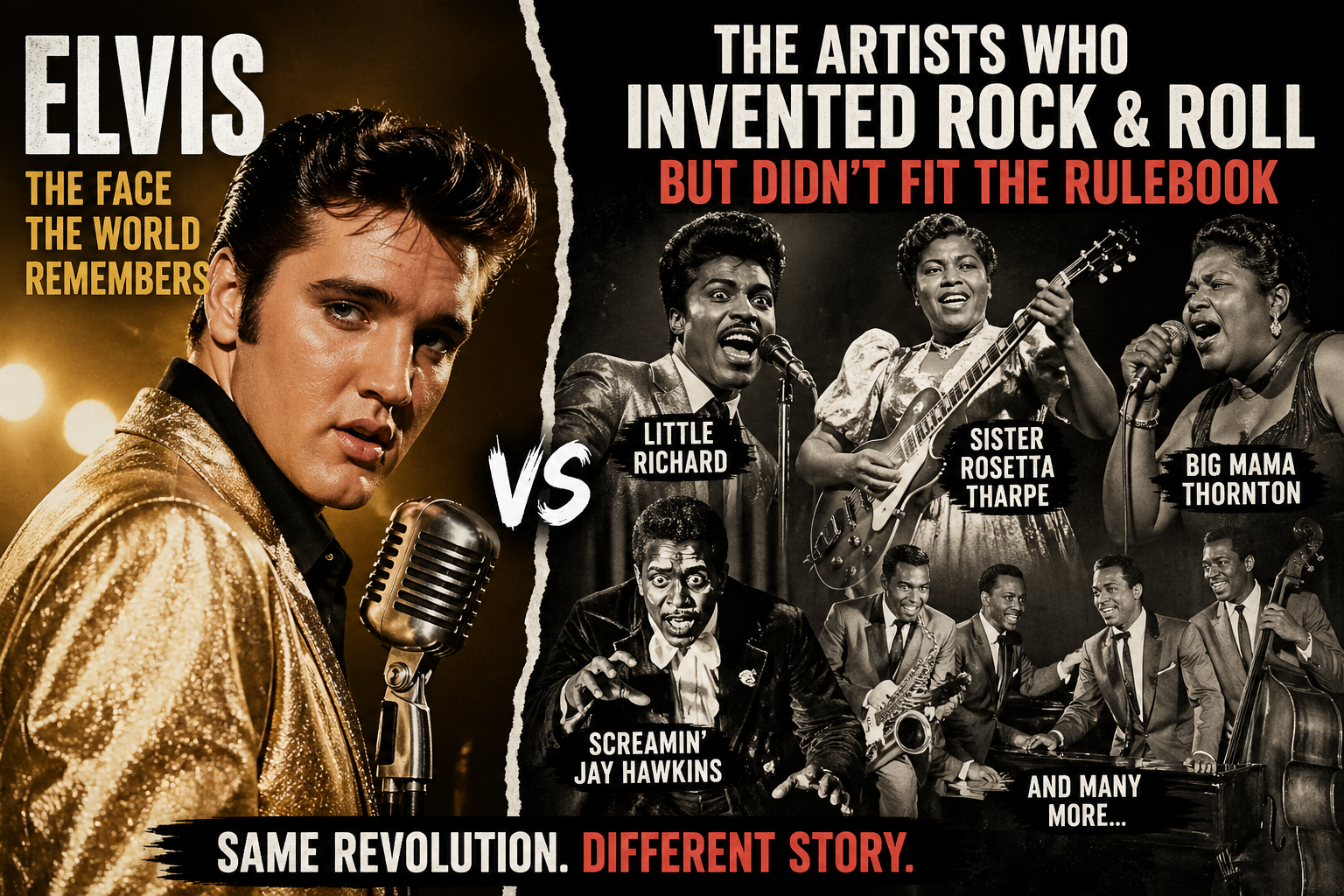
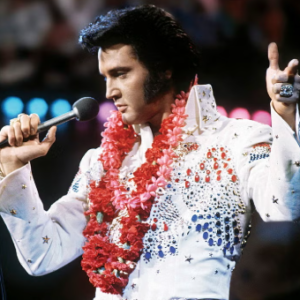
Everyone knows Elvis Presley: The sideburns, the voice, the hips and the extraordinary story of a good-looking Southern boy who became the international face of musical rebellion.
That’s the version of rock and roll history most of us inherited, and there is no question that Elvis was enormously talented or that his influence was immense. But if you look more closely at the story of where rock and roll actually came from, something uncomfortable begins to appear beneath that familiar narrative.
Elvis didn’t emerge from nowhere, and he didn’t invent rock and roll in a vacuum. He stepped into a musical revolution that was already happening in churches, clubs, juke joints and recording studios, driven by artists whose music was often louder, stranger, more provocative and considerably less acceptable to mainstream America.
And that is where the more interesting story begins.
Watch the NoRuleBook Documentary
Prefer to watch? See the short NoRuleBook documentary below, then continue reading for the deeper story.
The Sound Was Already There
Before Elvis walked into Sun City Records, rock and roll wasn’t sitting there waiting for someone to invent it. The sound was already alive in churches, clubs, juke joints and back rooms where musical boundaries mattered less, carried by performers who weren’t particularly interested in sounding polished, behaving safely or fitting comfortably inside the expectations of mainstream America.
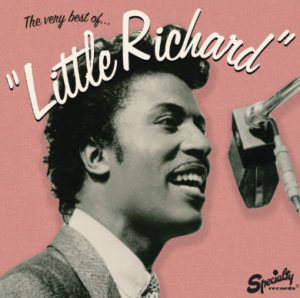
Take Little Richard. He didn’t just perform music – he attacked it. Screaming vocals, pounding piano, unapologetic energy. There was nothing controlled about him. Nothing packaged. He blurred gender lines, challenged expectations, and carried a level of intensity that most audiences at the time didn’t quite know how to process.
Or look at Big Mama Thornton, whose version of Hound Dog carried a rawness that felt almost confrontational. When she sang, it wasn’t about entertainment – it was about power. The kind of power that doesn’t ask for approval.
And then there’s Sister Rosetta Tharpe, a name that should sit at the very foundation of rock history but somehow still feels like a hidden chapter. She was playing electric guitar with a confidence and energy that predated what most people think of as rock and roll. She blended gospel with distortion, performance with presence, and in doing so created something entirely new before the world had a label for it. Read more about this forgotten pioneer, who shaped rock and roll before it even had a name, here.
None of these artists lacked the talent to become defining figures of the musical revolution they were helping to create; if anything, their extraordinary ability makes what happened next considerably more revealing.
The Problem Was Never Talent
The issue wasn’t whether these musicians were talented enough to succeed; their influence on the artists who followed them makes that question almost irrelevant. The more revealing question is whether they fitted the version of success that the music industry, broadcasters and mainstream American audiences of the time were prepared to embrace.
Talent matters enormously, but talent alone has never determined who reaches the largest audience. Timing matters, presentation matters, cultural attitudes matter, and so does whether something unfamiliar can be packaged in a form that enough people are willing to accept.
Elvis arrived at precisely that intersection. He absorbed influences from the Black gospel, blues, rhythm-and-blues and country music surrounding him and combined them with an extraordinary voice, charisma and stage presence of his own, but he also presented this emerging sound through a performer whom the mainstream music industry could take somewhere many of its originators could not easily go.
He was rebellious enough to feel dangerous, while remaining familiar enough to become marketable to an enormous audience.
That combination changed everything.
The Version The World Was Ready For
Looking back, it’s tempting to assume Elvis reached a level of fame that Little Richard, Big Mama Thornton, Sister Rosetta Tharpe and countless others did not simply because he was better. It fits neatly with the way we like to imagine success works: the greatest talent rises highest and history remembers the people who most deserve to be remembered.
But cultural success rarely works that cleanly.
Elvis was extraordinarily talented, charismatic and distinctive, but he also emerged at a moment when much of America remained deeply divided along racial and cultural lines. He could carry sounds and influences that had developed largely within Black musical traditions across boundaries that many of the artists who helped create them were prevented from crossing.
In that sense, Elvis became a bridge between worlds. What he represented still felt rebellious enough to excite a generation, but it arrived through someone the machinery of mainstream American entertainment could promote to audiences that might never have embraced the same music, presented by the people who had been developing it for years.
That doesn’t diminish Elvis’s achievement. It reveals something more interesting about achievement itself: History doesn’t necessarily remember the person who arrived first, or even the person who changed the rules most radically. It often remembers the person through whom the wider world was finally ready to accept such a change.
The Ones Who Were Too Early, Too Different, Too Much
There is a pattern here that extends far beyond music, because history is full of people whose ideas, personalities or ways of working arrived before the institutions around them knew what to do with them. Sometimes they were ignored because their ideas seemed strange; sometimes they were dismissed because they challenged existing assumptions; and sometimes the very qualities that would later make their work influential were the qualities that made them difficult to accept at the time.
The temptation is to look at those people retrospectively and assume they simply weren’t successful enough, weren’t persuasive enough or weren’t as talented as the people whose names eventually became famous. But that assumes the system evaluating them was neutral.
Often it wasn’t.
Every era has boundaries around what looks credible, marketable, respectable or even possible, and people who operate beyond those boundaries can find themselves overlooked not because their work lacks value, but because the world hasn’t yet developed a category in which to place them.
Sometimes the pioneer and the person who receives widespread recognition are the same person.
Sometimes they aren’t.
And understanding that difference changes the way we think about success.
The System Didn't Fail Them -
It Filtered Them
It is tempting to frame this simply as a story of missed opportunities or unfair outcomes, but something more revealing was happening. The music industry, like every large commercial system, had its own filters — some explicit, others almost invisible — determining what could be promoted, broadcast, packaged and ultimately presented to a mass audience.
Those filters did not judge talent alone. Race mattered. Gender mattered. Sexuality, image, geography, audience expectations and the commercial instincts of record executives all played their part, which meant that an extraordinary artist could help create the future of music and still find themselves standing outside the version of that future the mainstream was prepared to embrace.
That pattern reaches far beyond rock and roll. Institutions naturally become better at recognizing what already fits their definitions of success than recognizing something that challenges those definitions altogether, which is why genuinely original people can sometimes look unsuccessful right up until the world catches up with what they were doing.
The system didn’t necessarily fail to see them. It often didn’t know what to do with them.
Why This Still Matters
This story matters because the same pattern didn’t disappear with the early years of rock and roll. It appears whenever someone creates something that doesn’t fit comfortably inside the categories, expectations or assumptions that already exist.
The people who eventually change an industry are not always immediately recognizable as the people who will change it. Sometimes they look unprofessional because professionalism has been defined by the old rules; sometimes their ideas look impractical because the infrastructure needed to support them doesn’t exist yet; and sometimes they simply make people uncomfortable because they are showing us something we haven’t learned how to categorize.
That creates a difficult question for anyone building, creating or thinking differently. If what you’re doing isn’t working, should you change it?
Sometimes the answer is absolutely yes. Being different doesn’t automatically make an idea good, and rejection isn’t proof that everyone else simply lacks vision.
But sometimes the problem isn’t that your idea doesn’t work. It’s that you’re asking the existing world to understand something it doesn’t yet have a category for.
Knowing the difference may be one of the hardest judgments any creator, entrepreneur or rule breaker ever has to make.
The Real Lesson
Elvis Presley became the face the world remembers, but he was never the whole story. Behind that familiar history were artists whose voices, performances and ideas helped build rock and roll long before much of mainstream America was ready to recognize where those sounds had come from.
Their stories reveal something uncomfortable about the way we understand success. We tend to look backwards from the winners and assume recognition proves who mattered most, when history is often far messier: the pioneer may create the breakthrough, someone else may make it acceptable, and another person entirely may become its most recognizable face.
That doesn’t make Elvis an impostor, and it doesn’t require diminishing his extraordinary contribution. It simply means that fame and influence are not the same thing, just as recognition and originality are not the same thing.
So perhaps the question isn’t simply “Who invented rock and roll?”
A more interesting question is :
Because once you start asking that question about rock and roll, you begin seeing the same pattern almost everywhere.
Take The Next Step
The history of rock and roll is a reminder that recognition and originality don’t always arrive at the same time. The people who fit an existing system are often easier to understand, promote and celebrate, while those operating beyond its boundaries can spend years being dismissed as too strange, too difficult or simply too early.
That doesn’t mean being an outsider automatically makes you right, or that every unconventional idea deserves to succeed. But it does mean that fitting comfortably into the expectations of the moment is a poor way to measure the eventual value of something genuinely different.
Little Richard, Big Mama Thornton, Sister Rosetta Tharpe and the other artists in this story didn’t need history to make their work important; history simply took longer to understand what they had already created.
And that raises a question that reaches far beyond music: What part of yourself, your work or your ideas are you tempted to soften simply because the world hasn’t yet shown you where they fit?
NoRuleBook explores that same tension between fitting in and thinking independently, asking whether some of the rules we work hardest to satisfy were ever the right measure of success in the first place.
Click the NoRuleBook image below to explore the collection.
The NoRuleBook Collection
-
NoRuleBook
$9.95Original price was: $9.95.$7.95Current price is: $7.95. -
No Rules Start-Up
$19.95Original price was: $19.95.$9.95Current price is: $9.95. -
NoRuleBook Bundle
$22.90Original price was: $22.90.$14.95Current price is: $14.95.