
Most people, outside of the technology and activist worlds, had never heard of Aaron Swartz, until after he died
By then, the headlines had already simplified him into something easy to categorize : Hacker. Activist. Internet criminal. Digital rebel.
But reducing Aaron Swartz to just a hacker misses the uncomfortable reason his story still resonates today.
Because he wasn’t simply an outsider throwing rocks at the system from the fringes. He was one of the people helping build the modern internet itself.
He was brilliant. Exceptionally so. He had the technical ability and connections to pursue the conventional Silicon Valley path — building companies, accumulating wealth and enjoying the status that came with it.
Instead, he spent much of his short life asking two dangerous questions :
“Who gets to control knowledge — and who profits when ordinary people cannot access it?”
Watch the NoRuleBook Documentary
Prefer to watch? See the short NoRuleBook documentary below, then continue reading for the deeper story.
The Boy Who Understood the Internet Before Most Adults Did
Aaron Swartz was not someone who stumbled into technology accidentally. From an early age, he seemed to understand the internet not simply as a tool, but as an idea.
While most teenagers were using the web casually, Aaron was already helping shape parts of its infrastructure.
At just fourteen years old, he joined the working group that helped develop RSS 1.0, a web-syndication standard that allowed websites to distribute updates automatically across the internet. For years, RSS became part of the largely invisible infrastructure behind blogs, news feeds, podcasts and online publishing.
He was not simply rebelling against systems he didn’t understand. He understood them deeply. And unlike many critics of power structures, Aaron had already proven he could succeed within them.
He Could Have Played the Game
This part matters because it changes the entire tone of this story.
Aaron Swartz was not unsuccessful. He was not bitter. He was not someone lashing out because the world had rejected him.
In fact, the opposite was true.
He founded a startup called Infogami, which merged with Reddit in 2005 as part of Y Combinator’s first group of startups. Swartz became part of the newly merged company.
At an age when many people are still figuring out what they want to do with their lives, Aaron was already surrounded by opportunity, status, and growing influence in the technology world.
He could have continued down that path comfortably. But Aaron seemed increasingly uncomfortable with the direction the internet was moving. Because the internet he believed in was open.
But as the internet became increasingly dominant, it became increasingly controlled.
The Internet Was Supposed to Free Information
In the early days of the web, there was a genuine sense that knowledge was about to become democratized.
On an unprecedented scale, ordinary people could access ideas, research, education and information almost instantly, regardless of where they lived. Gatekeepers appeared weaker. Institutions appeared vulnerable. Information itself suddenly felt difficult to contain.
To many people, this looked like progress. To Aaron Swartz, it looked like possibility.
He became involved in the early development of Creative Commons, helping build the technical infrastructure behind a system designed to make creative and intellectual work easier to share legally online. He believed knowledge should not be artificially restricted behind corporate or institutional walls simply because someone had the legal power to place it there.
And this is where his story stops being just about technology. Because underneath it all was a much larger philosophical conflict.
The universities?
The publishers?
The corporations?
The governments?
Or humanity itself?”
The JSTOR Incident Was About More Than Downloading Files
This is the point where Aaron Swartz became controversial.
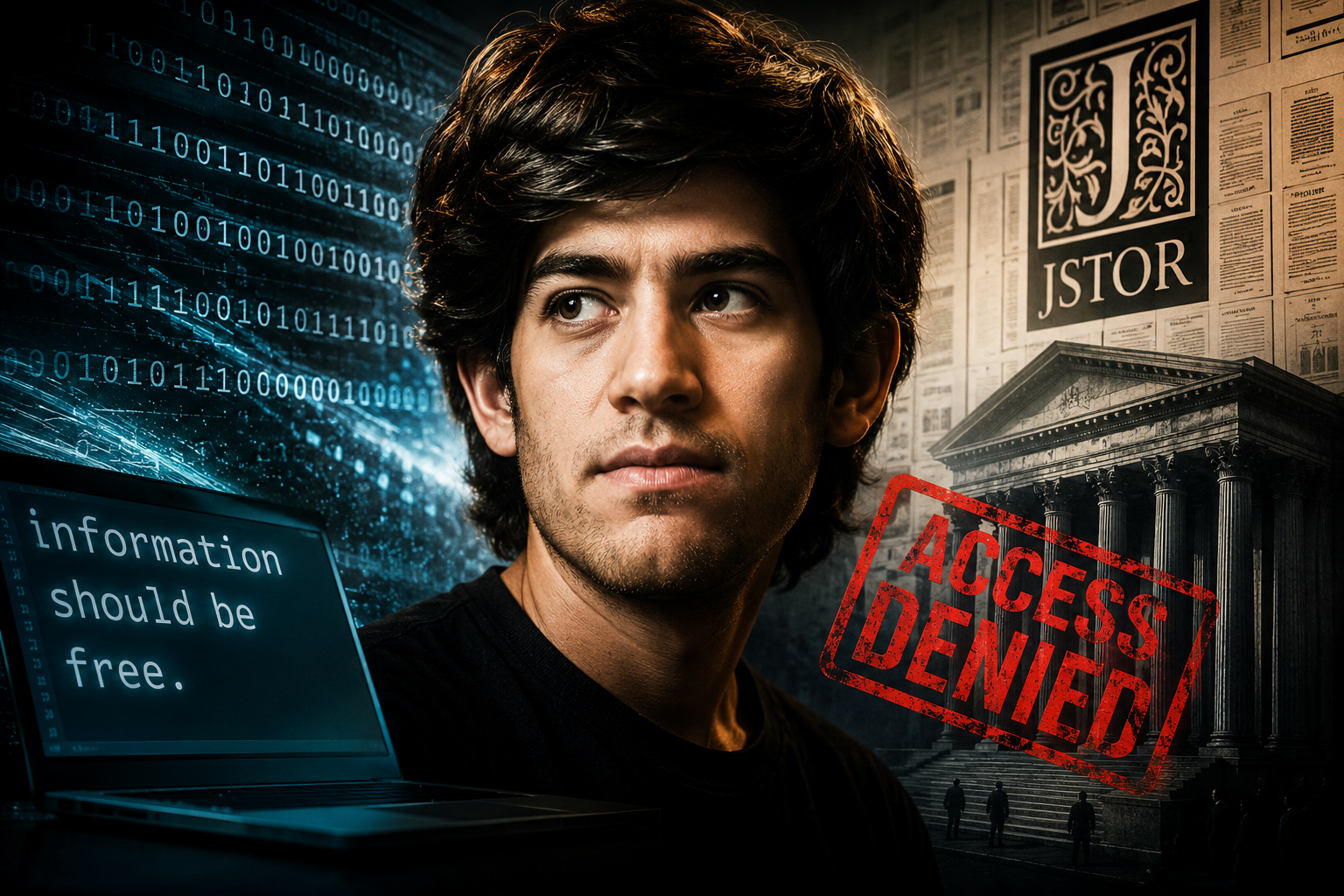
Between 2010 and 2011, Swartz downloaded millions of academic articles from JSTOR through MIT’s network. Federal prosecutors alleged that he intended to distribute a significant portion of the archive through file-sharing sites.
Legally, the case became serious very quickly.
The charges carried severe statutory maximum penalties — potentially decades in prison and enormous fines — although prosecutors later said they were seeking a much shorter sentence as part of a plea agreement.
Now, people will disagree strongly about what Aaron did.
Some will argue laws exist for a reason and that systems cannot function if individuals simply decide rules no longer apply to them.
That is a fair argument.
But Aaron’s story forces a deeper and far more uncomfortable question :
Why was so much publicly funded knowledge locked away behind expensive institutional barriers in the first place?
Aaron’s actions also drew attention to a much broader problem with academic publishing. Large amounts of scholarly research are :
- funded by taxpayers
- produced by publicly supported universities
- written by researchers seeking advancement, not royalties
Yet ordinary people frequently had to pay enormous fees to access it.
Outside well-funded universities and institutions, access to academic research could be prohibitively expensive. Independent researchers and ordinary readers often encountered paywalls that institutional users never saw. Knowledge became a gated asset controlled by institutions and publishers.
And Aaron fundamentally rejected that idea.
The Prosecution Became Part Of The Story
What shocked many people was not simply that Aaron Swartz was prosecuted. It was the intensity of the prosecution.
To critics, the case became an example of prosecutorial overreach and of the enormous power available under computer-crime laws. Prosecutors, however, maintained that Swartz had deliberately circumvented efforts to stop the downloads and that bringing charges was appropriate.
Aaron faced overwhelming legal pressure while negotiations and court proceedings continued.
In 2013, at just twenty-six years old, he took his own life.
His death intensified an already growing debate about computer-crime laws, prosecutorial discretion and whether the potential punishment had been proportionate to the alleged offence.
The Modern Internet Looks Less Like Freedom Than We Expected
The irony is that Aaron’s concerns now feel less radical than they once did.
Today :
- Information is algorithmically filtered
- Platforms decide visibility
- Corporations control digital ecosystems
- Access increasingly depends on subscriptions and paywalls
- Online behavior is tracked constantly
The open internet many people imagined decades ago now feels harder to find. Instead of complete freedom, much of modern digital life revolves around controlled platforms where visibility, access, and influence are quietly shaped by systems most users barely understand. That tension between openness and control is why Aaron Swartz’s questions still matter.
Not because he was perfect.
Not because every action he took should automatically be defended.
But because he forced people to confront questions many institutions would rather avoid.
The Uncomfortable Part of Aaron Swartz’s Story
The easiest version of this story is to turn Aaron into either :
- a heroic martyr
or - a reckless criminal
Reality is usually more complicated than that.
You don’t have to agree with what Aaron Swartz did to question whether the rules, institutions and punishments surrounding his case were right. But his story does force an uncomfortable question :
Who benefits when knowledge is locked away?
Because once you begin asking that question honestly, you start noticing how many parts of modern life operate the same way.
Final Thought
Aaron Swartz’s story doesn’t leave us with an easy answer. Perhaps that is why it still matters.
You can believe that rules matter and still question whether every rule is just. You can believe that actions should have consequences and still question whether those consequences are proportionate.
And you can disagree with what Aaron did, whilst still asking the question that ran through much of his life :
Who should control access to human knowledge?
Take The Next Step
Aaron Swartz’s story is difficult precisely because it doesn’t offer us the comfort of a simple hero-and-villain narrative. You can believe that laws matter while still questioning whether every law is just, and you can believe that actions should have consequences while asking whether those consequences remain proportionate to the harm involved.
That tension extends far beyond Aaron’s case. Rules and institutions are necessary, but once they become established it is easy to stop asking why they exist, whose interests they serve, and whether the circumstances that originally justified them still apply.
Independent thinking doesn’t require us to assume that authority is wrong. It requires something more demanding: The willingness to examine the rule separately from the authority behind it, and decide whether the two still deserve our agreement.
NoRuleBook explores that same territory—the unwritten rules and accepted assumptions surrounding work, success, money and life, and what can happen when we stop treating “that’s just how things work” as the end of the conversation.
Click the NoRuleBook image below to explore the collection.
The NoRuleBook Collection
-
-20%
NoRuleBook
$9.95Original price was: $9.95.$7.95Current price is: $7.95. -
-50%
No Rules Start-Up
$19.95Original price was: $19.95.$9.95Current price is: $9.95. -
-35%

NoRuleBook Bundle
$22.90Original price was: $22.90.$14.95Current price is: $14.95.

 Submitted 1.0
 Manual 5.0