

For decades, millions of young people were handed some version of the same basic deal :
- Study hard.
- Gain useful qualifications.
- Find a respectable job.
- Work your way upwards.
- Buy a home.
- Build financial security.
- Eventually reach the point where all those years of effort provide greater freedom.
It was never a guarantee, and it certainly didn’t work equally for everyone, but the underlying bargain was understandable: Make sacrifices now and there should be a reasonable chance of greater security later.
The problem begins when one generation inherits the instructions while growing up under very different conditions from the generation that wrote them.
Housing becomes less attainable. Employment changes. Technology transforms entire industries. Education becomes more expensive in some countries while no longer providing the same certainty of employment. Traditional milestones such as marriage, children and home ownership became harder to reach. At the same time, younger people can see alternative ways of working and living that previous generations rarely encountered.
And then something interesting happens. Behavior that looks like laziness, lack of ambition or irresponsibility from one generation’s perspective can look entirely rational from another.
Over the past decade, different expressions of this tension have appeared around the world. Japan has its Satori generation. South Korea developed terms such as Sampo and N-po. China saw the emergence of Tang Ping, or “Lying Flat.” More recently, frustration among young Indians helped turn an online joke about ‘cockroaches’ into a major protest movement.
These are not identical movements, and it would be misleading to pretend they have the same causes or objectives. Some are cultural labels rather than organised movements. Some involve quietly opting out of expectations, while others have become public protests. Their political and economic environments are also very different.
But together they raise a question that deserves more consideration than simply asking why young people don’t behave like previous generations did.
Perhaps they are not rejecting effort. Perhaps some are questioning whether the relationship between effort, sacrifice and reward has changed.
And if the circumstances have changed, then eventually someone has to ask the uncomfortable question:
Watch The Video
Prefer to watch? View the video version here.
WHEN OLD RULES NO LONGER FIT THE NEW REALITY
Every generation inherits advice from the one before it, and much of that advice is valuable. Human nature doesn’t reinvent itself every twenty years, and principles such as developing useful skills, taking responsibility, saving money and thinking about the future remain sensible. But there is a difference between an enduring principle and an instruction built for a particular set of circumstances.
- ‘Develop valuable skills’ is a principle.
- ‘Get this qualification and you’ll have a secure career’ is an instruction, whose usefulness depends heavily on what is happening in the economy and labour market.
- ‘Prepare financially for the future’ is a principle.
- ‘Work for the same organization for decades and it will look after you’ depends on an employment relationship that may or may not still exist.

This distinction matters because advice can remain culturally powerful long after the circumstances that made it effective have changed. Younger people then find themselves being measured against milestones established under different housing markets, different technologies, different employment structures and sometimes very different costs of entering adulthood.
That doesn’t automatically make the old advice wrong. It means it needs to be tested against current reality rather than inherited unquestioningly.
You can't build your future by assuming the rules of the past still apply.
JAPAN: WHEN WANTING LESS BECOMES ITS OWN FORM OF REBELLION

Japan provides an interesting example because the challenge to traditional expectations has often been quiet rather than confrontational.
The term Satori generation emerged to describe younger Japanese who appeared less interested than previous generations in conspicuous consumption, aggressive career advancement and some of the conventional markers of adult success. The term itself can oversimplify millions of people with different motivations, but the behaviour it attempts to describe is important.
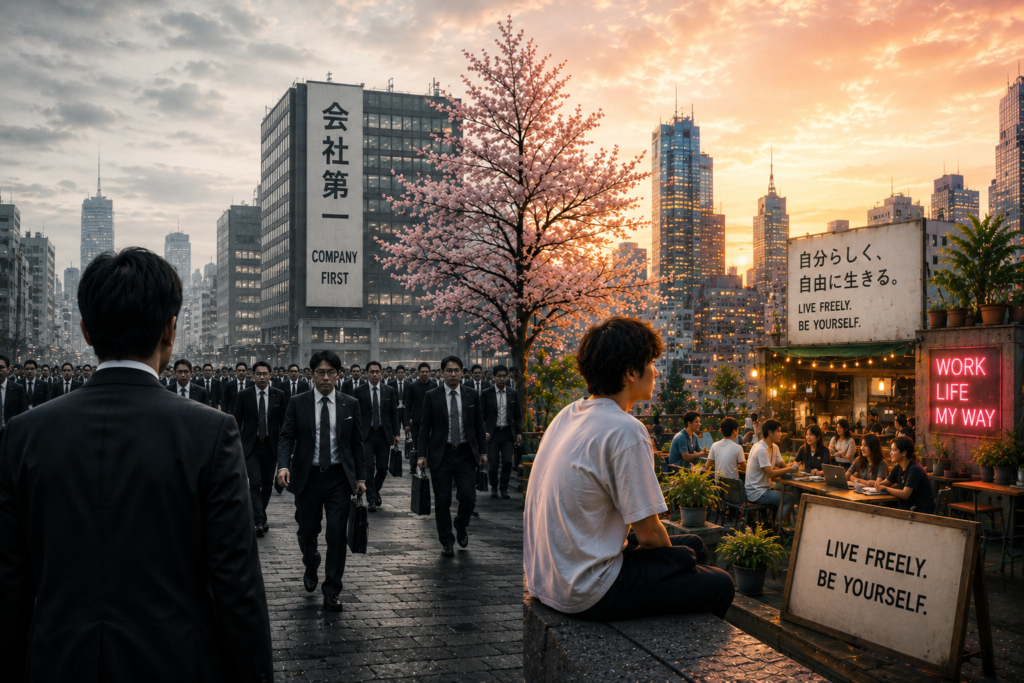
Post-war Japan had developed an extraordinarily powerful model of corporate commitment. For many workers, particularly men in large companies, the expectation was that loyalty, long hours and personal sacrifice would be exchanged for stability, status and long-term employment. For younger Japanese who came of age after decades of weaker economic growth and changing employment conditions, that bargain looked considerably less compelling.
If the reward for sacrificing enormous amounts of time to a company becomes less certain, then declining to make the same sacrifice isn’t necessarily evidence that a generation has lost its ambition. It may mean the price they are willing to pay for conventional success has changed. Choosing a smaller apartment, consuming less, caring less about status, or placing greater value on personal time can easily be interpreted as evidence that someone has lowered their aspirations. Yet that judgment only works if everyone agrees on what the aspiration should have been in the first place.
Perhaps the more interesting question isn’t: Why don’t these young people want what previous generations wanted?
It is: Why did we assume they should?
SOUTH KOREA: WHEN THE MILESTONES BECOME TOO EXPENSIVE
If Japan raises questions about whether younger people still want the same version of success, South Korea presents an even more difficult question.
What happens when people may still want the traditional milestones but increasingly struggle to afford the path towards them?
The term Sampo generation emerged in South Korea to describe young people who were postponing or giving up three things traditionally associated with adulthood: dating, marriage and having children. Over time, the language expanded into 5-po, 7-po and eventually N-po, reflecting the idea that an increasing number of aspirations – from home ownership and social relationships to career ambitions – were being placed beyond reach.
It would be easy to look at those choices individually and conclude that attitudes have simply changed. Younger people don’t value marriage as much. They don’t want children. They aren’t prepared to make the sacrifices their parents made.
There is some truth in changing values. Younger Koreans are less likely than previous generations to regard marriage as something everyone must do. But that is only part of the story.
South Korea combines intense competition for desirable jobs with high education and housing costs, particularly around Seoul. The OECD has found that these pressures are making the transition into independent adulthood increasingly difficult for younger Koreans.
Housing provides a particularly revealing example. More than half of young Koreans surveyed believed they needed to own a home before getting married, whilst the metropolitan house-price-to-income ratio rose from 6.7 in 2012 to 10.1 in 2021. Research cited by the OECD found that the doubling of Korean housing prices between 2013 and 2019 reduced the likelihood of marriage by an estimated 4 to 5.7 percent.
That changes how we should interpret the word “giving up.” Because if someone decides against a milestone because they genuinely don’t want it, that is a choice; If they want it but increasingly believe the economic cost makes it unrealistic, something different is happening.
And when the same pattern begins appearing across large numbers of people, continually telling individuals that they simply need to work harder, then this risks confusing a structural problem with a personal one.
This doesn’t mean every young Korean faces the same circumstances or that housing costs alone explain falling marriage and birth rates. Career expectations, changing attitudes towards gender roles, the costs and demands of raising children, and changing ideas about personal freedom all play a part.
But the Sampo and N-po labels expose something important for NoRuleBook. Societies can continue promoting the same milestones long after the cost of reaching those milestones has changed dramatically. And when that happens, perhaps the question shouldn’t only be: Why are young people giving up?
It should also be:
CHINA: WHEN WORKING HARDER NO LONGER FEELS WORTH IT
In China, this questioning of the traditional relationship between effort and reward developed in a very different way. In 2021, the phrase Tang Ping, or “Lying Flat,” began spreading across Chinese social media after an online post described a deliberately simpler life built around lower consumption and less participation in the relentless competition for career advancement, property and status.
At first glance, Lying Flat can sound like little more than giving up. China had experienced decades of extraordinary economic growth in which education, hard work and ambition had helped millions of people improve their living standards, so deliberately stepping away from that competition appeared to contradict the very behaviour that had contributed to the country’s transformation.
But younger Chinese workers were entering a different environment from the one experienced by many of their parents. Competition for desirable jobs had intensified, housing in major cities had become extraordinarily expensive, and the country’s demanding work culture had become symbolised by 996—working from 9 a.m. until 9 p.m., six days a week. For someone who believed that these sacrifices would eventually produce greater security and opportunity, the bargain might still seem worthwhile. For someone who no longer believed the reward justified the sacrifice, simply telling them to work harder was unlikely to address the real question.
That is what makes Tang Ping relevant to this article. It wasn’t necessarily a rejection of work itself, nor should millions of younger Chinese people be treated as though they all shared the same philosophy. What the idea captured was a growing willingness among some young people to question whether endlessly increasing their effort, consumption and ambition was automatically making their lives better.
There is an important distinction here. Choosing to work less or want less does not automatically make someone freer, just as working extremely hard does not automatically mean someone has been exploited. Both choices involve consequences, and different people will reasonably make different decisions depending on what they value and what opportunities are available to them.
For generations, societies have tended to assume that when people struggle to reach conventional markers of success, the solution is to help them run the race more effectively. Study harder. Work longer. Become more competitive. Earn more. Keep moving upwards.
Tang Ping introduced a much more disruptive possibility: What happens when some people look at the amount of their life the race is asking them to surrender and decide they no longer want the prize badly enough to pay for it?
Sometimes opting out isn't a rejection of effort. It is a rejection of what the effort is being exchanged for.
INDIA: WHEN FRUSTRATION TURNS INTO A MOVEMENT
If Japan’s Satori generation and China’s Tang Ping largely expressed their dissatisfaction by stepping away from expectations, India produced something very different in 2026. What began as satire on social media developed within weeks into an organised youth protest movement focused on education, employment and government accountability.
The Cockroach Janta Party, or CJP, emerged after controversial remarks by India’s Chief Justice triggered a backlash among young people who were already frustrated by unemployment, rising living costs and problems within the country’s intensely competitive examination system. Abhijeet Dipke, an Indian student in the United States, responded online with a simple question: “What would happen if the ‘cockroaches’ came together?” The idea caught fire extraordinarily quickly, with the CJP’s social-media following growing into the millions within days.
The name was deliberately absurd, but that absurdity became part of its power. A cockroach is normally something people want to ignore or get rid of, yet it is also remarkably difficult to eliminate, and younger Indians began using the symbol as a humorous expression of how they felt they were being treated by institutions that expected them to keep competing while offering increasingly uncertain outcomes.
Behind the jokes sat much more serious concerns. India’s competitive examinations can determine access to universities and coveted government jobs, which means young people can spend years studying for opportunities that only a fraction will secure. When examination leaks and administrative failures added another layer of uncertainty, frustration that had been accumulating around employment and opportunity found a focal point. By June, Reuters reported that the CJP had more than 22 million Instagram followers and that almost 800,000 students had signed a petition associated with its demands.
What makes the CJP particularly relevant to this article is what happened next. Instead of remaining an online expression of anger, the movement moved into the streets, with thousands of young Indians joining demonstrations in New Delhi and elsewhere. The protests initially focused heavily on failures in the examination system and demands for Education Minister Dharmendra Pradhan to resign, but they also became a vehicle for broader concerns about unemployment and whether education was still delivering the opportunities young people had been taught to expect. In July, after weeks of protests, Pradhan resigned, giving the movement a tangible political result rather than leaving it as another short-lived social-media phenomenon.
That does not mean every young Indian supports the CJP, nor that one movement represents the views of a country containing hundreds of millions of young people. Its significance for NoRuleBook is narrower and more useful than that. Young Indians had been told, as young people are told in many countries, that education and effort provide a route towards opportunity. Many still believe that, and there is good reason to. But when people spend years competing within a system and begin to believe that the pathway itself is unreliable, the conversation changes. The question is no longer simply whether individuals are working hard enough; it becomes whether the institutions asking for that effort are delivering a sufficiently credible opportunity in return.
The Cockroach Janta Party therefore represents a different kind of rule questioning from Tang Ping. One responds to dissatisfaction partly by reducing participation in the race, while the other attempts to change the conditions under which the race is being run.
Both begin, however, with the same fundamental act : Someone stops accepting that the existing arrangement must continue simply because it is the arrangement they inherited.
WHAT THESE YOUTH MOVEMENTS ACTUALLY HAVE IN COMMON
It would be tempting to take Japan’s Satori generation, South Korea’s Sampo and N-po labels, China’s Tang Ping and India’s Cockroach movement and package them as evidence of a single global youth rebellion. That would make for a neat story, but it would also be misleading.
They emerged from different cultures, different economies and very different political circumstances. Some describe broad changes in attitudes rather than organised movements, while others developed into public campaigns with specific demands. A young Japanese person choosing a less consumption-driven life is not doing the same thing as an Indian student protesting examination failures, and neither should be treated as interchangeable examples of a supposedly universal Gen Z mindset.
What connects them is more subtle, and considerably more interesting.
Each provides an example of what can happen when inherited expectations collide with changed circumstances. Younger people are told what adulthood, success and responsibility are supposed to look like, but they then have to pursue those things in the economy and society that actually exist around them—not the one in which the advice originated.
That distinction helps explain why describing these behaviours simply as laziness or declining ambition misses so much of what is happening. If home ownership becomes considerably more expensive relative to income, delaying it does not necessarily mean somebody values it less. If secure employment becomes harder to obtain, moving between jobs does not necessarily indicate a lack of loyalty. If the rewards associated with extreme working hours become less convincing, refusing those hours does not automatically indicate a weaker work ethic.
At the same time, the opposite simplification is equally unhelpful. Younger generations are not automatically right because they are challenging established expectations, and every old rule has not suddenly become obsolete. Some inherited principles remain valuable precisely because they have survived very different economic and technological eras.
The useful question is not whether the old generation or the young generation has the better rulebook.
It is whether the rule still fits the reality in which it is being applied.
THE NORULEBOOK 'GENERATIONAL ADVICE' TEST
We all inherit advice from people who grew up in a different time. Much of it remains valuable, but some advice was shaped by economic, technological and social conditions that have since changed.
So before following an important piece of inherited advice, ask three questions:
1. WHAT IS THE ADVICE?
Write down the actual advice you are considering.
“Get a degree so you’ll have a secure career.”
“Buy a house as soon as you can.”
“Stay with a good employer and work your way up.”
Be specific about the rule you are questioning.
2. DOES IT STILL MAKE SENSE TODAY?
Ask what has changed since that advice became conventional.
Has technology changed? Have costs changed? Has the job market changed? Have new opportunities appeared? Are the risks different?
You are not trying to prove the advice wrong. You are simply asking:
If this advice were being created for the first time today, would it still be the same?
3. DOES IT MAKE SENSE FOR ME?
Even advice that still makes sense generally may not make sense for your circumstances, priorities or goals.
Ask:
Does following this advice take me towards the life I actually want?
Then choose :
KEEP IT/CHANGE IT/REJECT IT
KEEP IT – If the advice still fits today’s world and your life.
CHANGE IT – If the underlying idea remains useful but there is now a better way to apply it.
REJECT IT – If it no longer makes sense for today’s reality or for the life you want.
The goal isn't to reject advice from the past. It's to stop following it without checking whether it still belongs in your future.
YOUNG PEOPLE ARE NOT WRITING A NEW RULEBOOK
There is a danger in looking at movements such as Satori, Sampo, Tang Ping and the Cockroach Janta Party and concluding that younger generations have simply discovered a better way to live. That would miss the point of this article almost as badly as dismissing them as lazy, entitled or unwilling to work.
Questioning an old rule does not automatically make the alternative better.
Working less may give one person greater control over their life while leaving another financially vulnerable. Renting rather than buying can provide flexibility in one set of circumstances and become an expensive long-term choice in another. Changing employers regularly may accelerate one person’s career while preventing someone else from building the expertise, relationships and opportunities that come from staying. Even rejecting conventional ambition can become its own form of conformity if people begin following that idea simply because their generation has made it fashionable.
NoRuleBook has never been about replacing conventional rules with unconventional ones. It is about recognising that a rule exists, understanding why it exists and deciding whether it still deserves a place in your life.
That is what makes these youth movements interesting. Their significance isn’t that they provide a new blueprint for adulthood, because they don’t. It is that they reveal what can happen when enough people begin questioning the relationship between what society asks of them and what they receive in return.
For previous generations, some of those bargains may have worked extremely well. Education opened doors. Loyalty to an employer could provide security. Rising property values rewarded home ownership. Years of work could eventually deliver a comfortable retirement. Many of those pathways remain perfectly sensible today for millions of people.
But younger generations have to make those decisions using the conditions that exist now, whilst also confronting changes that previous generations never had to consider at the same stage of life. Artificial intelligence is beginning to alter the value of certain skills and the nature of entry-level work. Digital technology has created ways of earning, learning and building businesses that barely existed a generation ago. Housing affordability has changed dramatically in many places, while careers that once appeared secure can be transformed surprisingly quickly.
The lesson isn’t that young people should ignore the experience of older generations. That would throw away an enormous amount of accumulated knowledge. It is that experience should be treated as evidence rather than instruction.
Listen to what worked. Understand why it worked. Learn from the mistakes. Keep the principles that still make sense. But before copying the decisions, check whether the conditions that supported those decisions still exist.
That is the difference between learning from the past and living by it.
THE REAL QUESTION ISN'T WHETHER YOUNG PEOPLE HAVE CHANGED
Every generation looks different from the one before it because every generation grows up in a world that is already changing. The mistake is assuming that when behavior changes, character must have changed with it.
When younger people delay buying homes, question traditional careers, reconsider marriage and children, resist extreme working cultures or search for different ways of defining success, some of those decisions will undoubtedly reflect changing values. Others will be responses to changing economics, technology and opportunity. Most will probably involve some combination of both.
That is why labels such as lazy, entitled or unambitious explain so little. They describe the behavior from the perspective of an older expectation without asking whether the environment underneath that expectation has changed.
The more useful question is not: “What’s wrong with this generation?”
It is: “What has changed that makes this generation behave differently?”
That question doesn’t automatically validate every choice younger people make, nor does it assume that every traditional expectation has become obsolete. It simply moves the conversation away from judgment and towards understanding.
And once you start looking at generational change that way, movements such as Satori, Sampo, Tang Ping and the Cockroach Janta Party become more than interesting cultural phenomena. They become signals that some of the assumptions connecting education, work, housing, success and eventual freedom are being tested against a different reality.
Some of those old rules will survive that test. Some will need updating. And some may eventually disappear.
The important thing is that they should not survive simply because previous generations followed them.
A rule should earn its place in the future. Age alone doesn't give it one.
Take The Next Step
The rules we inherit about work, money, success, relationships and the way a life is supposed to unfold can be difficult to recognise precisely because they often feel completely normal.
The NoRuleBook eBook explores those unwritten rules and, more importantly, how to decide which ones still make sense for the life you want to build. It isn’t about rejecting convention for the sake of being different. It is about making sure the important decisions in your life have been consciously chosen rather than simply inherited.
If you want to question more of the rules you may be living by without realising it, click the NoRuleBook image below to get your copy.
The NoRuleBook Collection
-
NoRuleBook
$9.95Original price was: $9.95.$7.95Current price is: $7.95. -
No Rules Start-Up
$19.95Original price was: $19.95.$9.95Current price is: $9.95. -
NoRuleBook Bundle
$22.90Original price was: $22.90.$14.95Current price is: $14.95.