

A few years ago, I was sitting at a family gathering when a relative asked a question that most people have probably heard at some point in their lives.
“So, when are you going to settle down?”
The question was delivered with a smile. There was no hostility behind it, no criticism, and certainly no intention to offend. In fact, it was asked by someone who genuinely cared about me and wanted the best for me. I gave a polite answer, the conversation moved on, and nobody thought much more about it.
Or at least nobody else did.
The more I thought about that moment afterwards, the more I realized that it wasn’t really a question at all. It was a statement disguised as a question. Hidden inside it was an assumption about how life is supposed to work. The assumption was that eventually everyone reaches a certain destination. They find a partner, buy a house, start a family, and settle into a predictable routine that society recognizes as success.
Since then, I’ve started noticing these questions everywhere.
They appear at weddings, family dinners, workplace conversations, school reunions, and casual catch-ups with friends. They often sound harmless, and individually they usually are. Yet when you step back and look at them collectively, they reveal something much bigger.
They are just constantly asking questions that assume
you should be living it a certain way."
Watch the NoRuleBook Documentary
Prefer to watch? See the short NoRuleBook documentary below, then continue reading for the deeper story.
The Invisible RuleBook
The Questions That Follow Us Through Life
For most of us, life is accompanied by a series of recurring questions that seem to arrive on schedule. When we are young, people ask what we want to be when we grow up. Once we leave school, the focus shifts towards careers. Soon after that come questions about relationships. Then property. Then children. Then retirement.
The exact wording changes, but the theme remains remarkably consistent :
“When are you buying a house?”
“Have you met someone yet?”
“When are you having kids?”
“What about your retirement plan?”
“Who will look after you when you’re older?” (like there’s an unwritten contract with your own kids!)
What makes these questions so fascinating is that they are usually asked by different people, in different places, and often years apart. Yet they all point towards the same destination. It is as though society has quietly agreed upon a preferred route through life and regularly checks to make sure everyone is progressing along it.
Most of the time we barely notice this process because it feels normal. These conversations are so common that they blend into the background. They become part of everyday life.
Yet if a person chooses a different path, the questions often become more frequent. The further someone drifts from the expected script, the more curious people seem to become.
The Assumption Hidden Inside the Question
 The interesting thing about these questions is that they rarely concern the specific choice itself. Instead, they reflect assumptions about what a successful life should look like.
Take the question, “When are you buying a house?”
On the surface, it sounds like a practical enquiry. Underneath it sits an assumption that home ownership is an important milestone and perhaps even a necessary one.
The same thing happens when people ask about marriage, children, or retirement.
The hidden message is not necessarily that these choices are good. The hidden message is that these choices are expected.
Most people never stop to question where those expectations came from. They inherit them from parents, friends, communities, media, and culture. Over time those expectations become so familiar that they start to feel like common sense.
The reality is that there is no universal formula for a meaningful life. What brings fulfilment to one person may feel completely wrong for another. Yet society often behaves as though there is only one sensible route available.
Why People Keep Asking
It is easy to assume these questions are motivated by judgment, but I don’t think that is usually true.
Most people ask them because they genuinely believe they are helping.
If someone found happiness through marriage, they naturally view marriage as something worth encouraging. If somebody worked hard to buy a home and felt secure as a result, they are likely to see home ownership as a worthwhile goal. Parents who found purpose in raising children often struggle to imagine why someone else might choose a different path.
There is nothing malicious about this. In many cases it comes from experience and good intentions.
However, there is another reason these questions persist.
Human beings like certainty. We like patterns. We like feeling that the major decisions we made were the right ones. When somebody chooses a radically different path and appears happy doing so, it quietly challenges the assumptions many people hold about their own lives.
That challenge can be uncomfortable.
Without even realizing it, people often seek reassurance that the path they followed is still the correct one.
When Expectations Become a Script
The real problem begins when expectations stop being suggestions and start becoming a script.
Many people spend years pursuing goals they never consciously chose for themselves. They chase promotions because they assume career progression is always desirable. They buy larger houses because everyone around them is doing the same. They remain in jobs they dislike because leaving feels irresponsible. They move from one milestone to the next without ever stopping to ask whether those milestones genuinely align with what they want.
From the outside, this often looks like success.
- The job title improves.
- The income increases.
- The mortgage grows.
- The retirement account expands.
Everything appears to be moving in the right direction.
Yet beneath the surface there is sometimes a lingering question that becomes harder to ignore with age.
“Is this actually the life I wanted, or simply the life I was expected to want?”
That question can be deeply uncomfortable because it forces people to separate their own desires from societies expectations.
The Cost of Following a Life You Never Chose
It is unconscious success.”
Failure at least forces reflection. It causes people to reassess, adapt, and change direction.
Success can be far more deceptive.
A person can spend decades successfully climbing a ladder only to discover that the ladder was leaning against the wrong wall.
History is filled with stories of people who reached positions that society admired but privately felt unfulfilled. They had followed the script perfectly. They had done everything they were supposed to do. Yet something still felt missing because they had spent years pursuing goals that were never truly their own.
This doesn’t happen because traditional goals are flawed.
It happens because borrowed goals rarely create lasting satisfaction.
People feel most fulfilled when they consciously choose their path rather than inherit it.
There Is Nothing Wrong With the Traditional Path
It is important to make a few points clear.
- This is not an argument against marriage.
- It is not an argument against children.
- It is not an argument against careers, mortgages, or even retirement planning.
For many people, these choices lead to deeply meaningful and rewarding lives.
The issue is not the destination. The issue is whether the destination was chosen freely.
wanting something and feeling obligated to want it.”
A person who genuinely wants a family should pursue one without apology. A person who dreams of owning a home should work towards that goal. Likewise, someone who wants a different life should feel equally free to pursue that path.
The problem arises when society treats one set of choices as normal and all other choices as deviations requiring further explanation.
Writing Your Own Rulebook
Perhaps the most valuable thing we can do is occasionally pause and examine the assumptions hidden inside the questions we are asked.
Not because every expectation is wrong.
Not because every social norm should be rejected.
But because every major life decision deserves conscious consideration.
The truth is that there has never been a single correct way to live a human life. There never will be.
Some people find fulfilment through family. Others find it through adventure, creativity, entrepreneurship, service, learning, or causes bigger than themselves. Many find it through a combination of all these things.
What matters is not whether your life resembles someone else’s.
What matters is whether it reflects your own values.
The Question Worth Asking
The next time somebody asks when you’re going to settle down, buy a house, have children, change careers, retire, or follow any other expected milestone, take a moment to look beyond the question itself.
Ask whether the answer reflects what you genuinely want or what you have been conditioned to want.
You may discover that your goals align perfectly with society’s expectations. If they do, that’s fine.
But if they don’t, that’s fine too.
The purpose of life is not to rebel against every rule. Nor is it to blindly follow them.
The purpose is to recognise that many of the most powerful rules were never written down in the first place.
Once you see them, you gain something valuable.
The freedom to decide which ones deserve to be followed and which ones don’t.
Take The Next Step
The hardest rules to question are often the ones nobody remembers teaching us. They arrive gradually through family, culture, education, friends and the examples we see around us, until a particular version of adulthood begins to feel less like one possible life and more like the way life is supposed to be lived.
There is nothing wrong with following that path if it genuinely reflects what you want. Marriage, children, home ownership, career progression and financial security can all be deeply meaningful choices. The problem begins when we pursue them—or any other version of success—without ever stopping long enough to ask whether the destination was actually ours.
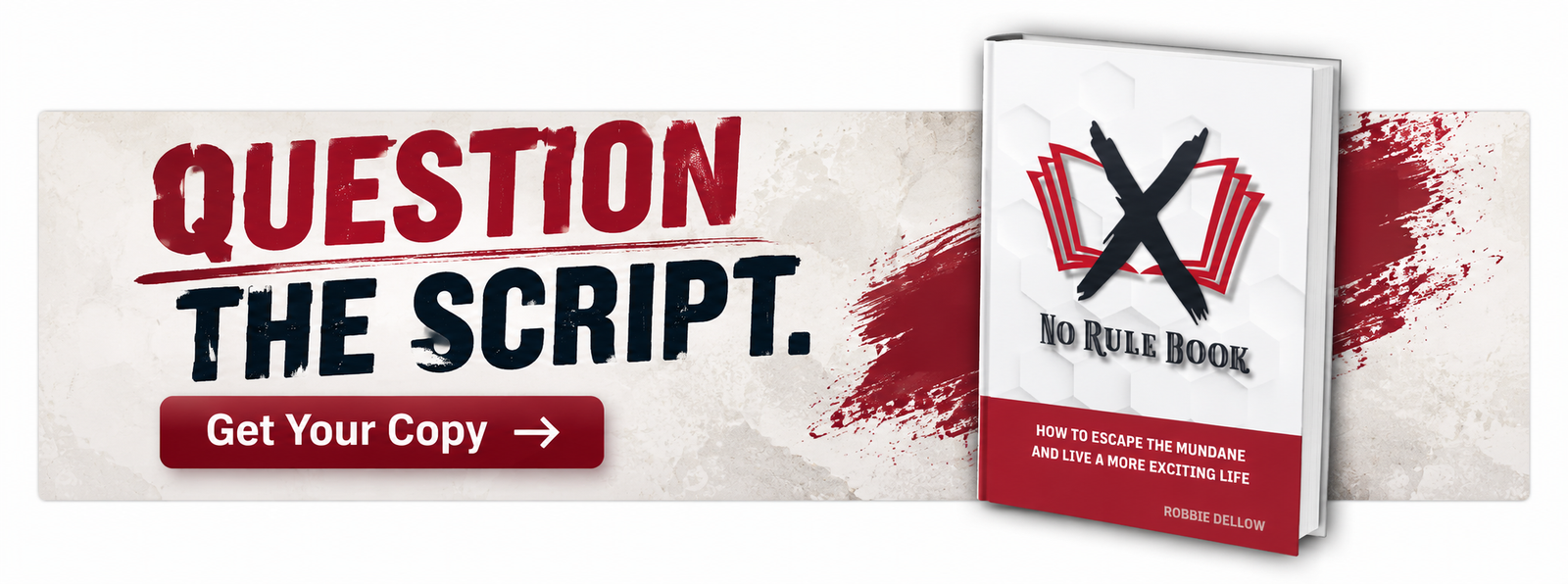
That is the question at the heart of NoRuleBook. Not “How do I rebel against society?” but something much more useful: “If nobody else had written the script for me, what would I choose for myself?”
The answer may not require you to change your life at all. Or it may change more than you expect. Either way, there is value in knowing that the life you’re building is one you consciously chose rather than one you simply inherited.
Click the NoRuleBook image below to explore the collection.
The NoRuleBook Collection
-
-20%
NoRuleBook
$9.95Original price was: $9.95.$7.95Current price is: $7.95. -
-50%
No Rules Start-Up
$19.95Original price was: $19.95.$9.95Current price is: $9.95. -
-35%
NoRuleBook Bundle
$22.90Original price was: $22.90.$14.95Current price is: $14.95.

 Submitted 1.0
 Manual 5.0