NoRule Book Banner

AI And Emerging Technologies: The Rules Are Being Rewritten Without Permission

by Robbie Dellow
AI and emerging technologies

Every generation likes to believe it is standing at a turning point, that the world is changing faster now than it ever has before, and that everything that came before was somehow more stable, more predictable, more certain. Most of the time, that belief is exaggerated. What people are really experiencing is iteration, not transformation.

This time feels different because it is.

Artificial intelligence is no longer a concept being tested in research labs or discussed in theory. Robotics is no longer confined to factory lines hidden from public view. Quantum computing is moving from speculation toward application, and biotechnology is quietly reshaping how we think about health, longevity, and even what it means to be human. None of these technologies exist in isolation, and that is where the real shift is happening. Together, they are not just improving the world we recognise, they are making parts of it obsolete.

From a NoRuleBook perspective, this is not simply a wave of innovation. It is a moment where the underlying assumptions of society are being challenged, not by policy or ideology, but by capability. The rules are not being debated. They are being ignored.

The Industrial Rulebook Is Breaking In Real Time

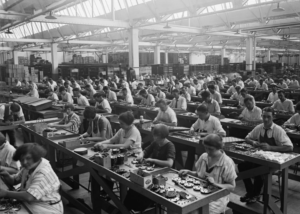
Factory in Industrial RevolutionFor over a hundred years, there was a structure that people could rely on, even if they didn’t consciously think about it. You would go through education, gain credentials, enter the workforce, and then slowly build stability over time. Promotions were tied to tenure, security was tied to loyalty, and success was something that unfolded in a straight line if you stayed within the system long enough.

That model worked because the system needed it to work.

It needed people to be predictable. It needed them to show up, follow processes, and trade time for money in a way that could be measured and managed. The entire structure of modern employment was built around that assumption, and for a long time, it held together.

What we are seeing now is not the system evolving, but the system quietly losing relevance.

Artificial intelligence does not care how long you have been in a role. Automation does not reward loyalty. Digital platforms do not require you to be in a specific location, and increasingly, they do not require you to belong to a specific organization either. What once required scale, capital, and permission, can now be achieved by individuals who understand how to use the tools available to them.

The rules did not adapt.

They simply stopped applying.

Artificial Intelligence : Leverage Changes Who Gets To Play

There is a tendency to describe artificial intelligence as a productivity tool, something that helps people do what they were already doing, just faster. That framing is comfortable because it suggests continuity, but it misses the real shift entirely.

AI is not just about speed. It is about leverage.

A single individual can now produce written content, design visuals, analyze data, build software, and automate processes in a way that previously required entire teams. The output may not always be perfect, but it is often more than sufficient to compete. And in many cases, that is all that matters.

What this really changes is not efficiency, but access.

The barrier to entry has dropped so significantly that the question is no longer “are you qualified?” but “are you willing to try?” The gatekeepers that once controlled distribution, validation, and opportunity still exist, but their control is weaker than it has ever been.

This is why AI feels disruptive in a way that previous tools did not.

It exposes how much of the old system was built on permission rather than capability.

Automation And Robotics: The Quiet Reshaping Of Work

While AI captures the lions share of the media attention, automation and robotics are quietly doing something just as significant, but far less visible. They are not replacing entire industries overnight, which is why many people underestimate their impact. Instead, they are slowly removing the need for specific tasks within those industries.

This is how disruption often happens in reality.

Not as a sudden collapse, but as a gradual erosion.

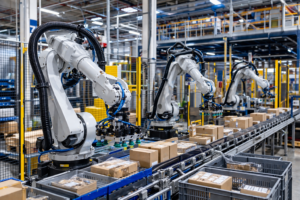
In warehouses, robots now handle logistics that once required teams of people. In retail, self-checkout systems have reduced the need for cashiers. In agriculture, automated machinery is beginning to take over processes that were historically labour-intensive. These changes do not immediately eliminate roles, but they reshape them.

The predictable parts disappear first.

What remains is either highly skilled work that requires judgment and creativity, or low-value work that is difficult to automate but also difficult to scale. The middle, where many people have traditionally built stable careers, becomes increasingly fragile.

If a task can be defined clearly enough, it can eventually be automated.

Decentralization And Digital Ownership : Control Is No Longer Central

At the same time, another shift is happening around ownership and control, one that is less about technology itself and more about how technology is structured.

For most of the modern era, control has been centralised. Platforms, institutions, and intermediaries have sat between individuals and opportunity, determining what gets seen, what gets funded, and what gets validated. That model is being challenged.

Decentralised systems, creator platforms, and direct-to-audience business models are giving individuals new ways to own and monetise their work without relying on traditional gatekeepers. You can publish without a publisher, sell without a retailer, and build an audience without a media company.

This does not mean that centralised systems disappear.

But it does mean they are no longer the only option.

And once people realize they have options, the old rules lose their power.

Quantum Computing And Biotech : The Shift Most People Will Miss

Biotech computingSome of the most important changes are happening in areas that still feel distant to most people, which is why they are often ignored.

Quantum computing, for example, has the potential to solve problems that are currently impossible for traditional computers, particularly in areas like optimisation, encryption, and complex simulation. It is not yet mainstream, but when it becomes practical, it will not feel gradual. It will feel sudden.

Biotechnology is following a similar path.

Advances in gene editing, personalised medicine, and synthetic biology are beginning to shift healthcare from something reactive to something predictive. Instead of treating problems after they occur, the focus is slowly moving toward preventing them before they develop.

You do not need to understand the technical details.

But you do need to recognise that these shifts are happening.

Because when they become visible, they will already be established.

Identity, Status And The Collapse Of Old Signals

One of the less obvious but more profound changes is happening in how identity and status are defined.

For a long time, identity was tied closely to occupation. What you did for work was often the primary way you described yourself, and status was linked to titles, income, and visible markers of success. That model is becoming less stable.

When work becomes more flexible, identity follows.

People are no longer limited to a single role or path. Someone can build a business, create content, invest, and consult, often at the same time. Skills are visible online, reputations are built in public, and opportunities are no longer confined to traditional career ladders.

This creates a different kind of freedom.

But it also requires a different kind of thinking.

Because there is no longer a clear path to follow. 

Read the ‘Why people continually follow rules that don’t work‘ article to learn more. 

The Real Risk Is Not Technology. It Is Doing Nothing

Every major shift creates uncertainty, and it is natural for people to focus on the risks. AI raises concerns about job loss, automation raises concerns about displacement, and new systems raise concerns about inequality and control.

Those concerns are valid. But they are not the biggest risk.

The bigger risk is hesitation.

Waiting for clarity. Waiting for regulation. Waiting for someone else to define what is safe and what is not. The problem with waiting is that by the time something feels certain, the advantage has already been taken by those who moved earlier.

Technology does not remove responsibility. It concentrates it.

The people who engage with these tools, even imperfectly, gain options. The people who avoid them inherit whatever structure is left behind.

NoRuleBook Thinking In A World Driven By Emerging Technology

The core idea remains simple, even as everything around it becomes more complex.

Systems change. Thinking endures.

Emerging technologies are not rewarding the most qualified or the most experienced in the traditional sense. They are rewarding the people who are willing to engage, experiment, and adapt before everything is fully understood.

You do not need to master artificial intelligence or understand quantum computing at a deep level.

But you do need to be aware of how these tools are shifting leverage. A good source for cutting-edge AI thinking is the MIT technologyreview.com website.

That might mean using AI to build something small. Testing a simple online product. Exploring how automation applies to your industry. Paying attention to where control is moving, and where it is weakening.

Because the real divide is not between those who understand technology and those who do not.

It is between those who act and those who wait.

Lessons : Navigating The Future Without A Rulebook

The first lesson is that clarity rarely comes before action. It usually follows it. Waiting until everything makes sense is a reliable way to be left behind.

The second is that skills are compounding faster than credentials. The ability to learn, adapt, and apply is becoming more valuable than formal validation.

The third is that identity needs to remain flexible. Rigid paths are difficult to maintain in a world where roles are constantly shifting.

And finally, the future is not shaped by those who are the most optimistic or the most pessimistic.

It is shaped by those who are willing to engage early. Even when the outcome is uncertain.

To learn more about the future of business and AI, with an emphasis on eCommerce, grab a copy of NoRules-Start-Up

The NoRuleBook Masterclass Collection

Facebook

Related Articles

Leave a Comment