Search for the habits of successful people and you will find remarkably similar advice repeated everywhere. Wake up earlier. Read more books. Exercise regularly. Keep a journal. Follow a morning routine. There is nothing inherently wrong with any of these habits, but copying them can create the illusion that success is built by reproducing the visible routines of people who have already achieved it. The more useful question is what sits underneath those routines.
A successful entrepreneur may wake at five in the morning, but getting up early is unlikely to be the reason the business succeeded. What may matter is that those early hours provide uninterrupted time to concentrate on difficult work. An investor might read constantly, but the number of books completed is less important than the habit of continually updating knowledge and questioning assumptions. Someone else may never journal, meditate or follow an elaborate morning routine and still become extraordinarily successful. This is where much of the conventional advice about success gets the order backwards. It notices what successful people do, but doesn’t always ask what those behaviors are designed to achieve.

There is no universal routine that guarantees success, and trying to imitate somebody else’s can become another rulebook to follow. What appears far more useful is understanding the behaviors that repeatedly help people make progress: acting before every uncertainty has disappeared, concentrating on what they can control, building systems that reduce dependence on motivation, continuing to learn, protecting their time, taking calculated risks and knowing when persistence requires changing the method rather than abandoning the objective.
Those habits are less glamorous than the routines usually presented on social media, but they are also far more adaptable to different lives.
Don't copy the routine. Understand what the routine is designed to achieve.
SUCCESSFUL PEOPLE ACT BEFORE THEY HAVE ALL THE ANSWERS
One of the easiest ways to avoid making a bad decision is to keep gathering information until you feel completely certain about what to do. The problem is that important decisions rarely offer that level of certainty, and waiting for it can become an extremely convincing form of procrastination.
Successful people are not necessarily more certain than everyone else. They are often simply more comfortable making a reasonable decision with incomplete information and then allowing experience to provide information that planning never could.
This doesn’t mean acting recklessly or ignoring obvious risks. Research matters, preparation matters and some decisions deserve considerably more caution than others. The distinction is between gathering information that can materially improve a decision and continuing to gather information because making the decision feels uncomfortable.
Starting a business illustrates the difference particularly well. You can spend months researching a market, refining a logo, adjusting a website and preparing forecasts, yet none of those activities can tell you with certainty whether somebody will actually pay for what you’re offering. At some point, the only way to obtain that information is to put something in front of a potential customer and see what happens.
Action creates feedback, and feedback creates clarity.
That principle applies well beyond business. Careers, creative projects, investments and major life changes often become clearer after the first sensible step has been taken, because reality begins replacing assumptions with evidence.
Successful people still make wrong decisions. The advantage is that they tend to discover those mistakes while they still have an opportunity to adjust, rather than spending so long searching for certainty that nothing is ever tested.
THEY TAKE RESPONSIBILITY WITHOUT PRETENDING EVERYTHING IS THEIR FAULT
Taking responsibility does not mean accepting blame for everything that happens to you. Sometimes circumstances really are against you. You can lose a job because a company restructures, see a business struggle because the economy changes, have an idea rejected by someone who never properly considered it, or encounter barriers that exist through no failure of your own.
Successful people don’t need to pretend those realities don’t exist. What matters is that they don’t allow “This wasn’t my fault” to become “Therefore there is nothing I can do.”
That is where responsibility becomes useful. You may not have chosen the situation, but you can usually make choices about how you respond to it. Losing a job might mean finding another employer, retraining for a different industry or finally testing the business idea you have been considering for years. A struggling business might require changing the product, reducing costs or accepting that the original idea isn’t working. A rejection might reveal something that needs improving, or it simply may mean finding another route.
None of those responses requires you to take responsibility for causing the original problem. They require you to take responsibility for what happens next.
This distinction also prevents personal responsibility from becoming the kind of shallow success advice that tells people every setback can be overcome through attitude alone. Some circumstances genuinely restrict our options, and some people begin with advantages that others do not have. Recognising those realities is not making excuses; pretending they don’t exist would simply be dishonest.
The useful habit is to acknowledge the situation as it actually is, separate what you cannot change from what you still can, and put your effort into the second category. Successful people cannot control everything that happens around them any more than anyone else can, but they are often unwilling to surrender control over the decisions that remain theirs.
You don't have to take the blame for what happened. You do have to decide what happens next.
THEY BUILD SYSTEMS THAT WORK WHEN MOTIVATION DOESN'T
Motivation feels powerful when it arrives, which is probably why so much success advice is built around finding more of it. The difficulty is that motivation is unreliable. It rises when an idea is new, when progress is visible or when enthusiasm is high, and often disappears precisely when the work becomes repetitive, difficult or boring. Anything that depends entirely on remaining motivated therefore has a fragile foundation.
Successful people often solve this problem less dramatically. They build routines, deadlines, environments and commitments that make useful behavior easier to repeat even when they do not particularly feel like repeating it. Instead of asking themselves every day whether they are motivated enough to work on something important, they reduce the number of times that decision needs to be made.
This is what discipline looks like when it is treated as infrastructure rather than willpower. A writer who has protected two hours every morning doesn’t need to rediscover a passion for writing before sitting down. An entrepreneur who reviews the same handful of business numbers every Friday doesn’t need to wait until there is a problem before paying attention to them. Someone who automatically transfers money into savings or investments has removed another recurring decision from the process.
The routine itself isn’t the point. The value lies in designing an environment in which the behavior that matters does not constantly have to compete with whatever feels easier at that particular moment.
The strongest systems are often surprisingly ordinary, which is one reason they receive less attention than dramatic stories about motivation. They don’t look impressive. They simply just keep working.
THEY KEEP LEARNING, BECAUSE WHAT WORKED YESTERDAY MAY NOT WORK TOMORROW
Successful people do not necessarily know more than everyone else, but they tend to remain willing to discover that something they believe is no longer true. That distinction becomes increasingly important in a world where technology, industries and consumer behaviour can change faster than the experience that once made someone successful.
For much of the past, it was possible to learn a profession or trade, become good at it and rely on much of that knowledge for decades. That is becoming harder to assume. Artificial intelligence (AI) can now perform tasks that recently required specialist skills, new technologies are changing how businesses operate, and entire industries can be disrupted before the people working within them have had much time to adapt.
The useful habit, therefore, is not simply reading more books. Reading can be valuable, but so can experimenting, taking a course, listening to someone with different expertise, using new technology, studying competitors, asking better questions or learning directly from something that failed. The method matters less than maintaining the willingness to update what you know.
This is also why experience can become both an advantage and a liability. Years of experience can produce valuable judgment, but they can also create confidence in methods that succeeded under circumstances that no longer exist. The longer something has worked, the easier it becomes to assume that it will continue working.
Successful people tend to treat knowledge as something that requires maintenance. They keep the useful parts of their experience while remaining willing to replace ideas, skills and methods when better evidence appears.
The objective is not to know everything. It is to avoid becoming so attached to what you already know that you stop noticing when the world has moved on.
THEY PROTECT THEIR TIME ACCORDING TO WHAT REALLY MATTERS
Almost everyone says their time is valuable, yet calendars often reveal a very different set of priorities. Hours disappear into meetings that achieve little, notifications interrupt concentrated work, minor tasks are completed because they feel productive, and important projects are repeatedly pushed aside because they rarely arrive with the same urgency.
Successful people are not given more time. What often distinguishes them is a greater willingness to decide what deserves their time and, just as importantly, what does not.
That doesn’t mean trying to make every waking hour productive. Rest, relationships, exercise, travel and doing absolutely nothing can all be worthwhile uses of time. The mistake is assuming that being busy and using time well are the same thing.
Protecting time begins by recognizing which activities actually move something important forward. For an entrepreneur, that might mean developing a product, talking to customers or improving distribution rather than spending hours making minor changes to a logo. For someone building a new career, it might mean acquiring a valuable skill rather than repeatedly reorganizing a résumé. The specific activity changes, but the principle remains the same: Important work needs enough uninterrupted time to produce a result.
This is why successful people often become comfortable saying NO, delegating work, automating repetitive tasks or simply eliminating activities that no longer justify the time they consume. They understand that every YES carries an invisible cost because the same hour cannot be spent twice.
Money can be earned again. An opportunity can return. Time cannot.
The habit isn’t filling every hour. It is making sure that enough of those hours are going towards the things you claim matter most.
THEY TAKE RISKS BY LOOKING AT THE DOWNSIDE AS WELL AS THE UPSIDE
It is difficult to achieve anything unusual while avoiding uncertainty altogether, but that does not mean successful people are naturally fearless or comfortable gambling with everything they have. Often, the more useful habit is learning how to distinguish a calculated risk from a reckless one.
Instead of only asking “What if this fails?”, they also ask :
- What failure would actually look like.
- How much money could be lost?
- How much time would be wasted?
- Would the decision be reversible?
- Could they recover?
- What might they learn even if the outcome is disappointing?
Once the downside has been defined rather than merely feared, the risk can look very different.
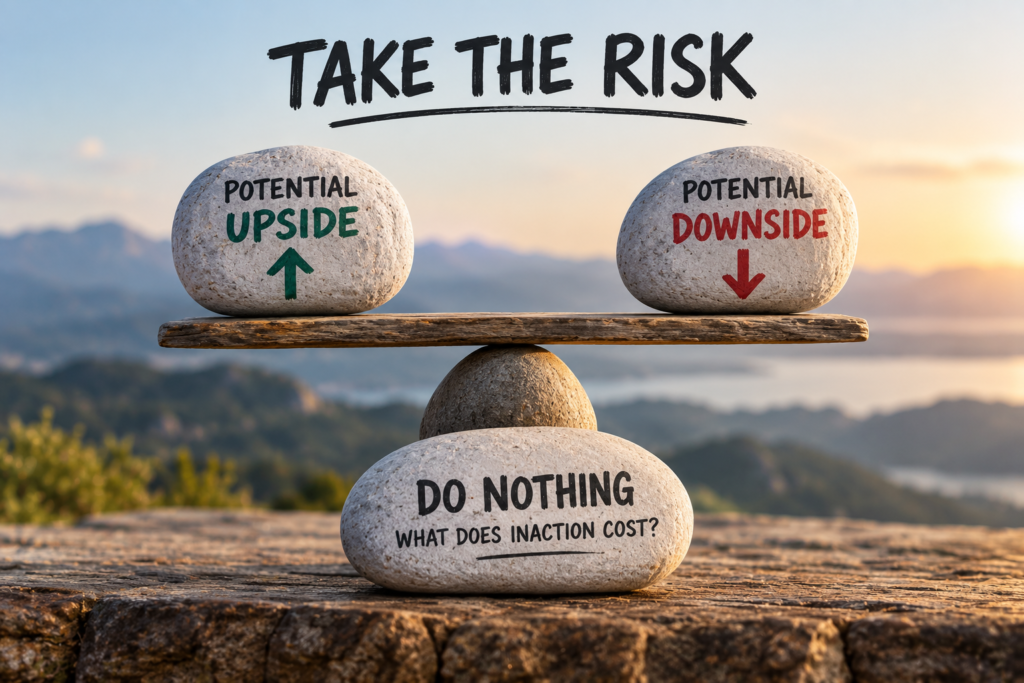
The other side of that calculation matters just as much. Avoiding a risk also has consequences, yet those consequences are easier to overlook because nothing immediately happens. Staying in an unsatisfying career for another ten years carries risk. Never testing a business idea carries risk. Keeping all your money in an inappropriate place because investing feels uncertain carries risk. Waiting indefinitely for the perfect moment can be a decision with its own cost.
This doesn’t mean the adventurous option is automatically the right one. Sometimes examining the downside will show that a risk really is too large, particularly when failure could cause damage from which recovery would be extremely difficult. The habit is simply to evaluate both sides rather than treating action as risky and inaction as safe.
That is a much more useful way to think about risk, because some of the most important opportunities in life do not require eliminating uncertainty. They require understanding whether the uncertainty is worth accepting.
THEY PERSIST, BUT NOT WITH SOMETHING THAT CLEARLY ISN'T WORKING
Persistence appears in almost every discussion about success, and for good reason. Most worthwhile outcomes take longer than expected, progress is rarely consistent, and there are usually periods when the effort being invested seems considerably greater than the results coming back.
The problem is that persistence is sometimes confused with stubbornness. Continuing to do exactly the same thing despite mounting evidence that it isn’t working is not necessarily determination; sometimes it is simply an unwillingness to reconsider the approach.
Successful people tend to persist with the objective while remaining much more flexible about the method. An entrepreneur may remain determined to build a viable business while changing the original product, pricing or target market. Someone pursuing a particular career may continue working towards the same broader goal while acquiring different skills or finding another route into the industry. The destination can remain relatively stable even while the path towards it changes repeatedly.
This is why setbacks can be useful when they are treated as information rather than simply something to endure. A failed attempt can reveal what customers don’t want, where an assumption was wrong or which part of an approach needs changing. Persistence becomes valuable when that information is fed back into the next attempt.
There is also a point at which the evidence may justify walking away altogether. Successful people are not immune to sunk-cost thinking, but continuing merely because you have already invested years, money or effort can turn persistence into a liability. Sometimes the intelligent decision is to stop, take what you have learned and direct your effort somewhere with better prospects.
The habit, then, isn’t simply never giving up. It is knowing the difference between a difficult path that still has potential and a dead end you are refusing to acknowledge.
Be persistent about the objective. Be flexible about the method.
THEY LOOK FOR AN EDGE INSTEAD OF SIMPLY WORKING HARDER
Hard work matters, but there is a limit to how far simply ‘doing more’ can take you. Everyone has the same number of hours in a day, and eventually working longer becomes a poor substitute for finding a better way to use them.
Successful people often look for an edge: Something that allows the same effort to produce a disproportionately better result. That advantage does not have to be revolutionary. It might be specialist knowledge, a better business model, a distinctive product, stronger distribution, a useful network, an underserved market or a technology that allows one person to accomplish work that previously required several.
Artificial intelligence makes this principle particularly relevant now. Used well, AI can give an individual or small business capabilities that would previously have required considerably more time, money or specialist expertise. But the advantage is unlikely to come simply from having access to AI when everybody else has access to the same tools. The edge comes from learning how to use those tools better, combining them with knowledge others don’t have or applying them to a problem competitors have overlooked.
The same principle applies without technology. A small business trying to compete with a much larger company may never win by spending more on advertising, but it might win by serving a narrower group of customers exceptionally well. Someone building a career may struggle to compete on qualifications alone but become unusually valuable by combining two skills that rarely appear together.
This is why working harder at everything is usually less useful than identifying where additional effort creates the greatest advantage. Once that edge is found, consistent work can compound it rather than merely adding more hours.
Success is rarely about being better at everything. It is often about becoming unusually good, useful or difficult to replace in the places that matter.
THEY BUILD A LIFE THAT MATTERS TO THEM
Perhaps the most important habit of successful people is also the easiest to overlook: At some point they determine what success actually means to them.
Society provides plenty of ready-made answers. Earn more money. Build a bigger business. Buy a better house. Gain status. Climb further up the career ladder. Retire with enough wealth to finally enjoy yourself. None of those ambitions is inherently wrong, but they become questionable when we pursue them without ever deciding whether they are things we genuinely want.
This is where conventional success advice can become its own trap. It teaches people how to become more disciplined, productive and ambitious without first asking whether all that effort is taking them somewhere they actually want to go. You can become extraordinarily efficient at building a life that doesn’t particularly matter to you.

For one person, success might mean building a company and becoming financially independent. For another, it could mean having enough income to work three days a week, spend more time with their children and travel. Someone else may want to master a profession, create something important, live in different countries, or simply have enough control over their time that work no longer dominates their identity. There is no universal answer, which is precisely the point.
Passion can certainly be part of this. If you discover work you genuinely care about and can build a life around it, that can be enormously rewarding. But a meaningful life does not require turning everything you love into a career. Sometimes work provides the money, flexibility or independence that allows the things you care about to happen elsewhere.
The habit is therefore not following your passion. It is regularly questioning whether the things consuming your time, energy and ambition are contributing to a life you would consciously choose.
That can require an unusual kind of courage because your definition of success may look unimpressive according to somebody else’s. Earning less in exchange for more freedom, declining a promotion, leaving a prestigious career, keeping a business deliberately small or choosing experiences over possessions can look like moving backwards when measured against conventional markers of achievement. But those judgments only matter if you have accepted somebody else’s definition of what winning looks like.
Successful people don't necessarily build the biggest life, the richest life or the most impressive life. But they do build a life that matters to them.
THE NORULEBOOK 'SUCCESS HABIT' AUDIT
The habits in this article are deliberately different from a checklist of morning routines or productivity tricks because there is no single routine that works for everyone. What matters is whether the behaviours underneath your routine are helping you build the life you have decided matters to you.
Rather than asking whether you wake early enough, read enough books or work enough hours, ask yourself:
Action
Do I make reasonable decisions with the information available, or do I keep waiting for certainty before I act?
RESPONSIBILITY
When something goes wrong, do I spend most of my energy on what happened, or identify what remains within my control and decide what to do next?
SYSTEMS
Am I relying on motivation to keep making progress, or have I built routines and systems that continue working when motivation disappears?
LEARNING
Am I continuing to update my skills, knowledge and assumptions, particularly when the world around me is changing?
TIME
Does the way I actually spend my time reflect what I say matters most to me?
RISK
Do I calculate the potential upside and downside before taking a risk, whilst also considering the cost of doing nothing?
PERSISTENCE
Am I persistent about what I want to achieve, whilst also remaining willing to change the method when evidence shows it isn’t working?
AN EDGE
Am I simply trying to work harder, or am I looking for an advantage that can make my effort more valuable?
There is no perfect score. The purpose of this audit is to identify where the gap is greatest between how you currently behave and the person you need to become to build the life you actually want.
That last part matters because these habits are not the definition of success. They are the tools for pursuing it.
SUCCESS ISN'T A ROUTINE YOU CAN COPY
There is an understandable appeal in studying successful people and trying to reproduce what they do. If someone has achieved something we want, copying their habits can feel like a shortcut to achieving the same result. But the visible routine is often the least useful part to copy.
Getting up at 5am will not make you successful if the extra hours are spent on things that don’t matter. Reading a book every week achieves little if nothing you learn changes how you think or act. Working longer hours can actually move you further away from the life you want if you have never stopped to decide what all that work is supposed to achieve.
The more useful lessons sit underneath those behaviours. Act when you have enough information rather than waiting forever for certainty. Take responsibility for what you can influence. Build systems that reduce your dependence on motivation. Keep learning as circumstances change. Protect your time. Understand risk rather than automatically avoiding it. Persist without becoming stubborn, and look for ways to make your effort more valuable rather than simply increasing it.
Most importantly, decide what all of those habits are for.
There is little value in becoming exceptionally disciplined, productive and successful according to somebody else’s definition, only to eventually discover that you have become very good at building a life you never consciously chose.
The goal isn’t to copy the habits of successful people. It is to develop the habits that help you build your version of a successful life.
Take The Next Step
If this article has made you question some of the conventional advice about success, the next question is much more personal: How many of the goals you are working towards did you consciously choose, and how many did you simply inherit?
That question sits at the heart of NoRuleBook. The book explores the unwritten expectations that influence how we think about work, money, success, relationships and the way a life is supposed to unfold, then helps you decide which of those assumptions still deserve a place in your own life.
If you’re ready to look beyond somebody else’s definition of success, grab a copy of NoRuleBook below and start questioning the rules that may be shaping your decisions without you even realising it.
Success isn’t about following the right rulebook. It’s about making sure you’re building a life you would actually choose.
The NoRuleBook Collection
-
NoRuleBook
$9.95Original price was: $9.95.$7.95Current price is: $7.95. -
No Rules Start-Up
$19.95Original price was: $19.95.$9.95Current price is: $9.95. -
NoRuleBook Bundle
$22.90Original price was: $22.90.$14.95Current price is: $14.95.