George Orwell’s Nineteen Eighty-Four was published in 1949, yet it has never really disappeared.
We usually remember the obvious warnings: surveillance, propaganda, censorship and an all-seeing state. But beneath them sits a quieter and perhaps more unsettling idea.
The most effective rules are the ones we eventually enforce upon ourselves
Orwell’s world didn’t simply control what people did. It shaped what they believed was acceptable to think, say and even imagine.
Strip away the telescreens and Thought Police, and that idea becomes considerably harder to dismiss as dystopian fiction. Because every society has invisible boundaries. And most of us become remarkably good at staying inside them.
It Was Never Just About Surveillance
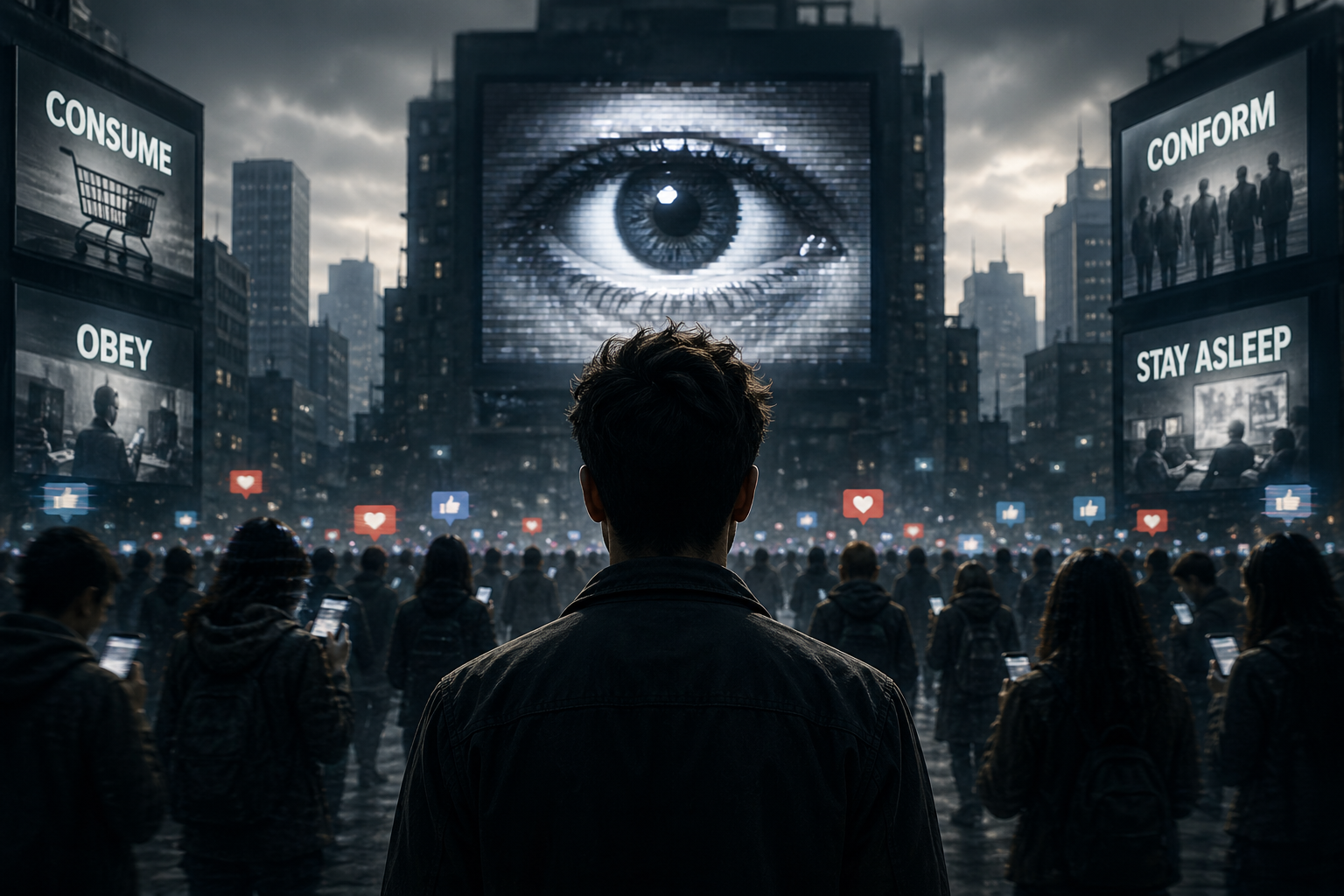
When people think of 1984, they picture cameras, screens and an all-seeing authority.
That’s the visible layer — the part that makes it easy to say, “That would never happen here.”
But Orwell’s deeper mechanism of control was psychological.
People learned what could be said. What could be questioned. What could be believed.
Eventually, they began policing themselves.
That transition matters because external enforcement is expensive and obvious. Internalised rules are neither.
Once people anticipate the boundaries and adjust their own behaviour accordingly, the boundaries can become almost invisible.
The Power of Self-Censorship
What makes 1984 especially unsettling is not merely that people are controlled. It is that external control gradually reaches inside them.
Winston knows the rules. He anticipates the consequences of breaking them. Even his private thoughts become something he learns to fear. That is where Orwell’s idea reaches beyond the novel.
Modern democratic life is obviously not Orwell’s Oceania. But the psychological mechanism is worth recognizing :
- We all learn boundaries.
- Which opinions receive approval.
- Which ambitions seem respectable.
- Which careers look sensible.
- How we’re expected to behave at particular ages.
- What success is supposed to look like.
Nobody necessarily commands us to follow these expectations. Often, nobody needs to.
We choose the safe option. Suppress an unpopular opinion. Follow the expected path. Abandon an ambition that might look foolish. And because the decision came from inside us, it feels entirely our own.
The most effective form of control is the one that feels like freedom.
The Invisible Rules That Shape Everything
Most people think of rules as something visible — written down or enforced by authority.
But some of the rules that shape our lives most powerfully are never written anywhere :
- Get a secure job.
- Be realistic.
- Don’t take unnecessary risks.
- Follow the conventional path.
- Act your age.
Nobody necessarily orders us to follow these rules. They are repeated through families, workplaces, schools, advertising and everyday conversation until eventually they begin to feel less like expectations and more like common sense.
And that’s when they become most powerful.
"A rule you recognize can be questioned.
A rule you mistake for reality rarely is.
Language as a Tool of Control
One of the most fascinating ideas in 1984 is Newspeak — a deliberately restricted language designed to reduce the range of thoughts people could express.
Orwell took the idea to a terrifying extreme: Remove the language for certain ideas and eventually those ideas become harder even to conceive.
Modern everyday language obviously isn’t Newspeak. But Orwell’s broader insight remains interesting :
Language doesn’t just describe our choices. It can frame them.
- “Be realistic.”
- “That’s not how the world works.”
- “You need security.”
- “People your age don’t do that.”
- “You can’t just throw everything away.”
None of those statements physically prevents someone from doing anything. But repeated often enough, they can establish invisible boundaries around what seems sensible, respectable or possible.
Eventually those voices can become our own.
WHEN SAFETY BECOMES ITS OWN RULE
There is nothing wrong with wanting stability.
A secure income, a home, routines and financial commitments can create enormous freedom.
The problem begins when security stops being something we consciously choose and becomes something we’re afraid to question.
A career we once wanted becomes a career we can’t imagine leaving.
A lifestyle becomes expensive to maintain.
Responsibilities accumulate.
Eventually the cost of changing direction feels greater than the cost of remaining unhappy.
Nothing is physically keeping us there.
Yet the structure we’ve built can begin to feel immovable.
Sometimes the safest-looking path carries its own risk : Waking up years later and realizing you never chose another one.
How Reality Gets Shaped Without You Noticing
Human beings learn what is normal partly by watching everyone around them. If almost everyone follows the same path, that path begins to look inevitable.
Education. Career. Mortgage. Marriage. Children. Retirement.
None of these choices is inherently wrong. For millions of people they are exactly the life they genuinely want.
The problem comes when :
quietly becomes
“This Is How Life Is Lived.”
Once that happens, alternatives begin to look unusual simply because fewer people choose them. And unusual can easily become unrealistic. Unrealistic becomes irresponsible.
Eventually an option disappears from consideration without anyone ever formally banning it.
WHY NORMAL RARELY GETS QUESTIONED
Most of us don’t wake up each morning examining the assumptions beneath our lives. Nor could we. We’d never get anything done.
We rely on familiar patterns because familiarity makes life manageable. But familiarity has a side effect:
What we see repeatedly begins to feel inevitable.
That’s why invisible rules are difficult to recognise. They don’t usually announce themselves as restrictions. They appear as normality.
And if you cannot see an alternative, there seems little reason to question the path you’re already following.
This is where Orwell’s warning becomes useful — Not because we’re secretly living in Oceania, but because he understood something important about human beings:
Once a system becomes normal enough, we stop seeing the system.
Seeing the System Changes Everything
This isn’t about rejecting structure or abandoning stability. That would miss the point just as much as blindly following it. The real shift comes from awareness — Recognizing that some of the decisions that feel automatic may be shaped by assumptions you never consciously chose. Once you begin to notice those patterns, even in small ways, you approach decisions differently.
Instead of asking :
“What am I supposed to do?”
you begin asking :
“Is this actually what I want?”
That question alone can interrupt the automatic cycle.
Because once you can see the rule, you can decide whether it deserves to remain one.
WHAT 1984 CAN STILL TEACH US
1984 is often framed as a warning about a dystopian future. But part of its enduring power lies closer to home: in how people adapt to systems, how boundaries become normal, and how difficult those boundaries become to see once we’ve lived inside them long enough.
Our world does not need to look like Orwell’s for that insight to matter.
The useful question isn’t whether we’re literally living in 1984. We’re not.
The more interesting question is whether some of the psychological mechanisms Orwell explored — conformity, self-censorship, restricted thinking and the normalisation of control — can appear in far less dramatic forms.
And once we recognise them, the focus shifts from the system back to ourselves.
Because that’s where we still have choices.
The Uncomfortable Truth
Here is the uncomfortable part.
Most of the unwritten rules governing our lives don’t have an obvious author.
Nobody necessarily ordered us to pursue a particular career, measure success a particular way, fear certain risks or postpone certain dreams. We absorbed those ideas gradually. Which means eventually we have to confront an uncomfortable possibility :
Some of the rules restricting us may now be enforced by us.
We repeat them. We defend them. We sometimes pass them to other people. And often we don’t even recognize them as rules.
That’s why awareness matters.
There may be no official rulebook telling you how your life must be lived. But that doesn’t mean you’re not living as if there is one.
Further Reading
This article is part of the NoRuleBook Hidden Rules Series — four different stories exploring the forces that quietly shape how we think, choose and live.
Explore the series :
Part 1: 1984 Meaning Explained — The Hidden Rules Controlling Your Life
(Why you follow rules you never consciously agreed to)
Part 2: Fight Club Meaning Explained — Why Doing Everything Right Feels Empty
(What happens when you build a life that looks right but doesn’t feel like yours)
Part 3: The Matrix Meaning Explained — What If Your Reality Isn’t Real?
(Why the world you accept may not be the full picture)
Part 4: The Truman Show Meaning Explained — What If Your Life Was Being Shaped Without You Knowing?
(How observation and environment quietly shape what you see — and what you never question)
Take The Next Step
Orwell imagined a world in which the rules were impossible to miss. They appeared on screens, shaped language, rewrote history and reached into the most private corners of people’s lives. The unwritten rules surrounding our own lives are rarely so obvious, which may be precisely why they can be so difficult to recognise.
They arrive quietly through expectations about work, money, success, age, security and what a sensible life is supposed to look like, until ideas we never consciously chose can begin to feel like conclusions we reached entirely on our own.
The purpose of noticing those rules isn’t to reject everything conventional. Many conventional choices are good choices. It is simply to create enough distance to ask a question we don’t ask nearly often enough: is this something I genuinely want, or something I’ve simply learned to want?
NoRuleBook explores those invisible expectations and what can happen when you begin separating the rules that genuinely serve you from the ones you’ve been following simply because they were already there.
Click the NoRuleBook image below to explore the collection.
The NoRuleBook Collection
-
-20%
NoRuleBook
$9.95Original price was: $9.95.$7.95Current price is: $7.95. -
-50%
No Rules Start-Up
$19.95Original price was: $19.95.$9.95Current price is: $9.95. -
-35%
NoRuleBook Bundle
$22.90Original price was: $22.90.$14.95Current price is: $14.95.

 Submitted 1.0
 Manual 5.0