



For much of the industrial age, there was a relatively understandable relationship between labor and output. Factories needed people standing beside machines. Offices needed people processing paperwork. Businesses needed employees physically present because most work couldn’t easily travel beyond the person performing it.
If a factory wanted twice as much output, it might need twice as many workers, longer shifts, more machines or some combination of all three.
Under those conditions, hours mattered enormously. So an unwritten bargain developed around work: Give an organization your time, effort and loyalty, and in return it would provide income, stability and perhaps an increasingly comfortable life as your career progressed.
That bargain was never universal, nor was it always fair, but it became deeply embedded in the way generations thought about work.
Then technology began changing what one person’s effort could produce. Computers automated tasks. Software replicated work. The internet made global distribution almost instantaneous. Digital products could be copied at negligible cost. Social platforms allowed individuals to build audiences previously available only to media companies. Artificial intelligence is now accelerating parts of that transformation again.
The connection between hours worked and value created became much less straightforward.
But culturally, we kept much of the old rule. We continued treating effort as though effort itself deserved a return.
 One of the hardest things to accept about work is that effort feels as though it should have a direct relationship with reward. If someone finishes a twelve-hour shift physically exhausted, while somebody else spends a few hours at a laptop solving a problem that earns considerably more money, it is understandable that the difference can feel unfair. We instinctively associate effort with deservingness because most of us were taught from childhood that the harder we work, the more we should expect in return.
The economy, however, doesn’t measure how tired you are at the end of the day. It responds, often imperfectly and certainly not always fairly, to things such as scarcity, demand, usefulness, judgement, ownership and the number of people who can benefit from what you create. Two people can therefore work with exactly the same determination for exactly the same number of hours and receive radically different financial outcomes, not because one person’s effort matters more as a human contribution, but because their effort is attached to something the market values differently.
Imagine one person who becomes exceptionally efficient at performing a task that thousands of other people can also perform, while another spends the same amount of time developing a specialised skill that very few people possess. Both may be hardworking, conscientious and exceptionally good at what they do, yet their economic value is unlikely to develop in the same way because scarcity changes what somebody is willing to pay for their ability.
This distinction matters because economic value and human value are not the same thing, and confusing them can lead us towards a particularly damaging conclusion: if we’re not being rewarded sufficiently, perhaps we simply aren’t working hard enough. So we stay later, take on more responsibility, answer more emails and sacrifice more of our time, even when the structure surrounding that work gives the additional effort very little opportunity to produce a significantly different result.
At some point, therefore, the better question may not be how much more effort we can squeeze out of ourselves, but whether all that effort is actually moving us towards something we want.
“The better question isn’t always ‘How can I work harder?’ Sometimes it’s :
One of the biggest changes in the modern economy isn’t that hard work has become less important, but that technology and distribution have radically changed how far the results of that work can travel.
Consider a teacher standing in a classroom. For most of history, the number of people who could benefit from a lesson was limited by physical space and the teacher’s available time. Once the lesson ended, reaching another group generally required teaching it again. Today, that same teacher might spend considerably more time developing an exceptional online course, but once it exists, thousands of people can potentially learn from work that only had to be created once.
The same principle appears almost everywhere. A designer can continue selling their time project by project, but can also create templates or digital products that are sold repeatedly. A writer can spend months producing a book that continues reaching readers years later. A software developer can spend thousands of difficult hours creating a product without knowing whether anybody will buy it, but if it succeeds, serving the next thousand customers doesn’t necessarily require another thousand times the original development effort.
None of these people have discovered an escape from hard work. In many cases, creating something capable of reaching a large audience requires far more initial effort than simply selling another hour of labor. What changes is what happens after the work has been done.
 This is the basic idea behind leverage: finding ways for the results of your effort to extend beyond the individual hours you spent producing them. Technology can provide it, but so can media, capital, intellectual property, reputation, systems, distribution and an audience that trusts what you create.
The important question isn’t therefore how to avoid working hard. It is whether some of the work you’re already doing could be structured so that its value continues travelling after your involvement ends.
This can also encompass ownership, because there is a meaningful difference between being paid once for the time you spend and using some of that time to create something that remains valuable afterwards. That doesn’t mean everyone should start a business or turn every hobby into an income stream; an asset could be as conventional as an investment or as personal as a book, product, piece of intellectual property or body of expertise. The point is simply to recognise that while time disappears as we spend it, some of the things we create with that time don’t have to
Artificial Intelligence (AI) is making this distinction even harder to ignore because it is beginning to separate the amount of human effort required for some tasks from the amount of useful output those tasks can produce. Work that once required hours can sometimes be completed much faster with the right technology, while new kinds of work are becoming possible for individuals who previously would have needed teams of specialists.
The instinctive response can be to view this as somehow devaluing hard work, as though completing a task in one hour with technology is less worthy than spending five hours doing exactly the same thing manually. But if the outcome is equally good—or better—the additional four hours don’t automatically make the work more valuable simply because they made the person performing it more tired.
The more interesting question is what happens to those four hours.
They might simply disappear into more work, allowing organizations to expect greater output without improving anyone’s life. But they could also be redirected towards judgement, creativity, relationships, strategy, learning or entirely new opportunities that previously had no room to exist. The technology itself doesn’t decide which outcome occurs.
 AI is therefore another example of why direction matters. Someone can use it to produce mediocre work faster, just as somebody with a powerful machine can manufacture the wrong product more efficiently. The advantage comes from combining technology with the human abilities that remain essential: deciding which problems are worth solving, recognizing when an answer is wrong, understanding context, exercising judgement and knowing what other people actually value.
For NoRuleBook, the question isn’t whether using AI means someone has worked less hard. It is whether they have used the tools available to make their effort more useful.
-
-20%

NoRuleBook
Original price was: $9.95.$7.95Current price is: $7.95. -
-50%

No Rules Start-Up
Original price was: $19.95.$9.95Current price is: $9.95. -
-35%
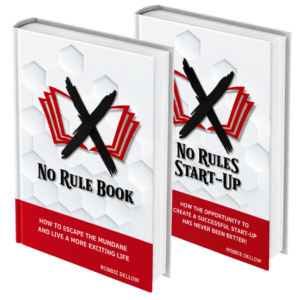
NoRuleBook Bundle
Original price was: $22.90.$14.95Current price is: $14.95.

 Submitted 1.0
 Manual 5.0