
THE OLD BUSINESS RULEBOOK
For much of modern business history, starting something of your own came with a fairly predictable set of requirements. You needed capital, premises, equipment and usually employees. If you wanted to sell physical products, you might need wholesalers, distributors or retailers willing to stock them. If you wanted to advertise, reaching a meaningful audience could require newspaper, radio, television or other media that was expensive and largely controlled by established businesses.
Geography mattered enormously because most businesses sold primarily to people who lived nearby, whilst specialist knowledge often meant hiring someone who possessed it. Growing a business usually meant adding more people, more premises, more inventory and more overheads.
None of these were necessarily written rules. They were simply consequences of the business environment that existed at the time, and after generations of operating within those constraints, many of them became embedded in our idea of what starting and running a business was like.
Then the environment changed.
The internet made it possible to reach customers directly. Ecommerce allowed a small business to sell well beyond its local market. Cloud software replaced infrastructure that once required considerable investment. Freelance platforms opened access to expertise around the world. Social media gave businesses ways to reach audiences without owning traditional media, while automation allowed increasingly complex processes to be handled without adding another employee every time the workload increased.
Now artificial intelligence is lowering another set of barriers by giving individuals access to capabilities that previously required considerably more specialist knowledge, time or money.

The important point isn’t that business has become easy. It hasn’t. It is that many of the assumptions about what you need before you’re allowed to start were created for a business environment that no longer exists.
Yesterday's business rules can quietly become today's unnecessary limitations.
THE COST OF TESTING AN IDEA HAS COLLAPSED
One of the biggest changes is not simply that businesses are cheaper to start. It is that many ideas can now be tested before you build much of a business at all. That changes the order in which things can happen.
Under the traditional model, an entrepreneur might spend considerable money developing a product, leasing premises, purchasing stock, printing marketing material and putting infrastructure in place before discovering whether enough customers actually wanted what was being offered. The commitment often came before the evidence.
For many modern businesses, that sequence can now be reversed.

Someone considering a service business can create a simple online presence and start looking for their first customers before investing heavily in branding or infrastructure. A person developing a physical product can test interest with prototypes or a small production run rather than immediately committing to large quantities. A digital product can often begin in a basic form, be put in front of real users and then improved according to what those users actually do rather than what its creator assumed they would do.
The purpose isn’t to build something cheaply for the sake of being cheap. It is to buy information before buying infrastructure. This matters because one of the greatest risks in business has always been spending significant amounts of money proving that an assumption was wrong. When the cost of testing falls, more assumptions can be challenged before they become expensive mistakes.
This doesn’t remove risk, and some businesses will still require substantial capital before they can operate. Manufacturing plants, restaurants, laboratories and many other businesses cannot be launched from a laptop with a few hundred dollars. But that doesn’t change the broader shift. For a growing range of ideas, the first question no longer has to be:
“How do I find enough money to build this?”
It can be:
“How can I test whether people will buy this before I spend money producing it?”
Test the demand before you build the business.
YOUR MARKET IS NO LONGER DEFINED BY WHERE YOU LIVE
A small business once had a problem that was almost impossible to escape: There were only so many potential customers within practical reach.
If you opened a specialist shop in a small town, your market was largely determined by the number of people who could physically get to it. If the local population wasn’t large enough to support what you wanted to sell, the idea might never be commercially viable regardless of how good the product was.
The internet changed that calculation. A niche that is too small to support a business within one town can become a substantial market when those customers can be reached nationally or globally. A designer in New Zealand can work for a client in the United States. A specialist manufacturer can sell directly to customers scattered across several countries. A person with highly specific knowledge can potentially teach, advise or create products for people who share that interest without any of them living in the same place.
That doesn’t mean every business should pursue the entire world. In fact, trying to appeal to everyone can make a business considerably weaker. The opportunity comes from being able to reach enough of the right people, wherever those people happen to be.
This has quietly changed one of the oldest assumptions in business : Your location still matters. It just doesn’t necessarily define the size of your opportunity.
BUSINESS NO LONGER HAS TO SCALE ONE HOUR AT A TIME
Traditional employment creates a fairly direct relationship between time and income. You work a certain number of hours and receive money in return. Many businesses operate in much the same way. A consultant, tradesperson, hairdresser or freelancer may own the business, but there is still a practical limit to how many hours can be sold personally.
There is nothing wrong with that model, and many excellent businesses are built around it. The important change is that it is no longer the only realistic option available to an individual or small company.
Technology makes it possible to introduce leverage.
A digital product can be created once and sold repeatedly. An ecommerce store can accept orders without the owner personally processing every transaction. Software can serve additional customers without requiring another employee for each one. A recorded course can reach people in different countries and time zones. Automation can handle repetitive processes that previously consumed hours of someone’s working day.
The result isn’t passive income in the effortless sense that phrase is sometimes sold. Products still need creating, customers still need finding, systems still need maintaining and problems still need solving.
What changes is the relationship between Additional Effort and Additional Output. If every extra dollar of revenue requires another proportional hour of your time, growth eventually collides with the fact that your day has only so many hours. When systems, products or technology allow output to increase without effort rising at exactly the same rate, the business begins to gain leverage.
That is one of the most important changes in the modern business rulebook.
Working harder is no longer the only way to produce more.
YOU NEED FEWER PEOPLE'S PERMISSION TO START
Starting a business once depended heavily on gaining access to people and organizations that controlled the route to customers. A manufacturer might need a distributor willing to carry its products. An author needed a publisher. A musician needed a record company. A retailer needed premises in the right location, while reaching a large audience through advertising generally meant paying whichever newspaper, magazine, radio or television company controlled that audience.
Those gatekeepers haven’t disappeared – New ones have emerged :
- Online marketplaces decide who can sell through their platforms.
- Social networks control access to audiences through algorithms.
- Payment providers can restrict accounts.
- Search engines influence which businesses are discovered.
Building a modern business entirely around someone else’s platform can therefore create a different kind of dependency.
But there is an important difference: Many of the traditional gatekeepers are no longer the only route available.
A business can create its own website and sell directly to customers. A creator can publish without convincing a traditional publisher that an audience exists. A specialist can demonstrate expertise publicly and attract clients without waiting for an organization to award the right credentials or position. A small brand can begin building its own audience rather than depending entirely on retailers to put its products on a shelf.
The opportunity is not that modern business has no gatekeepers. It is that entrepreneurs often have more than one route around them.
That changes the starting question. Instead of asking “Who needs to give me permission?”, it is increasingly possible to ask:
and the people who might want it?”
AI HAS LOWERED ANOTHER BARRIER
The internet reduced the cost of reaching customers and accessing information. Cloud software reduced the need for expensive infrastructure. Online marketplaces and freelance platforms made skills and services available from almost anywhere.
Artificial intelligence is now lowering another barrier: Access to Capability.
Until recently, a small business owner who needed help analyzing information, writing marketing material, creating concepts, understanding data, developing software or researching a new market might have needed to learn the skill personally or pay someone who already possessed it. Those options still have value, particularly where genuine expertise and professional judgment are required, but AI can now help an individual perform a growing range of tasks that previously demanded considerably more time, technical knowledge or money.

This matters most for small businesses, because they have always operated with limited resources. A large company can employ specialists across marketing, design, research, technology and administration. A solo entrepreneur cannot. AI doesn’t suddenly make one person an expert in all of those areas, but it can narrow the capability gap and allow that person to attempt, test and understand far more before deciding where specialist help is genuinely necessary.
There is also an important warning here. Once the same technology becomes available to everyone, simply using AI is not an advantage. The advantage comes from understanding where it can remove friction, learning how to use it effectively, and combining it with knowledge, judgment or ideas that competitors cannot obtain simply by opening the same tool.
AI therefore doesn’t change the central requirement of business. You still need to create something people value. But it does change how much one person may be capable of doing on the way to achieving this.
THE NEW RULES DON'T REMOVE THE HARD WORK
Lower barriers can easily be mistaken for lower effort. They are not the same thing.
It may now be cheaper to test an idea, easier to build a website, possible to reach customers on the other side of the world and increasingly practical for one person to perform tasks that once required a team. Still, none of that guarantees that customers will care about what you create.
In some respects, lower barriers make competition tougher because the same tools available to you are also available to thousands of other people. When almost anyone can launch a website, create an online store or produce competent marketing material, simply having these things stops being much of an advantage. The work therefore moves elsewhere. You still have to understand a real customer problem, create something worth paying for, earn trust, communicate why your offer is different and continue adapting when the market tells you that an assumption was wrong. Technology can make those things easier to execute, but it cannot make the underlying business worthwhile.
This is why the changing rules of business should not be interpreted as a promise that entrepreneurship has become easy. The more important change is that failure can often be discovered earlier, ideas can be tested more cheaply and opportunities can be pursued without committing the level of resources that might once have been required. This is a much more useful kind of progress.
The modern business environment doesn’t guarantee success. It gives more people a practical opportunity to quickly and more cost effectively find out whether their idea has merit.
THE NORULEBOOK “OLD BUSINESS RULE OR CURRENT REALITY?” TEST
Many business assumptions survive long after the circumstances that created them have changed. Before accepting that something is simply ‘how business works,’ examine whether the restriction is still real.
IDENTIFY THE OLD RULE
What am I assuming I need before I can start, test or grow this idea?
ASK WHY IT EXISTED
Was there a genuine reason for this requirement, and does that reason still exist?
CHECK WHAT HAS CHANGED
Has technology, AI, ecommerce, automation, global access or a different business model reduced or removed the original barrier?
FIND THE NEW CONSTRAINT
If the old barrier has disappeared, what actually limits me now?
TEST THE NEW REALITY
What can I do cheaply and practically to find out whether my old assumption is still true?
The point isn’t to assume every old business rule is obsolete. Many exist for good reasons, and some constraints cannot be bypassed simply because technology has improved.
The purpose is to stop treating yesterday’s limitations as today’s facts without checking whether they still apply.
Take The Next Step
The opportunity created by the changing rules of business isn’t that everyone should quit their job and launch a company. It is that far more people can now explore an idea before taking that kind of risk.
You can test demand before committing heavily, reach customers beyond your immediate location, use technology to create leverage, access capabilities that once required a larger team and find alternative routes around many of the traditional gatekeepers. None of those advantages guarantees a successful business, but they can make discovering whether an opportunity exists considerably faster, cheaper and less risky.
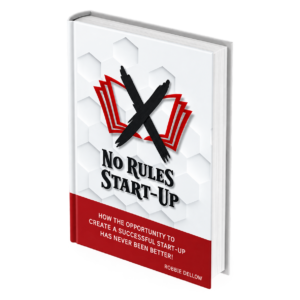
That is exactly why I wrote the No Rules Start-Up eBook. It takes the next step from understanding how the business environment has changed to showing you how to use the tools now available to actually build an online business, without burying the process under unnecessary technical jargon.
If you have an idea you’ve been putting off because you assume starting a business requires more money, technical knowledge or infrastructure than you currently have, grab a copy of No Rules Start-Up below.
You may discover that the biggest thing standing between you and testing the idea isn’t a current business rule at all. It’s an outdated one you never thought to question.
The NoRuleBook Collection
-
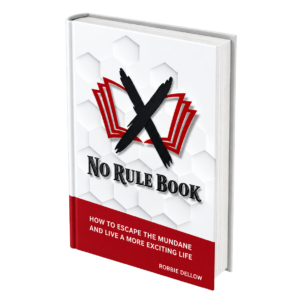
NoRuleBook
$9.95Original price was: $9.95.$7.95Current price is: $7.95. -
No Rules Start-Up
$19.95Original price was: $19.95.$9.95Current price is: $9.95. -
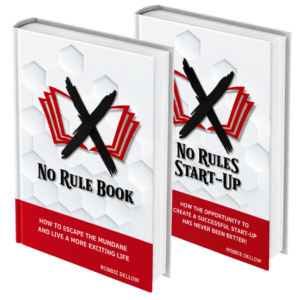
NoRuleBook Bundle
$22.90Original price was: $22.90.$14.95Current price is: $14.95.