



A customer would walk into a video store, choose a movie, take it home and agree to return it within a specified period. If the movie came back late, there was a penalty.
There was a perfectly sensible business reason for this. A physical copy of a movie could only be rented to one household at a time, which meant a video sitting forgotten beside someone’s television couldn’t be rented to another customer. The rental company therefore needed some mechanism to encourage people to return its inventory.
But the penalty also created one of the strangest relationships in retail: a company could make additional money when its customer made a mistake.
Netflix’s original DVD-by-mail subscription model approached the problem differently. Rather than building the relationship around individual rentals and late-return penalties, customers could keep discs until they were ready to return them, with the subscription structure limiting how many they could have at once.
The underlying problem hadn’t disappeared. Netflix still needed its DVDs back.
What changed was the mechanism.
Then Netflix did something even more interesting. Having challenged the assumptions of the video-rental store, it eventually had to challenge the assumptions of its own successful DVD-by-mail business as broadband made streaming increasingly practical.
That is an important part of the story because unwritten rules aren’t only inherited from old industries. Successful companies create their own.
A business model can begin as a rebellion against convention and eventually become the convention its own people are afraid to question.

There were good historical reasons for it. Selling cars required local inventory, salespeople, servicing capability, financing relationships and physical locations spread across enormous geographic areas. A dealer network allowed manufacturers to achieve that reach without owning thousands of retail operations themselves.
Tesla looked at that structure from the perspective of a new entrant and chose a different approach, selling directly to customers through its own stores and online channels rather than building a conventional franchised dealer network. What followed demonstrated something particularly useful about unwritten rules: Business convention and written regulation can become intertwined.
Tesla’s direct-sales strategy encountered resistance and legal restrictions in parts of the United States because dealer-franchise laws differed from state to state. The company wasn’t simply challenging an outdated habit; it was confronting an ecosystem of established businesses, regulation, consumer-protection arguments and commercial interests that had grown around the existing model.
That distinction matters.
Not every intermediary exists because nobody thought to remove it. Intermediaries often perform valuable functions, and sometimes the rules protecting them were created for legitimate reasons. The useful question is not simply, Can we eliminate the middleman?
It is: What function does the middleman perform, and is there now a better way to perform it?
Tesla’s significance wasn’t merely that it removed dealerships. It forced the automobile industry to reconsider which parts of the traditional distribution structure were essential and which parts existed because the industry had spent decades organising itself around them.

The building had a name over the entrance. There was usually a reception desk. Somebody cleaned the rooms. Standards were controlled by the hotel operator or brand, and that institutional structure gave travellers a reason to trust that the room they booked would actually exist when they arrived.
The assumption underneath all of this was deeper than it first appeared :
Hospitality required dedicated hospitality inventory.
Yet at the same time, millions of bedrooms, apartments and homes around the world were sitting empty for at least part of the year.
Airbnb‘s breakthrough wasn’t discovering that people could sleep in somebody else’s house. Humans had been doing that for centuries. The challenge was making strangers sufficiently comfortable arranging that exchange at enormous scale.
Profiles, reviews, payments, photographs, identity systems, host histories and platform rules created mechanisms through which people could make judgments about strangers they had never met.
Airbnb therefore didn’t eliminate trust or eliminate the intermediary. In many respects, Airbnb itself became the intermediary.
What it challenged was where trust had to come from.
A traveller no longer necessarily needed a Hilton or Marriott sign outside the building to feel sufficiently confident about booking accommodation. Digital reputation systems could make an ordinary apartment, spare bedroom or house legible to a stranger on the other side of the world.
The valuable question wasn’t :
How do we build another hotel chain?
It was :
Does the accommodation actually have to be a hotel?
That small shift in the question unlocked an enormous amount of previously invisible supply.

If you wanted to hear a particular album whenever you chose, you bought the record, cassette or CD. Even when music became digital, the early commercial model largely preserved the same assumption: Purchase a song or album and add it to your collection.
The container changed. But the underlying rule remained.
Spotify helped popularise a fundamentally different relationship between customer and product. Instead of paying primarily to possess individual recordings, listeners could pay for access to a vast catalogue.
That distinction sounds obvious now because streaming has become ordinary. Before it became ordinary, however, it required questioning an assumption deeply embedded in the economics and culture of the industry :
- What was the customer actually buying?
- Was it the file?
- Was it permanent possession?
- Was it the ability to display a collection?
- Or was the underlying desire simply to hear almost any song whenever they wanted?
Once reliable internet connections, smartphones, licensing systems and digital distribution made continuous access practical, ownership was no longer the only way to satisfy that desire.
This is one of the most useful places to look for unwritten rules in any business.
Sometimes customers don’t actually want the thing your industry has spent decades selling them. They just want what the thing allows them to do.

That is hardly an unreasonable expectation. A company that permanently spends more than it earns eventually discovers that enthusiasm doesn’t pay its bills.
Yet there is a subtler assumption hiding underneath that obvious truth: That a rapidly growing company should maximize, or demonstrate near-term profitability, as evidence that the business is succeeding.
Amazon repeatedly challenged that expectation during its rise by reinvesting heavily in warehouses, technology, logistics, new categories and infrastructure. For long periods, the company’s enormous sales growth produced surprisingly modest profits relative to its scale.
From a conventional short-term perspective, that could look like weakness.
From Amazon’s perspective, much of that spending was building capabilities that could make the company far more formidable later.
The distinction matters because the lesson is not that profits are irrelevant or that founders should simply keep losing money while assuring everybody that the future will eventually vindicate them. Amazon was able to pursue its strategy because investors continued to provide the company with the capital and confidence necessary to fund it. The deeper question was about time horizon.
If spending one dollar today could create infrastructure, technology or customer relationships worth considerably more in the future, was retaining that dollar as current profit necessarily the smartest measure of success?
Amazon didn’t prove that profitability doesn’t matter. It demonstrated that sometimes the more useful question is when it should matter most.

Once assembled, it occupies an enormous amount of space. A truck can carry only so many. A warehouse can store only so many. Moving it through doorways becomes difficult, delivery becomes expensive and the retailer spends considerable resources transporting something that, in physical terms, consists largely of empty space surrounded by pieces of wood.
Now take the same wardrobe apart. Suddenly the economics look very different. The components can be packed into a relatively flat box. More units fit into warehouses and trucks. Customers may be able to take the product home themselves. There is, however, a catch :
Somebody still has to assemble it.
The conventional furniture business largely treated that as part of the product it provided. IKEA shifted a significant part of that work to the customer.
On paper, asking customers to do more work sounds like a terrible customer-experience strategy. Yet IKEA combined that trade-off with lower costs, distinctive design, enormous stores, immediate product availability and an experience in which self-assembly became an expected part of the proposition.
This is why questioning an unwritten rule is more complicated than simply removing something expensive.
IKEA didn’t merely say, Let’s stop assembling furniture.
It redesigned enough of the surrounding system that asking the customer to participate created advantages elsewhere.
That leads to a much more interesting business question :
-
-20%

NoRuleBook
Original price was: $9.95.$7.95Current price is: $7.95. -
-50%

No Rules Start-Up
Original price was: $19.95.$9.95Current price is: $9.95. -
-35%
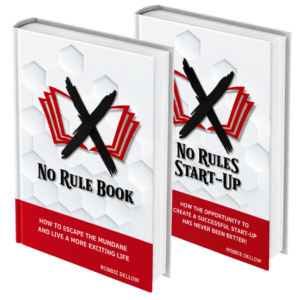
NoRuleBook Bundle
Original price was: $22.90.$14.95Current price is: $14.95.

 Submitted 1.0
 Manual 5.0