

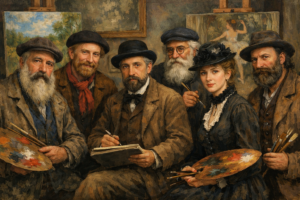
 Then came a group of outsiders – Claude Monet, Pierre-Auguste Renoir, Edgar Degas, Camille Pissarro, Berthe Morisot, and Paul Cézanne – they were not united by a desire to destroy art’s standards or prove that technique no longer mattered. In fact, their approaches differed considerably. What increasingly connected them was a willingness to explore subjects and methods that did not always fit comfortably within the expectations of the established art world.
Paris itself was changing, and so was everyday life. Railways carried people beyond the city, cafés and theatres became part of a growing culture of leisure, industrialisation altered the landscape, and new technologies were changing how people experienced movement, time and modernity. Rather than continually looking backwards for grand historical subjects, these artists increasingly turned toward the world unfolding around them.
They painted crowded boulevards, railway stations, dancers rehearsing backstage, people sitting in cafés, families enjoying afternoons outdoors and sunlight moving across water. Monet became fascinated by the changing effects of atmosphere and light, while Degas found subjects in theatres, rehearsal rooms and modern urban life. Morisot painted intimate scenes of contemporary experience, while Renoir, Pissarro, Sisley and others explored their own ways of representing a world that rarely remained still long enough to be rendered as something fixed.
Their techniques changed with their subjects. Brushstrokes could remain visible rather than being polished away, colours could sit beside one another rather than being smoothly blended, and landscapes painted outdoors encouraged artists to work with the fleeting effects of weather and light. What later generations would recognise almost immediately as Impressionism could appear startlingly unfinished to viewers accustomed to a different visual language.
The important point is not that the old way of painting was wrong and the new way was right. It is that :
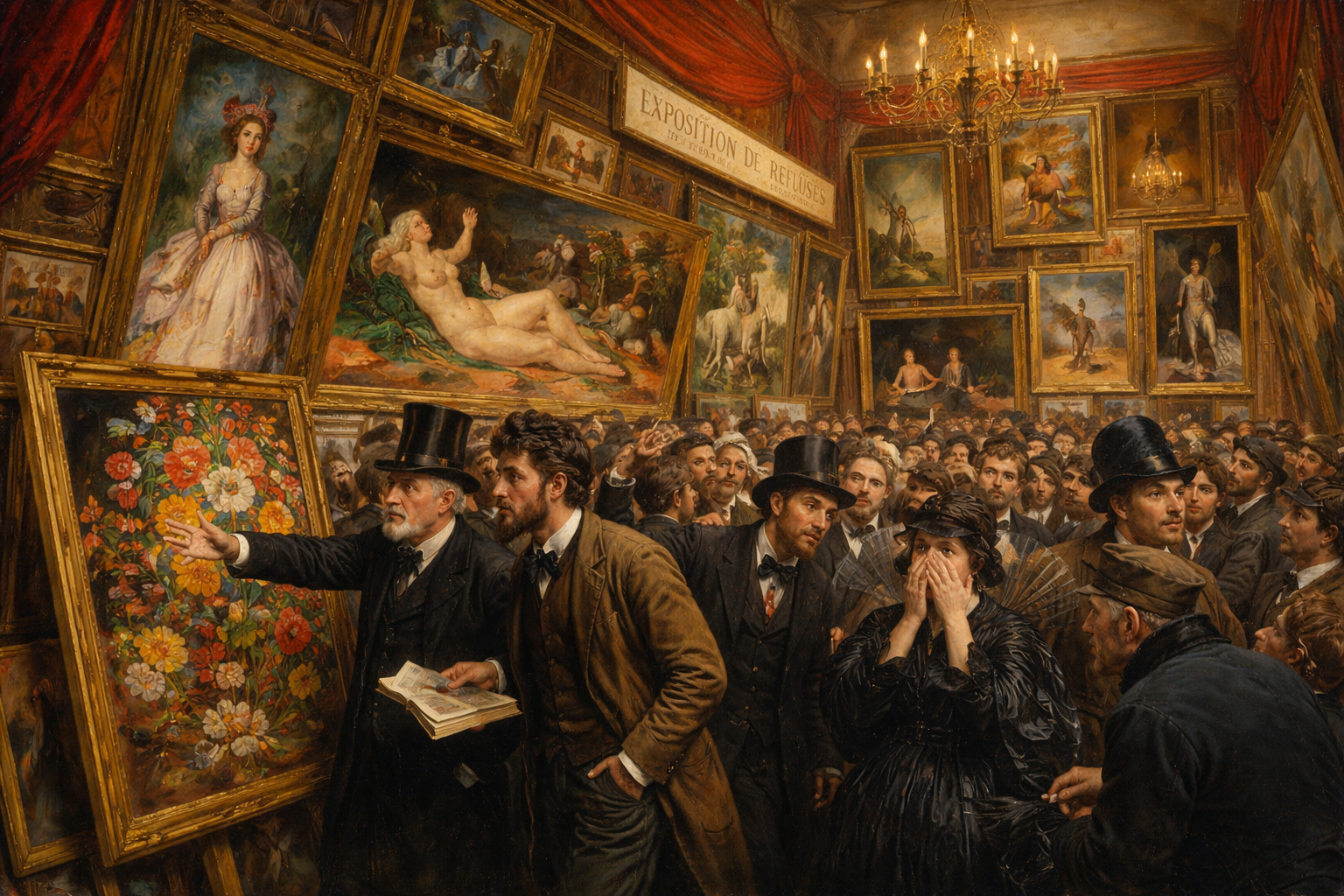
Rejection by the Salon was not unusual, but by 1863 the number of rejected works had become so large, and the complaints surrounding the selection process so persistent, that Emperor Napoleon III authorised a separate exhibition for work the Salon jury had refused. It became known as the Salon des Refusés — the Exhibition of the Rejected.
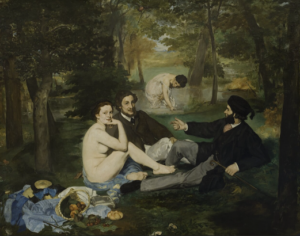
Among the works shown there was Édouard Manet’s Le Déjeuner sur l’herbe (Luncheon on the Grass), a painting that provoked controversy not simply because of how it was painted, but because of what it depicted: a nude woman seated casually beside two fully dressed men in a recognisably contemporary setting. Manet would become enormously influential on the younger artists gathering around him, although he never joined their later independent exhibitions.
The Salon des Refusés mattered because it exposed something that usually remained hidden. A jury could reject a work from the official Salon, but once that same work was placed in front of the public, people could encounter it and form their own opinions. The gatekeeper still had power, but it no longer had quite the same ability to determine whether rejected work would be seen at all.
For Monet and the artists around him, however, the more important break would come eleven years later.
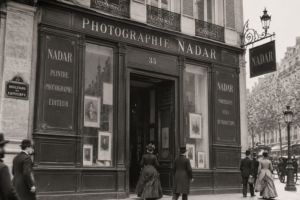 By 1874, they were no longer prepared to make acceptance by the Salon the condition upon which their work could reach an audience. Monet, Renoir, Degas, Morisot, Pissarro, Cézanne and others organised an exhibition independently, renting the former Paris studio of photographer Nadar and putting their work before the public without the Salon jury deciding what belonged on the walls.
It was not an immediate triumph. Around thirty artists participated, and the exhibition attracted only a fraction of the enormous audience visiting the official Salon. Critics could still dismiss the work, visitors could still dislike it, and creating their own exhibition did nothing to guarantee that the artists would eventually be proved right.
But it changed something more fundamental.
Rejection was no longer the end of the process.
Until then, the artists had largely been trying to succeed through a system whose standards they did not entirely share. By organising their own exhibition, they created another possibility: rather than persuading the gatekeeper to change its judgement, they could allow an audience to judge the work for itself.
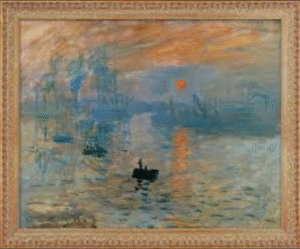 Among the paintings Monet displayed at the 1874 exhibition was a small harbour scene showing the port of Le Havre emerging through mist and morning light. Rather than attempting to render every detail with polished precision, Monet captured the fleeting atmosphere of the scene and called the painting Impression, Sunrise.
The title provided critic Louis Leroy with ammunition.
Writing a satirical review of the exhibition, Leroy seized upon the word impression as evidence of what he considered the artists’ unfinished approach, joking that even wallpaper in an embryonic state was more finished than Monet’s painting. His article referred mockingly to the exhibitors as “Impressionists,” turning Monet’s title into a label for work he did not take seriously.
The insult endured, but not in the way Leroy intended.
Over the following years, the artists continued exhibiting independently and the name Impressionism gradually lost much of its sting as the work itself found collectors, defenders and an increasingly receptive audience. What had initially looked unfinished to many viewers eventually became recognisable as a different artistic language, one capable of capturing experiences that the conventions of academic painting were not necessarily designed to express.
This is one of the reasons the Impressionist story is so often misunderstood in hindsight. Once an innovation becomes familiar, it becomes difficult to reconstruct how strange it originally appeared. Monet’s paintings now hang in major museums and appear on calendars, books and reproductions around the world, which makes their original rejection seem almost absurd.
Yet the critics and juries of the nineteenth century did not have the benefit of knowing what Impressionism would become.
They were encountering something new using standards shaped by what they already understood.
That is precisely what makes the story useful. The Impressionists were not important because rejection proved they were right. It didn’t. They became important because rejection did not prevent them from continuing to develop the work, putting it before audiences and allowing time to provide evidence that the existing definition of good painting was not the only possible one.
The establishment had judged their work against the standards of its time.
The Impressionists helped change the standards by which future art would be judged.
-
-20%

NoRuleBook
Original price was: $9.95.$7.95Current price is: $7.95. -
-50%

No Rules Start-Up
Original price was: $19.95.$9.95Current price is: $9.95. -
-35%

NoRuleBook Bundle
Original price was: $22.90.$14.95Current price is: $14.95.

 Submitted 1.0
 Manual 5.0