

There was a time when comparing your life with other people’s lives required you to actually encounter them. You might hear that an old school friend had bought a house, attend a cousin’s wedding, discover that a colleague had been promoted, or notice that someone you knew seemed to be earning more money than you. Families had their expectations, communities had their ideas about what success looked like, and there was never any shortage of people willing to ask when you were going to settle down, buy a home, have children or find a better job.
None of that began with social media. The pressure to measure ourselves against other people is much older than Instagram, Facebook or TikTok, and the expectations surrounding career, relationships, appearance, wealth and status existed long before anyone carried a smartphone. What changed was our ability to get away from it all.
Those comparisons in life, that once arrived intermittently, can now follow us from the moment we wake up until the moment we go to sleep. We can lie in bed and see someone announce an engagement, scroll over breakfast and watch somebody travelling through Italy, check our phone at lunchtime and discover that a former colleague has launched a successful business, then spend the evening watching people display beautiful homes, expensive restaurants, perfect bodies and apparently effortless relationships.
By themselves, none of those things necessarily mean anything. The person getting married may genuinely be delighted. The holiday really may be spectacular. The entrepreneur may have built a successful company, and the photograph of the beautiful house may contain no deception whatsoever. The distortion begins when hundreds of these separate moments are placed alongside one another and presented to us as though they represent ordinary life.
Social media didn’t create society’s expectations. It removed the OFF switch.
THE PRESSURE WAS ALWAYS THERE. THE SMARTPHONE CHANGED IT.
Previous generations were certainly not free from social pressure, and in many respects the expectations placed upon them were considerably more restrictive than those many people experience today. What they did have, however, were natural interruptions in the comparison. The wedding ended. The family gathering finished. You left work. The neighbour with the new car disappeared behind their front door, and whatever anybody else was doing with their life was no longer being placed continuously in front of you.
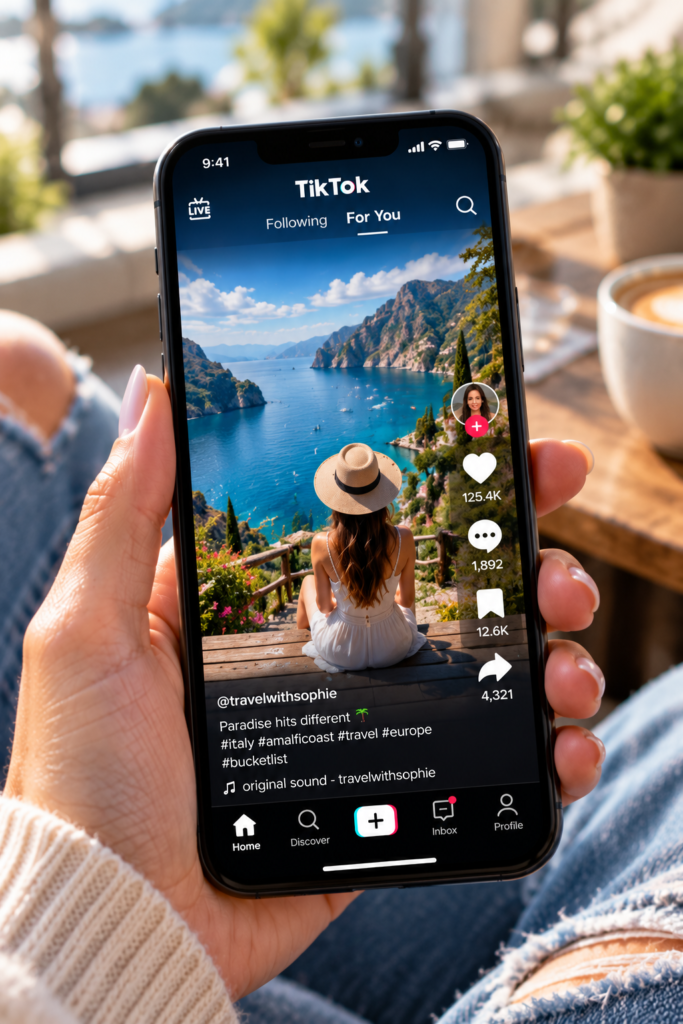
The smartphone changed that relationship because it brought other people’s lives into spaces that had previously been private. Comparison no longer needed a school reunion, a conversation with relatives or an encounter with somebody who appeared to be doing better than you. It could happen while you were sitting alone on the sofa, waiting for a bus or lying awake at two in the morning.
More importantly, the number of people available for comparison expanded enormously. We are no longer limited to measuring ourselves against the relatively small group of people we actually know. A teenager in Brisbane can compare her appearance with an influencer in Los Angeles, a young employee can compare his income with an entrepreneur in Singapore, and somebody struggling to buy their first home can spend an evening looking through photographs of beautifully renovated houses belonging to people they have never met.
That doesn’t automatically make social media harmful, and comparison itself is not necessarily unhealthy. Seeing what other people have achieved can introduce us to possibilities we had never considered, expose us to different ways of living and sometimes provide exactly the motivation required to pursue something ourselves.
The problem begins when exposure becomes so constant that we stop noticing what we're actually comparing.
WHEN EVERYONE ELSE'S HIGHLIGHTS BECOME YOUR NORMAL
Imagine opening your phone one evening and scrolling through a hundred posts :
- One friend has just been married.
- Another has bought a house.
- Someone you went to school with has been promoted.
- A former colleague is posting photographs from Greece.
- Someone else has transformed their body after months in the gym.
- Another person announces a pregnancy.
- An entrepreneur celebrates a record month in business.
- An influencer walks through a hotel suite you could never imagine paying for.
There may be nothing fake about any of it. That is what makes the effect so easy to misunderstand.
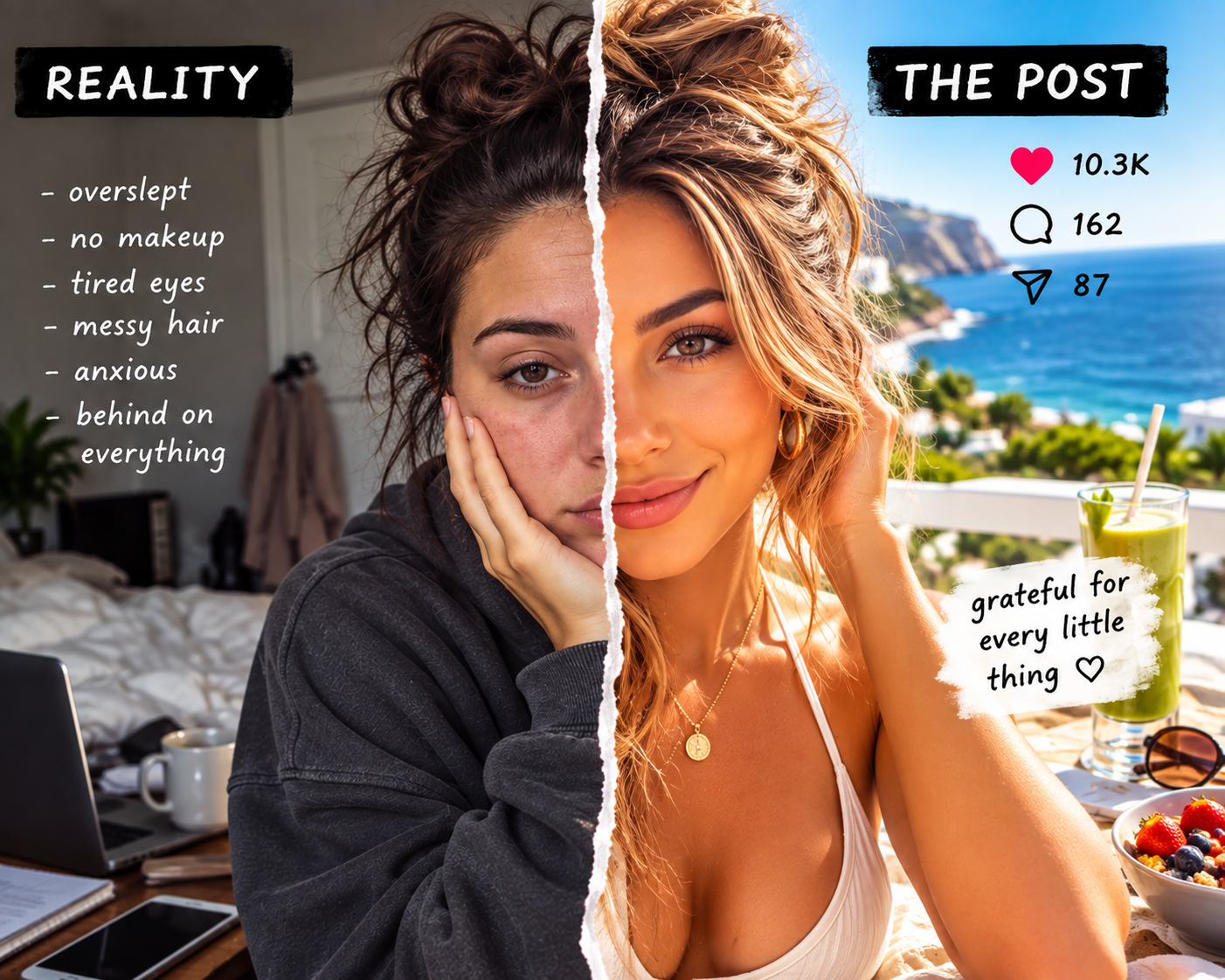
We often talk about social media as though its distortion comes mainly from filters, rented supercars, edited bodies and influencers pretending to live lives they don’t actually have. Those things certainly exist, but social media doesn’t require deception to create an unrealistic picture of reality. It only requires millions of people to do something completely understandable: They show the moments they consider worth showing.
Most people don’t announce an ordinary Tuesday. They don’t photograph the evening spent doing laundry, post about the month in which nothing particularly changed, or upload a celebratory video because their relationship remained perfectly ordinary for another week. The failed job application usually receives less attention than the promotion that eventually follows it, just as the months of uncertainty behind a new business rarely appear as prominently as the photograph announcing its success.
What reaches the feed is therefore not necessarily false. It is selected.
The problem comes when our minds begin combining those selections into a picture of how everybody else is living.

We compare our career with the most successful person we follow, our appearance with the most attractive, our relationship with the happiest-looking couple, our house with the wealthiest, our holidays with the most travelled and our progress with whichever person happens to be achieving something we currently feel we lack.
Without ever consciously deciding to do it, we can construct an imaginary person who has the best career, the best body, the beautiful relationship, the impressive house, the money, the children, the freedom and the extraordinary experiences.
That person doesn’t exist. But it is remarkably easy to feel as though we’re falling behind them.
SOCIAL APPROVAL NOW COMES WITH A NUMBER
Comparison is only one part of what changed when our social lives moved onto screens. Something else happened that would have been difficult to imagine before social media: Approval Became Measurable.
People have always cared about what others think of them. We have always looked for signs that we are accepted, respected, attractive, successful or simply part of the group, but those signals were once relatively vague. You might sense that people liked your new haircut, enjoyed something you said or admired something you had achieved, but there was no number attached to that approval and no dashboard allowing you to compare today’s response with yesterday’s. Social media changed that by turning reactions into data.
A photograph receives 37 likes while another receives 280. One video disappears almost unnoticed while another attracts thousands of views. Follower counts rise and fall, comments accumulate, posts are shared, and suddenly something as complicated and deeply human as social approval can appear to have a score.
That doesn’t mean everyone becomes obsessed with those numbers, nor does receiving attention automatically make social media unhealthy. The more interesting question is what repeated exposure to those measurements gradually teaches us about what receives approval.
If the carefully posed photograph gets more attention than the ordinary one, we notice. If talking about success produces more engagement than talking about uncertainty, we notice that too. If one version of our appearance, lifestyle or personality repeatedly attracts more approval than another, it becomes surprisingly easy to begin presenting more of the version that performs well and less of the version that doesn’t.
Over time, the boundary between sharing your life and performing a version of it can become difficult to see.
Social media didn't just give us an audience. It gave the audience a scoreboard.
The strange part is that nobody needs to instruct us to play along. The system can reinforce itself. We post what we believe presents us well, other people reward those posts with attention, platforms notice what attracts engagement and distribute more of it, and everyone else receives a feed increasingly concentrated around the things people find impressive, attractive, controversial or desirable. Then we compare ourselves with the feed we collectively helped create.
This is where the pressure becomes more complicated than simply blaming influencers, algorithms or technology companies, because ordinary users participate in the same cycle. We select the photograph in which we look best, share the achievement, rather than the months when nothing happened, and naturally prefer to show experiences that other people might find interesting. There is nothing inherently dishonest about doing any of that, but when millions of people make similar choices simultaneously, the combined result can create a version of ordinary life that very few people actually experience.
We compare ourselves with a version of life that we collectively created — and then wonder why our own life doesn't measure up.
EVERYONE CAN JUDGE YOU NOW
There is another side to social approval that receives considerably less celebration. The same technology that allows almost anyone to find an audience also allows almost anyone to become part of somebody else’s audience, and that means the number of people capable of judging how we look, what we believe and how we choose to live has expanded far beyond our physical communities.
Social judgement itself is nothing new. People have always criticized those who looked different, behaved differently or stepped outside whatever their culture considered normal, and in many earlier societies the consequences of doing so could be far more severe than an unpleasant comment online. What social media changed was not the existence of judgement, but its reach, speed and distance from accountability.
A stranger who knows almost nothing about someone’s life can now look at a photograph and comment on their weight. They can see a relationship announcement and decide whether somebody is marrying the right person, watch a parent interact with their child for thirty seconds and pronounce judgment on their parenting, or discover that somebody is unmarried, childless, renting, changing careers or living differently and explain why they believe that person has failed.
Sometimes the judgement is openly abusive. Sometimes it arrives disguised as advice. At other times it appears as humor, sarcasm or the familiar question that sounds harmless until you’ve heard it for the hundredth time. What makes online judgement particularly strange is how little investment the person delivering it needs to have in the person receiving it. Someone can write something cruel in seconds, close the app and continue with their day. The person on the other side may carry those words considerably longer.
Anonymity can widen that gap even further. When your name, reputation and relationship with the other person are removed from the interaction, some of the social restraints that normally influence face-to-face behavior disappear with them. People can say things to strangers that they would be far less comfortable saying across a table.
Yet the deeper issue for this article is not simply that people can be cruel online. It is that social media has given social expectations an enormous new enforcement mechanism. The pressure to look a certain way, achieve particular milestones, hold acceptable opinions or present the right kind of life no longer comes only from family, friends, colleagues or the community around us. It can be reinforced by thousands of people we have never met, through comments, reactions, ridicule and the knowledge that almost anything we share can be publicly evaluated.
Social media didn't invent judgement. It gave almost everyone the ability to deliver it, and almost everyone else a reason to anticipate it.
This last part matters because pressure does not require somebody to actually criticize others. Once we understand that criticism is possible, we can begin adjusting ourselves before it ever arrives. We can reconsider the photograph, soften the opinion, hide the failure, remove the post or present a safer version of ourselves because we already know how quickly the audience can respond.
At that point, society’s expectations no longer need to be explicitly imposed. We can begin enforcing them on ourselves.
WHEN EXTRAORDINARY ACHIEVEMENT STILL DOESN'T FEEL LIKE ENOUGH
Several years ago, a young New Zealand athlete died after reaching a level in her sport that only a tiny proportion of people will ever experience. She had represented her country at the Olympic Games, competed internationally and spent much of her young adult life pursuing the kind of sporting achievement that, from the outside, might appear to be an extraordinary measure of success.
Shortly before her death, however, she published a social-media post describing what that pursuit had cost her. Much of what she wrote concerned the enormous highs and lows of elite sport, including injury, selection and the experience of giving everything to something only to discover that effort did not guarantee the outcome she had worked towards.
But embedded within that message was another kind of pressure.
She wrote:
“The feeling when you win is unlike any other, but the feeling when you lose, when you don't get selected even when you qualify, when you're injured, when you don't meet society's expectations such as owning a house, marriage, kids, all because you're trying to give everything to your sport is also unlike any other.”
In the aftermath of her death, much of the public discussion understandably concentrated on elite sport. Questions were asked about athlete welfare, sporting culture, selection processes and the organizations responsible for supporting athletes, and those questions eventually contributed to extensive scrutiny of the high-performance sporting system.
Those issues mattered and deserved investigation. But there is another part of her message that deserves attention as well.
She didn’t only write about winning, losing or being selected. In the same sentence, she mentioned owning a house, marriage and children.
That is an extraordinary juxtaposition.
Here was someone who had represented her country at the Olympic Games, yet alongside the pressures of succeeding in one of the most demanding sporting environments imaginable sat another measure of whether life was progressing as it supposedly should. Sporting success existed on one scoreboard, while the conventional milestones of adulthood existed on another.
We should be extremely careful about what we conclude from that. Suicide is complex, and it would be wrong to isolate one sentence and suggest that society’s expectations explain why this young woman died. Subsequent examination of her circumstances has involved sporting, personal and mental-health factors, and evidence presented during the later coronial inquiry showed just how difficult it is to separate the different pressures she was experiencing.
But we don’t need to explain her death to take her words seriously. What they reveal is how deeply ideas about where we should be in life can coexist with genuine achievement. You can succeed enormously according to one measure and still look sideways at another person’s house, marriage, family, career, income or lifestyle and wonder whether you are somehow behind.
Social media places those different measures beside one another every day. An Olympic achievement can appear next to somebody else’s wedding. A promotion appears next to a pregnancy announcement. A successful business appears beside somebody travelling through Europe. A fitness transformation appears beside a new house. There is always another category available in which someone else seems to be doing better.
And once success is presented to us across enough different categories, there may be no level of achievement capable of making us feel completely ahead.
When success has a thousand different measures, even extraordinary achievement can leave you feeling behind.
THE NORULEBOOK PERSPECTIVE
The obvious conclusion from all of this might be that social media is the problem and that the solution is simply to spend less time using it. For some people, reducing their exposure may certainly help, but that explanation is too easy because it treats the technology as though it created something that existed long before the first social network appeared.
Human beings have always compared themselves with one another, sought approval and worried about being judged. Society has always developed ideas about what attractiveness, achievement, respectability and success are supposed to look like. What social media changed was the environment in which those instincts operate, taking pressures that once appeared intermittently and placing them inside a system capable of delivering comparison, approval and judgement almost continuously. That distinction matters because deleting an app does not necessarily remove the expectations we have already absorbed, just as keeping an app does not mean we have to accept everything it places in front of us as a meaningful standard for our own lives. The more useful response is to become conscious of what is happening while we are using it.
When somebody posts photographs from an extraordinary holiday, their enjoyment doesn’t mean your ordinary week is inadequate. When a friend announces an engagement, their happiness doesn’t provide evidence that your relationship status is wrong. When someone celebrates buying a house, receiving a promotion or reaching a fitness goal, their achievement does not create a deadline by which you should have achieved the same thing. Yet when enough of those moments arrive together, the distinction becomes surprisingly easy to lose.
Someone else's achievement is not evidence that you are falling behind.
There is an equally important distinction to make around popularity. A post receiving thousands of likes tells us that thousands of people reacted positively to that particular piece of content; it does not tell us that the person who posted it has a better life, that their choices are wiser, or that whatever attracted the attention should become something we aspire to ourselves. The same applies in reverse. A critical comment from a stranger is not automatically useful information simply because technology gave that stranger access to you. Popularity and criticism can both tell us something, but neither deserves to bypass our judgement and become a verdict on our worth.
This is where the NoRuleBook philosophy becomes particularly relevant, because unwritten rules become most powerful when we stop recognising them as rules at all. If enough images of success look similar, enough people celebrate the same milestones and enough approval flows towards particular lifestyles, appearances and achievements, those patterns can gradually begin to feel less like other people’s choices and more like evidence of how life is supposed to be. Social media can make that process extraordinarily efficient.
But awareness changes our relationship with it. Once we recognise that the feed is a selected concentration of other people’s moments rather than a representative sample of human life, we can appreciate those moments without automatically turning them into standards. We can admire someone’s achievement without converting it into evidence of our own failure, and we can see somebody else’s choices without assuming they should become ours.
The feed is not normal life. It is what people decided was worth showing.
Perhaps the most important unwritten rule to question is the assumption that there must be a single scoreboard at all. There is no universal ranking that combines career, income, relationships, appearance, property, parenthood, travel, popularity and possessions into an objective measure of whether somebody is doing well at life, even though scrolling through social media can sometimes make it feel as though one exists.
The technology will continue showing us other people’s lives. People will continue selecting what they share, audiences will continue responding to it, and platforms will continue measuring those responses. None of that requires us to stop using social media or pretend that we are somehow immune to comparison.
It simply requires us to remember what we’re looking at.
Social media didn't create society's expectations. It removed the OFF switch.
Take The Next Step
NoRuleBook is built around a simple idea: Many of the rules shaping our lives were never formally written, yet they can influence our decisions as powerfully as rules that were. Social media has given some of those expectations a louder voice, but it hasn’t made them any more true.
The NoRuleBook eBook explores how to recognise the assumptions, expectations and unwritten rules influencing your choices, then decide for yourself which deserve to remain and which deserve to be questioned.
If you want to become more conscious of the rules influencing your life — before they quietly make your decisions for you — click the NoRuleBook image below to get your copy.
The NoRuleBook Collection
-
NoRuleBook
$9.95Original price was: $9.95.$7.95Current price is: $7.95. -
No Rules Start-Up
$19.95Original price was: $19.95.$9.95Current price is: $9.95. -
NoRuleBook Bundle
$22.90Original price was: $22.90.$14.95Current price is: $14.95.