The Ultimate NoRuleBook Thinker the World Wasn’t Ready For
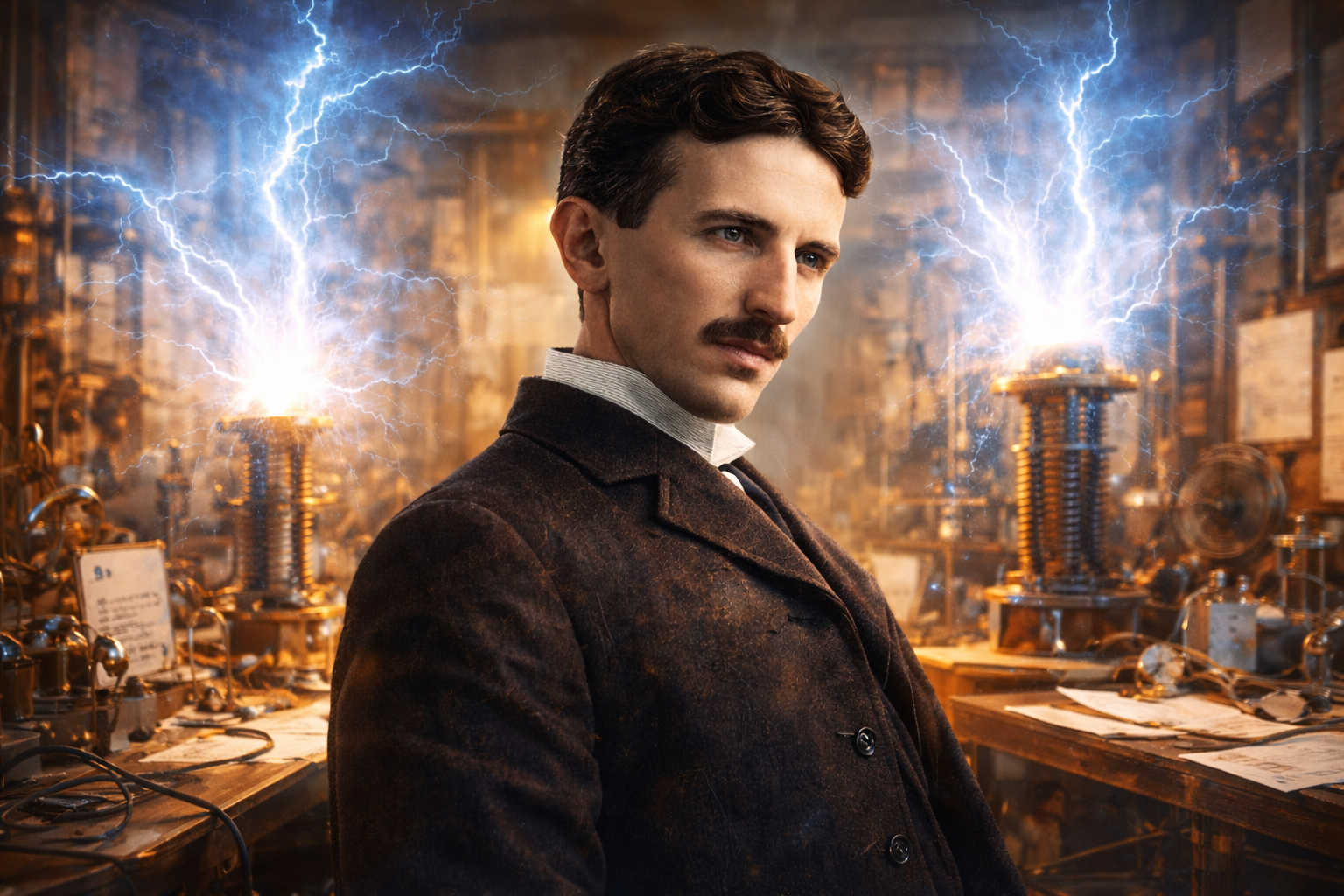
Nikola Tesla did not merely bend the rules of society. He lived entirely outside them.
In an era that rewarded conformity, obedience, and commercial compromise, Tesla chose isolation, principle, and vision. The result was a life marked by ridicule, financial hardship, and misunderstanding — and a legacy that now underpins the modern world.
To view Nikola Tesla through a NoRuleBook lens is to see a man who paid the full price of originality. He refused to dilute his ideas to fit the market, refused to bow to authority, and refused to measure success by wealth or social acceptance. Instead, he measured his life by what would remain after he was gone.
Living Outside Society’s Approval System
Tesla’s life was not romantic in the way history sometimes rewrites it.
He was mocked by peers, sidelined by financiers, and dismissed by institutions that could not understand his thinking. At times, he was so destitute that he resorted to manual labor simply to survive. Yet throughout this, he never abandoned his belief that his work would one day matter.
What separated Tesla from most was not intelligence alone. It was detachment from validation.
While others chased recognition, Tesla quietly built ideas that would outlive the applause of his contemporaries. He understood something that the NoRuleBook philosophy returns to again and again : Approval is temporary, but contribution is permanent.
An Inventive Mind Far Ahead of Its Time
Tesla’s mind operated in a future his present could not yet comprehend.
He visualized inventions completely in his head before building them. He imagined systems of wireless energy transmission decades before infrastructure existed to support them. Alternating current, induction motors, radio technology, remote control — these were not incremental improvements – they were paradigm shifts.
The tragedy was not that Tesla failed. The tragedy was that he succeeded too early.
Society often labels those ahead of their time as unstable/crazy-ones/misfits, because it lacks the language to describe what it does not yet understand.
“They Called Me a Lunatic Before”
In a 1933 interview with the New York Tribune, Nikola Tesla was asked how it felt to be so far ahead of his time that his sanity was questioned. His response reveals a mindset that feels strikingly modern.
He explained that he had long stopped caring about public opinion. What mattered to him were not present judgments, but future acceptance. He found peace in knowing that ideas once dismissed would eventually become scientific dogma.
Tesla spoke openly about being trampled, mocked, and misunderstood. Yet he did not resent it. He accepted it as part of the pioneer’s path. A pioneer, he explained, does not move with the current. He moves against it.
To move against the current is to accept ridicule as a tax on originality.
Why Nikola Tesla Was Dangerous to the Status Quo
Tesla was not dangerous because he was wrong. He was dangerous because he was uncontrollable.
He believed energy should be abundant and accessible, not monopolized. He prioritized discovery over profit. He refused to play the game of patents, leverage, and corporate allegiance in the way others did. This made him incompatible with systems built on scarcity and control.
As a result, others with sharper commercial instincts, but lesser vision, often profited from his work. Tesla accepted this, believing that ideas belonged to humanity rather than shareholders.
The Cost of Refusing to Follow the Rulebook
Nikola Tesla died without wealth, accolades, or institutional power. By conventional standards, his life looked like failure.
By historical standards, it looks like inevitability.
The systems he imagined power the modern world. His name is now synonymous with innovation, electricity, and visionary thinking. The irony is brutal but instructive: society rarely rewards those who create the future while they are still alive.
NoRuleBook thinking does not promise comfort. It promises meaning.
Lessons Learned from Nikola Tesla
Nikola Tesla’s life offers lessons that go far beyond science or invention.
Firstly, originality often arrives before acceptance. If your ideas are immediately popular, they may not be original enough to matter long-term.
Secondly, public opinion is a poor compass for meaningful work. Tesla detached his self-worth from applause and anchored it in contribution. This allowed him to persist when validation disappeared.
Thirdly, vision without compromise carries a cost. Tesla paid that cost willingly. Not everyone should live as he did, but everyone can learn from his refusal to outsource his thinking.
Finally, legacy is built quietly. Tesla worked for a future he would never fully see. That kind of patience requires a different definition of success — One that values impact far above recognition.
The NoRuleBook Perspective
Nikola Tesla was not trying to be rebellious. He was trying to be truthful.
Truthful to his ideas, his curiosity, and his sense of responsibility to the future. In doing so, he became one of history’s greatest examples of what happens when someone lives without asking permission.
Nikola Tesla reminds us that the world is not changed by those who follow rules well.
It is changed by those who are willing to be misunderstood first.
This philosophy — questioning authority, refusing to conform, and designing life around values rather than validation, sits at the heart of the NoRuleBook eBook. Get you copy here.

 Submitted 1.0
 Manual 5.0