NoRule Book Banner

Stanislav Petrov: The Man Who Saved the World

by Robbie Dellow
the man who saved the world image

THE NIGHT ONE MAN REFUSED TO TRUST THE SYSTEM

History tends to remember the moments when people acted: The orders given, battles fought, discoveries announced and decisions that visibly changed what happened next. Yet one of the most consequential decisions of the Cold War was remarkable for precisely the opposite reason. Faced with a system demanding urgent action, one man decided that the information in front of him did not make sense, and instead of simply passing the warning onward as fact, he stopped long enough to think. That man was Lieutenant Colonel Stanislav Petrov.

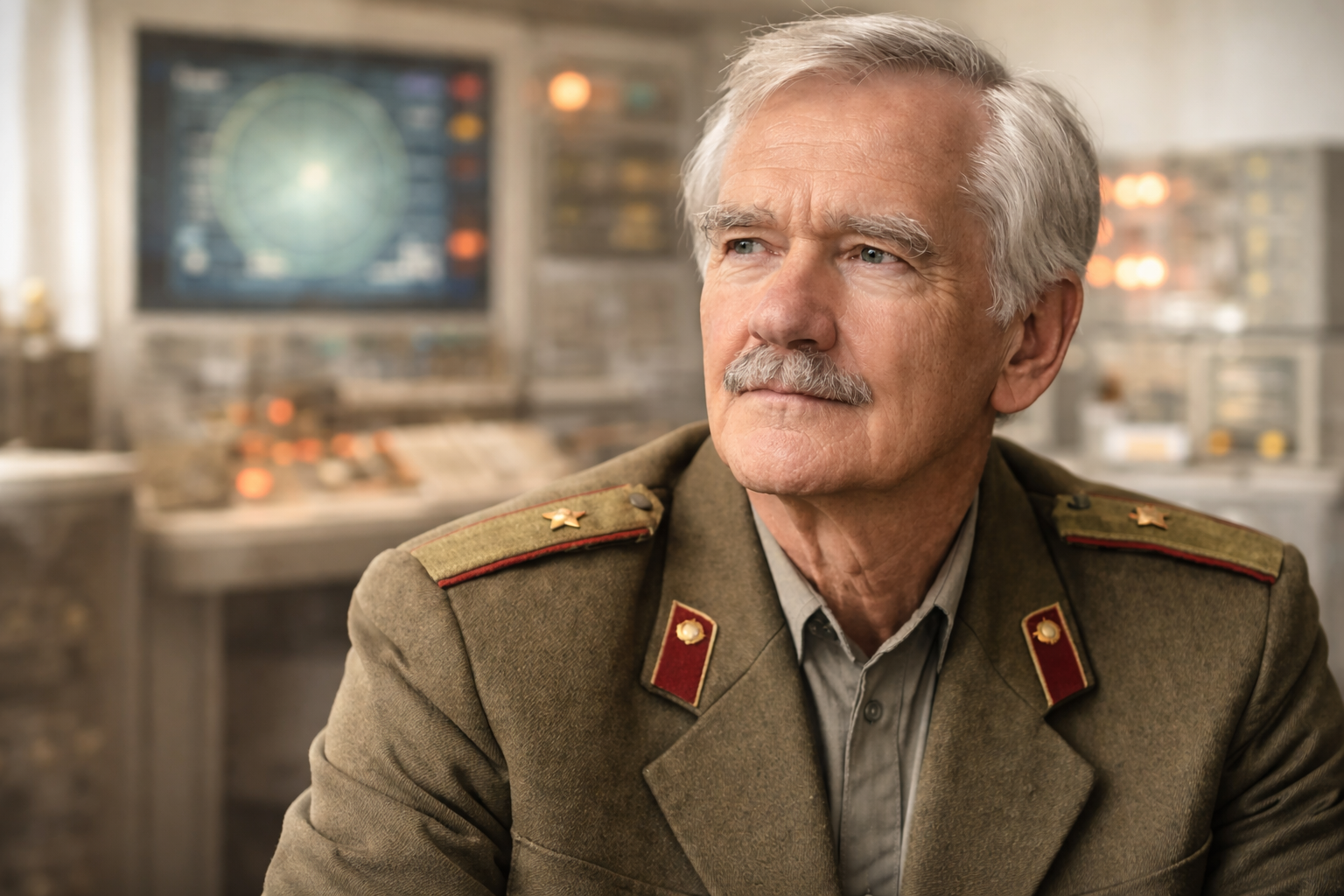
Shortly after midnight on September 26, 1983, Petrov was the duty officer at Serpukhov-15, a secret Soviet command centre outside Moscow monitoring the country’s satellite early-warning system. The Cold War was entering one of its most dangerous periods, relations between the Soviet Union and United States were deeply hostile, and only weeks earlier the Soviets had shot down Korean Air Lines Flight 007, killing all 269 people aboard. Against that background, warning systems were not monitoring a theoretical danger; They existed because both superpowers genuinely feared that the other might launch a nuclear attack.

Then the alarm sounded.

The Soviet satellite system reported that an American intercontinental ballistic missile had been launched toward the Soviet Union. Soon the system indicated more launches, until five missiles appeared to be heading toward Soviet territory. Petrov was suddenly confronting exactly the situation the technology, procedures and people inside that bunker had been created to detect. Except something about it did not make sense.

What happened next is why Petrov’s story belongs in NoRuleBook.

He did not reject the system because he distrusted technology, disliked authority or considered himself some kind of rebel. He questioned it because the information being presented as certainty did not fit what he understood about the situation, and with potentially unimaginable consequences hanging over the decision, he refused to allow procedure to replace judgment.

Petrov didn't ignore the evidence. He questioned whether the machine was interpreting the evidence correctly.

WHEN THE MACHINE SAID ATTACK

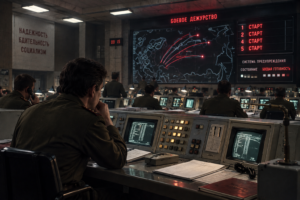
Soviet Cold War command centerImagine the position Petrov was in. A sophisticated military warning system existed for one overriding purpose: to detect an American nuclear attack early enough for Soviet leaders to respond. Now that system was telling him that the event everyone feared had begun.

The easiest decision would have been to trust it. After all, Petrov had not personally seen what was happening thousands of kilometers away. The satellites had. The computers were displaying the warning, alarms were sounding around him, and the entire system carried the authority of the Soviet military establishment behind it. Yet Petrov noticed something the machine could not adequately explain.

Why would the United States begin a nuclear war with only a handful of missiles? A genuine first strike was expected to involve an overwhelming attack intended to cripple the Soviet Union’s ability to retaliate, rather than five isolated missiles that would leave most of its nuclear arsenal intact. Petrov also knew that the satellite warning system was relatively new and was not prepared to treat its output as infallible merely because a computer had presented it with apparent certainty.
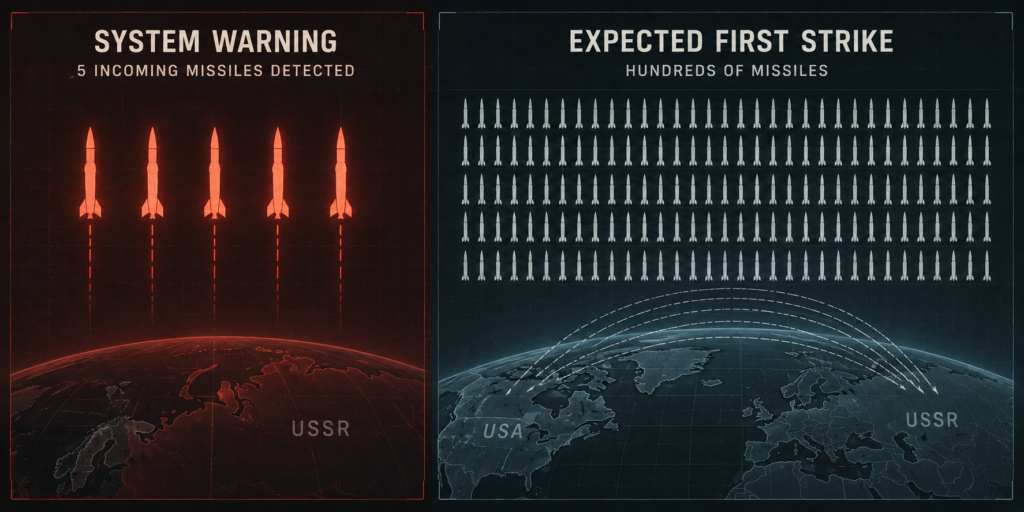
Cold War missile alert comparison imageThe warning and Petrov’s understanding of the world were pointing in different directions.

That left him with a decision that no procedure can make comfortable: Whether to trust the system because that was what the system was designed for, or trust his own reasoning enough to question what it was telling him.

Petrov judged the warning to be false.

He was right. The satellites had mistaken sunlight reflecting from high-altitude clouds for missile launches. What appeared on the screens as the beginning of a nuclear attack was, in reality, an error produced by the interaction between technology and an unusual set of environmental conditions.

THE DIFFERENCE BETWEEN DISOBEDIENCE AND JUDGMENT

It is tempting to reduce Petrov’s story to a simple lesson about breaking rules, but that would miss what makes his decision so important.

Petrov did not decide that rules were irrelevant. He did not casually disregard procedure or assume that his instincts must be superior to the technology around him. Instead, he recognized that the purpose of the system was to help humans understand reality, and when the system’s conclusion appeared inconsistent with the wider evidence, he used judgment rather than surrendering responsibility to the machine.

That distinction sits at the heart of NoRuleBook.

Breaking a rule simply because it exists is not independent thinking. Sometimes the rule is correct, the procedure exists for good reason and following it is exactly what responsible judgment requires. Independent thinking begins when you understand why the rule exists well enough to recognize the exceptional situation in which blindly applying it may produce precisely the outcome it was intended to prevent.

Petrov’s importance therefore comes not from choosing human over machine, but from refusing to confuse information with certainty.

The computer had information. Petrov supplied context. Together they should have produced better judgment, but that was only possible because the human being in the process remained willing to think.

THE COURAGE TO BE WRONG

There was another side to Petrov’s decision that is easy to overlook with the benefit of hindsight.

We know the missiles were not real. Petrov did not.

If he had dismissed a genuine attack as a false alarm, the consequences could also have been catastrophic. His decision therefore was not an act of certainty but a judgment made under profound uncertainty, where either conclusion carried risks that were almost impossible to comprehend.

That is what makes the decision courageous.

It is relatively easy to challenge a system when you already know the system is wrong. It is considerably harder when the system may be right and you must decide whether the inconsistencies you can see are strong enough to justify questioning it.

Petrov could not outsource that responsibility. He had to assess the information available, compare it with what he knew about how an actual attack was likely to unfold, recognize the limitations of the technology and then make a judgment without knowing whether history would prove him correct.

This is where his story becomes much more useful than the simplistic message of ‘trust your gut.’ Petrov was not substituting instinct for evidence; His doubt arose from evidence that did not fit. His judgment mattered because it was informed judgment.

Independent thinking is not ignoring the system. It is understanding the system well enough to know when its answer deserves to be questioned.

WHAT HAPPENED AFTERWARDS

There was no immediate celebration because the Soviet Union had little reason to advertise that one of its nuclear early-warning systems had malfunctioned. The incident remained secret for years, and Petrov himself received no heroic promotion for what happened that night. Accounts indicate that he was criticized over deficiencies in his documentation of the incident, while the larger story remained largely unknown outside the Soviet military establishment.

Only years later did the story become widely known, and Petrov gradually received international recognition, including the Dresden Peace Prize in 2013. He nevertheless remained uncomfortable with the heroic interpretation placed upon him and repeatedly presented what he had done much more modestly.

That modesty almost strengthens the story.

Petrov was not trying to make history. There was no audience watching him, no public reward available for challenging the system and no certainty that anyone would ever know what had happened inside that command center. He simply found himself in a position where following the apparent answer was easier than questioning it, yet the consequences were too important for him to stop thinking.

WHY PETROV'S STORY MATTERS EVEN MORE NOW

The technology surrounding Petrov in 1983 was primitive compared with the automated and algorithmic systems increasingly making or informing decisions today, yet the central problem he confronted has become more relevant rather than less.

Computers can process information at extraordinary speed, identify patterns invisible to humans and make decisions with a consistency that human beings often cannot match. Artificial intelligence will extend those capabilities much further, and in many situations relying on technological systems will produce better decisions than relying on human judgment alone.

The danger begins when confidence in the system becomes a substitute for thinking about what the system is actually telling us.

Researchers discussing nuclear command systems now use the term automation bias for the tendency of people under pressure to place excessive trust in computer-generated information or recommendations. Petrov’s case is frequently cited precisely because he did the opposite: He considered the machine’s warning alongside the broader context rather than treating its output as unquestionable truth.

That lesson extends far beyond nuclear weapons. Algorithms influence what information we see, software assesses financial risk, automated systems screen job applicants, navigation systems tell us where to travel, and increasingly sophisticated AI can provide answers that sound authoritative even when the underlying information may be incomplete or wrong.

The lesson from Petrov is not that humans should distrust machines.

It is that the more authority we give machines, the more important it becomes to preserve the human capacity to question them when the evidence does not fit.

THE RULE PETROV REALLY BROKE

Stanislav Petrov’s story is often presented as the extraordinary night when one man broke protocol and saved the world. There is truth in that description, but the more useful lesson is subtler.

Petrov refused to accept that responsibility ended where procedure began.

He understood that following the established process could protect him personally because, if the outcome proved disastrous, he could at least say that he had done what the system required. Questioning it meant accepting a far more uncomfortable form of responsibility, because the decision would partly become his.

That is one of the hardest forms of independent thinking. Rules can provide guidance, consistency and protection, but they can also provide somewhere to hide when circumstances demand judgment. The existence of a procedure does not automatically remove the responsibility to ask whether the procedure makes sense in the situation unfolding in front of you.

On September 26, 1983, Petrov asked that question when the stakes could scarcely have been higher.

The world continued as normal, almost everyone completely unaware that anything unusual had happened.

Perhaps that is the most fitting outcome of all.

Sometimes responsibility means following the rule. Sometimes it means understanding why the rule exists well enough to know when following it could be the greater mistake.

Take The Next Step

Most of us will never face a decision carrying consequences even remotely comparable to Stanislav Petrov’s, but the principle behind his choice appears in ordinary life far more often than we might realize. We encounter procedures at work, advice from experts, recommendations from algorithms and assumptions that have acquired authority simply because they have been repeated for long enough.

The lesson is not to distrust them automatically. It is to resist handing over responsibility for your thinking simply because somebody – or something – appears more authoritative than you.

When an important rule, recommendation or system produces an answer that does not seem to fit the evidence, stop long enough to ask why. Understand what the rule was designed to achieve, examine the assumptions behind it, consider what information may be missing and then make the most informed decision you can rather than confusing obedience with responsibility.

That is one of the central ideas behind NoRuleBook: Not breaking rules for the sake of rebellion, but learning to recognize which rules deserve to guide you, which assumptions deserve to be questioned and when your own judgment still has a role to play.

If you want to take that thinking further, the NoRuleBook eBook explores the unwritten rules influencing how we work, succeed and live, and provides practical ways to examine them before deciding which ones still deserve your obedience.

Click the NoRuleBook image below to get your copy and start questioning the rules that should never be followed without thought.

The NoRuleBook Collection

Facebook

Related Articles

Leave a Comment