
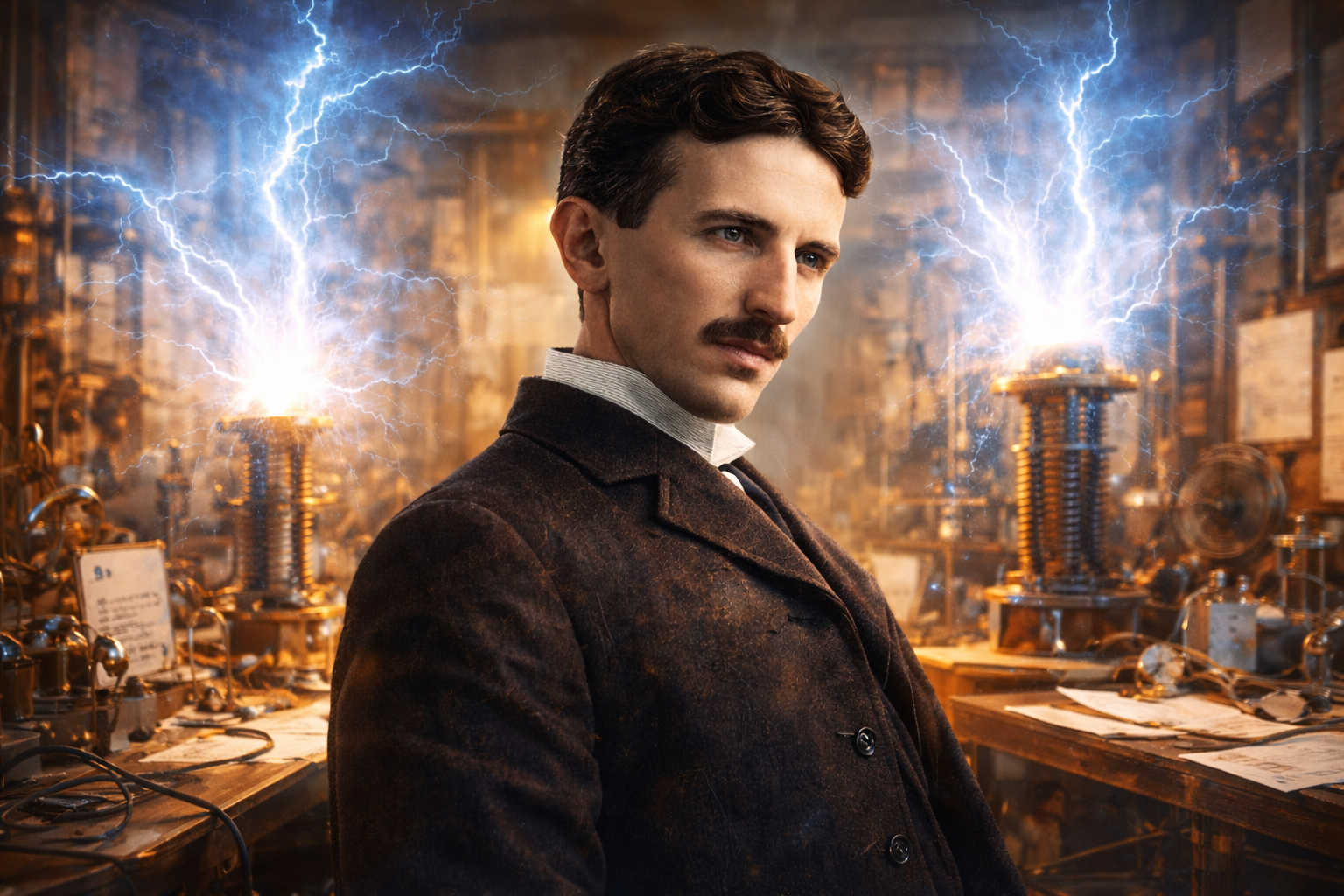
When Tesla arrived in the United States in 1884, electricity was still a developing technology, and there was no settled agreement about how it should be generated and distributed on a large scale. Thomas Edison had invested heavily in direct current, or DC, but Tesla had become convinced that alternating current offered possibilities that the existing system could not easily match, particularly when electricity needed to be transmitted over greater distances.
Tesla’s contribution was not simply that he supported a different system. His work on polyphase alternating current and the induction motor helped solve practical problems that stood between AC and its wider use, and when he demonstrated his motor to the American Institute of Electrical Engineers in 1888, industrialist George Westinghouse recognized the potential and acquired rights to Tesla’s patents.
This period of Tesla’s life is often presented as evidence of the lone genius succeeding because he refused to listen to everyone else, but the reality is more interesting. Tesla had the technical imagination to see possibilities that others had either overlooked or had not yet solved, while Westinghouse possessed the commercial and industrial capabilities required to take those ideas beyond Tesla’s laboratory. Neither contribution made the other less important.
For Tesla, it was also an early demonstration that questioning an established approach could produce extraordinary results. The electrical system already being built around him was not a law of nature simply because companies had invested heavily in it, and existing infrastructure did not prove that a better alternative could not replace it. Tesla was willing to question assumptions that had already begun hardening into convention, and in this case his judgment was vindicated.
 Alternating current became central to the expansion of electrical power, with the hydroelectric development at Niagara Falls becoming one of its most visible demonstrations. Tesla had experienced something that few people ever experience so dramatically: He had backed an idea that faced considerable opposition and then watched the world move towards it.
That success matters to the rest of his story because being proved right can teach us something useful, but it can also teach us something dangerous.
Tesla now had very good reasons to trust his own ability to see beyond what other people considered possible.
The question was whether being right about one future made him any more likely to be right about the next.

Tesla was never likely to spend the rest of his career simply refining technologies that had already established his reputation. His attention increasingly moved towards wireless communication and the possibility that electricity itself might eventually be transmitted without the vast networks of wires that were spreading across cities and landscapes.
Some of what he imagined was remarkably ambitious for the period. Tesla envisaged information travelling wirelessly across enormous distances and described a future in which people could receive news and messages almost anywhere in the world. Looking backwards from an age of smartphones, Wi-Fi and instantaneous global communication, it is easy to take those predictions as evidence that Tesla had somehow seen our technological future in extraordinary detail.
That interpretation needs caution. Tesla did not invent the modern communications systems that eventually emerged, and some of his ideas about wireless power never developed into the practical technologies he imagined. What makes this period interesting is not that Tesla somehow knew exactly what the future would look like, but that he was willing to think at a scale far beyond what existing technology had yet achieved.
His previous success gave him reason to believe that apparently unrealistic ideas could become reality because he had already watched it happen.
There is an important psychological trap hidden inside that experience. When someone challenges conventional thinking and fails, the lesson is usually obvious. When they challenge it and succeed spectacularly, the lesson can be much harder to interpret. Was the success evidence that careful independent thinking had exposed a flawed assumption, or could it gradually become evidence in the person’s own mind that their instincts deserved to be trusted whenever other people disagreed? Those are not the same lesson.
Tesla was about to pursue an idea ambitious enough to test the difference.
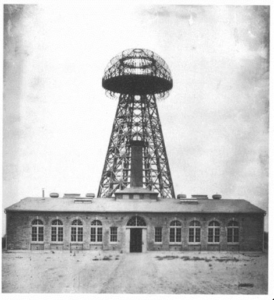 In 1901, Tesla secured $150,000 from J.P. Morgan to develop a wireless system and began constructing what became known as Wardenclyffe on Long Island. The project centered on a large transmission tower and laboratory from which Tesla hoped to demonstrate a new approach to long-distance wireless communication.
But Tesla’s ambitions did not remain neatly contained within the project Morgan had originally agreed to finance. His vision expanded towards something far greater, involving not only worldwide communication but his longstanding ambition to transmit electrical energy wirelessly over enormous distances. The larger that vision became, the more money Tesla needed to pursue it.
At almost the same time, Guglielmo Marconi was taking a more focused approach to wireless communication and successfully received a transatlantic radio signal in late 1901. While Tesla was attempting to build towards a much broader technological system, Marconi had demonstrated something narrower that already worked.
Tesla returned to Morgan for additional funding. Morgan refused.
This is the point where Tesla’s story is often distorted by the appeal of a much simpler narrative. The visionary inventor wanted to transform the world, the powerful financier couldn’t understand him, and an idea that might have benefited humanity was supposedly killed by people protecting the existing system.
The problem is that Morgan had already backed Tesla. So had Westinghouse.
Tesla was not a genius whom nobody was willing to support. He had repeatedly convinced serious businesspeople to risk substantial amounts of money on his ideas. Wardenclyffe therefore raises a more difficult question than whether financiers were capable of recognizing innovation. It asks whether Tesla himself was capable of reducing, adapting or staging an enormous vision when the practical circumstances demanded it.
Perhaps narrowing the project would have allowed Tesla to demonstrate part of his system before attempting something larger. Perhaps it would have made no difference. We cannot know, and it would be misleading to rewrite his life with the benefit of hindsight.
What we do know is that the money ran out, further investment failed to arrive and Wardenclyffe was never completed as Tesla intended.
The important NoRuleBook question isn’t whether Tesla should have abandoned his vision. It is whether changing the route would really have meant abandoning it at all.
-
-20%
NoRuleBook
Original price was: $9.95.$7.95Current price is: $7.95. -
-50%
No Rules Start-Up
Original price was: $19.95.$9.95Current price is: $9.95. -
-35%
NoRuleBook Bundle
Original price was: $22.90.$14.95Current price is: $14.95.

 Submitted 1.0
 Manual 5.0