

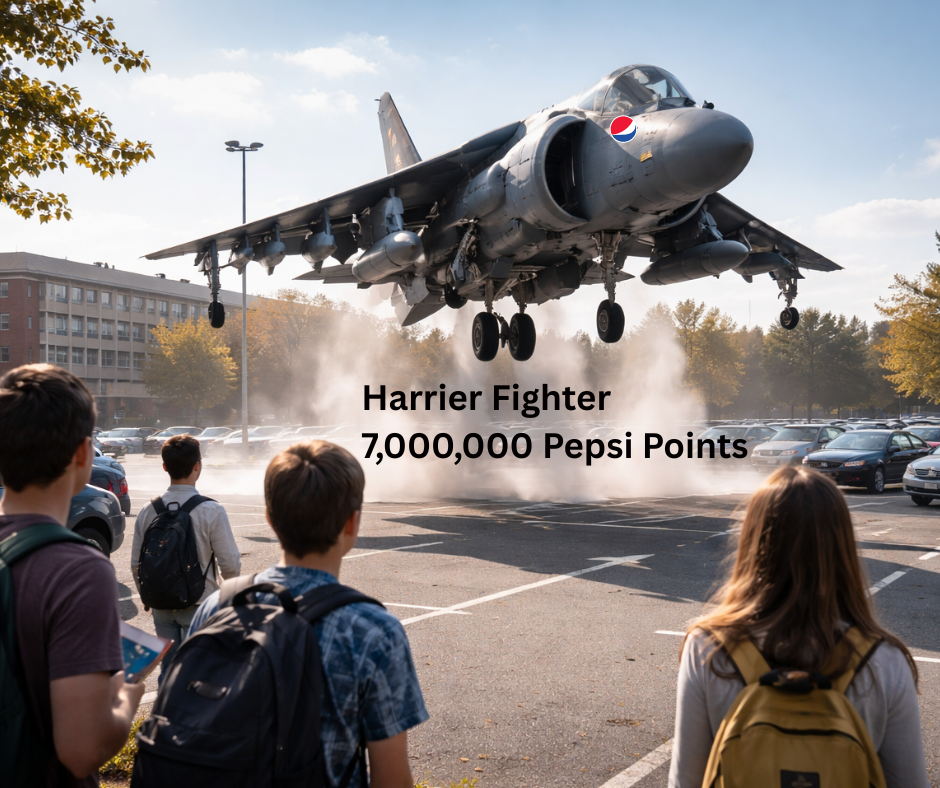
How a 21-year-old student tried to claim a Harrier fighter jet using Pepsi Points — and accidentally created one of the strangest legal battles in advertising history.
 The Kid Who Tried to Buy a Fighter Jet From Pepsi
 The Kid Who Tried to Buy a Fighter Jet From Pepsi
In the mid-1990s, Pepsi ran what looked like a typical advertising campaign. It was colorful, loud, and built around the idea that drinking Pepsi could earn you points that could be redeemed for merchandise. The promotion was called “Pepsi Stuff,” and it worked the same way most loyalty programs worked then—and still do today. You collected points from bottle caps and packaging, saved them up, and traded them for items from a catalogue.
Most of the rewards were ordinary promotional items. T-shirts with the Pepsi logo. Sunglasses. A leather jacket if you saved up enough points. The idea was simple: drink soda, collect points, get free branded gear.
But the commercial advertising the promotion ended with something ridiculous.
The ad followed a teenager preparing for school. He walks through his morning routine, grabs his Pepsi, and heads outside. Then, in the final scene, he arrives at school not by bus or car but by landing a military Harrier jet directly in front of the building. The other students stare in amazement as he climbs out of the cockpit.
On the screen appears a caption identifying the prize :
 Harrier Jet – 7,000,000 Pepsi Points
 Harrier Jet – 7,000,000 Pepsi Points
For the marketing team behind the commercial, the joke was obvious. It was meant to exaggerate the idea of redeemable prizes. Nobody expected viewers to think Pepsi was offering a military aircraft as part of a soda promotion. The scene was designed to get a laugh and reinforce the idea that Pepsi rewards could be exciting.
But one viewer didn’t laugh.
He started calculating.
The Promotion That Had an Unintended Price Tag
 The Promotion That Had an Unintended Price Tag
The viewer was a 21-year-old business student named John Leonard. When he saw the commercial, something about the promotion caught his attention. Instead of dismissing the Harrier jet as an obvious joke, he began looking more closely at the rules of the Pepsi Stuff campaign.
Those rules contained an interesting detail.
Participants didn’t actually have to collect all their Pepsi Points by drinking soda. The promotion allowed customers to buy additional points directly from Pepsi for ten cents each. The option existed to help people reach prizes faster if they were a little short.
For most people, that clause was just a convenience. For Leonard, it created something else entirely: a price.
If one point cost ten cents, then seven million points equaled seven hundred thousand dollars.
For a promotional T-shirt, that pricing system didn’t matter much. But for a military aircraft capable of vertical take-off and supersonic speed, it suddenly looked very different.
Leonard realized that the advertisement had effectively assigned a price to the jet.
So he decided to test whether Pepsi meant what it said.
Taking the Commercial Seriously
Leonard knew he didn’t have $700,000 sitting in a bank account. But he believed the opportunity was worth pursuing. A Harrier jet normally costs tens of millions of dollars. Even if the idea seemed ridiculous, the potential payoff was enormous.
He approached friends and potential investors and explained the plan. If Pepsi honored the promotion exactly as written, they could obtain a military aircraft for a fraction of its actual value.
Eventually he gathered enough support to move forward.
Leonard filled out the official Pepsi Stuff order form, just as the promotion instructed participants to do. On the line for the item being requested, he wrote “Harrier Jet.” Instead of submitting millions of bottle caps, he enclosed a cheque for roughly $700,000 to cover the cost of purchasing the points required.
Then he mailed the package to Pepsi.
From Leonard’s perspective, he was simply following the rules of the promotion.
From Pepsi’s perspective, something had gone very wrong.
 When Marketing Meets Contract Law
 When Marketing Meets Contract Law
Pepsi quickly rejected Leonard’s request and returned the cheque. The company insisted that the Harrier jet scene in the commercial was clearly meant as a joke and that no reasonable viewer would interpret it as a legitimate prize.
Leonard disagreed.
He believed the advertisement created a clear offer. It showed the jet, assigned it a point value, and allowed those points to be purchased. If the promotion rules allowed people to buy points, then the prize technically had a defined cost.
Rather than drop the matter, Leonard took the issue to court.
The lawsuit became known as :
It soon attracted national attention. The idea that someone was suing Pepsi over a fighter jet sounded absurd, but the legal arguments behind the case were surprisingly serious.
The question before the court was not whether Pepsi actually intended to give away a jet. The real issue was whether the advertisement legally counted as a contractual offer.
The Court’s Decision
The case ultimately hinged on how the law interprets advertising.
Generally speaking, advertisements are considered invitations for customers to make offers rather than binding offers themselves. But there are exceptions. If an advertisement clearly describes a product, a price, and the method of acceptance, it can sometimes be interpreted as a legitimate offer.
Leonard argued that Pepsi’s commercial met those conditions. The jet was displayed as a redeemable item, the point value was clearly stated, and the promotion allowed points to be purchased at a known price.
Pepsi’s legal team countered that the commercial was obviously humorous. A reasonable person, they argued, would understand that Pepsi was not seriously offering a military aircraft through a soda promotion.
The court ultimately sided with Pepsi.
The judge ruled that the commercial was clearly meant as a joke and that no reasonable viewer could interpret it as a genuine offer. Because of that, the advertisement could not form the basis of a legally binding contract.
Leonard lost the case.
The fighter jet remained firmly in Pepsi’s imagination.
The Story That Refused to Disappear
Although the lawsuit ended in defeat, the story never really faded away. It remained one of the strangest examples of advertising backfiring in modern marketing history. Years later the incident was revisited in a documentary series that explored the case and the strange chain of events that led to it.
The documentary brought renewed attention to the episode and introduced the story to a new generation of viewers who had never seen the original commercial.
What made the story endure was not just the absurdity of the situation, but the deeper questions it raised about how systems work.
The Rulebook Nobody Reads
Most promotional campaigns rely on a kind of silent agreement between companies and consumers. The company exaggerates, jokes, and pushes the boundaries of what is possible. The audience understands the exaggeration and treats it as entertainment rather than a literal promise.
The system works because both sides share the same assumptions.
But every once in a while someone approaches the situation differently.
John Leonard did not view the commercial through the lens of marketing humor. He viewed it through the lens of written rules. He saw a promotion that allowed points to be purchased and a commercial that assigned a point value to a specific item.
Instead of asking whether Pepsi meant the jet seriously, he asked a different question: what do the rules actually say?
That shift in perspective is what made the entire story possible.
What the Pepsi Jet Case Reveals
In hindsight, Leonard’s attempt to claim the jet was always unlikely to succeed. Courts tend to interpret advertisements generously in favor of the advertiser, especially when humor is involved.
But the case still exposed something interesting about how many systems operate.
Much of modern life runs on assumptions rather than strict logic. Marketing relies on exaggeration. Contracts rely on interpretation. Institutions rely on the idea that most people will not examine the fine print too closely.
When someone does examine it closely, the results can be surprising.
Leonard did not hack the system or manipulate the rules. He simply followed them in a way that nobody expected.
That approach is rare because most people instinctively accept the “spirit” of a rule rather than the exact wording.
Occasionally, someone decides to test that difference.
The Lesson Hidden in the Story
John Leonard never flew a Harrier jet to school, and Pepsi never had to deliver one. Yet the case remains a reminder that the rules governing everyday systems are often more flexible—and more fragile—than they appear.
Many structures in business, law, and society depend on shared understanding. People behave in certain ways because they believe that is how the system is meant to work.
But every so often someone reads the rulebook carefully enough to notice the gaps.
Sometimes that leads to innovation. Sometimes it leads to legal battles.
And sometimes it simply reveals that the rules we assume are solid may actually be held together by little more than expectation.
The Pepsi jet story is memorable not because a student tried to get a fighter jet from a soda company. It is memorable because it shows what happens when someone decides to take the rules at face value.
Most people accept the system exactly as it appears.
A few people decide to test it.
Related NoRuleBook Stories
- This strange legal battle reveals something many people rarely notice — that society often operates with two rulebooks, one written down and another quietly understood : Two Rulebooks In Society? Why Power Changes The Rules
- Most people ignored the commercial completely, but rule-breakers often see opportunities where others see jokes : Hidden Opportunities And How Independent Thinkers Find Them
- History is full of rule-breakers who tested systems others accepted without question. Read about two NoRuleBook rulebreakers here : The Outsider Who Built Success By Ignoring The Rules and The Man Who Gave Away The Internet

 Submitted 1.0
 Manual 5.0