

NoRule Book Banner

Chung Ju-yung: The Man Who Sold Ships Before He Had a Shipyard

by Robbie Dellow
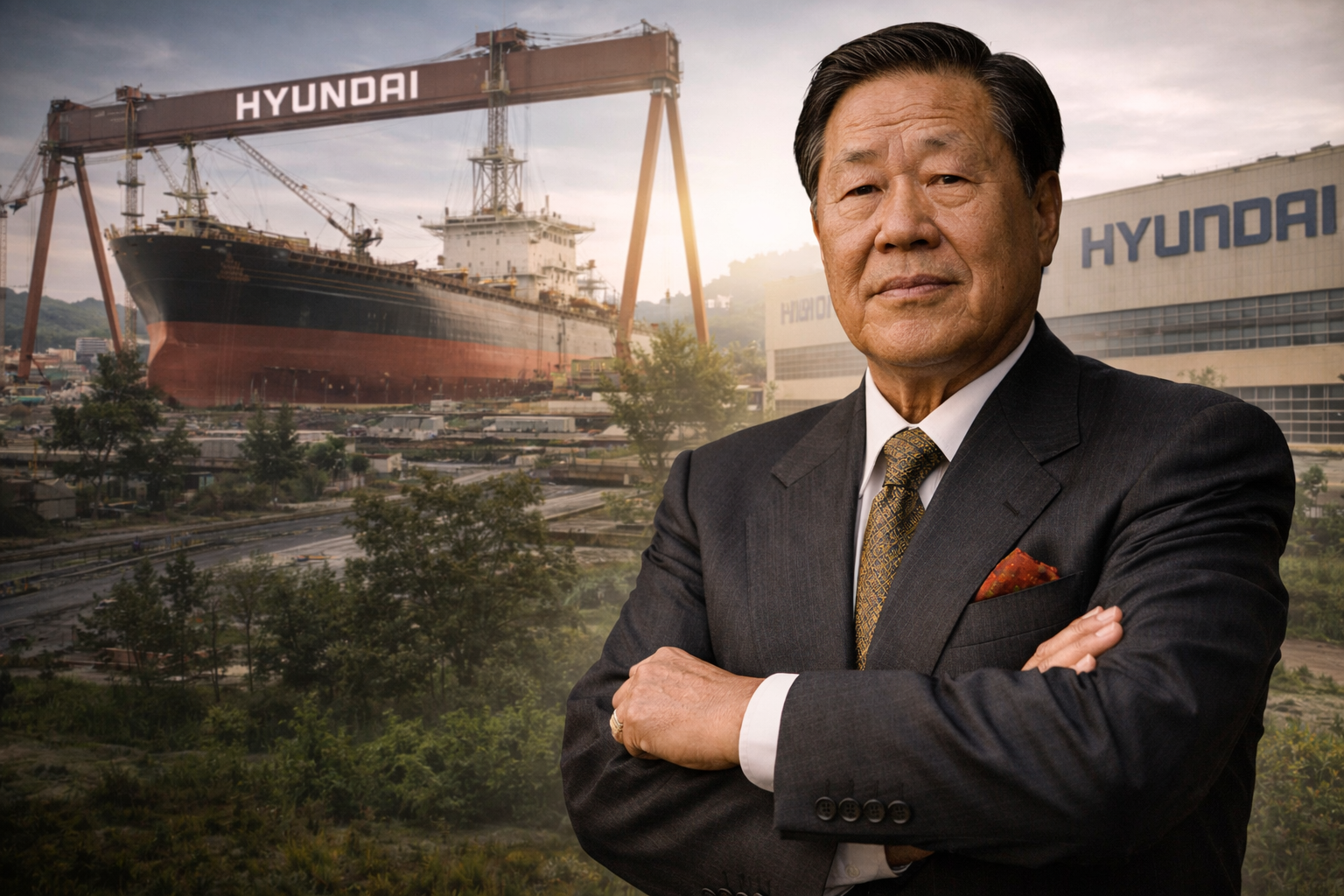
Chung Ju-yung and Hyundai image

There are ambitious business plans, and then there is what Chung Ju-yung proposed in the early 1970s.

South Korea was still emerging from decades of occupation, war and poverty when Chung decided that Hyundai should enter one of the most technically demanding industries in the world: shipbuilding. The established shipyards were in countries such as Britain and Japan, Korea had little experience building large modern vessels, and Hyundai itself had never built a ship.

There was another fairly significant problem – Hyundai didn’t have a shipyard.

Chung nevertheless travelled to Britain seeking the enormous amount of foreign financing required to build one. According to Hyundai’s historical account, he carried plans for the proposed facility and a photograph of the empty shoreline at Mipo Bay in Ulsan—the place where the shipyard would supposedly appear. When doubts were raised about Korea’s shipbuilding credentials, Chung famously produced a Korean 500-won banknote bearing an image of the sixteenth-century Turtle Ship and used Korea’s maritime history as part of his argument that his country was not as unfamiliar with shipbuilding as his audience might imagine.

It was a wonderful piece of persuasion, but history printed on a banknote wasn’t enough to finance a modern shipyard.

The bankers wanted something considerably more convincing: A customer.

If Chung could find somebody willing to order ships from Hyundai, financing the shipyard became possible. But finding a customer created an almost absurd circular problem. Hyundai needed a shipyard before it could build ships, needed financing before it could build the shipyard, and needed an order for ships before it could obtain the financing.

Most people would probably have interpreted that as the end of the idea. Chung interpreted it as the problem that needed solving.

He eventually persuaded the Greek shipping company Livanos to order two enormous crude-oil carriers from Hyundai. The contracts helped unlock the financing, construction began at Ulsan in 1972, and Hyundai did something extraordinary: it began building the shipyard and the ships at the same time.

The company that had never built a large ship had sold two of them before it possessed the place in which to build them.

If that were the only improbable chapter in Chung Ju-yung’s life, it would still be a remarkable story.

It wasn’t even close.

The Life He Was Supposed To Live

The early life of Chung Ju-yungChung Ju-yung was born in 1915 in a farming village in what is now North Korea, the eldest son in a poor family during the Japanese occupation of Korea. His father was a farmer, and the expected path for his eldest son was not particularly mysterious: Chung would work the land, assume responsibility for the family and eventually become the kind of hardworking farmer his father had been before him.

There was dignity in that life. But there was also very little choice.

As a boy, Chung worked alongside his father in the fields and experienced the relentless physical demands of farming firsthand. He reportedly wanted to become a teacher, but after finishing primary school the family’s circumstances offered little room for further education. His father expected him to farm, and from his father’s perspective that expectation was entirely understandable. A poor farming family did not have the luxury of designing careers around personal fulfilment.

Chung, however, could not accept that the circumstances into which he had been born should automatically determine the circumstances in which he would spend the rest of his life.

So he left.

His father brought him back.

Chung left again.

He was brought back again.

The pattern repeated itself, because the conflict wasn’t really between a rebellious son and an unreasonable father. It was between two completely different ideas about what a person owed to the life they inherited. His father saw responsibility in staying; Chung increasingly saw resignation.

Eventually, at nineteen, he left for good. He travelled toward Seoul and Incheon and took whatever work he could find, including farm labour, construction work and a period in a rice-candy factory. There was no dramatic moment when somebody recognised his potential, no prestigious education waiting for him and no influential business network into which he had been fortunate enough to be born.

This was simply a young man who had decided that an uncertain life he had chosen was preferable to a predictable life chosen for him.

The first rule Chung Ju-yung broke wasn't a business rule. It was the assumption that the life you inherit is the life you must keep.

A Bicycle, A Rice Shop and An Education That Didn't Come From School

Eventually Chung found work delivering rice for the Bokheung Rice Store in Seoul.

It hardly looked like the beginning of an industrial empire.

His compensation included meals and rice, and the job required him to make deliveries by bicycle. According to the Asan historical account, Chung practised riding at night until he could transport heavy bags of rice on the bicycle, and within months he had become the shop’s leading delivery worker. His employer trusted him enough that Chung progressed from deliveries to keeping the books, giving him something his formal education never had: a close-up education in how a business actually worked.

He watched customers. He learned accounts. He learned what made people return, how goods moved, how margins worked and, perhaps most importantly, how trust accumulated.

Within a few years, the owner gave him the opportunity to take over the business, and in 1938 Chung opened the Kyungil Rice Store. It prospered, but his first taste of entrepreneurial success also delivered a lesson that would recur throughout his life: competence does not give you control over the world around you.

Japanese colonial rice-distribution policies forced Korean rice stores, including Chung’s, out of business around 1939. He had done what entrepreneurs are constantly told to do—worked hard, served customers and built a successful operation—and circumstances outside his control changed the rules anyway.

It could easily have become the story he told himself for the rest of his life about why taking risks was foolish.

Instead, it became experience.

Hyundai Didn't Begin With Cars

Today the word Hyundai immediately brings cars to mind, which makes it easy to imagine that Chung’s journey followed some carefully conceived automotive master plan.

It didn’t.

After the rice business ended, Chung eventually entered automobile repair, taking over a garage in 1940. In 1946 he established Hyundai Auto Service, followed in 1947 by Hyundai Civil Works. Those businesses were eventually brought together as Hyundai Engineering & Construction, the company that would become the foundation of the Hyundai group.

The timing was brutal and extraordinary.

Korea emerged from Japanese occupation in 1945 only to be divided, and the Korean War devastated much of the country between 1950 and 1953. Roads, bridges, buildings and infrastructure needed to be rebuilt, while experienced contractors, modern machinery and capital were scarce.

For Chung, those shortages weren’t merely obstacles. They were problems for which somebody would eventually have to provide solutions.

Hyundai took construction work connected with the U.S. military and then became increasingly involved in rebuilding South Korea’s infrastructure. Yet the mythology of successful entrepreneurs often compresses these years into a smooth upward curve, as though Chung simply moved from one triumph to another because he possessed some supernatural instinct for business.

The reality was considerably messier.

The Bridge That Lost Money But Built Something Else

In the 1950s Hyundai took on the restoration of the Goryeong Bridge over the Nakdong River.

The project went badly.

Severe inflation pushed costs far beyond expectations, and Hyundai faced substantial losses. Chung could have abandoned the contract, protected what remained of the company’s money and blamed circumstances that genuinely were outside his control.

Instead, Hyundai finished the bridge.

Financially, the project hurt. Reputationally, it did something very different. Completing a difficult contract despite the losses helped Hyundai establish credibility as a company that would finish what it had promised to finish, and in 1957 it secured the restoration contract for the Han River Footbridge, then one of South Korea’s largest construction projects.

That episode reveals something more useful about Chung than the simplistic idea that successful people are fearless.

He wasn’t merely willing to take risks. He understood that sometimes the asset you are building isn’t the thing named in the contract.

Hyundai was ostensibly building a bridge. It was also building a reputation. That reputation would eventually become something Chung could spend.

From Building Korea, To Betting On Korea

As South Korea industrialised during the 1960s, Hyundai’s ambitions expanded with it. The company built roads, dams, ports and other infrastructure, entered overseas construction and in 1965 won a highway project in Thailand—an important early step for Korean construction companies competing internationally. Hyundai Motor Company followed in 1967.

None of this happened in isolation.

South Korea’s government was aggressively pursuing industrialisation and exports, using state policy, access to credit and close relationships with large business groups to accelerate economic development. Hyundai’s rise cannot credibly be reduced to the heroic story of one man succeeding entirely through individual determination. Chung benefited from a country that was itself making an extraordinary economic transformation, just as the country’s transformation benefited from entrepreneurs willing to attempt projects of a scale that would previously have seemed unrealistic.

This matters because NoRuleBook isn’t interested in replacing one simplistic story with another. Chung wasn’t a lone genius building an empire while everyone else stood in his way. He operated within systems, negotiated with governments, borrowed money, recruited expertise, worked with foreign companies and depended upon thousands of people who could do things he personally could not.

His unusual ability was often something different. He could look at what did not yet exist without automatically treating its absence as proof that it could not exist.

Which now brings us back to the beach at Ulsan.

Then He Decided Hyundai Should Build Ships

By the beginning of the 1970s, Chung wanted Hyundai to enter heavy shipbuilding.

On paper, the objections were overwhelming. Modern shipbuilding required enormous capital, specialized engineering, experienced workers, sophisticated infrastructure and customers willing to trust a company with vessels costing vast sums of money. Established competitors already possessed all of those things.

Hyundai possessed almost none of them.

The conventional sequence therefore seemed obvious: Acquire expertise, construct a shipyard, demonstrate capability and then seek customers.

There was just one problem. Hyundai could not afford the conventional sequence.

To build the shipyard it needed financing. To obtain financing it needed credibility. And to establish credibility it needed evidence that someone believed Hyundai could actually sell the ships it intended to build. So Chung began rearranging the sequence.
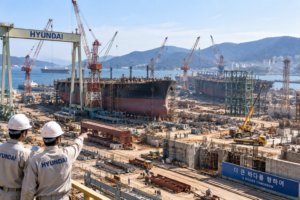
Building the shipyard and the shipsHe travelled to Britain seeking financial and technical backing with plans for the proposed shipyard and a photograph of Mipo Bay. Hyundai’s own history recounts the famous moment when he used the Turtle Ship depicted on a 500-won banknote as part of his pitch for Korea’s underlying shipbuilding potential. Whatever weight that gesture carried in the final financial negotiations, it has survived because it perfectly captured Chung’s talent for changing the frame of a conversation.

His audience saw a country without a modern large-scale shipbuilding industry.

Chung wanted them to see a country that simply hadn’t built one yet.

Sell The Ships Before You Build The Shipyard

The crucial obstacle remained the customer.

A British banker was reportedly willing to support the project if Chung could produce a contract showing that someone was actually prepared to buy ships from Hyundai. Chung therefore went looking for a shipowner willing to place an order with a company that could not yet point to the shipyard where those ships would be constructed.

Eventually, he found one. A Greek shipping company called Livanos agreed to order two crude-oil carriers.

Think about what Chung was effectively selling :  Not two completed ships. Not two ships under construction. Not even two ships that would be built in an established facility. He was selling confidence in Hyundai’s future ability to create the capability required to fulfil the promise it was making in the present.

The contracts helped secure financing. Ground was broken for the Ulsan shipyard in March 1972, and rather than wait until the enormous facility was completed before beginning work on the vessels, Hyundai constructed the shipyard and the first ships simultaneously.

This is where Chung’s story is often turned into motivational advice:

  • Believe in yourself.
  • Say yes before you’re ready.
  • Commit first and figure it out later.

But those slogans miss the most important part of what happened.

He Didn't Ignore Expertise. he Went and Found It

Chung’s great bet was not based on the belief that knowledge and experience were unnecessary.

Hyundai sought foreign financing, technical assistance and experienced expertise precisely because the company understood that ambition could not substitute for engineering. Chung wasn’t proving that qualifications don’t matter. He was refusing to accept that you must already possess every qualification before you are allowed to begin assembling the capability you need.

That is a very different philosophy.

There is an enormous difference between saying, “I’ve never done this before, therefore expertise doesn’t matter,” and saying, “I’ve never done this before, so what expertise, people, technology and resources would make it possible?”

Chung repeatedly operated in the space between those two statements.

He was willing to make commitments before every piece was comfortably in place, but then treated the gaps between the promise and the existing capability as problems that had to be solved.

He didn't wait until Hyundai looked like a shipbuilder before deciding it could become one. He made the decision—and then built the capability required to make the decision true.

That is much more demanding than confidence.

It requires execution.

The Danger Of Learning The Wrong Lesson

There is, however, an uncomfortable problem with stories like Chung Ju-yung’s.

We know how his story ended :  Hyundai became one of South Korea’s great industrial groups. Its shipbuilding operation became one of the world’s largest. Its cars became familiar on roads across the planet. Once you know that ending, Chung’s earlier decisions can begin to look almost inevitable, as though his willingness to make enormous bets was itself evidence that those bets were wise.

But history doesn’t preserve failed bets with anything like the same enthusiasm.

Failed construction projectFor every entrepreneur who commits to an audacious project before possessing all the resources required to deliver it, there are others who do exactly the same thing and fail. Confidence can be visionary, but it can also be delusion. Persistence can rescue a difficult idea, but it can also keep somebody trapped in a terrible one.

The lesson from Chung therefore cannot simply be :


  • Take bigger risks.

Nor can it be:

  • Ignore people who say something can’t be done. (Sometimes they are right).

The more useful question is whether the obstacle in front of you represents an actual impossibility, or merely a capability that does not exist yet.

That single word changes everything.

The NoRuleBook Test

When you find yourself dismissing an idea because you aren’t qualified enough, experienced enough, connected enough or prepared enough, don’t immediately respond by telling yourself to be more confident. Interrogate the gap instead.

What exactly are you missing? Is it knowledge you could learn? Expertise you could hire? Capital you could raise? Technology you could acquire? A partner who already understands the problem? Evidence that could be created with a smaller experiment? A customer willing to take the first chance?

And then ask the harder question that motivational stories often leave out:

What happens if you’re wrong?

If failure means inconvenience, embarrassment or a recoverable financial loss, beginning before you feel completely ready may be rational. If failure places other people’s livelihoods, safety or enormous amounts of borrowed money at unacceptable risk, enthusiasm deserves considerably more scrutiny.

Independent thinking doesn’t mean assuming the doubters are wrong. It means understanding why they might be right—and then deciding whether their objections describe permanent barriers or solvable problems.

The NoRuleBook Truth

Chung Ju-yung’s life is sometimes presented as proof that determination can overcome almost anything.

That is too easy.

Determination mattered enormously, but so did timing, South Korea’s industrial transformation, government policy, foreign finance, technical expertise, employees, customers and Chung’s ability to persuade other people to participate in things that did not yet exist.

His real challenge to conventional thinking was not that he ignored reality.

It was that he refused to assume reality had finished being built.

The poor farmer’s son wasn’t born knowing how to run a rice store. The rice-store owner wasn’t born knowing how to repair cars. The garage owner wasn’t born knowing how to build bridges. The construction contractor wasn’t born knowing how to manufacture automobiles. And the man standing on an empty stretch of Korean coastline certainly wasn’t born knowing how to build some of the largest ships in the world.

At each stage, the absence of existing capability could have been interpreted as an instruction to stop.

Chung treated it as a list of things that would have to be learned, acquired, financed, negotiated or built.

And perhaps that is the part of his story worth carrying into our own lives.

You don't always need proof that you can do something before you begin. Sometimes beginning is how you create the proof.

The danger is believing that confidence alone will get you there.

The opportunity is recognising that “I can’t do this yet” and “This cannot be done” are two completely different statements.

Next Step

Think about something you have quietly ruled out because you don’t currently have the experience, qualifications, money, contacts or knowledge to do it.

Instead of asking, “Am I ready?”, write down precisely what being ready would actually require.

Then separate the list into what you genuinely need before beginning and what could be learned, acquired or built after you begin.

Chung Ju-yung didn’t stand on the shore at Ulsan pretending a shipyard already existed. He saw very clearly that it didn’t.

Then he started assembling everything required to make it exist.

Sometimes the question isn’t whether you’re ready for the opportunity. It’s whether you’re willing to build the capability the opportunity requires.

Click the NoRuleBook image below to explore the collection.

The NoRuleBook Collection

Facebook

Related Articles

Leave a Comment