NoRule Book Banner

Dave Thomas Success Story – How A Dropout Built The Wendy’s Burger Empire

by Robbie Dellow
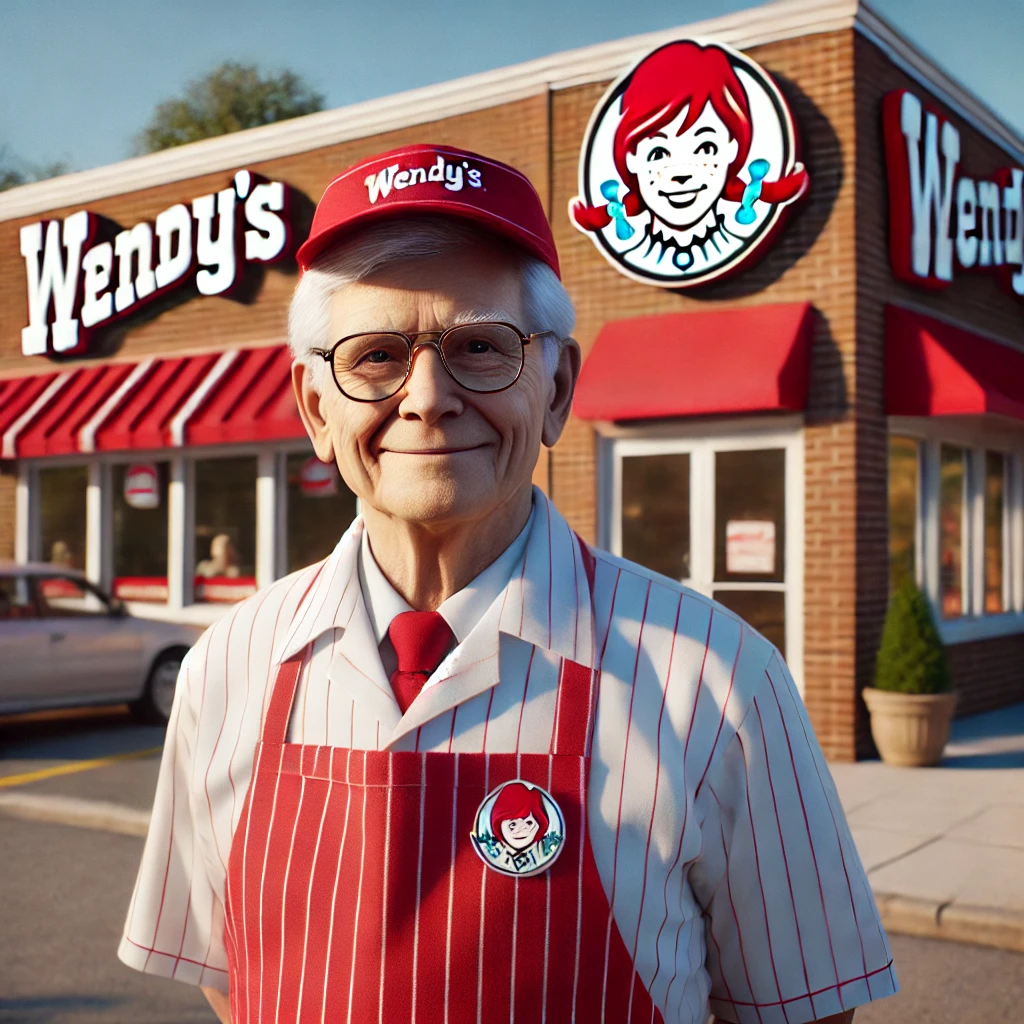
Dave Thomas and Wendy's image

Long before Dave Thomas became the familiar face of Wendy’s, appearing in hundreds of television commercials and building one of America’s largest restaurant chains, his life contained almost none of the stability that would later define the business he created.

Born in Atlantic City, New Jersey, in 1932, Thomas was adopted when he was six weeks old by Rex and Auleva Thomas. When Dave was five, Auleva died, and much of the childhood that followed was spent moving from one place to another as his adoptive father searched for work. For a boy already separated from his biological parents, the constant movement meant that home was never quite as permanent as it appeared to be for many of the families around him.

One of the few places where he found that sense of permanence was with his grandmother, Minnie Sinclair, whom he visited during summers in Michigan. Thomas would later credit her with teaching him lessons about hard work, treating people with respect, doing the right thing and taking pride in quality and service—ideas that sound ordinary until you consider how consistently they would reappear throughout his business life.

Restaurants provided another kind of stability. His father was frequently occupied with work, but the two of them sometimes ate together in local restaurants, and Thomas later remembered those meals as occasions when he felt he had his father’s attention to himself. He also noticed the families sitting around him, sharing meals together, and somewhere inside those experiences an ambition began forming. Wendy’s records that by the age of eight, Thomas was already imagining that one day he might run a restaurant of his own.

As the family continued moving, work became increasingly important to him, not simply because it provided money but because it offered something his childhood often lacked: a place where effort produced a relatively predictable result. If he arrived, worked hard, learned what needed to be done and became useful, he could establish a reputation that did not disappear simply because his father had found another job somewhere else.

That relationship with work eventually brought him to the Hobby House restaurant in Fort Wayne, Indiana, where he began working as a teenager. When his father prepared to move again, Thomas made a decision that would later become an irresistible ingredient in the mythology surrounding his success: at fifteen, he left school and remained in Fort Wayne so that he could keep working at the restaurant. He lived at the YMCA and began building a life independently rather than following his father to another city. Contemporary accounts describe him working there as a busboy before gradually taking on greater responsibility.

It is easy, knowing what happened afterwards, to turn that moment into the beginning of a motivational story.

Teenager drops out of school. Teenager chooses work instead. Teenager eventually becomes a millionaire and builds Wendy’s. Therefore, perhaps school didn’t matter after all.

But that is almost exactly the lesson Dave Thomas himself eventually rejected.

Leaving school was not a carefully designed entrepreneurial strategy, nor was it evidence that Thomas had discovered formal education was unnecessary. He was a fifteen-year-old whose unusual circumstances presented him with choices that would have looked very different from those facing most fifteen-year-olds. He chose the route that seemed to offer him stability and opportunity at the time, and then spent years acquiring through work, mentors and experience much of the knowledge he had not acquired through school.

That distinction matters because success stories become dangerous when we remember the outcome and rewrite the decision that preceded it as though the outcome had always been obvious.

A decision that eventually works is not necessarily evidence that everybody else should make the same decision.

Thomas himself would eventually understand that better than almost anyone.

LEAVING SCHOOL WASN'T A BUSINESS STRATEGY

The years after Thomas left school were not a rapid march toward Wendy’s. There was no brilliant business plan waiting to be executed and no moment when a teenage dropout suddenly discovered the secret to entrepreneurship. Instead, there were years spent learning an industry from the inside, beginning with the ordinary work that successful-business biographies often compress into a few convenient sentences.

early diner Dave Thomas imageAt the Hobby House, Thomas had the opportunity to observe the restaurant business at a level no classroom could reproduce exactly. He could see what customers complained about, what brought them back, how employees behaved when a restaurant became busy, where food was wasted, how service affected the experience and how hundreds of small operational decisions determined whether a restaurant actually worked. After serving in the U.S. Army, where he worked in food service while stationed in Germany, he returned to the Hobby House and continued developing within the business.

None of this means that working in a restaurant was inherently a better education than remaining in school. It means that Thomas happened to enter an environment in which he was able to keep learning after leaving formal education. That is a much more useful distinction, because dropping out removes one structured route to acquiring knowledge; it does not magically replace that route with another. Thomas had to build the replacement himself.

He learned from managers, customers, mistakes and repetition, while also benefiting from people who recognised his ability and gave him greater responsibility. One of the most important was Phil Clauss, whose restaurant business would eventually place Thomas in the situation that transformed his career. Another was Colonel Harland Sanders, whom Thomas came to know as Kentucky Fried Chicken expanded through franchising and who became an important mentor in Thomas’s understanding of the restaurant industry.

By 1962, Clauss owned four struggling KFC restaurants in Columbus, Ohio, and offered Thomas the opportunity to try to revive them. Even Colonel Sanders advised against taking on the challenge, according to Wendy’s account of Thomas’s life, but Thomas accepted it and moved to Columbus.

What he did next is more revealing than the familiar description of him as a man who simply ‘worked hard.’

Thomas simplified the menu, concentrated attention on the products the restaurants could execute well and experimented with unconventional promotion, including exchanging chicken meals for radio advertising and creating an illuminated sign resembling a rotating bucket of chicken. Rather than approaching the restaurants as though their failure proved that customers didn’t want Kentucky Fried Chicken, he looked at the way the businesses were being operated and marketed and asked what could be changed.

The distinction is small, but it would recur throughout his career.

When something wasn’t working, Thomas did not automatically conclude that the underlying idea was wrong. He looked for unnecessary complexity, poor execution and ordinary frustrations that everybody else had become accustomed to accepting.

The four restaurants recovered, and Thomas eventually acquired an ownership interest before selling his stake back to KFC. By then he had something far more valuable than the story of being a successful dropout. He had accumulated years of practical knowledge about food, customers, operations, franchising and marketing, together with the financial resources that would allow him to begin thinking seriously about the restaurant he had imagined since childhood.

His education had continued all along. It simply hadn’t taken place entirely inside a school.

And that distinction would become especially important when Dave Thomas eventually discovered that the hamburger business had its own collection of assumptions waiting to be questioned.

THE PROBLEM EVERYONE HAD LEARNED TO ACCEPT

By the late 1960s, Dave Thomas had accumulated something that is easy to underestimate when looking back at the founder of a billion-dollar restaurant chain: he had spent years watching ordinary people buy food. He had seen restaurants from almost every angle, from clearing tables and preparing meals to managing staff, promoting stores and turning around failing locations, and that experience had taught him to pay attention to the small frustrations customers encountered so regularly that businesses often stopped noticing them.

When Thomas began considering opening his own hamburger restaurant in Columbus, Ohio, he wasn’t entering an empty market waiting for someone to discover hamburgers. McDonald’s and Burger King were already expanding rapidly, while smaller chains and independent restaurants competed for the same customers. The obvious entrepreneurial question might therefore have been whether the market really needed another hamburger restaurant, but Thomas approached the problem differently. Instead of asking whether hamburgers had already been done, he looked at how they were being done and began noticing the compromises that had become normal.

Fast-food menus were often growing more complicated as operators tried to appeal to more customers, yet Thomas had already learned from his experience with KFC that complexity could make a restaurant harder to operate consistently. He believed there was room for a simpler menu built around hamburgers that tasted closer to something customers might expect from a traditional restaurant, using fresh rather than frozen beef and allowing people greater choice over how their burgers were prepared.

First Wendy's burger restaurantOn November 15, 1969, Thomas opened the first Wendy’s restaurant in downtown Columbus, naming it after his daughter Melinda Lou, whose family nickname was Wendy. The restaurant offered hamburgers made with fresh beef and served them in square patties, a distinctive choice that would eventually become one of the brand’s most recognisable features. Thomas liked the fact that the corners of the square patty extended beyond the round bun, making the beef clearly visible and reinforcing the impression that Wendy’s was not trying to hide what customers were buying.

None of those decisions amounted to a revolutionary reinvention of the hamburger. That is precisely what makes the story useful.

Innovation is often described as though it requires somebody to invent an entirely new category, develop a technology nobody has seen before or discover a market that did not previously exist. Thomas’s approach was much more ordinary and therefore much more transferable: he entered an established industry, looked closely at the compromises customers and operators had learned to accept, and asked whether some of them could be removed.

The same thinking appeared in Wendy’s approach to convenience. As fast food expanded across America, speed increasingly became part of what customers expected, but Thomas saw an opportunity to make ordering from a car more practical. Wendy’s introduced its Pick-Up Window in 1970, which the company describes as the first modern drive-through window, allowing customers to place and receive an order without leaving their vehicles. Rather than changing what people were buying, the innovation changed the friction involved in buying it.

This is an important distinction because businesses often become so familiar with the inconveniences built into their industries that those inconveniences begin to look like requirements. Customers queue because customers have always queued. Products are sold in a particular format because that is how the category works. Menus become complicated because competitors offer more choices, while procedures remain cumbersome because everybody has learned how to work around them.

Over time, “This is how we do it” can quietly become “This is how it has to be done.”

Thomas’s restaurant career repeatedly suggests that he was good at noticing the difference. At KFC he had simplified operations rather than assuming complexity was necessary, while at Wendy’s he concentrated on product quality, a relatively focused menu and convenience rather than trying to imitate every feature of the chains already dominating the market. His advantage did not come from rejecting everything the fast-food industry had learned; in fact, much of Wendy’s success depended on adopting the systems, consistency and franchising principles that established chains had already demonstrated could work. What Thomas questioned were particular assumptions within that model when he believed customers could be served better.

The most useful question in an established industry is sometimes not “What hasn't been invented yet?” but “What has everyone else simply learned to put up with?”

That is a much more practical form of rule-breaking than rebellion for its own sake, because it begins with understanding why an existing system works before deciding which parts of it deserve to change.

And Wendy’s growth would eventually make Dave Thomas extraordinarily wealthy.

But his success also created a problem with the story people began telling about him.

SUCCESS DOESN'T PROVE THE RULE WAS WRONG

Once Wendy’s became successful, the basic facts of Thomas’s life could be arranged into an irresistible entrepreneurial narrative. He had left school at fifteen, spent his working life in restaurants, built his own company and eventually became one of America’s most recognizable business founders. If you wanted evidence that formal education was unnecessary for success, Dave Thomas appeared to provide it. Except Thomas himself didn’t see his life that way.

This is where survivorship bias can quietly distort the lessons we take from successful people. We begin with the person who succeeded and then work backwards through their biography, identifying the unconventional choices that preceded the success and treating those choices as though they caused the outcome. The billionaire dropped out of university, therefore dropping out must demonstrate entrepreneurial courage. The successful investor ignored conventional advice, therefore ignoring advice must be the route to better decisions. The famous artist was rejected repeatedly, therefore rejection must indicate hidden genius.

But the people who made the same unconventional choice and failed rarely become the subjects of inspirational biographies.

Thomas had succeeded after leaving school, but that did not mean leaving school was responsible for his success. What happened afterwards mattered enormously. He entered an industry in which he was able to keep learning, encountered mentors who helped develop his judgement, accumulated decades of practical experience and gradually acquired the operational, financial and marketing knowledge required to run restaurants successfully. Someone else leaving school at fifteen without those opportunities might have experienced an entirely different outcome.

This doesn’t mean Thomas should have remained in school regardless of his circumstances, because that would simply replace one simplistic lesson with another. The more useful question is what education is supposed to provide in the first place. Knowledge, discipline, exposure to ideas, credentials, social networks and opportunities can all matter, but the relative importance of each depends on what somebody is trying to do. Formal education packages many of those things into a recognized route, while people who leave that route have to consider which benefits they still need and how they intend to acquire them elsewhere.

Thomas had found another route to many of them.

Years later, however, his unusual success began producing an unintended consequence. When he encouraged young people to remain in school and get as much education as they could, some had an obvious response :  “Why should we listen to a man telling us to finish school when he dropped out and became enormously successful?”

It was a fair question.

And Dave Thomas eventually decided that explaining the difference wasn’t enough.

WHY A SUCCESSFUL DROPOUT WENT BACK TO SCHOOL

By the early 1990s, Thomas no longer needed a diploma to prove anything about his ability to run a business. Wendy’s had become an international restaurant company, Thomas was famous enough to appear as the brand’s television spokesman, and his career had already provided a more convincing demonstration of commercial competence than any qualification could have offered.

Yet the unfinished part of his education still bothered him, particularly because he had become increasingly vocal about encouraging young people to stay in school. Thomas understood the contradiction between the advice he was giving and the example his own biography appeared to provide, and instead of dismissing the criticism by pointing to his success, he decided to address it.

older Dave Thomas with daughter WendyIn 1993, at the age of sixty-one, he earned his high-school equivalency credential. Coconut Creek High School in Florida then adopted him into its graduating class, where students voted the founder of Wendy’s ‘Most Likely to Succeed.’ Thomas and his wife Lorraine were also made honorary prom king and queen, giving an unusual ending to an educational story that had begun more than four decades earlier.

The humor of a multimillionaire businessman being voted most likely to succeed is obvious, but the decision behind it reveals something more important about Thomas. He did not return to education because the absence of a qualification had prevented him from achieving his ambitions; by then it plainly hadn’t. He returned partly because he understood that his exceptional outcome could easily be turned into advice he did not believe other young people should automatically follow.

There is intellectual humility in that position.

Successful people are often encouraged to transform the route they happened to take into a universal formula, particularly once audiences begin asking them how they did it. Yet Thomas’s later attitude toward education suggests that he understood the difference between saying “I succeeded without following the conventional route” and saying “The conventional route has no value.”

Those statements are not remotely the same.

Breaking a rule and succeeding doesn't automatically prove the rule was useless. Sometimes it proves there was another route.

That distinction sits at the heart of the Dave Thomas story, because his life provides evidence both for questioning conventional paths and for resisting the temptation to romanticise the alternatives. Leaving school did not prevent him from building Wendy’s, but neither did building Wendy’s persuade him that leaving school was something young people should imitate.

The real lesson was never that education didn’t matter.

It was that education and schooling are related, but they are not identical – and if you leave the one route to knowledge, you still need to find another way to acquire what your ambitions require.

DON'T CONFUSE THE ROUTE WITH THE DESTINATION

Dave Thomas’s experience points to a mistake we often make when thinking about conventional paths. We become so accustomed to the route that most people take toward a particular objective that eventually we stop distinguishing the route from the thing it was designed to provide.

Education is an obvious example. A school or university can provide knowledge, develop skills, expose students to unfamiliar ideas, create professional networks and supply credentials that employers or regulators require. For many careers, some of those benefits are essential, and in fields such as medicine, engineering or law, simply deciding to acquire the knowledge through experience is not an acceptable substitute for the qualifications required to practice. In other areas, however, the relationship between the qualification and the capability it is supposed to represent can be much less straightforward.

Thomas needed to understand customers, food preparation, restaurant operations, marketing, finance, management and franchising if he wanted to build a successful restaurant company. What he did not necessarily need was a conventional academic route through which to acquire all of that knowledge. His unusual circumstances placed him inside the restaurant industry at fifteen, and over the following decades he accumulated much of what he needed through work, mentorship, experimentation and repeated exposure to real business problems.

That distinction becomes increasingly important in a world where the number of possible routes to knowledge has expanded enormously. Someone wanting to learn programming, design, marketing, languages, finance or almost any other broadly accessible skill can now combine formal education with online courses, books, professional communities, apprenticeships, direct experience and increasingly capable AI tools that can explain concepts, provide feedback and help people practice at a level of individualization that would once have been difficult to obtain.

None of that makes formal education obsolete. It makes the decision about education more interesting.

Instead of beginning with the question “Am I supposed to go to college?”, the better starting point is to ask what you are trying to become capable of doing, what knowledge and credentials that objective genuinely requires, and which combination of routes gives you the strongest chance of acquiring them. For one person, the answer may still be a university degree; for another, it may be an apprenticeship, vocational training, employment, self-directed learning or some combination that does not fit neatly into any traditional category.

The NoRuleBook mistake would be to turn Dave Thomas into evidence that everyone should reject formal education, because that would simply replace one unquestioned rule with its opposite. His life offers something much more useful: evidence that when a conventional route becomes confused with the objective it was designed to reach, people can overlook alternatives that may work better in particular circumstances.

Before rejecting a conventional path, identify what it is supposed to give you. Then ask whether you still need the destination—and whether there is another credible way to reach it.

Thomas did not spend his life proving that education was unnecessary. He spent it demonstrating that learning could continue outside a classroom, before eventually returning to complete the educational milestone he had left behind.

There was another part of his childhood, however, that success never allowed him to forget.

TURNING HIS OWN BEGINNING INTO SOMETHING BIGGER

The Wendy’s story could comfortably have ended with restaurants, franchising and wealth, but Dave Thomas’s later life increasingly returned to something that had nothing to do with hamburgers and everything to do with the circumstances in which his own life had begun.

He had been adopted as an infant, and although adoption had given him a family and opportunities that shaped everything that followed, his childhood had also given him an unusually personal understanding of how much stability matters to a child. The loss of his adoptive mother and the repeated moves that followed had made permanence something he understood partly through its absence.

As Thomas became more successful and publicly recognizable, he began using that visibility to advocate for children in foster care who were waiting for permanent families. In 1990, President George H. W. Bush asked him to become a national spokesperson for adoption awareness, and two years later Thomas established the Dave Thomas Foundation for Adoption, which would become one of the most enduring parts of his legacy.

There is a useful contrast here with the way success is usually presented. We often treat the difficult parts of someone’s early life as obstacles whose only narrative purpose is to make the eventual achievement look more impressive. The poverty, rejection, instability or failure appears in the first chapter, success arrives in the final chapter, and the message becomes that the person overcame the past.

Thomas did something more interesting with his.

The instability of his childhood was not simply something he escaped on the way to becoming successful; it eventually became part of what he chose to do with the influence that success had given him. The restaurant empire provided resources and public visibility, but those things became more meaningful when they could be directed toward a problem he understood personally.

That doesn’t mean everyone who experiences hardship acquires an obligation to turn it into a cause. People are entitled simply to move forward with their lives. But Thomas’s story demonstrates another possibility: sometimes an experience that once limited your choices can later give you an unusually clear understanding of a problem that other people have learned to see only from the outside.

Success can then become more than proof that you escaped your circumstances. It can become leverage over them.

THE NORULEBOOK TRUTH

It would be easy to reduce Dave Thomas’s life to the familiar story of the school dropout who ignored conventional wisdom and became enormously successful, but doing so would remove the very contradiction that makes his story worth examining.

Thomas left school at fifteen and built Wendy’s without following the conventional educational route, yet he did not spend the rest of his life arguing that education was pointless. He encouraged young people to remain in school and eventually completed his own high-school equivalency credential because he understood that his exceptional outcome should not be mistaken for universal advice.

Similarly, he did not build Wendy’s by rejecting everything the restaurant industry already knew. He learned from experienced operators, absorbed lessons from Colonel Sanders, used established franchising principles and understood the importance of operational discipline. What he questioned were particular assumptions that appeared to be getting in the way of serving customers better.

That combination is much closer to the NoRuleBook philosophy than rebellion for its own sake.

Conventional paths often exist because they work. The fact that millions of people have followed a particular route successfully is evidence worth considering, not evidence that the route should automatically be rejected. Yet a path can be useful without being compulsory, and a rule can contain wisdom without becoming the only legitimate answer.

The challenge is learning to separate what you genuinely need from the conventional method of obtaining it.

The conventional path isn't automatically right. The unconventional path isn't automatically better. What matters is understanding what the path is supposed to provide—and whether there is a better way for you to get there.

Dave Thomas’s life never proved that dropping out was the secret to success. If anything, his decision to return to education decades later makes that interpretation particularly difficult to defend.

What his life demonstrated was far more useful: You can take an unconventional route without needing to pretend that everyone else should follow you.

Next Step

Think about one objective in your own life that appears to come with a predetermined route. It might involve education, career progression, starting a business, buying a home, retirement or something much more personal, but try to separate what you actually want to achieve from the sequence of steps you have been told normally leads there.

Then identify what that conventional route genuinely provides. If the route gives you knowledge, credentials, experience, financial security, relationships or some other capability that your objective really requires, don’t dismiss those things simply because you want to do something differently. Instead, ask whether each requirement is genuinely necessary and, where it is, whether the traditional route remains the best way for you to obtain it.

You may discover that the conventional route is still the smartest choice. You may discover that only part of it is necessary, or that technology, experience, self-directed learning or another route can now provide something that once required a very different path. The purpose of asking the question is not to manufacture an unconventional answer; it is to make sure the route you follow has been chosen because it serves the destination rather than because everyone around you started walking in the same direction.

Dave Thomas found another route, but he never needed to pretend that his route should become everybody else’s rule.

That may be the most NoRuleBook part of his story.

If you want to explore more stories and ideas about questioning conventional paths without automatically rejecting the wisdom behind them, the NoRuleBook collection takes these ideas further.

Click the NoRuleBook image below to explore the collection.

The NoRuleBook Collection

Facebook

Related Articles

Leave a Comment