
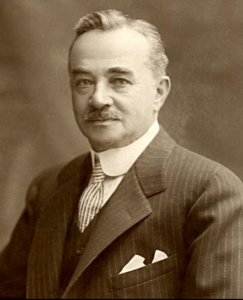
In 1918, Milton Hershey made a decision that would have seemed extraordinary even among the wealthiest businessmen of his era. Without fanfare, he transferred the bulk of his personal fortune, including his ownership interest in the Hershey Chocolate Company, into a trust established to support a school he and his wife had created for children in need.
By then, Hershey was already enormously successful. He had built one of America’s best-known chocolate businesses, developed a town around his factory and accumulated the kind of wealth that could have supported almost any lifestyle he wanted. At sixty-one, he could easily have spent the remainder of his life enjoying what he had created while leaving the company and fortune to be dealt with after his death.
Instead, he effectively asked a different question:
That question is what makes Milton Hershey’s story more interesting than another familiar tale of an entrepreneur who failed several times before eventually becoming rich. His early failures certainly mattered, and his determination to manufacture affordable milk chocolate helped create the fortune that made everything else possible, but neither explains why his story still deserves attention. The more revealing part came after he had achieved the outcome business success is usually supposed to deliver.
Hershey had reached the point where accumulating more would no longer substantially change his own life, yet the resources he controlled could profoundly change the lives of other people. What he chose to do with that distinction turned a successful chocolate company into something much larger than its founder.
To understand why, however, it is worth going back to a time when Milton Hershey had very little to give away.
FAILURE BEFORE HERSHEY
Milton Snavely Hershey was born in Pennsylvania in 1857 and received little formal education before entering the working world as a teenager. His first apprenticeship was with a printer, but it proved a poor fit and ended badly. He subsequently began working for a confectioner in Lancaster, where he learned the techniques of candy making and discovered the industry that would occupy much of the rest of his life.
Success did not follow quickly. Hershey attempted to establish confectionery businesses of his own, first in Philadelphia and later elsewhere, but the ventures failed, leaving him with years of experience and very little financial evidence that he was heading towards anything resembling the business empire that would eventually carry his name.
It is tempting to turn this part of his life into the familiar entrepreneurial lesson that failure inevitably leads to success if someone simply refuses to give up, but Hershey’s experience does not prove that. Many businesses fail and never recover, while persistence applied indefinitely to a bad idea can be just as destructive as giving up too early. What mattered in Hershey’s case was that the years of failure were accompanied by learning. He was gradually becoming better at understanding the product, the manufacturing process and, crucially, what customers would actually buy.
His breakthrough eventually came through caramel rather than chocolate. After returning to Lancaster, Hershey established the Lancaster Caramel Company and developed a successful business using fresh milk in his caramels. The company expanded rapidly, turning a man whose earlier ventures had repeatedly failed into a wealthy manufacturer.
For many entrepreneurs, that transformation would have provided a perfectly satisfactory ending. Hershey had gone from struggling confectioner to successful businessman and had finally obtained the financial security that had eluded him for years. But while caramel had made him successful, Hershey had already become interested in something he believed could become much bigger.
Chocolate.

WHEN A MILLION DOLLARS WASN'T THE FINISH LINE
At the end of the nineteenth century, milk chocolate was still relatively expensive in the United States, and Hershey became convinced that it could be manufactured efficiently enough to become an everyday product rather than something primarily associated with luxury. He had already established the Hershey Chocolate Company while operating his caramel business, and in 1900 he sold the Lancaster Caramel Company for $1 million while retaining the chocolate operation and the equipment connected with it.
The decision is important because Hershey was not walking away from a failed business in search of something better. He was selling the enterprise that had made him wealthy in order to concentrate on an opportunity he believed had greater potential.
He eventually developed a formula and manufacturing process for mass-produced milk chocolate and began building a large factory in rural Pennsylvania, close to the dairy farms capable of supplying the enormous quantities of fresh milk the operation required. Around that factory grew the community that would eventually become Hershey, Pennsylvania.
The town is sometimes presented as evidence that Hershey was simply a uniquely benevolent employer, but the reality is more practical and therefore more interesting. A huge factory built in a rural area needed workers, and workers needed somewhere to live. Hershey therefore invested in housing and infrastructure around the factory, eventually helping create a community that included schools, public transportation, recreational facilities and other amenities.
There was commercial logic behind those decisions, just as there was commercial logic behind making chocolate affordable to a mass market. Hershey was still building a business, and there is no need to transform him into a businessman uninterested in profit in order to make his story meaningful.
What distinguishes the next part of his life is what happened when the business had already succeeded.
By then, Hershey no longer needed to prove that he could make money. He had done that first with caramel and then on a much larger scale with chocolate. The question facing him was no longer whether he could create wealth, but what purpose that wealth should serve once creating more of it ceased to be the most important problem in his life.
There comes a point when the more interesting question is no longer how much success you can create, but what you want that success to accomplish.
WHAT WAS THE MONEY ACTUALLY FOR?
Milton Hershey and his wife, Catherine, had no children, and in 1909 they established what was then known as the Hershey Industrial School, initially providing a home and education for orphaned boys. The decision gave their wealth a purpose that was very different from simply expanding the company or increasing the estate they would eventually leave behind.
Catherine died in 1915, but Hershey’s commitment to the school continued. Three years later he made the decision that transformed it from one philanthropic project supported by a wealthy businessman into the central beneficiary of the fortune he had created.
In 1918, Hershey transferred the bulk of his wealth, including Hershey Chocolate Company shares, into the trust supporting the school. It was an extraordinary transfer not simply because of its financial value, but because of what Hershey was giving up. Company ownership represents more than money: It represents control over an asset capable of generating wealth far into the future. By placing that ownership into the trust, Hershey was directing the economic power of what he had built towards a purpose intended to continue long after he was gone.
That makes his decision fundamentally different from occasionally donating some of the income produced by his success. He changed where a substantial part of the success itself would ultimately belong.
There is an important distinction here. Giving away wealth does not automatically make someone virtuous, just as keeping wealth does not automatically make someone selfish. People have families to support, obligations to meet and entirely legitimate reasons for wanting financial security, and NoRuleBook has no reason to replace the conventional rule that more wealth equals more success with another rule insisting that successful people must give everything away.
Hershey’s story raises a better question.
Once you have enough, what is the additional money for?
For one person, the answer might be greater security for children and grandchildren. For another it could mean freedom from work, the ability to travel, investment in another business, support for a community, scientific research, philanthropy or simply the freedom to spend more time doing something that matters to them. There is no single correct answer.
The problem begins when the question is never asked at all, because accumulation can easily become its own objective. More revenue justifies pursuing still more revenue, a larger business creates the desire for an even larger business, and a higher level of wealth establishes a new benchmark from which anything less begins to feel inadequate.
Hershey had spent much of his life learning how to create more. Eventually, he made a conscious decision about what the more was for.
SUCCESS THAT OUTLIVES THE PERSON WHO CREATED IT

Milton Hershey died in 1945, but the unusual structure he created meant that his death did not end the purpose he had attached to his fortune. The school that he and Catherine founded continued to develop and today operates as Milton Hershey School, educating children from families with limited financial resources.

That continuing legacy helps explain why the most interesting measure of Hershey’s success is not simply the size of the company bearing his name. Businesses can survive their founders, brands can become globally recognized and fortunes can pass through generations, but Hershey deliberately connected the economic value of what he had created to an institution designed to continue serving people he would never meet.
His story therefore challenges one of the quieter assumptions surrounding ambition: That success is primarily about continuing to increase whatever measure originally told us we were succeeding. In business that measure is usually revenue, profit, valuation or personal wealth, and all of those measurements can be useful. The problem comes when the measurement quietly becomes the purpose.
A person can spend decades climbing towards financial independence only to discover that the instinct to keep climbing does not automatically disappear when independence arrives. The target simply moves, because without consciously deciding what ‘enough’ means, there is always another number available.
Hershey chose his own answer. It does not need to become ours.
What his life demonstrates is the importance of eventually asking the question.
THE NORULEBOOK TRUTH
There is nothing wrong with wanting to become successful, build a valuable company or create financial security. Milton Hershey spent decades doing exactly that, and without the commercial success of his businesses there would have been no enormous fortune available to support the institution that became his legacy.
The NoRuleBook question begins once success stops being merely a destination and becomes a resource.
At that point, continuing to accumulate may still be exactly what someone consciously chooses to do, but it should not be mistaken for the only possible definition of progress. Money can purchase security, independence and opportunity, but once those needs have been substantially met, its greatest value may lie in what it allows someone to create beyond themselves.
Success gives you more choices. The important question is whether you ever stop long enough to decide what those choices are for.
Milton Hershey’s legacy was not meaningful simply because he gave away a great deal of money. It became meaningful because, after spending much of his life learning how to build wealth, he eventually decided what he wanted that wealth to continue doing when he was no longer there to use it.
Take The Next Step
You do not need a fortune like Milton Hershey’s before seeing how this question becomes relevant. Most of us accumulate something as we move through life—money, knowledge, experience, influence, relationships or simply greater control over our own time—and it is easy to become so focused on acquiring more that we never decide what we ultimately want those resources to make possible.
The useful question, therefore, is not whether you should give away what you have or abandon the ambitions you are pursuing. It is whether the definition of success you are working towards is actually yours, and whether you know what you want that success to allow you to do once you reach it.
Because Building Something Valuable and Deciding What That Value Is For are two different achievements.
Click the NoRuleBook image below to explore the collection.
The NoRuleBook Collection
-
NoRuleBook
$9.95Original price was: $9.95.$7.95Current price is: $7.95. -
No Rules Start-Up
$19.95Original price was: $19.95.$9.95Current price is: $9.95. -
NoRuleBook Bundle
$22.90Original price was: $22.90.$14.95Current price is: $14.95.