

NoRule Book Banner

Dick Fosbury: The Man who Changed the Rules by Questioning the Method

by Robbie Dellow
Dick Fosbury Flop at Mexico Olympics No Rules

In October 1968, Dick Fosbury stood inside the Olympic Stadium in Mexico City preparing to compete for a high jump gold medal. Around him were some of the best athletes in the world, most using techniques that spectators, coaches and other competitors recognised as the established ways of clearing a high-jump bar. Fosbury was about to do something very different.

As he approached the bar, he ran in on a curve, turned his body during take-off and launched himself backwards, clearing the bar head and shoulders first before landing on his back. To anyone accustomed to watching the straddle and other established techniques, it looked peculiar, yet Fosbury wasn’t trying to attract attention or prove how unconventional he could be. He had developed the technique for a much more practical reason: the accepted methods hadn’t worked particularly well for him, so he had spent years finding one that did.

The distinction is important because Fosbury never actually broke the fundamental rules of high jumping. The objective remained exactly the same: take off from one foot and clear the bar without knocking it down. What generations of athletes and coaches had developed were accepted methods for achieving that objective, and over time it had become easy to confuse those methods with the rules themselves.

Fosbury questioned that assumption, and in Mexico City the answer played out in front of the world. He cleared 2.24 metres, won Olympic gold and established a new Olympic record, demonstrating on sport’s biggest stage that something could look completely wrong according to convention while producing a better result according to the only measurement that really mattered.

Sometimes the rule isn't the problem. The problem is that we've mistaken the accepted method for the only method.

WHEN THE ACCEPTED METHOD DOESN'T WORK FOR YOU

Fosbury had not begun his high-jump career with an ambition to reinvent the sport. As a teenager in Oregon, he struggled to achieve the heights he wanted using the established techniques. The scissors method he had learned was relatively straightforward but limited his progress, while attempts to adopt the more sophisticated straddle technique did not work particularly well for him.

It would have been easy to interpret those results as evidence that he simply wasn’t a very good high jumper. Instead, Fosbury began experimenting with the part of the equation that everybody else seemed to take for granted: The way he was getting over the bar.

His new technique did not appear fully formed. As he experimented, he gradually changed his approach, adjusted the position of his hips and shoulders and found that rotating his body allowed him to clear greater heights. Over time, those adjustments evolved until he was crossing the bar backwards, with his head and shoulders clearing first and his legs following behind.

What makes this particularly relevant to NoRuleBook is that Fosbury wasn’t rejecting convention simply because it was conventional. He had a clear objective, and every change he made could be tested against it. If an adjustment allowed him to clear a higher bar, it was worth developing; if it didn’t, there was no reason to keep it merely because it was different.

That gave him something far more useful than other people’s opinions about how strange his technique looked: Results.

THE EXPERIMENT THAT BECAME THE FOSBURY FLOP

Fosbury’s experimentation also coincided with an important change in the sport. High-jump landing areas were moving away from sand, sawdust and relatively unforgiving landing surfaces towards much softer foam mats, which made it possible for an athlete to land safely on the back and shoulders in a way that earlier generations of jumpers could not realistically have attempted.

Fosbury adapted to that changed environment. Rather than continuing to optimise a technique developed around the limitations of older landing areas, he explored what the new conditions made possible, gradually refining his approach as his performances improved.

The unusual style inevitably attracted attention, and not all of it was complimentary. Yet as Fosbury became increasingly successful, won NCAA titles and qualified for the United States Olympic team, the discussion began to change. People could continue debating whether his technique looked awkward or unconventional, but those judgments became less important every time he cleared a height that mattered.

This is where Fosbury’s story becomes much bigger than high jumping. Established methods often survive not because somebody has recently proved they remain the best solution, but because they are familiar, widely taught and reinforced by everyone else using them. When circumstances change, or when the accepted method simply doesn’t work particularly well for a particular problem, continuing to perfect the old approach may make less sense than questioning the approach itself.

Fosbury had an unusually clear way of determining which mattered more. He didn’t need his technique to look correct according to convention; he needed it to clear the bar. By 1968, it was clearing the bar high enough to take him to the Olympic Games.

MEXICO CITY, 1968

By the time Fosbury arrived at the 1968 Olympic Games in Mexico City, his unusual technique was no longer merely an experiment that worked for one high-school athlete in Oregon. He had developed it through years of competition, refined the curved approach and backward rotation that made it effective, and earned his place on the United States Olympic team. What had begun as a solution to his own difficulty with conventional techniques was now about to be tested against the best high jumpers in the world.
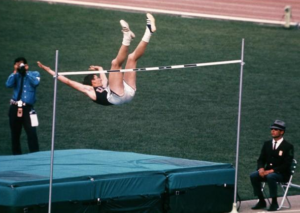
Dick Fosbury Mexico OlympicThe Olympic final provided exactly the kind of test that makes Fosbury’s story so compelling. There was no need for him to persuade anyone that his method was theoretically superior, nor did judges have to decide whether they approved of the way he jumped. The bar provided an objective measurement, and as the competition progressed Fosbury continued to clear it.

Eventually the field was reduced to three athletes: Fosbury, his American teammate Ed Caruthers and the Soviet Union’s Valentin Gavrilov. Fosbury cleared 2.24 metres on his third attempt, setting a new Olympic record and securing the gold medal.

The significance of what had happened extended beyond the medal. Millions of people watching the Olympics had now seen an athlete use a technique that looked dramatically different from the established methods and defeat the world’s best high jumpers with it. Fosbury had taken an approach that once appeared awkward and unconventional and demonstrated, under the most demanding conditions available, that it could work at the highest level of the sport.

He hadn’t won because he ignored the objective of high jumping. He won because he had become willing to question the accepted method of achieving it.
WHEN THE STRANGE METHOD BECOMES THE STANDARD

Fosbury’s Olympic victory did not cause every high jumper in the world to abandon existing techniques overnight, nor was he the only athlete experimenting with a backward style during this period. What Mexico City did was place the method on an international stage and provide compelling evidence that it deserved to be taken seriously.

Other athletes and coaches began studying what Fosbury was doing, and as modern foam landing areas became increasingly common, the practical advantages of going over the bar backwards became easier to exploit. Over the following years, variations of the technique spread through the sport until what had once looked unconventional became the dominant approach used by elite high jumpers.

There is an irony in that transformation. Once a new method becomes successful enough, future generations can inherit it in exactly the same way previous generations inherited the method it replaced. Young high jumpers today can learn the Fosbury Flop as the conventional technique without ever needing to question why athletes jump that way.

That doesn’t diminish Fosbury’s achievement. It reveals something important about how convention works. Today’s accepted method may simply be yesterday’s unconventional idea after enough evidence accumulated to make everyone comfortable with it.

What looks like 'the way things are done' is often just the best method somebody has found so far.

THE RULE FOSBURY NEVER ACTUALLY BROKE

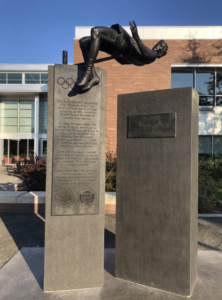
Dick-Fosbury-Oregon-University-statue

Dick Fosbury statue at Oregon University

Dick Fosbury is often presented as someone who broke the rules, which makes his story an obvious fit for NoRuleBook. Yet the more interesting truth is that he succeeded precisely because he understood, whether consciously or intuitively, the difference between a Rule and a Method.

The rules defined what counted as a successful high jump. Fosbury still had to take off from one foot, clear the bar and comply with the same competition rules as everyone else. He didn’t demand that those rules be changed because the existing techniques didn’t suit him. Instead, he recognized that the techniques athletes traditionally used to satisfy those rules were not themselves rules.

That distinction extends far beyond sport. In business, education, careers and everyday life, we are constantly surrounded by established methods that gradually acquire the authority of rules. We are told how a particular job is normally done, what sequence a career should follow, how a business should operate or which approach is considered professional, and because those methods are familiar and widely repeated, it becomes easy to stop asking whether they remain the best way of achieving the actual objective.

Questioning the method doesn’t mean automatically rejecting it. Convention often exists for good reasons, and doing something differently has no value if the result is worse. The lesson from Fosbury is therefore not that unconventional thinking is inherently superior, but that an established method should be able to survive the same question as an unconventional one:

Does it still work better than the alternatives?

Fosbury’s great advantage was that his answer could be measured in centimetres.

For the rest of us, the measurement may not always be so obvious, but the principle remains useful. Before accepting that something must be done a particular way, it is worth establishing whether you are looking at a genuine constraint or simply a method that has become familiar enough to feel like one.

THE NORULEBOOK 'RULE OR METHOD' TEST

When you encounter something that ‘has always been done this way,’ ask:

IDENTIFY THE RULE

What outcome or requirement actually has to be satisfied?

IDENTIFY THE METHOD

Which part is simply the conventional way of achieving it?

QUESTION THE ASSUMPTION

Why is this method used, and do the reasons behind it still apply?

FIND AN ALTERNATIVE

Is there another way to achieve the same outcome?

TEST THE RESULT

Can you compare the alternative against the existing method using evidence rather than preference?

The objective isn’t to be different. It is to avoid mistaking familiarity for necessity.

Fosbury didn’t prove that conventional thinking is always wrong. He demonstrated something considerably more useful

Sometimes the best way to respect the objective is to stop assuming there is only one acceptable way to reach it.

WHY DICK FOSBURY'S STORY STILL MATTERS

Dick Fosbury’s achievement is often remembered because of how dramatically different his jump looked. But appearance was never the important part of what he did. His real breakthrough came from recognizing that the technique he had been taught was only one way of achieving the objective, and when that technique wasn’t producing the result he wanted, he gave himself permission to experiment with another.

That distinction matters because established methods surround us. Some have survived because they genuinely work well, while others continue largely because they are familiar and few people have had a reason to challenge them. The difficulty is that, over time, both can begin to look equally permanent.

Fosbury showed why independent thinking requires more than simply rejecting convention. He experimented, measured the results and continued refining his approach because the evidence showed that it was working. Had his unusual technique consistently produced worse results, there would have been little value in defending it simply because it was different.

By the time he stood on the Olympic podium in Mexico City, he hadn’t proved that the old methods were foolish or that every convention deserved to be overturned. He had demonstrated something more useful: An accepted method should never become so unquestioned that we forget what it was originally designed to achieve.

The Fosbury Flop eventually became the convention itself, which may be the most fitting conclusion to the story. What once looked wrong became normal because someone was willing to test whether there was a better way.

Don't question a method just because it's conventional. Question it when you have reason to believe there may be a better one.

Take The Next Step

Most of us will never have an Olympic bar providing an immediate measurement of whether our alternative approach works, but we encounter accepted methods every day: how we’re supposed to build a career, organise our working lives, measure success, manage our money or decide what a “normal” life should look like.

The difficult part is recognising which of those are genuine constraints and which are simply familiar ways of doing things that we’ve stopped thinking about.

That distinction sits at the heart of NoRuleBook. If Fosbury’s story has made you wonder which accepted methods you may be treating as rules in your own life, grab a copy of NoRuleBook below. It will help you identify the unwritten assumptions influencing your decisions, question where they came from and decide consciously which ones still deserve to guide you.

Dick Fosbury didn’t change high jumping by ignoring the objective. He changed it by finding a better way to reach it.

The question worth asking is: Where in your own life have you mistaken the method for the rule?

The NoRuleBook Collection

Facebook

Related Articles

Leave a Comment