
NoRule Book Banner

Anna Muzychuk – The Grandmaster Who Played By Her Own Rules

by Robbie Dellow
Anna Muzychuk image

In December 2017, Anna Muzychuk was preparing to lose something most chess players spend their entire careers trying to win.

She was the reigning Women’s World Champion in both rapid and blitz chess, having won the two titles in 2016, and ordinarily the following year’s championships would have offered her the opportunity to defend them. Instead, when many of the world’s best players travelled to Riyadh, Saudi Arabia, for the King Salman World Rapid and Blitz Chess Championships, Muzychuk stayed away.

It was not because she was injured, had lost interest in chess or believed she could no longer compete with the world’s best. She stayed away because she had decided there were conditions under which competing was no longer worth the prize.

That distinction matters, because refusing an opportunity is easy to romanticise when there is little at stake. Muzychuk’s decision was different. She knew that by not going she would surrender the opportunity to defend two world championships, lose potential prize money and watch titles she had worked for years to earn pass to somebody else.

She went public with the decision before the tournament, explaining that she would not participate under conditions that, in her view, treated her as something less than equal. Her language was unusually direct: she did not want to feel like a ‘Secondary Creature.’ The existing article correctly identifies this boycott as the defining NoRuleBook moment in her story, but its significance becomes much clearer when we understand exactly what she was prepared to give up.

Muzychuk wasn’t asking whether refusing to participate would help her career. Almost certainly, competing offered the greater immediate reward.

She was asking a different question.

What is a principle worth when keeping it actually costs you something?

That question reaches far beyond chess, because almost everyone believes they have principles when those principles are free. It is considerably harder to discover where your boundaries lie when crossing one of them brings money, recognition, status or an opportunity you have spent years trying to reach.

For Muzychuk, that moment arrived when she was already at the top.

THE MAKING OF A WORLD CHAMPION

Anna Muzychuk had been playing chess for almost as long as she could remember. Born in Lviv, Ukraine, in 1990, she grew up in a family in which chess was part of everyday life, and her younger sister Mariya would eventually become a Grandmaster and world champion herself.
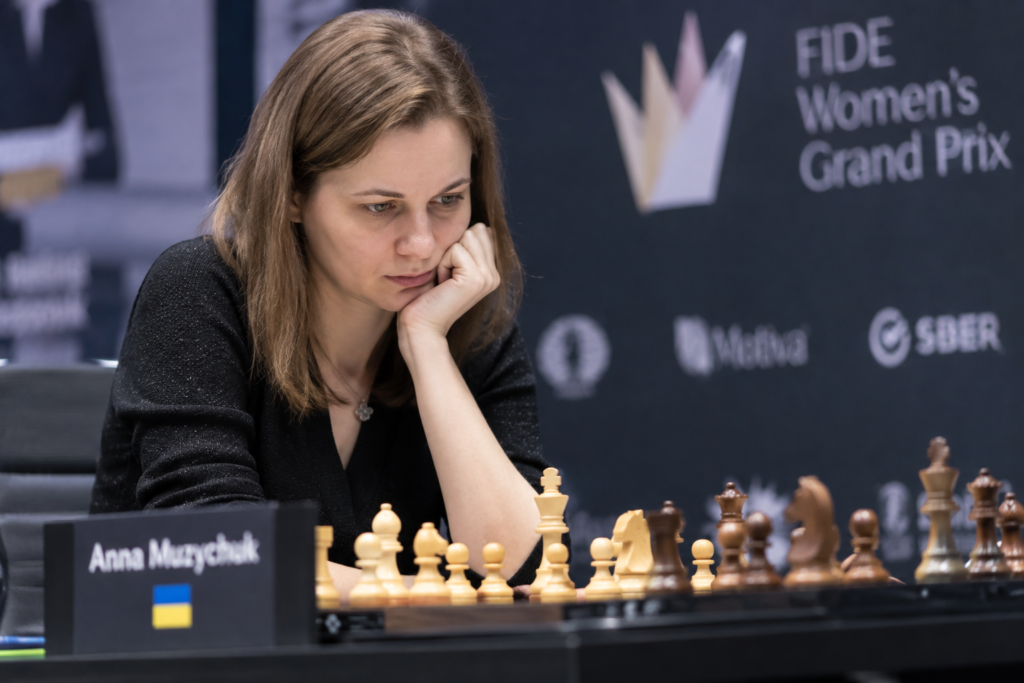
Anna Muzychuk tournament chessAnna’s progression through competitive chess was remarkable. She accumulated international titles while still young, became a full Grandmaster in 2012 and crossed the 2600 rating threshold, placing her among a very small group of women who had reached that level. Yet the part of her career that matters most to this story came in 2016.

At the Women’s World Rapid Championship in Doha, Muzychuk won the title without losing a game. She then followed it by winning the Women’s World Blitz Championship, completing an extraordinary double and leaving Qatar as the world champion in two different forms of speed chess.

That context changes the meaning of what happened a year later.

Muzychuk wasn’t walking away from something she had failed to obtain, nor was she criticizing a competition from safely outside it. She had already won. The titles were hers, and the next championships represented her chance to defend them.

Years of training had created the opportunity. Her principles were about to determine whether she took it.
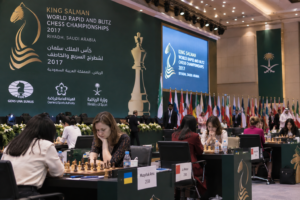
THE TOURNAMENT IN RIYADH

Chess Championship HallWhen the 2017 World Rapid and Blitz Championships were awarded to Saudi Arabia, the decision immediately created complications that went beyond chess.

Saudi society at the time operated under restrictions affecting women’s clothing, movement and personal autonomy that were very different from those Anna Muzychuk experienced in Europe. There were also broader concerns surrounding participation in the championship, including controversy over players who could not obtain permission to enter the country.

It is important, however, not to simplify Muzychuk’s decision into the claim that she was simply being forced to play chess wearing an abaya.

Before the tournament, FIDE announced that organisers had agreed to modified clothing requirements for female competitors. Foreign players would not be required to wear an abaya or hijab inside the venue and could instead compete in formal trousers and a high-necked blouse.

Muzychuk still chose not to go.

Her objection was therefore more fundamental than the clothes she would physically have worn while sitting at the chessboard. She objected to participating within a wider system of restrictions that she believed compromised her dignity as a woman, and when she announced her decision publicly, she made clear that she understood what it would cost her.

“In a few days I am going to lose two World Champion titles – one by one. Just because I decided not to go to Saudi Arabia… I refuse to play by someone’s rules…”

There is something important hidden inside those words.

Muzychuk did not claim that rules themselves were the problem. Chess is, after all, one of the most rule-bound activities imaginable. Every legal move is constrained. The board has fixed dimensions, the pieces have prescribed movements, clocks dictate how long players can think, and championships operate according to detailed regulations.

She had spent her life mastering those rules.

What she refused to accept was the assumption that because an organisation offered her an opportunity, she was therefore obliged to accept every condition surrounding that opportunity.

And that is where her story becomes much more interesting to NoRuleBook than a simple tale about rebellion.

WHAT DOES A PRINCIPLE COST?

It is easy to believe that you are a person of principle when your principles have never been placed in competition with something you badly want. Most of us can describe the values we consider important—fairness, independence, honesty, dignity—but those values remain largely theoretical until maintaining one of them requires us to surrender something tangible in return.

For Anna Muzychuk, the price was unusually visible. She wasn’t being asked to give up an opportunity she could easily replace next week, because world championships do not come around that way. She had spent much of her life developing the ability to compete at that level, had reached the summit in two formats, and now had to accept that another player would leave Riyadh holding titles she had not lost across a chessboard.

That is what gives her decision its weight. Whether someone agrees with every aspect of her reasoning is almost beside the point, because Muzychuk was willing to absorb the consequences of acting according to it. She did not demand that her titles be protected while she stayed home, nor did she pretend that refusing to participate would somehow leave her in exactly the same position. She understood there would be a cost and decided that accepting it was preferable to making a compromise she would struggle to respect afterward.

There is a useful distinction here, because NoRuleBook is not about treating compromise as weakness. Every functioning relationship, workplace and society requires compromise, and refusing to bend on anything is not independence; it can just as easily become another form of rigidity. The more difficult question is knowing which things are negotiable and which ones are so closely connected to your values that accepting the opportunity would change what the opportunity means.

Muzychuk appears to have found that boundary.

Principles are easy to claim when they cost you nothing. You discover what you really value when keeping them means giving something up.”

REFUSING THE OPPORTUNITY, NOT THE GAME

There is another reason Anna Muzychuk’s decision deserves more careful consideration than the familiar story of someone simply ‘breaking the rules.’ She did not reject the institution of chess, abandon competition or decide that rules themselves were incompatible with freedom. After the Riyadh championships were over, she continued doing what she had been doing for most of her life: playing chess at an elite level.

That matters because there is a tendency to tell stories about unconventional people as though independence requires rejecting an entire system. If a workplace contains a rule you dislike, leave the workplace. If an industry operates in a way you disagree with, reject the industry. If society expects something from you, do the opposite. It can make for a satisfying story, but it is a poor philosophy for navigating an actual life.

Muzychuk demonstrated something more selective. She remained committed to chess while refusing one particular opportunity because she believed the conditions surrounding it crossed a boundary she was unwilling to cross. Her objection was not to competition but to what she believed she would have to accept in order to participate in that competition.

That distinction sits close to the heart of NoRuleBook. Thinking independently does not mean automatically opposing whatever everybody else accepts, just as living by your own rules does not mean constructing a life in which nobody else gets to impose any constraints upon you. It means examining the rules, expectations and trade-offs attached to the choices in front of you, understanding why they exist, and then deciding consciously which ones you are prepared to accept.

Sometimes that examination will lead you to exactly the same decision everyone else makes.

Occasionally, it will lead you to stay home while everyone else boards the plane.

THE DIFFERENCE BETWEEN A RULE AND A VALUE

Chess offers an almost perfect setting for this distinction because Anna Muzychuk built her career by becoming exceptionally good at following rules.

A bishop cannot suddenly move like a rook because the player values independence. A pawn cannot move backwards because somebody considers the restriction outdated. The rules give the game its structure, and without them there is no meaningful game to play.

Life is considerably messier because the rules surrounding us do not arrive with a handbook explaining which are essential and which are merely inherited expectations. Legal requirements sit alongside workplace conventions, cultural traditions, family expectations, social habits and assumptions that have survived for so long that nobody remembers why they began. We often absorb all of them together and only discover where our own boundaries lie when one of those expectations conflicts with something we value more.

That is why the useful lesson from Muzychuk’s story is not “refuse to play by someone else’s rules.” Taken literally, that would be both impractical and contrary to the way she herself lived. The more useful lesson is to understand the difference between a rule that makes participation possible and a condition of participation that asks you to compromise something you have consciously decided matters more.

There is no universal formula for making that distinction, because two people can examine exactly the same situation and reach different conclusions without either one having failed to think independently. Muzychuk made her decision; other female chess players made theirs and competed in Riyadh. Turning her choice into a new rule that everyone else should have followed would miss the very point her story helps illuminate.

The real question is whether the decision is genuinely yours.

THE NORULEBOOK ‘PRICE OF PRINCIPLE’ TEST

Most values are easy to defend in the abstract. The harder test comes when an opportunity you genuinely want asks you to accept something that conflicts with one of them. When that happens, rather than immediately accepting the opportunity or rejecting it on principle, work through these five questions :

1. WHAT EXACTLY AM I BEING ASKED TO ACCEPT?

Separate the actual condition from your emotional reaction to it. What specifically must you do, tolerate or endorse in order to take the opportunity?

2. WHICH VALUE DOES IT CONFLICT WITH?

Name the principle, rather than relying on a vague feeling that something is wrong. If you cannot identify what you believe is being compromised, it may be worth questioning whether the conflict is as fundamental as it initially appears.

3. IS THIS A COMPROMISE OR A BOUNDARY?

Some compromises allow people with different interests to function together. Others cross a line you have consciously decided should not be crossed. Knowing the difference prevents flexibility from becoming surrender—and prevents stubbornness from masquerading as principle.

4. WHAT WILL SAYING NO ACTUALLY COST ME?

Do not romanticize refusal. Consider the money, opportunity, relationships, reputation or progress you may genuinely lose. A decision becomes more conscious when you acknowledge its consequences rather than pretending they do not matter.

5. WHICH COST WOULD I RATHER LIVE WITH?

The choice is rarely between paying a price and paying nothing. Often it is between the external cost of walking away and the internal cost of accepting something you believe you should have refused.

Muzychuk answered those questions for herself long before we gave them names. Her answer cost her the opportunity to defend two world titles, but that cost was precisely what made the decision meaningful.

The question isn't whether standing by your principles has a price. It's which price you are more willing to pay.

THE NORULEBOOK TRUTH

Anna Muzychuk’s story could easily be reduced to the familiar language of rule-breaking : A woman disagreed with the conditions surrounding a tournament, refused to participate and chose to ‘play by her own rules.’ Yet that interpretation is too simple, because throughout most of her life Muzychuk has operated inside an activity governed by extraordinarily strict rules, demanding discipline and years of structured preparation.

What made the Riyadh decision different was not that she suddenly decided rules did not apply to her. It was that she recognised a boundary between the rules she willingly accepted in order to participate in chess and the wider conditions she was unwilling to accept simply because participation in one particular championship required them.

Nor did saying no mean rejecting chess, competition or ambition. Muzychuk continued competing at the highest levels after Riyadh, adding major results to a career that had already established her among the strongest female players of her generation. That continuation matters because it shows that refusing one opportunity does not necessarily mean abandoning the larger direction of your life. A promotion can be refused without rejecting a career, a business deal can be declined without abandoning entrepreneurship, and an invitation can be turned down without deciding that every similar opportunity should be rejected forever.

Muzychuk was willing to lose an opportunity, but she wasn’t willing to surrender the game.

There is another important distinction. Respecting her decision does not require us to declare that every other woman should have made the same choice. Other competitors examined the circumstances and went to Riyadh, and independent thinking has to allow for that possibility too. If NoRuleBook turned Muzychuk’s decision into another instruction everyone was expected to follow, we would simply replace one externally imposed rule with another.

The more enduring lesson is therefore not about Saudi Arabia, chess or even boycotts. It is about deciding what matters to you before the price of defending it becomes inconvenient. Most lives will never present that choice through two world championship titles, but smaller versions appear constantly in careers, relationships, businesses and everyday decisions whenever something we want comes attached to a condition we would rather not accept.

There will not always be an obvious correct answer. Sometimes compromise is sensible, sometimes refusal is necessary, and often the hardest part is distinguishing between the two. What matters is that the decision does not happen by default simply because the opportunity is prestigious, profitable or difficult to replace.

Muzychuk’s story matters because she knew exactly what she stood to lose and made the decision consciously anyway.

Living by your own rules doesn't mean refusing every compromise. It means knowing which compromises would leave you living by rules you no longer recognize as your own.

Take The Next Step

Most of the rules shaping our decisions do not arrive as explicit instructions. They are more likely to appear as assumptions about opportunities we are supposed to accept, compromises successful people are expected to make, or costs we are told are simply part of getting ahead. Because those expectations are so familiar, it can be surprisingly difficult to notice when following them has stopped being a practical compromise and started becoming a decision about what we are prepared to trade away.

Anna Muzychuk’s story offers a useful reason to examine those boundaries before the stakes become high. NoRuleBook explores the unwritten expectations surrounding success, work, money, relationships and the way a life is supposedly meant to unfold, not to tell you which ones to reject, but to help you recognise them clearly enough to make the choice for yourself.

Click the NoRuleBook image below to explore the collection.

The NoRuleBook Collection

Facebook

Related Articles

Leave a Comment