
NoRule Book Banner

Having Children Is a Choice. So Why Do We Treat It as the Default?

by Sarah Winstanley
Couple meeting childless friend

There are few decisions we make in life that are as consequential as deciding to have a child. Becoming a parent can change where you live, how you spend your money, the direction of your career, the freedom you have to make spontaneous decisions and the way you organise almost every ordinary day for years to come. More importantly, it creates a responsibility for another human being that cannot simply be abandoned when circumstances change or the decision no longer suits you.

Given the magnitude of that commitment, you might expect the decision to become a parent to be one of the most carefully questioned choices we ever make. Yet listen to the way we often talk about it.

A couple gets married and sooner or later someone asks when they are going to have children. A woman reaches her thirties and relatives begin wondering when she is going to settle down and start a family. Friends start having babies and conversations gradually shift from whether children are wanted to when they might arrive.

Then somebody says they don’t intend to have children and suddenly a decision that had barely required explanation in one direction can require considerable explanation in the other. “Are you sure?” “Won’t you regret it?” “What if you change your mind?” “Who will look after you when you’re old?”

Most of these questions are not asked maliciously. They often come from people who genuinely care, and some raise issues that anyone making such a permanent decision should think about. What makes them interesting is the assumption underneath them, because we rarely interrogate someone who wants children with the same persistence that we interrogate someone who doesn’t.

One answer has become so culturally familiar that it often doesn’t feel like an answer at all. It simply feels like what comes next.

THE DECISION WE STOPPED SEEING AS A DECISION

For much of human history, parenthood was not experienced as the kind of deliberate lifestyle decision that many people are able to make today. Reliable contraception was unavailable, women’s economic independence was severely restricted in many societies, families were important economic units, and powerful religious and cultural expectations connected adulthood, marriage and reproduction. For enormous numbers of people, having children wasn’t one possibility among several equally accepted versions of adult life. It was simply part of the expected progression.

Much of the world has changed dramatically since then. Contraception has given people greater control over reproduction, women have far greater educational and economic independence in many countries, marriage has changed, people are settling down later, and adulthood can now take forms that would have been difficult for previous generations to imagine. What is interesting is how much of the old expectation survived those changes.

The familiar sequence of finding a partner, settling down and having children still feels completely natural to millions of people, and there is nothing inherently wrong with that. Plenty of people genuinely want exactly that life, and for them becoming a parent may prove to be one of the most meaningful and rewarding decisions they ever make.

Travelling towards parenthoodThe more interesting NoRuleBook question is whether people travelling towards parenthood have actually stopped to make that decision, or whether the strength of the default sometimes allows the question to change before they even notice.

Instead of asking “Do I want children?”, we begin asking “When should I have children?”

The difference seems small, but it isn’t. The second question has already answered the first.
A default is most powerful when we stop noticing there was ever another option.

SOMETIMES THE UNWRITTEN RULE IS HIDING IN THE QUESTION

One of the easiest ways to see an unwritten rule is to listen carefully to ordinary language, because expectations that would sound intrusive if stated explicitly can appear completely harmless once they have been embedded in familiar expressions.

“When are you having children?” sounds like casual conversation, but it assumes that children are coming and only the timing remains unresolved. “Do you want children?” creates an entirely different conversation because suddenly both answers are legitimate.

The same assumption appears in the phrase starting a family. Two people may have shared their lives for fifteen years, built a home together, combined their finances, cared for one another through difficult periods and regard themselves unquestionably as a family, yet people can still ask when they intend to ‘start’ one, as though the family remains incomplete until a child arrives.

Perhaps the most revealing response comes when somebody confidently says they don’t want children and hears, “You’ll change your mind.”

Of course they might. People change their minds about enormously important things throughout their lives, and there is nothing wrong with someone who was certain at twenty-five that they didn’t want children reaching thirty-five and discovering that they now desperately do. Nor is there anything wrong with somebody who always imagined becoming a parent eventually realizing that the desire was never particularly strong once they separated it from what they had always assumed adulthood would involve.

What is revealing is not that people can change their minds. It is which decision we tend to assume is temporary.

Someone who says, “I’ve always wanted children,” is rarely told with the same confidence that they will probably grow out of it. The conventional answer is allowed to stand on its own, while the unconventional one is more likely to be treated as something requiring explanation, reassurance or eventual correction.

None of this requires some organized social campaign encouraging people to reproduce. Unwritten rules rarely work that way. They become powerful through repetition, habit and thousands of small assumptions that individually appear insignificant but collectively establish what a normal life is expected to look like.

WHY DOES ONE ANSWER REQUIRE SO MUCH EXPLAINING?

That imbalance becomes particularly visible when someone reaches the age at which children are expected and they still haven’t had them.
People who deliberately choose not to become parents can find themselves discussing an intensely personal decision with relatives, friends, colleagues and sometimes people they barely know. They may be asked whether they are worried about regret, whether they are being selfish, whether their life will feel empty later or whether they simply haven’t met the right person yet. Sometimes there is an assumption that the decision must conceal disappointment because being genuinely content without children does not fit comfortably with the traditional sequence.
Women have historically carried much more of this scrutiny because motherhood has been so closely connected with ideas about femininity, fulfilment and what a complete woman’s life should look like. That becomes especially revealing when women who have achieved extraordinary things are still repeatedly expected to explain the absence of motherhood from their lives.
Jennifer Aniston is perhaps one of the clearest public examples. After years of tabloid speculation about whether she was pregnant, why she wasn’t pregnant and whether her personal life was somehow incomplete, she eventually challenged the assumption directly, arguing that women do not need marriage or motherhood in order to be complete. Oprah Winfrey has also spoken openly about not becoming a mother without describing that absence as a deficiency, while Dolly Parton has reflected on how her life developed differently without children and how that freedom contributed to the work she was able to pursue.
Their celebrity isn’t important here, and their success certainly doesn’t prove that not having children produces a better life. Plenty of parents have built extraordinary careers and plenty of people without children have ordinary ones.
What their experiences reveal is something much simpler: Even when a woman has achieved almost every conventional measure of success imaginable, the absence of motherhood can still be treated as something that requires an explanation.

When one choice requires an explanation, and the other is simply expected, you have probably found an unwritten rule.

QUESTIONING THE DEFAULT DOESN'T MEAN REJECTING IT

There is an easy mistake to make once we begin questioning an expectation like parenthood. We can become so focused on challenging the conventional path that the unconventional path starts looking inherently more independent, as though someone without children must have thought more deeply about life than somebody raising three of them.
That would miss the entire point.

NoRuleBook thinking isn’t about automatically choosing whatever society considers unusual. If it were, convention itself would still be controlling the decision; we would simply be reacting against it instead of following it.

A person who has thought seriously about parenthood and concludes that they deeply want to raise children has made a conscious decision, regardless of how conventional that decision appears. Someone who examines the same question and concludes that parenthood isn’t the life they want has done exactly the same thing. The answers are different, but the thinking behind them can be equally independent.

There is even a possibility of drifting into the unconventional choice without properly examining it. Someone may build an identity around freedom, travel, career or being childfree and become so attached to that version of themselves that admitting their desires have changed begins to feel like surrendering to convention. Independent thinking has to leave room for that possibility too.

The purpose of questioning an unwritten rule is not to discover the rebellious answer. It is to discover whether the answer is actually yours.

The goal isn't to choose the unconventional life. It's to make sure you actually chose your life.

That distinction becomes particularly important with parenthood because the consequences are unusually difficult to reverse. We can leave careers that no longer suit us, sell houses we regret buying, close businesses that didn’t work and move home from countries where we thought we wanted to live. Parenthood creates responsibilities of an entirely different order, just as reaching the point where having biological children is no longer possible can make the opposite decision irreversible too.
There are therefore genuine consequences on both sides, which is precisely why neither should be allowed to happen simply because one direction felt more normal.

WHY DO WE QUESTION THE UNUSUAL DECISION MORE THAN THE BIG ONE?

There is a strange contradiction in the amount of scrutiny we give to different decisions.
Tell people you are leaving a secure career to start a business and questions about risk arrive almost immediately. Announce that you are moving to another country and people want to know about employment, housing and what happens if it doesn’t work out. Spend a large amount of money on something uncertain and somebody will probably suggest that you think carefully before committing yourself.
We understand instinctively that consequential decisions deserve scrutiny.
Yet familiarity can disguise consequence. When millions of people have done something before us and almost everyone around us regards it as normal, the decision can feel less risky simply because it is common.
Having children is common. It is also enormous.
For someone who genuinely wants to become a parent, accepting years of responsibility for another person may be inseparable from what makes the experience meaningful. The sleepless nights, financial costs, restrictions on freedom and compromises around career are not arguments against parenthood; they are part of the reality that comes with choosing it.
That reality deserves consideration precisely because parenthood matters so much.
The unusual decision attracts questions because it breaks the pattern. Perhaps the more useful principle would be to question decisions according to the size of their consequences rather than how unusual they happen to be.

That is where the idea of the invisible default becomes useful. A default doesn’t necessarily push us towards a bad decision. It simply makes one answer feel sufficiently normal that we may spend less time examining it than its importance deserves.

The objective isn’t therefore to eliminate the default or convince people to reject it. It is to make the default visible again so that it becomes what it should always have been: An Option.

A FULL LIFE DOESN'T HAVE ONE DEFINITION

There is no honest way for an article like this to tell somebody whether they will be happier with children or without them, because no amount of philosophy can answer a question that depends so heavily on the individual living the life.

For some people, parenthood becomes one of the deepest sources of meaning, love and connection they will ever experience, and they would regard the sacrifices involved as insignificant compared with what they received in return. Others may build lives without children that are rich in relationships, creativity, work, travel, community, friendship or whatever else gives their lives meaning, without ever experiencing the absence of parenthood as something missing. Neither outcome invalidates the other.

What matters from a NoRuleBook perspective is recognizing the assumptions surrounding the decision before those assumptions become indistinguishable from our own preferences. That requires more than asking whether we are following convention, because deliberately rejecting convention can influence us just as powerfully as deliberately following it.

A better question is quieter and considerably harder:

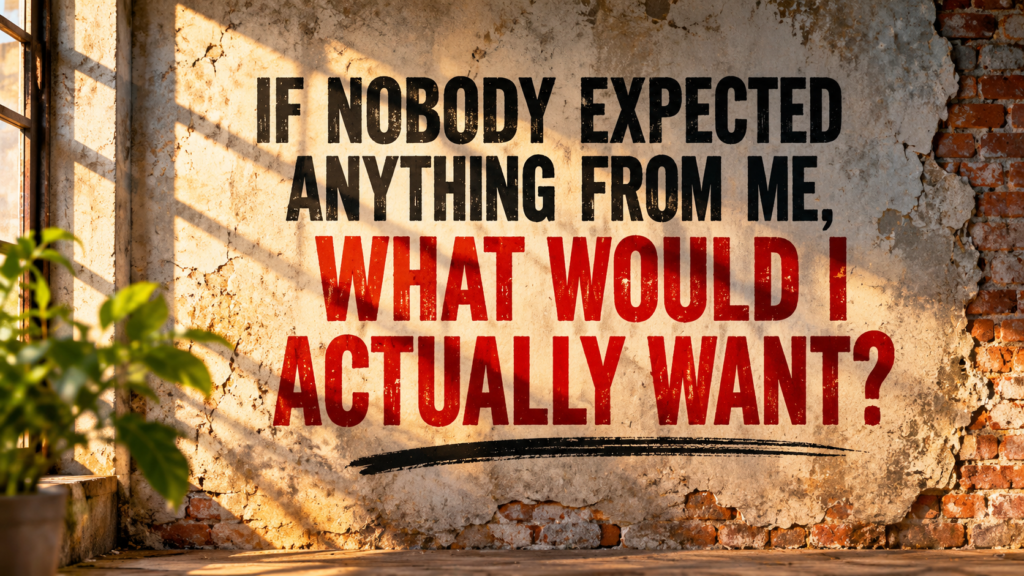
If nobody expected anything from meNot what would make your parents happy. Not what your friends are beginning to do. Not what would make you look independent, adventurous or unconventional. Not what somebody else’s version of a meaningful life is supposed to look like.

What would you want if neither answer required defending?

Parenthood does not become the wrong choice because society expects it, and a childfree life does not become the right choice because it challenges that expectation. Once we remove those assumptions, we are left with something much more personal and much more important: the responsibility to make one of life’s biggest decisions consciously.

Parenthood isn't the unwritten rule. Assuming parenthood without consciously choosing it is.

Perhaps that is the distinction worth remembering the next time somebody asks when the children are coming.

Before asking when, there is a much bigger question : Do you actually want them?

Take The Next Step

Many of the unwritten rules shaping our lives are difficult to recognise precisely because they arrive disguised as normality. We inherit assumptions about what responsible adults do, what successful lives look like and which milestones are supposed to come next, often without ever being explicitly told that these are rules at all.

NoRuleBook is about learning to recognise those assumptions before they quietly make important decisions for you. It isn’t about automatically rejecting the conventional path, but understanding why you’re choosing it and making sure the answer belongs to you.

If you want to start identifying the unwritten rules influencing your own decisions, click the NoRuleBook image below to get your copy.

The NoRuleBook Collection

Facebook

Related Articles

Leave a Comment