

NoRule Book Banner

Sister Rosetta Tharpe : The Woman Who Played Rock and Roll Before It Had A Name

by Robbie Dellow
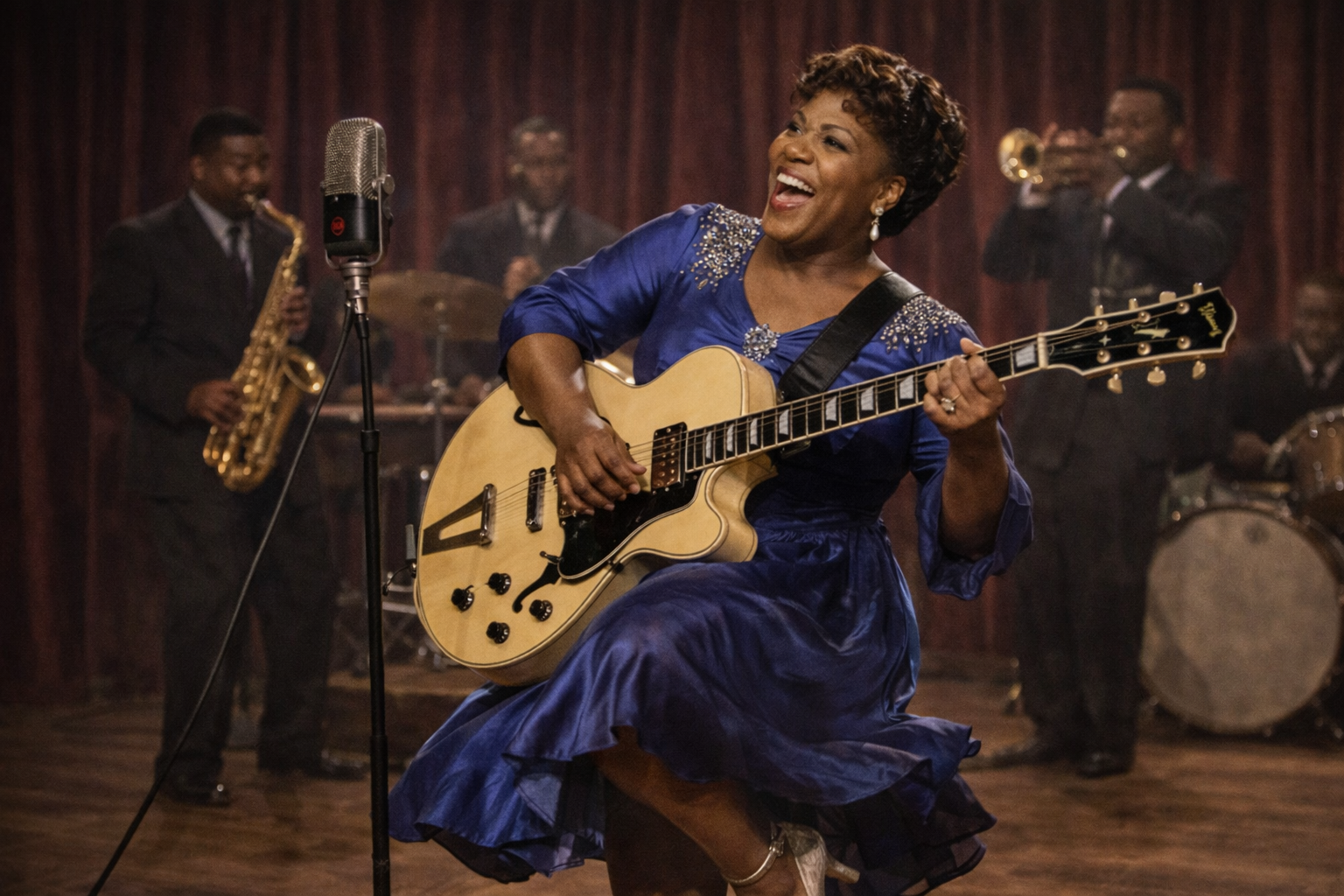
Rosetta Tharpe and band image

Long before rock and roll acquired its leather jackets, screaming teenagers and mythology of rebellious young men with electric guitars, a Black woman from Arkansas was already standing onstage with a guitar strapped across her body, turning gospel music into something that sounded as though it had arrived from the future.

Her name was Sister Rosetta Tharpe.

If you could somehow take a modern listener back to one of her performances without telling them the year, much of what they heard would feel strangely familiar. There was the distorted bite of an electric guitar, the driving rhythm, the showmanship, the confidence of a performer who understood that the guitar could do much more than accompany a singer. There were gospel melodies and religious lyrics, certainly, but underneath them was an energy that later generations would recognise immediately in rhythm and blues and rock and roll.

The remarkable thing was not simply that Tharpe was doing this before many of the musicians who would become synonymous with rock had become famous. It was that she was doing it while occupying almost every category the conventional history of rock would later make difficult to accommodate.

She was black, in an America still structured by racial segregation. She was a woman playing lead electric guitar in an era when instrumental virtuosity was overwhelmingly presented as male territory. She came from the church but performed in nightclubs. She sang about God while playing music that could make people dance. She could appear before religious audiences one night and secular audiences another, moving between worlds that many people around her believed ought to remain separate.

And perhaps that is why Rosetta Tharpe’s story matters far beyond music.

Because sometimes the people who change an industry are not the ones who become best at operating within its existing categories. Sometimes they are the people who expose how arbitrary those categories were in the first place.

Before Rock And Roll Had A Rulebook

There is a problem with looking backwards at cultural history: Once something becomes established, its existence begins to feel inevitable.

Today we know what rock and roll sounds like. We know what a rock guitarist is supposed to look like. What instruments belong onstage, and which musicians occupy the familiar family tree stretching from early rhythm and blues, through Chuck Berry and Elvis Presley, to the Beatles, the Rolling Stones, Jimi Hendrix and generations beyond them. Museums, documentaries, record collections and popular culture have spent decades turning a messy musical evolution into a story that feels surprisingly orderly. But musical revolutions rarely happen that way.

Rock and Roll did not suddenly appear when somebody invented a new genre and gave it a name. It emerged gradually from musical traditions that had been developing, colliding and borrowing from one another for years—particularly blues, gospel, rhythm and blues and country. The Rock & Roll Hall of Fame itself identifies gospel as one of the traditions that helped shape early R&B, soul and rock and roll, with Rosetta Tharpe occupying an important place in that lineage.

That distinction matters, because saying that Sister Rosetta Tharpe ‘invented rock and roll’ would simply replace one oversimplified history with another. She was part of a much larger musical evolution involving countless black musicians, church performers, blues players, bandleaders and recording artists whose ideas flowed into one another long before the resulting sound received the label we recognize today.

What makes Tharpe extraordinary is that so many elements of what would later become rock and roll were already visible in her work remarkably early.

She did not need to know what the genre would eventually be called. She simply needed to play.

The Girl With The Guitar

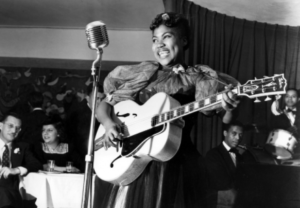
Rosetta Tharpe early imageRosetta Nubin was born in 1915 in Cotton Plant, Arkansas, and music entered her life through the church rather than the nightclub. As a child she performed alongside her mother, Katie Bell Nubin, an evangelist and musician, and after the family moved to Chicago she grew up inside the vibrant world of Black Pentecostal worship, where music was not merely decoration around religion but an intensely physical part of the experience. For a young musician, it was an extraordinary education.

The church gave Rosetta an audience, a musical vocabulary and somewhere to develop the commanding stage presence that would later make her such a compelling performer. It also placed her inside a tradition where the distance between performer and audience could disappear, where rhythm mattered, emotion was not something to conceal, and music was expected to move people rather than merely impress them.

By the time she was an adult, Rosetta could sing with enormous power and play guitar with a confidence that challenged assumptions about what the instrument—and the woman holding it—was supposed to do.

Then, in 1938, at around twenty-three years old, she made a move that would complicate almost everything. She went to New York.

There she began recording for Decca and performing in places far removed from the religious environment in which she had learned her craft. One of them was the Cotton Club, the famous Harlem nightclub associated with some of the biggest names in American entertainment. The Rock & Roll Hall of Fame describes her appearance there in 1938 as a remarkable crossing of boundaries for a performer emerging from Black Pentecostal tradition.

For Rosetta, however, crossing that boundary came with a problem.

The musical skills that made her exciting to secular audiences had been developed inside the church, and many people within the gospel world did not necessarily regard nightclubs and popular entertainment as harmless extensions of religious performance. The categories mattered. Sacred music belonged here. Secular entertainment belonged there.

Rosetta Tharpe was beginning to discover what happens when your talent refuses to stay where other people have decided it belongs.

When Sacred Music Walked Into The Nightclub

It would be tempting to tell this part of Rosetta’s story as a simple rebellion: The fearless artist rejecting a conservative church and escaping into the freedom of popular music. But that would entirely miss what makes her story interesting.

Rosetta did not abandon gospel in order to become something else. Gospel remained fundamental to her music, her identity and much of her career. What she challenged was the assumption that the musical language she had learned within that world had to remain confined to it.

That distinction changed everything.

When she brought gospel performance into nightclubs, recording studios and popular entertainment, she carried its rhythmic intensity with her. When she played electric guitar, she could move between accompaniment and aggressive lead passages, making the instrument answer her voice and pushing it forward in ways that would become increasingly familiar in the decades ahead.

To some listeners, the combination was exhilarating. To others, particularly those who believed sacred and secular music required a firm boundary, it could be uncomfortable.

But Rosetta had stumbled into one of the recurring problems faced by people who create something genuinely new: The audience often tries to understand the new thing using categories created for the old things :

  • If you were gospel, there were expectations about where you performed and what you sounded like.
  • If you were a woman, there were expectations about your role onstage.
  • If you were a guitarist, there were expectations about what kind of musician occupied the spotlight.

Rosetta Tharpe fitted into all of those categories and none of them particularly well. And rather than choosing one box and climbing inside it, she kept playing in the space between them.

A Sound The World Didn't Yet Have A Name For

By the early 1940s, Rosetta Tharpe had already crossed boundaries that many performers would have regarded as career-defining choices. She had moved from the church circuit into commercial recording, appeared in nightclubs and theatres, and discovered that the musical intensity she had learned in Pentecostal worship could reach audiences who might never have entered the churches where it had been developed. Yet the most important boundary she was crossing was harder to see, because the musical category on the other side of it did not properly exist yet.

Listen to Tharpe’s recordings from this period with modern ears and it can be difficult to understand just how unusual the combination must once have sounded. Her voice remained unmistakably rooted in gospel, but alongside it was an increasingly prominent electric guitar, played not merely as polite accompaniment but as a rhythmic and expressive instrument in its own right. She could strike chords with enough force to drive the song forward and then move into sharp single-note phrases that gave the guitar a personality of its own, combining the emotional intensity of church music with a sound that was becoming louder, harder and more electrified.

In 1944, she recorded “Strange Things Happening Every Day, accompanied by pianist Sammy Price and his trio. The song was still unmistakably gospel in subject, but musically it was doing something more complicated. Tharpe’s electric guitar interacted with the rhythm rather than sitting quietly behind her voice, while the performance carried the kind of propulsion that would soon become increasingly familiar in rhythm and blues and, eventually, rock and roll. When the record became a hit in 1945, it crossed onto Billboard’s race-record chart, making it one of the clearest early examples of gospel music reaching beyond its expected commercial boundaries. The Library of Congress would later describe the recording as helping to establish Tharpe as one of the earliest gospel performers to cross into the popular mainstream.

What makes that moment so interesting from a NoRuleBook perspective is that Rosetta was not sitting in a studio trying to invent a genre called Rock &  Roll. There was no marketing meeting in which somebody decided that gospel, blues, rhythm and electric guitar should be combined into a new commercial category. The labels came later. Rosetta was simply using the musical tools available to her in ways that made sense to her, and in doing so she was helping create a sound that the existing categories were becoming increasingly inadequate to describe.

That is often how genuinely new things enter the world. We imagine innovation as a deliberate act of invention in which somebody identifies a new category and then creates something to occupy it, but history frequently runs in the opposite direction. Somebody creates something because it feels interesting, useful or necessary, and only afterwards does everybody else work out what to call it.

Rosetta Tharpe had another advantage that is easy to underestimate: She understood performance.

She did not treat the electric guitar as an object that required solemn concentration. It was part of the show. She smiled while she played, moved with the music, exchanged energy with the audience and handled an instrument that would later become one of the great symbols of male rebellion with an ease that made the supposed rules around it look strangely unnecessary. Decades before the image of the guitar hero became embedded in popular culture, Rosetta was already demonstrating that the excitement did not come from fitting the image. It came from what happened when somebody picked up the instrument and knew what to do with it.

That becomes particularly striking when watching surviving footage of her today. In the famous 1964 performance of “Didn’t It Rain” at a disused railway station near Manchester during the American Folk Blues Festival tour, Tharpe arrives in a horse-drawn carriage, steps onto the platform, straps on her white Gibson SG-style electric guitar and launches into a performance before an audience sitting on the opposite platform. By then she was approaching fifty, yet the guitar playing sounds startlingly contemporary: forceful, rhythmic and completely at ease with amplification. The scene now feels almost like a historical glitch.

Here is a Black woman born in Arkansas in 1915, raised in Pentecostal gospel, standing on a railway platform in northern England and playing electric guitar in a way that popular memory would eventually associate far more readily with the male rock stars who followed her.

The future was already standing on the platform. The history books simply hadn’t caught up yet.

The Musicians Were Listening

Historical recognition can be deceptive because influence does not always travel neatly from the most famous person backwards. Sometimes the musician remembered by millions was once the young person standing at the edge of somebody else’s audience, absorbing ideas that would later become part of their own sound. Rosetta Tharpe occupied precisely that kind of position.

By the time Rock & Roll began emerging as a recognizable commercial force in the 1950s, she had already spent years recording, touring and demonstrating what could happen when gospel intensity met an amplified guitar. The musicians who followed did not need to copy her note for note for her influence to matter. What mattered was that she had expanded the range of what performers could hear, see and imagine.

Little Richard later spoke openly about Tharpe’s importance to him. In 1947, when Richard Penniman was still a teenager, Tharpe heard him singing before one of her performances in Macon, Georgia, invited him onto the stage and paid him afterwards. Long before the flamboyant Little Richard became one of Rock & Roll’s defining figures, Rosetta Tharpe had quite literally given the young performer an opportunity to experience the stage.

Her influence also sits within the musical world from which figures such as Chuck Berry, Elvis Presley, Jerry Lee Lewis and Johnny Cash emerged. It is important not to turn that into another convenient legend in which every famous rock musician can be traced directly to one forgotten originator, because music does not develop through a single family tree. These artists were absorbing gospel, blues, country, rhythm and blues and countless individual performers, and Tharpe was one important voice within that much larger exchange. But this is what makes her story more interesting, not less.

Because Rosetta’s significance does not depend upon proving that she single-handedly invented Rock & Roll. It rests on something historically more plausible and, in many ways, more remarkable: Before Rock & Roll became a recognized genre, she was already demonstrating several of the possibilities that would help make it possible.

And once a possibility has been demonstrated, other people no longer have to imagine it from nothing.

  • They can hear it.
  • They can build on it.
  • They can take it somewhere else.

The difficult part is that the people who demonstrate a possibility first are not always the people history eventually chooses to place at the centre of the story.

When The Future Arrives Before The Credit Does

Rosetta Tharpe record cover image

There is a comforting way we like to tell the history of innovation. Someone has an idea, the idea is recognised as important, the innovator receives credit, and history remembers the breakthrough as belonging to the person who made it.

Real life is rarely so tidy.

Recognition depends on much more than being early. It depends on whether the world is ready for what you are doing, whether there is already a category into which your work can be placed, whether the institutions that record history consider you important, and whether the people who come afterwards are easier to fit into the story that eventually gets told.

Rosetta Tharpe had the peculiar disadvantage of arriving before the story had settled into its final shape.

When Rock & Roll exploded into American popular culture during the 1950s, it acquired new stars, new audiences and, eventually, a mythology of its own. Chuck Berry duck-walked across stages with an electric guitar. Little Richard attacked the piano with an energy that seemed almost impossible to contain. Elvis Presley became an international phenomenon. As rock developed through the 1960s and beyond, the electric guitarist became one of popular culture’s most recognizable figures, and the story increasingly centered on the performers who became famous after Rock & Roll had acquired a name.

Rosetta belonged to an earlier, messier part of that history. She was not forgotten because nobody had heard her. She had been a successful recording artist, toured extensively and attracted substantial audiences. Nor would it be accurate to say that the musicians who followed simply took Rock & Roll from her and received the credit she deserved. The music emerged from a complicated exchange between gospel, blues, rhythm and blues, country and other traditions, shaped by many performers whose contributions overlapped and influenced one another. The problem was subtler.

Once Rock & Roll became a recognized category, the people who most obviously looked and sounded like what the category had become were easier to place at the center of its history. A black female gospel singer born in 1915, whose career crossed churches, nightclubs and popular entertainment before the genre had fully formed, was harder to fit neatly into the picture.

That is one of the strange things about being ahead of a category :

The people who arrive later can sometimes look more like the pioneers, than the actual pioneers themselves.

By the time the world knows what something is supposed to look like, it can forget the people who were experimenting before anybody knew what to call it.

Rosetta’s place in musical history has gradually been reassessed. In 2018, the Rock & Roll Hall of Fame inducted Sister Rosetta Tharpe in its Musical Influence category, describing her as a foundational figure whose distinctive guitar style and combination of gospel and secular musical elements helped shape the development of rock and roll.

The recognition mattered, but its timing tells its own story. Rosetta Tharpe had died in 1973. The institution devoted to preserving the history of Rock & Roll formally inducted her forty-five years later.

There is something worth thinking about in that gap, because it points to a problem that exists far beyond music. We tend to imagine recognition as evidence of originality, when recognition is often evidence that the world has finally developed the language necessary to understand the originality that was already there.

Sometimes the future arrives before the credit does.

The problem With Being Between Categories

Imagine for a moment that Rosetta Tharpe were beginning her career today and somebody asked the most ordinary question in the music business :

What kind of artist are you?

It sounds like a harmless question. In fact, it is one of the ways industries organise themselves.

Record stores need sections. Streaming services need genres. Radio stations need formats. Promoters need to know which audience to advertise to. Journalists need descriptions. Award organisations need categories. Customers themselves often want some indication of what they are about to hear.

Categories are useful because they make complicated worlds easier to navigate. The problem begins when we forget that a category is a description of what already exists, rather than a law governing what is allowed to exist next.

Rosetta Tharpe’s career repeatedly collided with that distinction. Gospel audiences could question her appearances in secular venues, while secular audiences encountered a performer whose repertoire remained deeply connected to religion. She was a singer, but the guitar was central to her identity as a performer. She belonged to a musical tradition that would profoundly influence popular music, yet the genre with which her playing would eventually be associated had not properly formed when she began exploring its possibilities.

From an industry perspective, those contradictions can look like problems. From an innovation perspective, they can be clues.

When somebody fits comfortably into an existing category, we know roughly how to understand them. When somebody sits awkwardly between several categories, however, our first instinct is often to ask them to choose. Are you this or that? Are you serious or commercial? Traditional or modern? Specialist or mainstream? Artist or entrepreneur? Employee or creator? Expert or outsider?

We assume the confusion belongs to the person who refuses to fit the category.

Sometimes the category is what has become inadequate.

This is why the most interesting part of Rosetta Tharpe’s story is not simply that she broke musical rules. If we reduce her life to ‘ignore the rules and do whatever you want,’ we miss the much more useful lesson contained within it. Gospel traditions gave her enormous musical foundations. The recording industry helped distribute her work. Audiences, collaborators and existing musical forms all contributed to what she became. She did not create in a vacuum, and she did not need to reject everything that existed before her.

What she refused to accept was that the existing boundaries between those things represented the limits of what could be created from them. This distinction matters.

NoRuleBook is not interested in breaking a category merely because a category exists. Categories can be enormously useful. Rules can preserve knowledge. Traditions can contain lessons accumulated over generations. But none of those things deserves to become a prison simply because it has acquired a name.

The category that describes what you are doing today does not necessarily define what you are capable of creating tomorrow.

Rosetta’s music became powerful partly because she could take things that other people understood separately and allow them to exist together. Sacred and secular. Tradition and experimentation. Singer and guitarist. Spiritual conviction and showmanship.

What looked contradictory from inside the old categories began to make much more sense once the world caught up.

And this leads to a question that extends far beyond music.

How many ideas do we reject, businesses  we misunderstand, careers  we abandon and versions of ourselves we suppress, simply because they do not fit comfortably into a category that already exists?

The Danger Of Waiting For The World To Understand

There is another tempting lesson we could draw from Rosetta’s life: That if you are sufficiently original, history will eventually recognize you. Unfortunately, even that would be too comforting.

History contains countless people whose work was overlooked and never rediscovered, people who challenged conventions and were simply wrong, and others whose ideas may have been valuable but arrived without the circumstances, resources or opportunities necessary to carry them further. Being misunderstood is not evidence that you are a genius, just as rejection is not proof that the world will eventually discover you were right.

Rosetta’s story gives us something more practical.

She did not have the luxury of knowing how history would judge her. She could not know that decades later people would look backwards through the development of rock and hear something remarkably important in the guitar playing she was already doing. She could only make decisions using the information and opportunities available to her at the time.

That is the uncomfortable position in which almost every genuinely independent decision has to be made.

If you wait until everybody understands what you are doing, you may be waiting until the thing you are doing is no longer particularly unusual. If you wait until an established category appears before allowing yourself to enter it, somebody else may have to create that category first. And if you require future recognition before deciding whether today’s experiment is worth attempting, you are asking for evidence that cannot possibly exist yet.

The alternative is not blind self-belief.

It is learning to separate ‘people don’t understand this yet’ from ‘I haven’t thought this through.’

Those are very different situations.

The first may be the unavoidable cost of exploring something new. The second is a warning worth listening to.

Independent thinking requires enough confidence to tolerate the first without becoming so convinced of your own originality that you ignore the second.

Rosetta Tharpe’s life does not give us a formula for knowing which is which. What it gives us is a reminder that the absence of an existing category, an established path or immediate recognition is not, by itself, evidence that the path leads nowhere.

Sometimes it simply means you have reached a place where the map hasn’t been drawn yet.

The NoRuleBook Truth

The easiest way to understand Rosetta Tharpe is to look backwards and call her a pioneer. The harder – and more useful – thing is to imagine what her choices looked like before anybody knew where they would lead.

There was no established story telling her that a black gospel woman playing an electric guitar across sacred and secular stages would eventually be regarded as an important figure in the development of rock and roll. There was no future Rock & Roll Hall of Fame induction waiting to reassure her that crossing those boundaries would one day make historical sense.

There were simply the musical possibilities in front of her and the categories surrounding them. Rosetta kept exploring these possibilities.

And that is the part of her story worth carrying forward.

Sometimes originality doesn't mean inventing something from nothing. It means refusing to keep apart the things everybody else assumes belong in separate boxes.

The challenge is not to reject every box, every tradition or every rule. It is to remember that they were created to help us understand the world as it existed—and the next important idea may not fit comfortably inside them.

Because sometimes the person who appears not to fit the category isn’t the problem. Sometimes the category is simply too small for what is arriving.

Take The Next Step

Rosetta Tharpe’s story is easy to admire because we can now see what happened afterwards. We know that the boundaries she crossed would become less rigid, that the electric guitar would become one of popular music’s defining instruments, and that the sounds developing around gospel, blues and rhythm and blues would help create something the world eventually called rock and roll.

The more useful question is whether there might be boundaries in your own life that appear equally natural simply because nobody has encouraged you to combine what sits on either side of them.

Think about two things you have always treated as belonging to different parts of your life. They might be :

  • skills developed in completely different jobs
  • a professional ability
  • a personal interest
  • something practical
  • something creative
  • an old area of experience
  • a new technology
  • or two interests that seem to belong to entirely different worlds.

Then ask yourself :

Who decided these things don’t belong together?

Is there a genuine reason they need to remain separate, or have you simply inherited the categories that other people use to organize them?

Now imagine deliberately combining them. You don’t need to resign from your job, launch a company or announce a dramatic reinvention of yourself. Instead, design the smallest experiment that would allow you to discover whether something interesting exists in the overlap.

Rosetta Tharpe could not have known where the musical boundaries she crossed would eventually lead, and neither can we know in advance which unusual combinations will produce something valuable. The point is not to assume that every unconventional combination is brilliant. It is to stop rejecting possibilities simply because there isn’t already a familiar box in which to put them.

Sometimes the most interesting opportunity isn’t waiting somewhere completely new.

It is sitting in the space between two things you already know.

That is one of the ideas at the heart of NoRuleBook: Not breaking conventions for the sake of being different, but becoming conscious of the boundaries you have inherited so that you can decide for yourself whether they still deserve to limit what comes next.

Click the NoRuleBook image below to explore the collection.

The NoRuleBook Collection

Facebook

Related Articles

Leave a Comment