

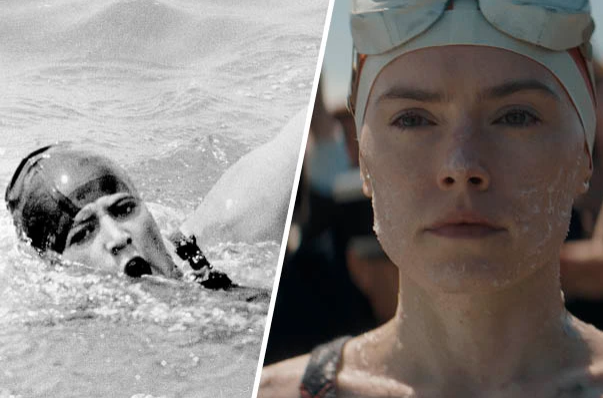
We are quick to cheer for talented athletes that show amazing ability and win countless awards. Records fall, medals accumulate, headlines move on. But largely forgotten are the individuals who didn’t just win — they changed the rules of what was considered possible. One such person was Trudy Ederle.
Gertrude “Trudy” Ederle became one of the world’s best athletes at a time when women were widely labelled the weaker sex. One hundred years ago, this courageous woman showed the world that women were not physically inferior — and that they could compete at the same level as men, even in the most brutal conditions imaginable.
Her story isn’t just about sport. It’s about dismantling an unwritten rule that society treated as biological fact.
Trudy Ederle’s Early Life : Defying the Odds From the Start
Trudy Ederle’s determination showed itself early — long before fame or records.
At just five years old, she contracted measles and was given up for dead. She survived, but the illness left her with severe hearing loss, a condition that would affect her for the rest of her life. In an era with little support or understanding for disabilities, this alone could have limited her opportunities.
Instead, it sharpened her resolve.
She showed an intense eagerness to learn to swim. Her father assisted by tying a clothesline around her waist, and Ederle learned to float and paddle in the Shrewsbury River in New Jersey, USA. It was not elegant training. It was not institutional. It was improvised, determined, and relentless.
That pattern would define her life.
Rising to the Top in a World That Expected Less
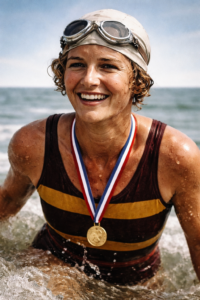 From those early river sessions, Trudy Ederle progressed into local female swimming competitions. She wasn’t just competitive — she was dominant.
She would go on to set 29 world records in women’s freestyle swimming, emerging as one of the United States’ brightest female swim stars. Her success earned her a place at the 1924 Paris Olympics, where she won multiple medals.
Yet even after standing on the Olympic podium, Ederle was dissatisfied. Not because she failed, but because she knew she could do more.
The standards she set for herself were higher than those society had set for her.
Her next goal was one many considered absurd : Becoming the first woman to swim the English Channel.
The English Channel : A Line Women Were Not Supposed to Cross
Up until 1925, only five men had ever completed the treacherous 21-mile swim across the English Channel. The water was freezing. The currents were unpredictable. The physical toll was extreme.
The belief of the time was simple and absolute : Women were physically inferior and incapable of enduring such punishment.
On August 6, 1926, a 19-year-old Trudy Ederle entered the frigid waters off the coast of France with one goal — to prove that assumption wrong.
The swim was brutal. She faced jellyfish stings, strong tides, exhaustion, and relentless skepticism from the world’s press. Sharks were even reported in the waters, adding to the danger and drama.
But after 14 hours and 31 minutes, Ederle emerged onto the sands of England.
She didn’t just succeed. She smashed the existing men’s record by over two hours.
How Trudy Ederle Changed the World
That swim changed everything.
In one act of sustained defiance, Trudy Ederle destroyed the narrative that women were the weaker sex. Not with arguments. Not with ideology. But with undeniable reality.
Her achievement forced the world to reconsider what had long been treated as biological destiny. If a woman could outperform men in one of the most demanding physical challenges on earth, what other limits were artificial?
Her success rippled far beyond sport. It influenced perceptions of women’s physical capability, resilience, and autonomy for generations.
Recently, her story has reached a new audience through the film Young Woman and the Sea, which showcases her extraordinary life and the courage required to challenge deeply embedded beliefs.
Key Lessons We Can Learn From Trudy Ederle
Unwritten Rules Can Be Dismantled
Just because a label like “weaker sex” is deeply entrenched doesn’t mean it’s immutable. Trudy Ederle proved that many so-called rules survive only because no one has challenged them hard enough.
You Don’t Need Permission to Redefine Yourself
Ederle didn’t wait for society to approve her ambitions. She didn’t ask to be included. She acted – and forced – the world to catch up.
Rewriting the Story Benefits More Than One Person
Her courage didn’t just change her life. It expanded what others believed was possible. That ripple effect sits at the heart of the NoRuleBook philosophy.
True Strength Often Looks Like Defiance
Breaking a rule isn’t always loud or aggressive. Sometimes it’s quietly refusing to accept the limits placed on you.
Conformity Keeps You Small. Autonomy Makes You Limitless
When you stop living by someone else’s rulebook, you create space to write your own. Trudy Ederle didn’t just swim across a channel — she crossed a cultural boundary that had constrained women for centuries.
Final Thoughts : Why Trudy Ederle Still Matters
Trudy Ederle didn’t campaign against the system. She didn’t debate it. She outperformed it.
Her legacy is a reminder that progress often begins when someone ignores what they’re told is impossible and pursues what feels undeniable.
At NoRuleBook, her story stands as proof that the most powerful revolutions start with a single person refusing to accept inherited limits.
One swim. One decision. One rewritten rule.
-
-20%

No Rule Book
Original price was: $9.95.$7.95Current price is: $7.95. -
-35%
No Rule Book + No Rules Start-Up
Original price was: $22.90.$14.95Current price is: $14.95. -
-50%
No Rules Start-Up
Original price was: $19.95.$9.95Current price is: $9.95.


 Submitted 1.0
 Manual 5.0