

NoRule Book Banner

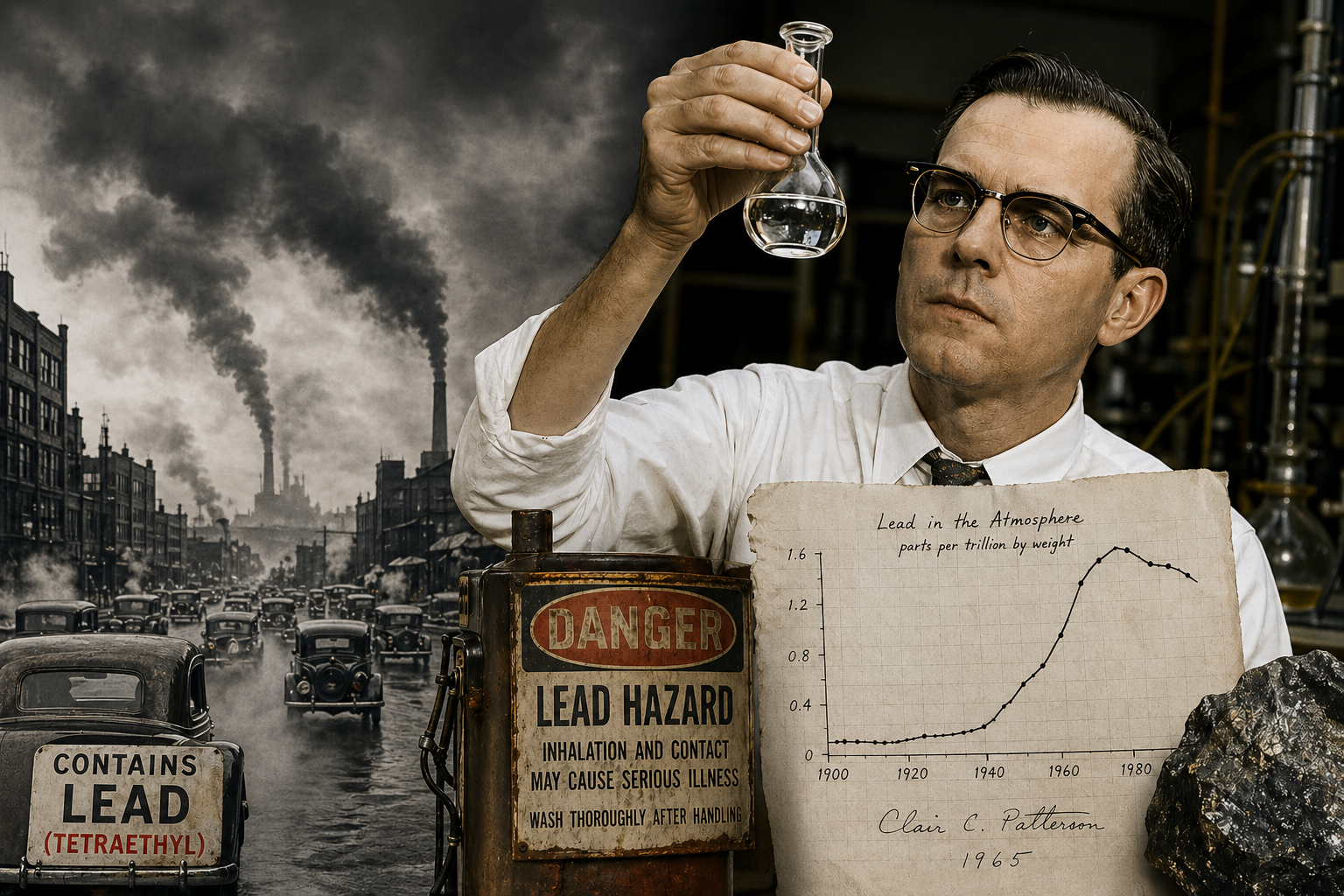
They Said It Was Safe. He Proved It Was Poison.

by Robbie Dellow
Clair Patterson lead poisoning

The Story of Clair Patterson — and the Truth the System Tried to Ignore

For decades, the world was being poisoned. Not by accident — but by something everyone accepted as normal.

Nobody questioned the air. People stepped outside and breathed without hesitation, never imagining that something so ordinary could be dangerous.

Cars were running. Cities were growing. Industries were booming. Progress carried with it a quiet assumption: if something was widely used, widely accepted and backed by authority, it must be safe.

There were no warning labels on the air. No public debate about invisible toxins drifting through streets where children played.

There was only trust. And that trust turned out to be badly misplaced.

We Trusted the Air Without Question

"The most dangerous things are often the ones that feel normal,"

At the time, lead was everywhere, though almost no one thought about it.
Tetraethyl lead

Lead had been added to petrol in the form of tetraethyl lead, a chemical that reduced engine knocking.

For the companies producing it, that meant profit and scale. For governments, economic growth. For the public, smoother cars and the appearance of progress.

So the rulebook was written.

Lead in petrol wasn’t merely accepted. It was endorsed.

And once something reaches that level of acceptance, people stop asking whether it is safe. Not necessarily because they have examined the evidence, but because institutions have already answered the question for them.

So the rulebook was written.

Lead in petrol was not just accepted. It was endorsed.

And once something reaches that level of acceptance, it stops being questioned, not because people have carefully examined it and decided it is safe, but because the system has already made that decision on their behalf.

Clair Patterson and the
Discovery of Lead Contamination

Clair Patterson was not trying to expose a global problem when he began his work; he was trying to solve a scientific one, a question that had fascinated researchers for decades: How old is the Earth?

His work required extraordinary precision. Determining the Earth’s age depended on measuring isotopes — particularly lead isotopes — in ancient rocks.

But no matter how carefully Patterson worked, something kept interfering with his results.

Lead contamination was everywhere.

At first, it looked like a technical problem. But Patterson noticed something important: the contamination was too consistent, too persistent and too widespread to dismiss as simple laboratory error.

Instead of forcing the data to fit his expectations, he asked a different question :

What if the contamination wasn’t coming from the laboratory? What if it was coming from the world itself?

A Discovery That Didn’t
Fit the Narrative

To find out, Patterson built one of the world’s first ultra-clean laboratories, allowing him to measure lead at levels of accuracy that had previously been almost impossible.

When he finally eliminated the contamination from his laboratory, the results revealed something far more disturbing.

There was vastly more lead in the environment than there should have been.

Not slightly more. Massively more.

Patterson expanded his research beyond the laboratory, examining ocean samples and ancient geological records. The pattern was unmistakable: modern lead levels were dramatically higher than natural historical levels.

This wasn’t a natural fluctuation. It was human-made contamination on an enormous scale.

The air people breathed, the soil beneath them and even the oceans carried the evidence.

Yet the prevailing story remained that lead exposure at existing levels was acceptable.

The Truth the System
Tried to Ignore

When Patterson began to present his findings, he wasn’t just introducing new data ; He was challenging a deeply entrenched system that had both economic power and institutional support behind it.
Ethyl-lead-gasoline-signThe source of the contamination was clear : Leaded Petrol.

And that meant the implications of his work extended far beyond science.

They touched industry, government policy, and the financial interests of some of the most powerful corporations of the time.

So the response was not curiosity. It was resistance.

Funding for Patterson’s work became harder to secure. Invitations to participate in conferences were withdrawn. His conclusions were questioned, not always through rigorous scientific debate, but through pressure, doubt, and attempts to undermine his credibility.

The system didn’t collapse under the weight of new evidence. It pushed back.
When the Truth Became a Threat to Industry

The idea that something as widespread as leaded petrol could be dangerous was not just inconvenient — it was disruptive, because it implied that an entire industrial practice, one that had been normalised for decades, might need to be reconsidered or even dismantled.

Patterson kept publishing.

He refined his measurements, strengthened his evidence and became increasingly outspoken about the dangers of lead contamination. This put him in direct conflict with an industry that had spent decades defending leaded petrol as safe.

Patterson hadn’t set out to become an activist. He was a scientist following the evidence. But the evidence had led him somewhere enormously inconvenient.

Patterson understood this, even if he never framed it in those terms. But  instead of stepping back, he continued forward, publishing his research, refining his conclusions, and speaking about the dangers of lead exposure with a clarity that became increasingly difficult to ignore.

He wasn’t trying to become an activist, but the truth he had uncovered left him with little choice.

He Didn’t Back Down

Eventually Patterson faced a choice.

He could soften his conclusions, redirect his research or step away from a fight that threatened his funding and standing within the scientific establishment.

He did none of those things.

The evidence was clear. And once you see something clearly, it becomes very difficult to pretend you haven’t.

Patterson continued researching, publishing and arguing his case. Slowly, the weight of evidence began to change the conversation.

“Once you see something clearly, it becomes very difficult to pretend you haven't.”

The Removal of Lead from Petrol Changed Everything

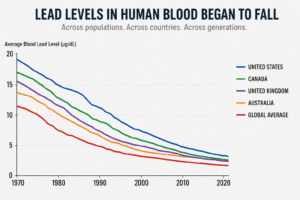
 lead levels in human blood

Change did not arrive in a single moment. Awareness grew. Scientific consensus strengthened. Regulatory pressure increased. Eventually, the reality Patterson had been pointing to for years became too large to ignore.

Policies changed. Leaded petrol was phased out.

And as lead disappeared from fuel, something remarkable happened :

Lead levels in human blood began to fall. Across populations. Across countries. Across generations.

The world had been contaminated. Now it was beginning to recover.

WHY CLAIR PATTERSON'S STORY STILL MATTERS

It is tempting to see this as a closed chapter — a dangerous problem from the past that was eventually solved. But Patterson’s story reveals something much more enduring.

Something can become normal long before anyone has established that it is safe. And once industries, institutions and everyday life have been built around that normality, challenging it becomes extraordinarily difficult.

Patterson didn’t begin by trying to overturn a system.

He simply followed the evidence somewhere the system didn’t want to go.

QUESTION WHAT FEELS “NORMAL”

Clair Patterson didn’t set out to break rules. He set out to find an answer.

But following the evidence eventually required him to question something almost everyone else had learned to accept.

That may be the most important part of his story.

The things most worth questioning are not always the things that look obviously wrong.

Sometimes they are the things that look completely normal.

"What are we accepting today that no one is questioning?"

Take The Next Step

Clair Patterson’s story is powerful because the danger he uncovered wasn’t hidden in some obscure corner of society. Leaded petrol was everywhere. It had become so embedded in everyday life that its very normality helped protect it from scrutiny.

That is what makes his story relevant long after lead began disappearing from petrol. We naturally become suspicious of things that look unusual, yet some of the assumptions most worth examining are precisely the ones that no longer look unusual at all. They have been repeated, accepted and built into everyday life for so long that questioning them can begin to seem more unreasonable than simply going along.

Patterson didn’t prove that accepted wisdom is always wrong, nor that institutions should automatically be distrusted. He demonstrated something more useful: when evidence conflicts with what everyone already believes, popularity and authority are not substitutes for asking better questions.

NoRuleBook explores that same habit of looking again at the assumptions we have stopped noticing — in our careers, ambitions, definitions of success and the choices we make about how to live — and asking whether what feels normal still deserves to go unquestioned.

Click the NoRuleBook image below to explore the collection.

The NoRuleBook Collection

Facebook

Related Articles

Leave a Comment