


NoRule Book Banner

Kathrine Switzer & the Boston Marathon : Breaking Barriers

by Robbie Dellow
Kathrine Switzer Boston Marathon

The Story of Kathrine Switzer and a Race That Changed Everything

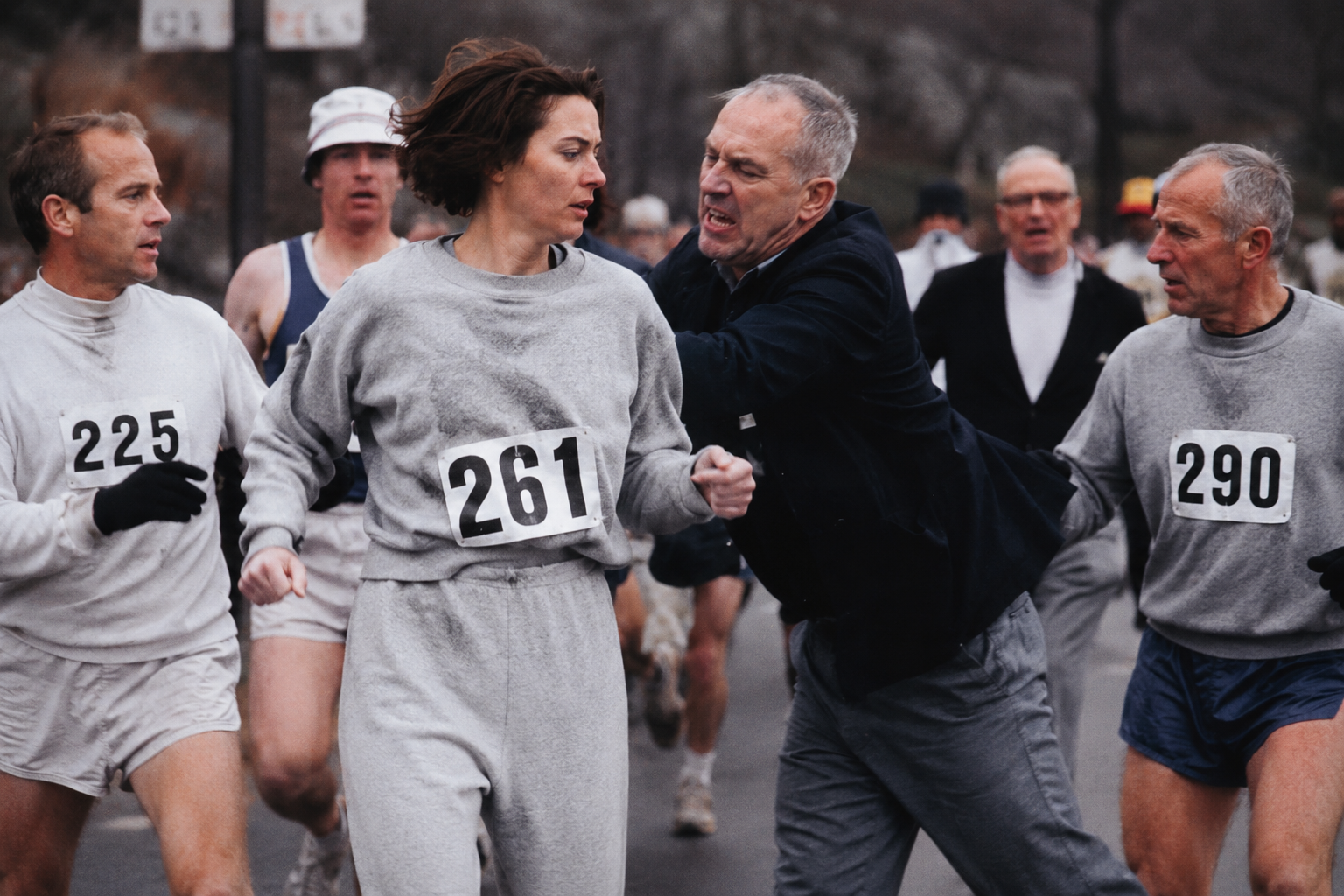
In 1967 the Boston Marathon was a revered event that men treated like a religious ritual; The rule book said nothing about women because the authorities simply assumed that a woman would never try to run twenty‑six miles. Twenty‑year‑old Kathrine Switzer was studying journalism at Syracuse University and training with the men’s cross‑country team; The assistant coach, Arnie Briggs, believed that women were too fragile to run such distances, but he promised to take her to Boston if she could prove herself in practice. Switzer loved long runs and had grown up alongside a father who told her that “life is for participating, not spectating,” so when she covered the full distance during a blizzard and her coach could no longer doubt her, she decided to apply for an official entry. The Amateur Athletic Union barred women from races longer than a mile and a half, but the Boston application asked only for name, address, and AAU number. Switzer paid the three‑dollar fee, signed ‘K.V. Switzer’ (the way she often signed her name), obtained a certificate of fitness, and had a male club member pick up her bib number 261. Even as she pinned the number to her sweatshirt, she sensed she was breaking an unwritten rule — yet she also believed that by following the letter of the law she could challenge its spirit.

The race begins and the sacred tradition is exposed

On the morning of April 19, 1967, the atmosphere around the starting line was jovial as runners recognized Switzer from training and celebrated her presence. The day was cold, and she wore a hooded sweatshirt that concealed her hair; within a few miles the hood slipped back and the world saw a young woman running with the men. Race co‑director Jock Semple, a fierce traditionalist who chased pranksters and novelty runners in past races, was following the pack on a press truck. When he spotted Switzer he became enraged that a woman might desecrate his sacred marathon; he leapt off the truck, lunged toward her and screamed “Get the hell out of my race,” while trying to tear off her bib. Switzer later recalled seeing his ‘vicious face’ with bared teeth as he grabbed her shoulder; Coach Briggs tried to shield her and was knocked to the pavement. In that split second, her boyfriend Tom Miller, a former football player and hammer thrower, threw his shoulder into Semple and sent him sprawling. The photographs of the attack, showing Semple clawing at Switzer while she resisted, were splashed across newspapers worldwide. The world saw not only a race but a confrontation between old rules and a woman who refused to stop.

Running through fear and finishing anyway

After the melee, Switzer was shaken and angry; She wanted to drop out and cry, but Briggs reminded her that quitting would hand victory to those who believed women didn’t belong. She kept running with wet gloves and a missing sock, processing the meaning of what had happened. The other competitors — mostly men — offered encouragement, and the crowd that lined the route cheered her on. She crossed the finish line in approximately four hours and twenty minutes, the first officially registered woman ever to do so. Meanwhile, another woman, Bobbi Gibb, who had run unofficially the year before, completed the race in a faster time, but the world focused on Switzer because of the dramatic confrontation. That moment — a woman refusing to let go of her bib while a man tried to rip it off — became an international symbol of defiance. In the immediate aftermath, the Amateur Athletic Union responded by banning women from all competitions with men; rather than correct the injustice, officials doubled down on it. Yet the attempt to tighten rules only amplified the story and galvanized support for change.

Pushing back against new bans and advocating for change

Switzer did not fade into obscurity after 1967; The attack propelled her onto a larger stage. The following year she married Tom Miller but focused her energy on running and activism. She campaigned for the Boston Athletic Association to allow women to race, and in 1972, after years of pressure, the race finally accepted women as official entrants. That year Switzer finished third in the women’s division and race director Jock Semple, who had once grabbed her shoulder, handed her the trophy — a moment of reconciliation and a sign that old attitudes could change. Switzer continued to compete; she won the 1974 New York City Marathon with a time of 3:07:29 and recorded her personal best of 2:51:37 when she finished second in the 1975 Boston Marathon. Through her performances she demonstrated that women were not only capable of finishing but also of racing at elite levels.

Switzer used her platform to advocate globally. In the late 1970s she partnered with Avon Products to create the Avon International Running Circuit, a series of women‑only races held in multiple countries. These events drew tens of thousands of participants and provided data showing that women’s marathoning had mass appeal and world‑class performances. The pressure from these races helped persuade the International Olympic Committee to add a women’s marathon to the 1984 Olympic Games. After the Olympic marathon debuted in Los Angeles and American runner Joan Benoit won the gold, Switzer noted that the emotional moment belonged not just to the champion but to every woman who had laced up shoes because someone had opened the door. She also became a commentator and writer, working on television broadcasts and penning training guides for women runners; Her professionalism earned her an Emmy Award and recognition as Runner’s World magazine’s Female Runner of the Decade

Creating 261 Fearless and building a global movement

261 fearlessThe number 261 became something more than a bib; It turned into a symbol of fearlessness. Women wrote the number on their arms, pinned it to their shirts, or tattooed it on their bodies as a declaration that they could do hard things. Switzer embraced the phenomenon; in 2015 she founded 261 Fearless, a non‑profit running network that establishes clubs, training programs, and events to empower women through running. The organization’s ambassador program trains women to lead local groups and encourages them to confront life obstacles with the same determination that carried Switzer through her race. In 2017, the fiftieth anniversary of her historic run, she returned to the Boston Marathon wearing bib number 261 and finished in 4:44:31. This time she was not the only woman in the field; more than 13,700 women lined up alongside her, nearly half of the total runners. After the race, the Boston Athletic Association announced that the number 261 would be retired from future events in her honor. The celebration contrasted sharply with the hostility she encountered in 1967 and underscored how far the sport — and society — had moved forward.

What her story means : Breaking rules and rewriting them

Kathrine Switzer’s story is not just a tale of athletic courage; it is a case study in how institutions enforce unwritten rules and how individuals can challenge them. She did not run in disguise; she filed the proper paperwork, paid the fee, and followed the same process as any male entrant. The attack she endured was not about a violation of rules but about her very presence. When the AAU responded by explicitly banning women, it revealed that rules are not neutral; they are tools to protect power structures. Switzer’s decision to keep running, to fight the ban, and to build a worldwide network for women runners shows how one person can turn a personal act of defiance into a movement that changes policy, public perception, and, ultimately, reality. Today, thanks in part to her activism, more than half of U.S. marathon finishers are women, and girls grow up seeing 26.2 miles as an achievable challenge rather than a forbidden distance.

The story also speaks to the importance of allies. Coach Arnie Briggs initially doubted that a woman could run a marathon; after Switzer proved him wrong, he not only trained with her but tried to shield her from assault. Tom Miller’s decision to use his strength to block Semple showed that male support can be pivotal when challenging sexist norms. Later, former adversary Jock Semple embraced change and presented Switzer with her trophy, illustrating that people can learn and evolve. These interactions highlight that rule breaking is rarely a solo endeavor; it often involves shifting the views of those who once upheld the rules.

Emotional conclusion : Running towards a world without limits

When Kathrine Switzer writes about the moment Semple’s hand seized her shoulder, she describes looking into his eyes and feeling pure fear. That fear could have turned into shame or retreat, but instead it transformed into resolve. The reason her story resonates decades later is not only because she was the first officially registered woman to finish Boston but because she turned her personal terror into a broader challenge to unjust rules. She continued to run despite the pain in her shoulder and the uncertainty about what would happen next; she kept her promise to finish and then pushed for systemic change. The image of her running while a man tried to drag her backwards is a metaphor for anyone who has felt pulled between obedience and authenticity. Switzer’s courage invites us to ask: which unwritten rules are we blindly following? What do we do when the world tries to rip off our number and send us back to the sidelines?

Her answer was to keep moving forward. That forward motion created ripples that became waves. The 1984 Olympic women’s marathon, the thousands of women running today, the non‑profit clubs in dozens of countries, and the tears on the shoulders of older runners who tell Switzer that running changed their lives — all of these outcomes stem from one determined young woman who refused to relinquish her place in a race. In a world full of unseen barriers, Switzer’s story reminds us that the most powerful rule breakers are those who break rules not out of rebellion for its own sake but out of a belief that participation is a right, not a privilege.

Take the Next Step

If this story inspired you to question the rules that hold you back, you’ll find more rule‑breaking stories and practical tools in our NoRuleBook eBook. Learn how thinkers, creators and activists across history have challenged conventions, and discover how you can apply these lessons to your own life. Click the NoRuleBook image below to grab your copy and join a community of fearless rule breakers.

The NoRuleBook Masterclass Collection

Facebook

Related Articles

Leave a Comment