

THE PROBLEM EVERYONE HAD LEARNED TO LIVE WITH
By the late nineteenth century, Lynn, Massachusetts, had become one of the great centres of American shoemaking, with factories producing shoes on a scale that would have been unimaginable only a few generations earlier. Machines could cut leather, stitch pieces together and perform an increasing number of tasks that had once depended entirely on skilled hands, yet one stubborn part of the process remained remarkably resistant to mechanisation.
It was called lasting.
Before a shoe could be finished, its upper had to be carefully stretched and shaped around a foot-shaped form called a last, pulled into exactly the right position and then attached so that the finished shoe retained its shape. It required judgement, coordination and a sequence of movements that experienced workers made look almost instinctive, which was precisely why attempts to mechanise the process had repeatedly struggled.
As factories became faster at almost everything else, lasting remained the bottleneck through which production still had to pass. A skilled hand laster could complete roughly 50 pairs of shoes in a day, and because the work demanded considerable skill, the industry organised itself around that limitation.
There is nothing particularly unusual about this. Every mature industry eventually develops constraints that people stop thinking of as problems and begin treating as facts.
A process takes three days because it has always taken three days. A particular job requires a specialist because only a specialist has ever done it. Customers have to tolerate an inconvenience because nobody has found a practical way around it. Eventually the explanation changes almost imperceptibly from “We haven’t solved this yet” to “This is simply how it works.”
That distinction matters.
Because an unsolved problem and an impossible problem can look remarkably similar when enough people have spent enough years failing to solve them.
In Lynn’s shoe factories, thousands of people could see the lasting problem. It wasn’t hidden. It happened every day, in plain sight, at one of the most important stages of production.
What was unusual was the person who eventually looked at it and refused to accept that the existing limitation had to remain. His name was Jan Ernst Matzeliger.
A bottleneck can survive for years, not because it cannot be removed, but because everyone has learned how to work around it.
THE OUTSIDER WHO STARTED WATCHING
Matzeliger did not arrive in Lynn with the credentials anyone would have expected from the man who was about to solve one of the shoe industry’s most persistent engineering problems.
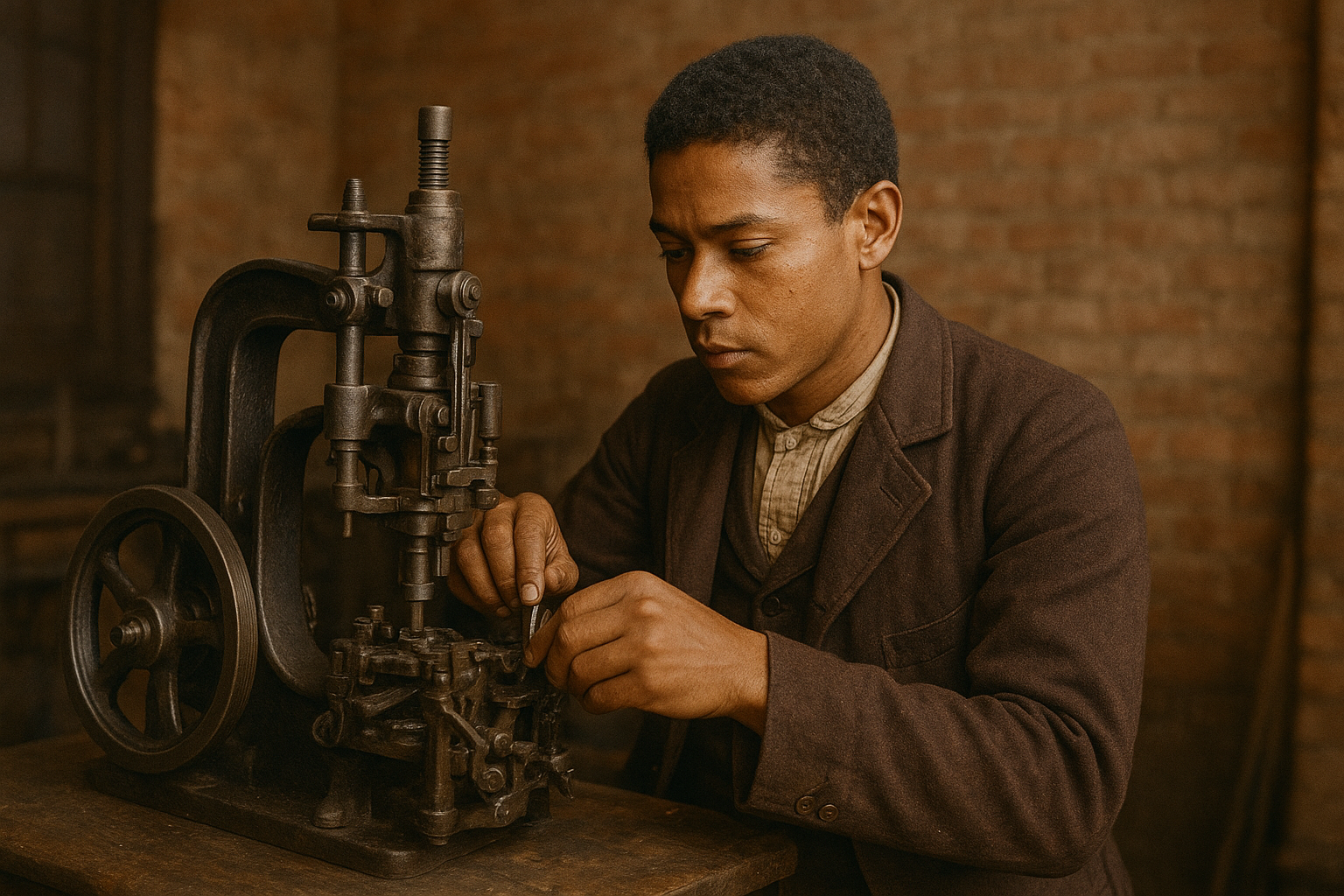
He had been born in 1852 in what is now Paramaribo, Suriname, the son of a Dutch engineer and a Surinamese mother who had been enslaved. His familiarity with machinery began unusually early. By the age of ten he was already working in machine shops supervised by his father, giving him an understanding of mechanical systems long before he encountered the particular problem that would eventually define his life.
At nineteen he went to sea aboard a merchant ship, eventually settling in Philadelphia in 1873 before moving several years later to Lynn, where he found work as an apprentice in a shoe factory. He was entering an industry whose conventions had been developed long before he arrived, and that outsider position is important – not because outsiders automatically see things more clearly, but because they sometimes encounter assumptions before they have had enough time to stop noticing them.
Matzeliger began watching the hand lasters.
He studied how they manipulated the leather. How they pulled it around the last, where tension had to be applied, and how several apparently simple movements combined into a process that machines had repeatedly failed to reproduce. Rather than assuming that the skill of the workers proved the task could never be mechanized, he treated their movements as information.
If a human being could perform the sequence consistently, perhaps the real question was not whether a machine could do it, but what the machine would have to understand mechanically in order to reproduce what the human hand appeared to do instinctively. That changed the nature of the problem.
Matzeliger obtained reference books and a second-hand set of drafting instruments and worked on the idea after his days in the factory were finished. His first model was hardly the sort of machine that would have convinced an industrialist that a manufacturing revolution was approaching. He constructed it from materials that included wooden cigar boxes, elastic and wire. But the crude appearance of the prototype concealed something far more important: Matzeliger was beginning to translate human expertise into mechanical steps.
He was not merely trying harder at something everyone else had failed to do.
He was learning to see the process differently.
What if the biggest opportunity in an industry is hiding inside the problem everyone else has learned to accept?
WHEN 'IMPOSSIBLE' REALLY MEANS “WE HAVEN'T SOLVED IT YET”
There is a subtle but important moment in the life of almost every difficult problem when repeated failure begins to change the way people describe it. At first, the problem is something nobody has solved yet. After enough unsuccessful attempts, however, the word yet quietly disappears, and what began as an engineering challenge starts to be treated as a permanent limitation.
That was the danger surrounding automated lasting. The difficulty was real: leather had to be gripped, pulled tightly and evenly around a three-dimensional last, positioned correctly and secured without damaging the material or distorting the shape of the shoe. Earlier inventors had developed machines that could perform parts of the process, but bringing those separate movements together into an automatic sequence remained extraordinarily difficult. Matzeliger’s own patent would later describe his objective very plainly: to perform by machinery, more quickly and economically, operations that had previously been performed by hand.
The distinction matters because NoRuleBook is not built around the idea that every supposedly impossible problem can be solved if somebody simply believes hard enough. Some constraints really are constraints, some ideas fail because they are bad ideas, and persistence without evidence can consume years that would have been better spent elsewhere. The more useful lesson from Matzeliger is that previous failure is evidence of difficulty, not necessarily evidence of impossibility.
For roughly two years he continued developing his machine, moving beyond the crude materials of his first model as he worked out how the separate mechanical actions could be coordinated. What he was attempting was sufficiently complicated that when his patent application reached the United States Patent Office, examiners reportedly could not fully understand the machine from the written description and drawings alone and needed to see it operate.
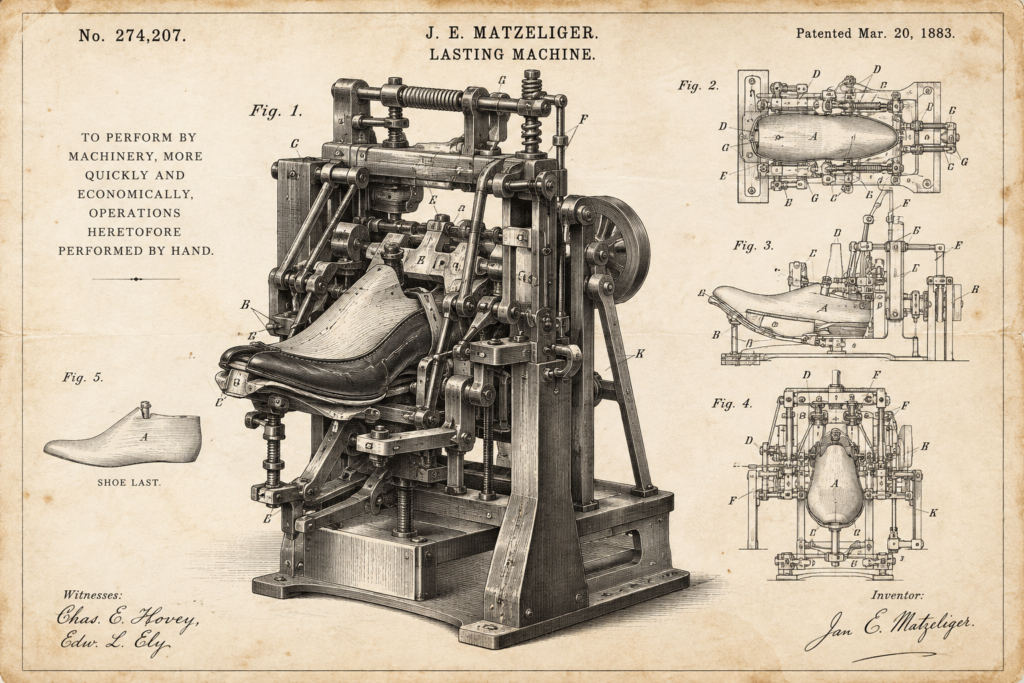
On March 20, 1883, Jan Ernst Matzeliger received U.S. Patent No. 274,207 for his lasting machine. The patent survives today, its seven sheets of intricate drawings revealing just how far the finished idea had travelled from those early experiments with cigar-box wood, elastic and wire.
He had not made the difficult part of shoemaking disappear. He had figured out how to make a machine do it.
Matzeliger did not prove that the experts were foolish. He proved that an unsolved problem should never be mistaken for an impossible one.
THE MACHINE THAT BROKE THE BOTTLENECK
To understand why Matzeliger’s invention mattered, it helps to forget for a moment that we are talking about shoes and think instead about the flow of a production system.
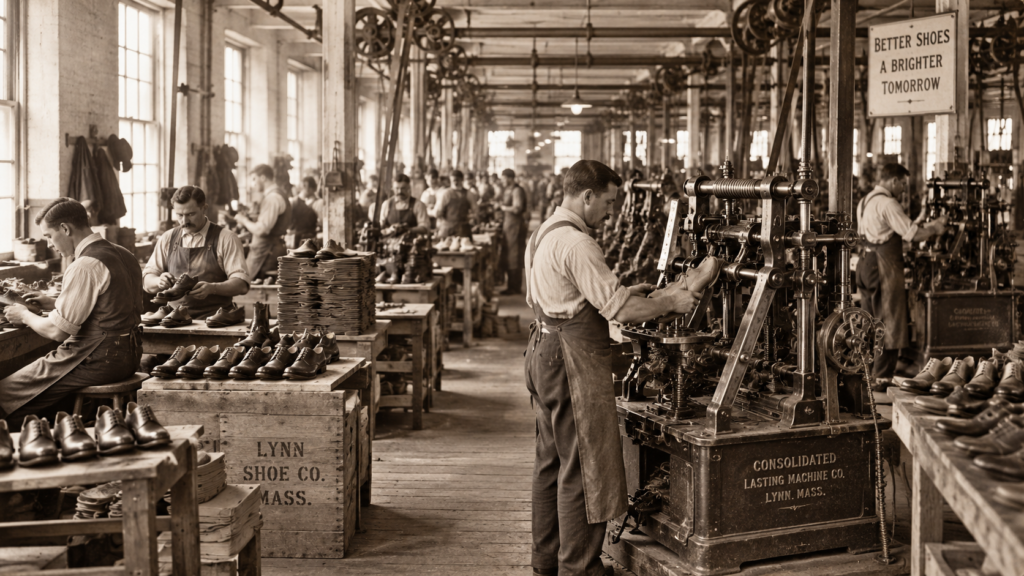
A factory can mechanize nine stages of a ten-stage process, but if everything still has to wait at stage ten for skilled workers performing a slow manual operation, the speed of the entire system remains constrained by that final bottleneck. Making the other nine stages faster may improve efficiency around the edges, but it does not fundamentally change how quickly finished products can leave the factory.
Lasting had become that constraint. Matzeliger’s machine attacked it directly. It held the shoe on the last, gripped and pulled the leather into position around the heel, drove in the nails and discharged the completed shoe, bringing together operations that previously depended upon the coordinated judgement and movements of an experienced hand laster.
The first versions did not immediately produce the extraordinary numbers associated with the mature machine, and Matzeliger continued improving his invention after receiving the 1883 patent. Eventually, however, versions of the machine could produce as many as 700 pairs of shoes in a day, compared with roughly 50 pairs for a skilled hand laster. The National Inventors Hall of Fame credits the resulting increase in productivity with helping shoe prices fall by nearly half, bringing quality footwear within reach of many more people.
That is what makes this more than the story of a clever machine.
Matzeliger had identified the point at which the entire system was being held back and concentrated his attention there. Once that constraint changed, the value of all the mechanization surrounding it changed as well, because factories could finally move shoes through the previously stubborn stage at a speed much closer to the rest of the production process.
Innovation is often presented as the creation of something completely new: a new product, a new technology or an idea nobody has seen before. Yet some of the most consequential innovations begin somewhere less glamorous, with somebody staring at an existing process and asking why one particular part of it remains unnecessarily difficult.
That question remains just as relevant in a modern software company, hospital, warehouse, government department or small business as it was in a nineteenth-century shoe factory.
- Where does everything slow down?
- What part of the process requires disproportionate time, money or expertise?
- What inconvenience has become so familiar that people no longer even describe it as a problem?
And, most importantly :
- is the constraint genuinely unavoidable – or has everyone simply become very good at living with it?
What if the biggest opportunity in an industry is hiding inside the problem everyone else has learned to accept?
WHEN ONE BOTTLENECK HOLDS BACK AN ENTIRE INDUSTRY
There is a reason this idea reaches much further than shoemaking.
When people enter an established industry, they inherit more than its equipment, customers and competitors. They also inherit its explanations. They are taught which parts of the business are difficult, which costs are unavoidable, which customers will never behave differently and which processes simply have to be done in a particular way. Most of those explanations originally had good reasons behind them, and many remain perfectly valid, but over time the distinction between a constraint that has been tested and a constraint that has merely been inherited can become surprisingly difficult to see.
The longer people work inside the system, the easier it becomes to optimise around those assumptions rather than examine them.
If something takes five hours, businesses hire enough people to handle five hours of work. If specialist knowledge is required, they build a department around the specialists. If customers must wait three days, they create procedures for managing the three-day wait. Each response may be entirely rational, yet every successful workaround also makes the original constraint easier to tolerate.
Eventually an organisation can become extraordinarily efficient at accommodating a problem it might have been better off trying to remove.
That is where Matzeliger’s story becomes particularly useful to NoRuleBook. He was not challenging convention merely because convention existed, and he wasn’t assuming that an outsider must automatically know more than experienced people inside the industry. He spent time understanding the work closely enough to distinguish between the skill of the existing solution and the necessity of the underlying limitation. These are not the same thing.
The hand lasters were highly skilled because lasting was difficult. Their expertise did not prove that lasting had to remain manual forever.
That distinction appears everywhere once you begin looking for it. A complicated process may require talented people because the process is genuinely complicated, or because nobody has redesigned it. An expensive service may cost what it does because the economics demand it, or because an old distribution model has never been challenged. A customer frustration may be unavoidable, or it may have survived because every competitor imposes the same frustration and customers have nowhere else to go.
The NoRuleBook question is therefore not simply “Why do we do it this way?”
It is more demanding :
“Which part of the reason is still true?”
THE MAN THE INVENTION OUTLIVED
Success did eventually arrive for Matzeliger, but not in the neat form that later biographies sometimes give inventors, where years of struggle are followed by recognition, wealth and a long life spent enjoying the consequences of the breakthrough.
As his lasting machine proved itself, its commercial potential became increasingly difficult to ignore. In 1889, companies connected with the technology were consolidated into the Consolidated Lasting Machine Company, and Matzeliger received a substantial shareholding in the new business. He had not simply handed away the invention that was transforming the industry; he had retained an economic interest in what he had created.
By then, however, another clock was running.
Matzeliger had contracted tuberculosis, and on August 24, 1889, he died in Lynn at just 36 years old. The machine he had spent years developing was only beginning to reveal how profoundly it could change shoe manufacturing, which meant that the inventor disappeared from the story at almost exactly the moment his invention was becoming larger than him.
That makes the familiar description of Matzeliger as a genius who simply ‘died poor and forgotten’ too convenient. His story is more complicated, and therefore more interesting. He had secured patents, attracted commercial backing and obtained an ownership interest in the company exploiting his work, but he died before time could turn those achievements into the kind of personal fortune or public reputation that might have permanently attached his name to the technology.
The machine, meanwhile, kept working. Factories adopted and improved lasting machinery, shoe production accelerated and the economics of manufacturing changed. Matzeliger’s name did not become as familiar as those of inventors such as Thomas Edison or Alexander Graham Bell, even though the problem he solved affected something worn by almost everyone.
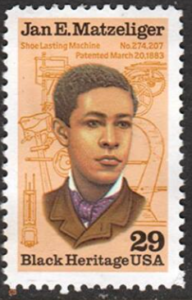
Recognition came much later. More than a century after his death, Matzeliger was inducted into the National Inventors Hall of Fame in 2006, while the United States Postal Service had already honoured him in 1991 with a stamp in its Black Heritage series.
There is something revealing in that delay, because history has a habit of remembering inventions more easily than the systems of assumptions that existed before them. Once a solution becomes ordinary, it becomes difficult to reconstruct the world in which the solution did not exist.
We see the machine and wonder why nobody built it sooner. We rarely see the decades during which intelligent people tried, failed, adapted and eventually organized an entire industry around the fact that the problem remained unsolved.
Matzeliger’s achievement becomes more significant when viewed against that background. He didn’t simply invent another piece of machinery. He changed something the industry had begun treating as part of the landscape.
THE PROBLEM EVERYONE ELSE HAS STOPPED SEEING
Most of us will never encounter a nineteenth-century shoe factory, but almost everyone works or lives inside systems containing their own versions of the lasting problem.
They are often surprisingly easy to recognize once you know what to look for, because they tend to attract the same language :
- “That’s just how the industry works.”
- “Customers are used to it.”
- “We’ve tried changing it before.”
- “You need an expert to do that.”
- “It has always taken that long.”
- “There’s no practical way around it.”
None of those statements is necessarily wrong. In fact, that is precisely what makes them worth examining rather than automatically rejecting. Some processes exist in their current form because years of experience have demonstrated that they are genuinely effective, while some constraints survive because physics, economics, regulation or human behaviour leaves little room for improvement.
But others survive for a very different reason: People have adapted to them so successfully that they have stopped noticing the original problem.
Think about what happens inside a business when a process consistently takes too long. At first, people complain about it and look for alternatives, but if no obvious solution appears, the organization gradually adapts. Schedules are extended, additional staff are hired, customers are given longer expectations and procedures are created to manage the delay. Eventually the workaround becomes part of the organization itself, and a new employee arriving years later may never realize that the system they have inherited was originally designed around a problem nobody could solve. That is how a bottleneck can become an unwritten rule. And it suggests that innovation does not always begin by asking what new thing could be created. Sometimes the better starting point is to walk through an existing system and ask:
What problem have we become unusually good at tolerating?
Matzeliger found his answer in the lasting room of a shoe factory.
Ours may be hiding somewhere far less obvious.
Some of the world's biggest opportunities are hiding inside the sentence : “That's just how it's done.”
THE NORULEBOOK 'ACCEPTED BOTTLENECK' TEST
Matzeliger’s story gives us something more useful than an instruction to ‘think differently.’ It gives us a way of examining the constraints we have inherited before deciding whether they deserve to remain.
Choose one process in your business, career or everyday life that repeatedly consumes more time, money, effort or frustration than you think it should. Particularly one process that people have largely stopped questioning because everybody already knows that’s how it works.
1. WHAT PROBLEM HAVE PEOPLE STOPPED TRYING TO SOLVE?
Look for the inconvenience everyone works around rather than the one everyone complains about. The strongest candidate may be a process so familiar that nobody describes it as a problem anymore.
2. IS THE CONSTRAINT FUNDAMENTAL — OR MERELY UNSOLVED?
Ask what actually prevents the process from being different. Is there a physical limitation, legal requirement, unavoidable economic cost or genuine human need behind it, or does the explanation eventually reduce to some version of we’ve never found a better way?
The distinction is crucial. NoRuleBook is not asking you to assume every constraint is artificial. It is asking you to discover which kind of constraint you are dealing with.
3. WHAT HAS CHANGED SINCE THE ASSUMPTION WAS FORMED?
An old solution may have been entirely rational when it was created. The mistake is assuming that because the reasoning was valid then, it must remain valid now.
Technology changes. Materials change. Costs change. Customer behaviour changes. Knowledge changes. What was impossible ten years ago may now be merely inconvenient, while something that was once prohibitively expensive may have become almost trivial.
4. HOW MUCH OF THE SYSTEM EXISTS TO ACCOMMODATE THE BOTTLENECK?
This is where the exercise becomes particularly revealing.
Look beyond the problem itself and identify everything built around it: additional staff, delays, procedures, specialist roles, customer explanations, extra inventory, duplicated work or other compromises. Sometimes the true cost of a bottleneck is much larger than the obvious cost of the task causing it.
5. WHAT BECOMES POSSIBLE IF THE BOTTLENECK DISAPPEARS?
Don’t stop at asking how much faster or cheaper the existing process would become. Ask what else changes once the constraint is removed.
Matzeliger’s lasting machine mattered because it did more than accelerate one manufacturing operation. By removing a constraint in the middle of the system, it allowed the productivity of the surrounding system to matter far more.
The same principle can expose opportunities that incremental improvement misses.
Don't ask only how you can work more efficiently around a problem. Ask what the world looks like if you no longer have to work around it at all.
THE NORULEBOOK TRUTH
Jan Ernst Matzeliger’s story is sometimes reduced to perseverance, even though it certainly mattered. He had spent years observing, experimenting and improving an invention whose success was anything but guaranteed. But perseverance alone does not explain why his story belongs in NoRuleBook. What mattered first was that he recognized the difference between a Difficult Problem and a Permanent Reality.
The shoe industry had not been foolish to rely on skilled hand lasters. They were solving a genuinely difficult manufacturing problem with the best method available. Nor was Matzeliger remarkable simply because he rejected what experienced people believed. He became remarkable because he studied the problem deeply enough to understand why the existing method worked, then found another way to achieve the same result.
That is a much more demanding form of rule-breaking than simply refusing to accept conventional wisdom. It requires understanding a system before challenging it, distinguishing inherited assumptions from genuine constraints and being willing to investigate the problems that everyone else has learned to tolerate.
Because sometimes the most important question isn’t :
“What new idea can I create?”
It is :
“What old problem have we stopped believing can be solved?”
“The world doesn't always change when someone invents something nobody imagined. Sometimes it changes when someone refuses to accept a problem everyone else has learned to live with.”
Take The Next Step
Matzeliger’s story invites you to look differently at the systems surrounding you, because the unwritten rules worth questioning are not always social expectations telling you how to live. Sometimes they are embedded inside industries, workplaces and everyday processes, where repeated experience has gradually transformed this is difficult into this is how it has to be.
NoRuleBook is about learning to recognise that transformation. The objective is not to challenge every established method or assume that convention is automatically wrong, but to become better at noticing when an explanation has survived longer than the conditions that originally made it true.
The next time you encounter a frustrating process that everybody accepts, resist the temptation to ask only how you can become better at working around it. Ask whether the problem itself still deserves to exist.
Click the NoRuleBook image below to explore the collection.
The NoRuleBook Collection
-
NoRuleBook
$9.95Original price was: $9.95.$7.95Current price is: $7.95. -
No Rules Start-Up
$19.95Original price was: $19.95.$9.95Current price is: $9.95. -
NoRuleBook Bundle
$22.90Original price was: $22.90.$14.95Current price is: $14.95.