
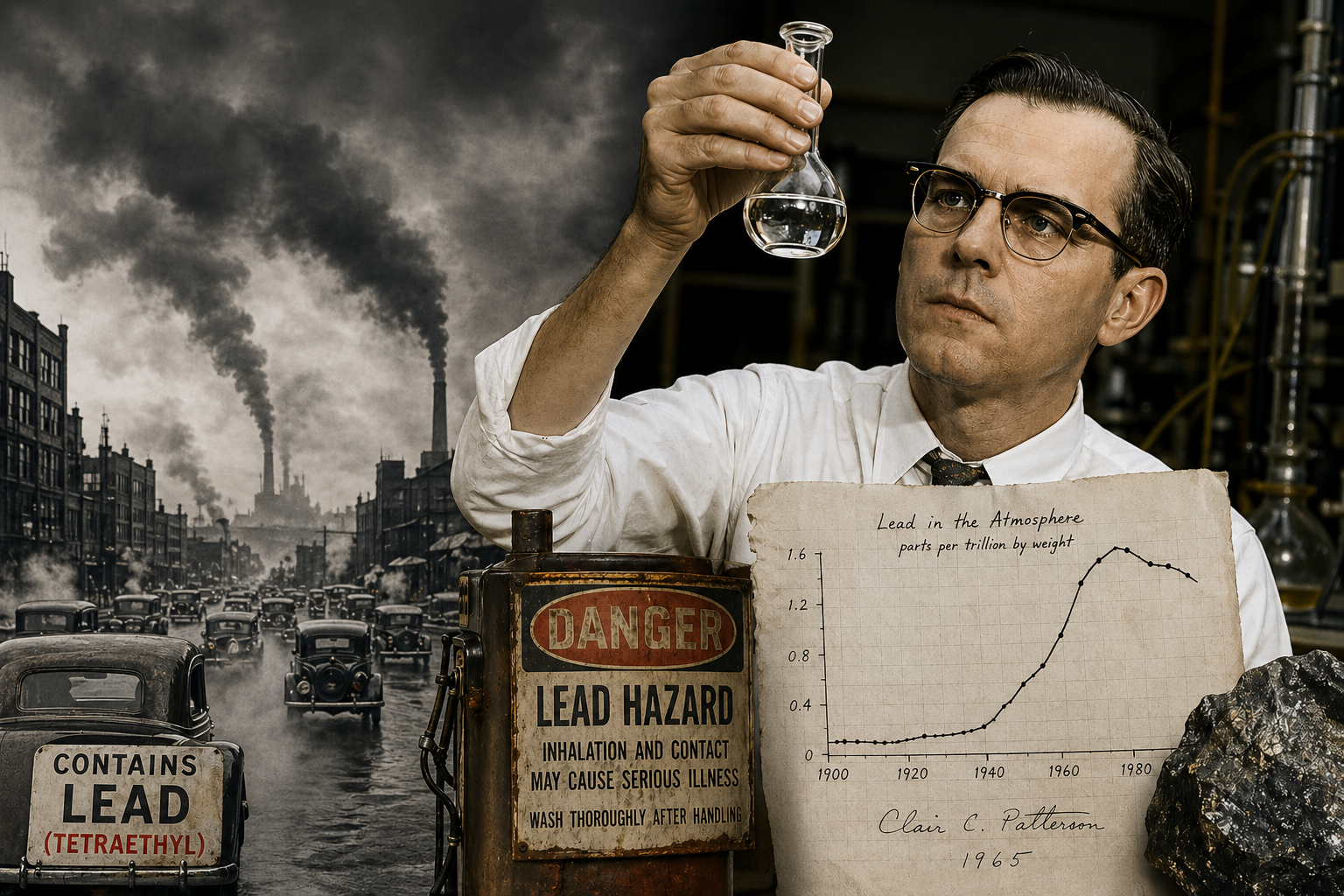
NoRule Book Banner

They Said It Was Safe. He Proved It Was Poison.

by Robbie Dellow
Clair Patterson lead poisoning

The Story of Clair Patterson — and the Truth the System Tried to Ignore

For decades, the world was being poisoned. Not by accident — but by something everyone accepted as normal.

For a long time, nobody questioned the air. People woke up, stepped outside, and breathed without hesitation, without suspicion, without even the faintest idea that something so ordinary could ever be dangerous, because the world they lived in had already made that decision for them. The cars were running, the cities were growing, industries were booming, and progress carried with it a quiet assumption that if something was widely used, widely accepted, and backed by authority, then it must be safe.

There were no warning labels on the air. No headlines telling people to be cautious. No public debate about invisible toxins floating through the streets where children played.

There was only trust – but that trust turned out to be misplaced.

We Trusted the Air Without Question

The most dangerous things are often the ones that feel normal, because normal doesn’t invite scrutiny, and when something becomes embedded in everyday life, it quietly avoids the one thing that could expose it : Attention.

At the time, lead was everywhere, though almost no one thought about it.
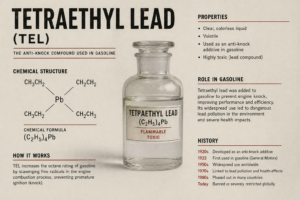
Tetraethyl leadIt had been added to petrol in the form of tetraethyl lead, a chemical solution that made engines run more efficiently and reduced knocking, and for the companies producing it, that meant profit, scale, and dominance. For governments, it meant economic growth. For the public, it meant smoother cars and faster progress.

So the rulebook was written.

Lead in petrol was not just accepted. It was endorsed.

And once something reaches that level of acceptance, it stops being questioned, not because people have carefully examined it and decided it is safe, but because the system has already made that decision on their behalf.

Clair Patterson and the Discovery of Lead Contamination

Clair Patterson was not trying to expose a global problem when he began his work; he was trying to solve a scientific one, a question that had fascinated researchers for decades: how old is the Earth?

It sounds distant from what he would eventually uncover, but the path to truth is rarely direct, and often it begins with a question that seems unrelated to the problem it ultimately reveals.

Patterson’s work required extreme precision, because measuring the age of the Earth depended on analysing isotopes, particularly lead isotopes, in ancient rocks, and that meant his experiments needed to be free from contamination at levels most laboratories had never attempted to control.

But no matter how carefully he worked, his results kept coming back wrong.

There was always interference.

At first, it seemed like a technical issue, the kind that scientists encounter all the time, something that could be fixed with better equipment or improved procedures, but Patterson didn’t settle for that explanation, because the contamination was too consistent, too persistent, and too widespread to be dismissed as a simple lab error.

So instead of forcing the data to fit expectations, he asked a question that shifted everything:

What if the contamination wasn’t coming from the lab?

What if it was coming from the world itself?

A Discovery That Didn’t Fit the Narrative

To test that idea, Patterson did something extraordinary for the time, building one of the first ultra-clean laboratories designed specifically to eliminate environmental contamination, a space so controlled that it allowed him to measure lead isotopes with a level of accuracy that had previously been impossible.

And when he finally removed the interference, the results didn’t just answer his original question. They revealed something far more unsettling.

There was far more lead in the environment than there should have been. Not slightly more. Not within a reasonable margin of error.

Massively more.

Patterson expanded his research beyond the lab, examining deep ocean samples, ice cores, and ancient geological records, and what he found was consistent across every dataset: lead levels in the modern environment were dramatically higher than in the natural past, and the increase aligned perfectly with industrial activity.

This wasn’t a natural fluctuation. This was human-made contamination on a global scale.

The air people breathed, the soil they walked on, the oceans that sustained life — all of it carried elevated levels of lead.

And yet, almost no one was talking about it. Because the narrative had already been set.

The Truth the System Tried to Ignore

When Patterson began to present his findings, he wasn’t just introducing new data ; He was challenging a deeply entrenched system that had both economic power and institutional support behind it.
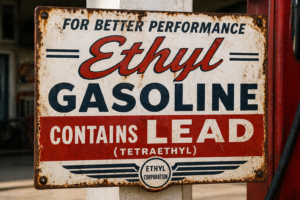
Ethyl-lead-gasoline-signThe source of the contamination was clear : Leaded Petrol.

And that meant the implications of his work extended far beyond science.

They touched industry, government policy, and the financial interests of some of the most powerful corporations of the time.

So the response was not curiosity. It was resistance.

Funding for Patterson’s work became harder to secure. Invitations to participate in conferences were withdrawn. His conclusions were questioned, not always through rigorous scientific debate, but through pressure, doubt, and attempts to undermine his credibility.

The system didn’t collapse under the weight of new evidence. It pushed back.

Because systems are not designed to prioritize truth ; They are designed to maintain stability, and when truth threatens stability, it is often treated as a problem to be managed rather than a reality to be embraced.

When the Truth Became a Threat to Industry

The idea that something as widespread as leaded petrol could be dangerous was not just inconvenient — it was disruptive, because it implied that an entire industrial practice, one that had been normalised for decades, might need to be reconsidered or even dismantled.

That kind of shift doesn’t happen easily.

It requires more than data.

It requires persistence.

Patterson understood this, even if he never framed it in those terms. But  instead of stepping back, he continued forward, publishing his research, refining his conclusions, and speaking about the dangers of lead exposure with a clarity that became increasingly difficult to ignore.

He wasn’t trying to become an activist, but the truth he had uncovered left him with little choice.

He Didn’t Back Down

There comes a point in stories like this where the path splits, where continuing forward becomes a conscious decision rather than a passive progression, and Patterson reached that point when it became clear that his work was not simply being debated, but resisted.

He could have adjusted his conclusions, softened his stance, or redirected his focus to less controversial areas of research, and in doing so, he would likely have preserved his funding, his reputation, and his place within the established system.

But he refused to …  because the data was clear.

And once you see something clearly, it becomes very difficult to pretend you haven’t.

So he continued. And slowly, almost imperceptibly at first, the weight of evidence began to shift the conversation.

The Removal of Lead from Petrol Changed Everything

Change did not arrive in a single moment, but through a gradual process of increasing awareness, regulatory pressure, and scientific consensus, until the reality Patterson had been pointing to for years became too large to ignore :

  • Policies began to change.
  • Leaded petrol was phased out.
  • Public health initiatives took hold.


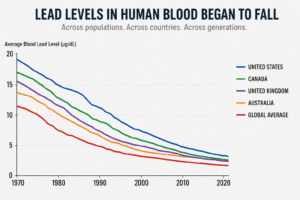
lead levels in human bloodAnd as lead was removed from fuel, something remarkable happened : Lead levels in human blood began to fall, across populations, across countries, across generations.

The world had been contaminated. And now, it was beginning to recover.

Not because the system had self-corrected, but because it had been challenged.

What This Means About Truth, Systems, and Power

It’s tempting to look at this story as a closed chapter, a problem that existed in the past and was eventually solved, but that interpretation misses the deeper pattern, the one that makes this story relevant far beyond its specific details.

The real lesson is not about lead.

It is about how easily something dangerous can become normal, how systems can reinforce that normality, and how difficult it can be to introduce a truth that disrupts it.

At the time, no one woke up thinking they were being exposed to a toxic environment.

They simply lived within it. Because that is what the system had made normal.

The NoRuleBook Lesson: Question What Feels “Normal”

The rulebook will always present itself as a source of certainty : Offering clear answers about what is safe, what is correct, and what can be trusted. But those answers are shaped by incentives, by power structures, and by the need to maintain stability, not necessarily by a commitment to truth.

Clair Patterson didn’t set out to break rules. He set out to find an answer. But in doing so, he exposed a much larger problem, one that had been hidden in plain sight for years.

And that raises a question that is far more important than anything contained in this story :

What are we accepting today that no one is questioning?

If this story made you question something, you’re starting to see what most people don’t. Read NoRuleBook to understand more – Grab your copy below.

The NoRuleBook Masterclass Collection

Facebook

Related Articles

Leave a Comment